

The European Starling is one of the most common birds in North America. However, tracking the birds in the wild remains a challenge because they are true biological chameleons.
Their plumage changes so dramatically between summer and winter that beginners routinely report the same species as two entirely different birds. Juveniles look nothing like adults, and adults in molt look like neither.
This guide works through every important identification challenge from the instant silhouette check to the seasonal bill color calendar and the unique waddling gait. These smart details provide you with a reliable toolkit for confirming an identification in any plumage.
How to Identify European Starlings?
The easiest method is looking for a stocky, short-tailed silhouette with a long pointed bill that walks with a distinct waddling gait on open lawns.
To confirm an identification, check for a heavily white-spotted coat and dark bill in the winter, which transforms through gradual structural feather wear to a glossy iridescent purple and green plumage with a bright yellow bill during the spring breeding months.
Visual Identification Masterclass for European Starlings
To see these forensic markers in motion, our video breakdown demonstrates the specific flight silhouettes and plumage transitions that define the species. Watch below to see the ‘three-second rule’ for identifying starlings in the field.
📝 View Video Timeline & Key Takeaways
[00:00 – 01:08]: Identifying the plain brown impostor phase. This segment breaks down the severe morphological differences in summer juvenile *Sturnus vulgaris*, which display unstreaked gray-brown plumage, dark irises, and lack the characteristic iridescence or spotting of mature adults.
[01:09 – 02:00]: The late-August molt transition. Analyzing the patchy, high-contrast transitional plumage stage where sleek, lustrous spotted adult feathers begin erupting across the pectoral region while the cranial plumage remains dull juvenile brown.
[02:01 – 03:16]: Decoding structural silhouettes and bill endocrinology. Tracing foundational skeletal features including stocky, low-aspect bodies, short squared-off rectrices, and sharp mandibular bills. The bill acts as a direct hormonal testosterone tracker, shifting from winter dark brown to vibrant breeding yellow with blue-gray (male) or pink (female) proximal bases.
[03:17 – 04:19]: The mechanical feather wear revelation. Explaining why starlings do not undergo a spring molt; their glossy summer appearance is a product of abrasive mechanical wear, where buff-tinted winter feather tips physically abrade to expose underlying iridescent bases. This green and purple shimmer is an optical illusion generated by structural nanoscale rod-shaped melanosome arrays.
[04:20 – 05:32]: Flight forensics and open-field foraging mechanics. Starlings exhibit rapid, linear flight corridors driven by steady 13.3 Hz wingbeats and distinct star-shaped triangular wings. On open turf, their unique rolling waddle and specialized open-mandible gaping (*prying open soil structures*) separate them from hopping native species.
[05:33 – End]: Dissecting native lookalikes and the diagnostic checklist. Providing explicit morphological field marks to isolate starlings from Common Grackles (which show bright yellow irises and long keel tails), Brown-headed Cowbirds (short conical bills), and female Red-winged Blackbirds (heavily streaked underparts).
Advanced Field Techniques for Instant European Starling Identification
To identify a European Starling instantly, look for a stocky, short-tailed silhouette with a long, dagger-shaped bill. Unlike longer, more slender blackbirds, the starling appears chunky and upright at rest.
During the spring and summer breeding season, look for glossy black plumage with an iridescent green and purple sheen paired with a bright yellow bill. During the autumn and winter months, look for a dark brown bill and plumage covered in hundreds of white or buff spots that create a starry look.
The combination of a short tail, pointed bill, and either iridescent or spotted feathers is unique to this species in North America. European Starlings are among the most common and widely observed birds in modern backyards.
To see how tracking these massive populations fits into the broader hobby, read our comprehensive Backyard Bird Watching Statistics Report.
The Unique Wing Shape of a Starling in Flight
In flight, the wing shape of a European Starling is short and triangular, tapering to a distinct point. This creates a silhouette that resembles a four-pointed star, setting it apart from the longer, tapered wings of most native songbirds.
Starlings fly with rapid, direct wingbeats in a straight line, completely lacking the undulating rise-and-fall pattern seen in finches or woodpeckers. At a distance, this combination of triangular wings and a short, squared tail is the fastest way to identify a starling in motion.
How Do I Identify European Starlings by Their Bill Color?
To identify a European Starling by its bill color, look for a bright yellow bill in the spring. In the winter, the bill changes to a dark brown or black color. According to the Cornell Lab’s All About Birds guide, this seasonal marker is completely reliable and driven by hormones.
The transition between these colors happens gradually. Birds you observe in late January may show a partially yellow bill with a dark tip. However, by March or April, the bill turns fully yellow in most adult starlings.
How Can You Tell the Difference Between Male and Female Starlings?
You can tell the difference between male and female starlings by looking at the base of the lower bill during the breeding season. Males have a blue-gray base, while females show a pinkish or reddish base. This color change is driven entirely by circulating hormones.
Because of this, the beak serves as a reliable external indicator of the bird’s internal reproductive condition all year round, rather than just being a random seasonal color shift.
In fact, a study published in Hormones and Behavior on testosterone and singing behavior in European Starlings confirmed that bright yellow beaks directly indicate that testosterone is actively present in the blood, while black beaks signal little to no testosterone is available.
What Color is a European Starling?
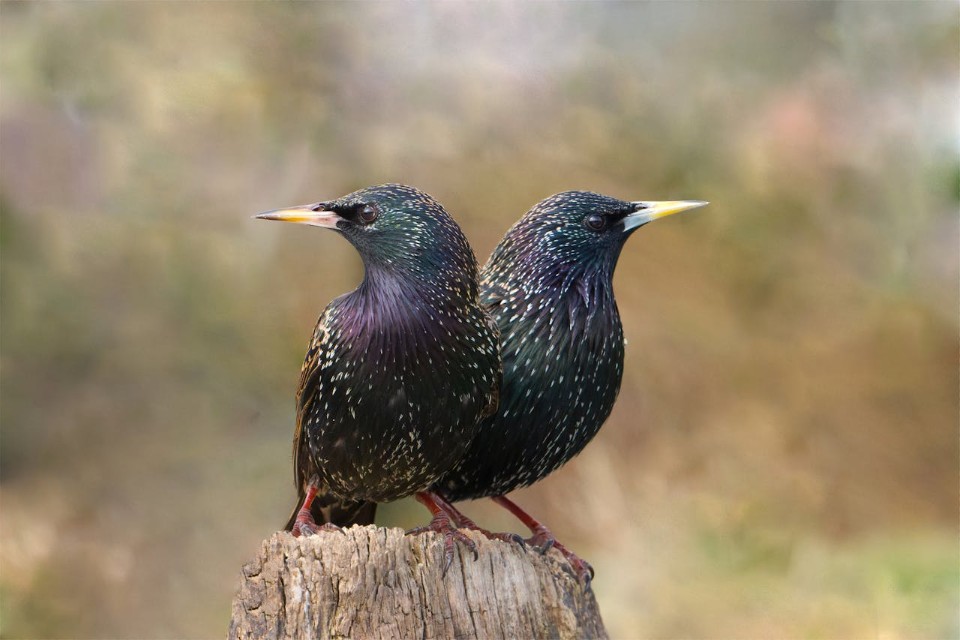
A European Starling is iridescent black with green and purple highlights in the summer and heavily spotted with white in the winter. During the breeding season, the entire body glows with a metallic sheen, particularly on the breast, which reflects a deep oily green in direct sun.
According to the Audubon Society’s European Starling field guide entry, adults in fresh fall plumage are covered in white spots that give the bird its winter spangled appearance, and these spots progressively wear away by spring to reveal the full iridescent summer coat underneath.
The source of that iridescence is structural rather than pigment-based. Research published in Frontiers in Ecology and Evolution found that the blue-to-purple iridescent colors in European Starling feather barbules are produced by a single organized layer of rod-shaped melanosomes, and that the precise thickness of the keratin cortex overlying those melanosomes determines which wavelengths of light are reflected.
It is not a pigment creating the green and purple shimmer. It is the nanoscale architecture of the feather interacting with light, which is why the color shifts so dramatically with viewing angle.
Do European Starlings Molt in the Spring?
European Starlings do not molt into their breeding plumage; instead, they undergo a process called “wear molt.” While they grow fresh, white-tipped feathers in the fall, these tips physically abrade and wear away over the winter months through normal activity. By spring, the white spots have disappeared, revealing the iridescent black feather bases underneath without the bird growing any new feathers.
According to the Cornell Lab’s All About Birds European Starling overview, this unusual transition allows the same feather to change from spotted to iridescent. Dark feathers contain more melanin, which makes them structurally more resistant to abrasion than the unpigmented white tips.
Because the white tips are weaker, they wear off while the iridescent black bases remain intact. This is also why starlings kept in sheltered environments with less feather abrasion may retain their spots longer than birds in more exposed, wild conditions.

How Do You Identify a Juvenile European Starling?
You can identify a juvenile European Starling by its uniform grayish-brown plumage, dark bill, and dark eyes. Unlike the iridescent or spotted adults, first-year starlings are relatively dull and unspotted from the time they fledge through their first fall. They are frequently mistaken for different species because they bear almost no resemblance to adult birds.
While the plumage is different, the body shape remains diagnostic. To confirm the identification, look for the classic starling silhouette: a stocky build, a short tail, and a long, pointed bill. If you see a plain brown, thrush-sized bird with these specific structural features at your feeder during the summer, it is almost certainly a juvenile starling.
Unusual Plumage Variants: When Your Starling Looks “Too Dark” or “Not Spotted Enough”
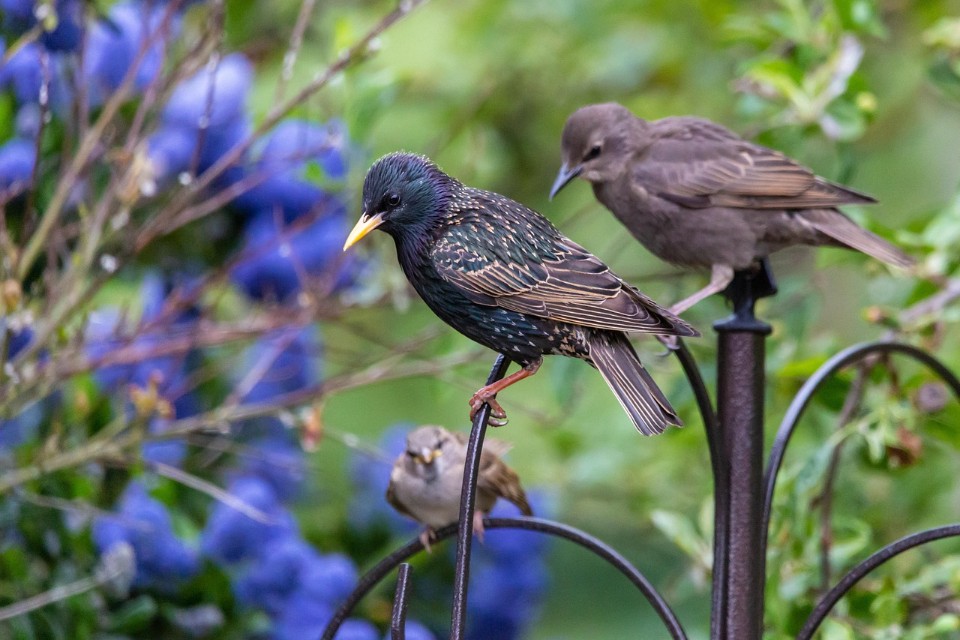
Nature frequently throws curveballs that can severely damage a beginner’s identification confidence. While standard field guides show crisp, textbook plumages, online birding communities often share photos of starling variants that look completely “wrong” compared to common illustrations.
The most frequent visual surprises to watch for include:
- “Too Dark” Juveniles: Some first-summer starlings display a genetic trait called melanism, which causes an excess of dark pigment. These birds look almost coal-black instead of the classic uniform gray-brown color, leading many observers to misidentify them as separate blackbird species.
- Spot-Poor Adults: In early spring, some mature individuals wear down their white feather tips incredibly fast or possess fewer spots from the start, appearing entirely sleek and dark ahead of schedule.
When plumage colors fail or contradict your expectations, always remember that structural geometry beats feather patterns. If a backyard bird looks deep black or lacks spots but still exhibits a stocky build, a stubby short tail, and a long dagger-shaped bill, you can confidently log it as a starling.
How Do You Identify a Starling During Its Juvenile Molt?
You can identify a starling in its juvenile molt by its patchy, “half-and-half” appearance, where plain gray-brown feathers are mixed with iridescent, spotted adult plumage. This transition, known as the first prebasic molt, typically occurs between August and November. During this stage, a bird may show a brown juvenile head and back while the breast and flanks have already been replaced by glossy, white-spotted adult feathers.
These patchy individuals are not a separate species or an unusual variant; they are simply first-year starlings in the process of becoming adults. The speed and timing of this transition can vary significantly depending on the bird’s hatch date and individual health. Identifying these birds relies on recognizing the mix of dull juvenile brown and high-contrast adult spotting on a single bird.
How Can I Identify a Starling While It Is Flying?
You can identify a European Starling in flight by its short, triangular wings and a very short, squared-off tail. This creates a distinctive silhouette that resembles a small, four-pointed star against the sky. Unlike many native songbirds that fly with an undulating “up-and-down” motion, starlings fly in a direct, straight line with rapid, purposeful wingbeats.
This flight profile is highly consistent across all individuals and seasons, making it one of the most reliable field marks for identification at a distance. When a starling takes off and crosses open sky, its lack of a tapered wing shape and its direct flight path set it apart from similar-sized blackbirds or thrushes.
What is the Wing Shape of a Starling in Flight?
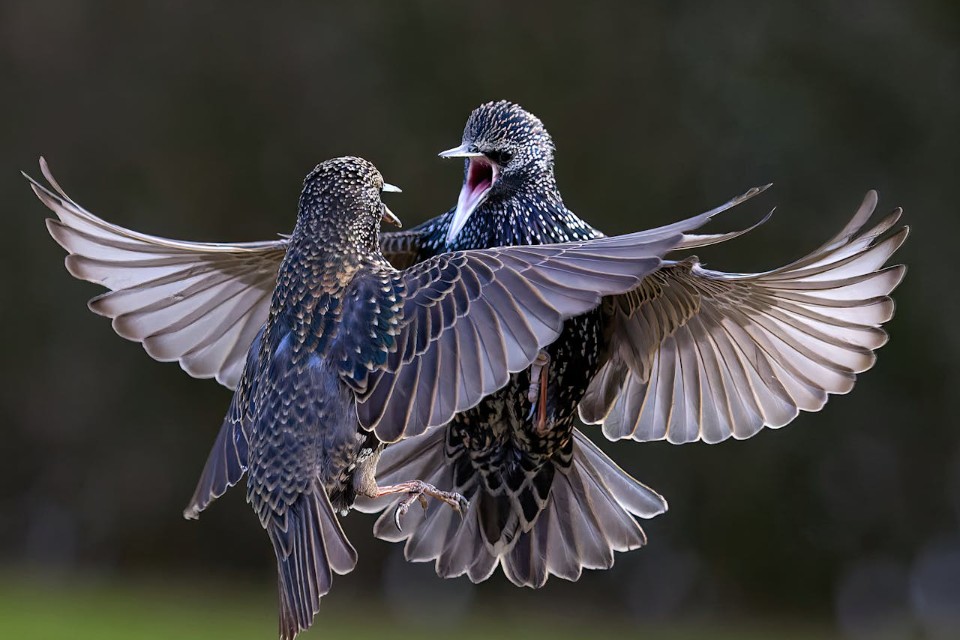
A European Starling in flight has a short, triangular wing profile that is broad at the base and tapers to a sharp point. This creates a distinctive silhouette that differs significantly from the longer, more rectangular wings of Common Grackles and Red-winged Blackbirds, or the rounded wings of American Robins.
This triangular shape is a functional flight characteristic. Research published in the journal Ibis (Swaddle and Lockwood, 2003) found that wingtip shape is directly linked to flight performance, with pointed wings influencing the bird’s angle of ascent during takeoff.
How do Starlings’ Wingbeats Differ from Other Birds?
Starlings are identified by their rapid, direct wingbeat pattern and a complete lack of the undulating “rise-and-fall” motion seen in many other songbirds. In a wind tunnel study published in PLOS ONE, researchers recorded an average wingbeat frequency of 13.3 Hz, confirming that starlings maintain a steady, non-undulating flight path.
This purposeful flight style is so unique that starlings in mixed flocks are often identifiable purely by their direct movement before their specific wing shape is even visible.
Why Your App Photo Doesn’t Match the Starling in Front of You
A common point of frustration shared by new birders in online forums is that popular field guide apps like Merlin frequently display idealized plumage stages. They show perfectly crisp winter spangles or flawless, glowing summer adults. In reality, wild backyard birds spend months stuck in messy, high-contrast transitional stages that can make you doubt your app’s accuracy.
To prevent confusion when matching your live views to digital guide images, use these translation tips:
- The App Shows a Fully Yellow Bill, But Yours Is Half Brown: This is completely normal for late winter. Bill color changes are driven by hormones and happen gradually from the base forward.
- The App Shows a Brightly Spotted Bird, But Yours is Barely Speckled: Your bird has simply undergone faster mechanical feather wear from rough branches, exposing the underlying iridescent base ahead of schedule.
Treat your identification apps as a helpful baseline, but use them in tandem with your seasonal bill and molt calendar to bridge the gap between static photos and real, messy field conditions.
How Can You Identify a Starling by Its Tail Shape?
To identify a European Starling by its tail, look for a notably short and squared-off profile. This “stubby” appearance is a primary field mark that distinguishes them from Common Grackles, which have long, keel-shaped tails, and Brown-headed Cowbirds, which have longer, more graduated tails.
This silhouette is particularly useful for identification during murmurations at dusk. Even when light levels are too low to see plumage, the starling’s short, squared rear profile remains visible against the sky. In mixed flocks, starlings are easily picked out because they lack the trailing tail length of native blackbirds, giving them a more compact, aerodynamic look in flight.
How Do European Starlings Move on the Ground?
The most reliable behavioral marker for a European Starling is its purposeful, waddling walk. Unlike American Robins, thrushes, and most native sparrows that typically hop, starlings move with alternating steps in a rolling gait. This walking motion is a high-speed identification cue that is visible on lawns even when light levels are too low to see plumage details.
What is the Starling’s Open-Bill Probing Technique?
European Starlings walk rather than hop. On the ground, they move with a purposeful, rolling walk that is distinctly different from the hopping gait of American Robins, thrushes, and most native sparrows. This “waddling” gait is one of the fastest behavioral identification cues available, visible even from a distance on open lawns.
In addition to their walk, starlings use a unique foraging technique called “rictal probing” or “gaping.” According to the Cornell Lab’s All About Birds European Starling account, starlings poke their closed bills into the soil and use powerful jaw muscles to force them open.
This levering action allows them to access subsurface invertebrates that are unavailable to other foragers. If you see a bird repeatedly stabbing its bill into the turf and prying it open, it is almost certainly a European Starling.
Field Shortcut: How to Tell “Blackbird Flocks” From Starling Mobs in Your Yard
When a massive, dark bird swarm descends onto your property, trying to inspect individual feathers through binoculars is nearly impossible. Experienced backyard birders rely on group behavior and flock movement metrics as an instant, gear-free identification shortcut.
Starlings are intensely social foragers that travel in tightly coordinated, high-density mobs rather than loose associations. If you look out at your grass and see dozens of birds moving systematically in a tight, rolling wave where every single bird is walking and probing simultaneously, you are dealing with starlings.
Native blackbirds, by contrast, travel in smaller, loose groups, rarely move in a single rolling wave, and are far more likely to hop or spread out randomly across a lawn. Additionally, scan the silhouette of the crowd as they move. A true starling mob will display a field of short, stubby tails, whereas a grackle flock will show a sea of long, keel-shaped tails trailing behind them.
How Does Flock Behavior Help Identify European Starlings?
The most certain behavioral marker for a European Starling is its highly social foraging pattern. Unlike the loose associations of mixed blackbird flocks, starlings move in tight, coordinated groups that can range from 20 to several hundred birds.
If you see a large, stocky group moving systematically across a field where all birds are walking and probing simultaneously, you can be nearly certain they are starlings without seeing a single plumage detail.
What is “Leapfrog” Foraging in Starlings?
European Starlings use a unique “leapfrog” foraging style that creates a visible rolling wave pattern across the ground. In this formation, the birds at the rear of the flock frequently fly over the group to land at the front, ensuring the entire flock moves in the same direction at a consistent pace. This coordinated, purposeful movement is a characteristic aerodynamic signature of the species and is visible from a considerable distance.
For a comprehensive look at the species’ social behavior and physical characteristics, see our article on characteristics of European starlings.
How to Tell the Difference Between a Starling and a Blackbird
To distinguish a European Starling from common blackbirds, you should evaluate the tail length, bill shape, and eye color. While starlings are often confused with Common Grackles, Red-winged Blackbirds, and Brown-headed Cowbirds, they possess a much shorter silhouette and a longer pointed bill.
Separating Starlings and Common Grackles by Eye Color
The fastest way to separate an adult European Starling from a Common Grackle is by inspecting the eye color. Starlings have dark brown eyes that look solid black, whereas Common Grackles have striking pale yellow eyes that are visible from a distance.
Additionally, field identification notes published by Birds and Blooms document that the grackle is longer and more slender with a distinctive keel-shaped tail. Meanwhile, the starling remains stocky with a short squared-off tail profile.
Distinguishing Starlings from Cowbirds and Red-winged Blackbirds
To separate a starling from a Brown-headed Cowbird, look closely at the shape of the mouth. The cowbird is smaller than a starling and has a short conical finch-like bill rather than the starling’s long dagger-shaped bill.
You can easily tell a female Red-winged Blackbird apart from a juvenile starling by examining the belly area. Female blackbirds feature heavily streaked underparts, while juvenile starlings are a plain unstreaked gray-brown color.
How Can You Tell a Starling Apart by Its Song?
You can identify a European Starling by its song, which is a complex, continuous stream of whistles, rattles, mechanical clicks, and mimicked phrases. Unlike native blackbirds, starlings produce non-tonal, percussive sounds that sound like metallic clicking or rattling. As covered in our detailed guide on starling calls, songs, and mimicry, this vocal variety is a definitive field mark.
Comparing the Sounds of Starlings and Native Blackbirds
If you are unsure of the bird’s identity, listen for these specific differences:
- European Starling: A highly variable mix of sounds with no consistent tonal center, often including mimicry of other bird species and mechanical clicks.
- Common Grackle: A harsh, grating call that sounds similar to a “rusty hinge” opening.
- Red-winged Blackbird: A liquid, gurgling “conk-la-ree” or “oak-a-lee” song with a distinct musical quality.
If the bird in your yard is producing a “messy” variety of sounds interspersed with mechanical clicking, it is almost certainly a European Starling.
Common Questions on Identifying Backyard Starlings
How can I tell a starling from a blackbird?
The fastest way to tell a starling from a blackbird is by its silhouette and tail. Starlings have stocky, chunky bodies with very short, squared-off tails, whereas most native blackbirds and grackles are more slender with noticeably longer, tapered tails.
Do European Starlings have yellow beaks?
Yes, European Starlings have bright yellow beaks, but only during the breeding season (late winter through spring). During the non-breeding months of autumn and winter, their beaks transition to a dark brown or blackish color.
Why is my starling covered in white spots?
Starlings appear covered in white spots during the winter due to a process called “wear molt.” They grow fresh feathers with white tips in the fall, which create a spangled appearance. These tips gradually wear away by spring, revealing the iridescent black feathers underneath.
Is it a starling or a grackle?
The easiest way to differentiate the two is by eye color. Adult European Starlings have dark brown eyes, while Common Grackles have striking, pale yellow eyes. Grackles are also larger, more slender, and have much longer, keel-shaped tails.
Why do juvenile starlings look brown?
Juvenile starlings are a uniform grayish-brown to help them stay camouflaged after fledging. They lack the iridescent sheen and white spots of adults but can still be identified by their distinctive stocky body shape and long, pointed bills.
Do European Starlings change color in the winter?
Yes, European Starlings change color through a process called “wear molt.” In the fall, they grow fresh feathers with white or buff tips, creating a heavily spotted appearance. Throughout the winter, these tips physically wear away through daily activity, gradually revealing the iridescent purple and green plumage underneath by spring.
Why is a starling’s beak yellow?
A starling’s beak turns yellow in response to increased testosterone and androgen levels as the breeding season approaches. This color change, which begins in late winter, serves as a social and reproductive signal to other birds. During the non-breeding season, these hormone levels drop, and the beak reverts to a dark brown or blackish color.
Summary of Field Marks for European Starling Identification
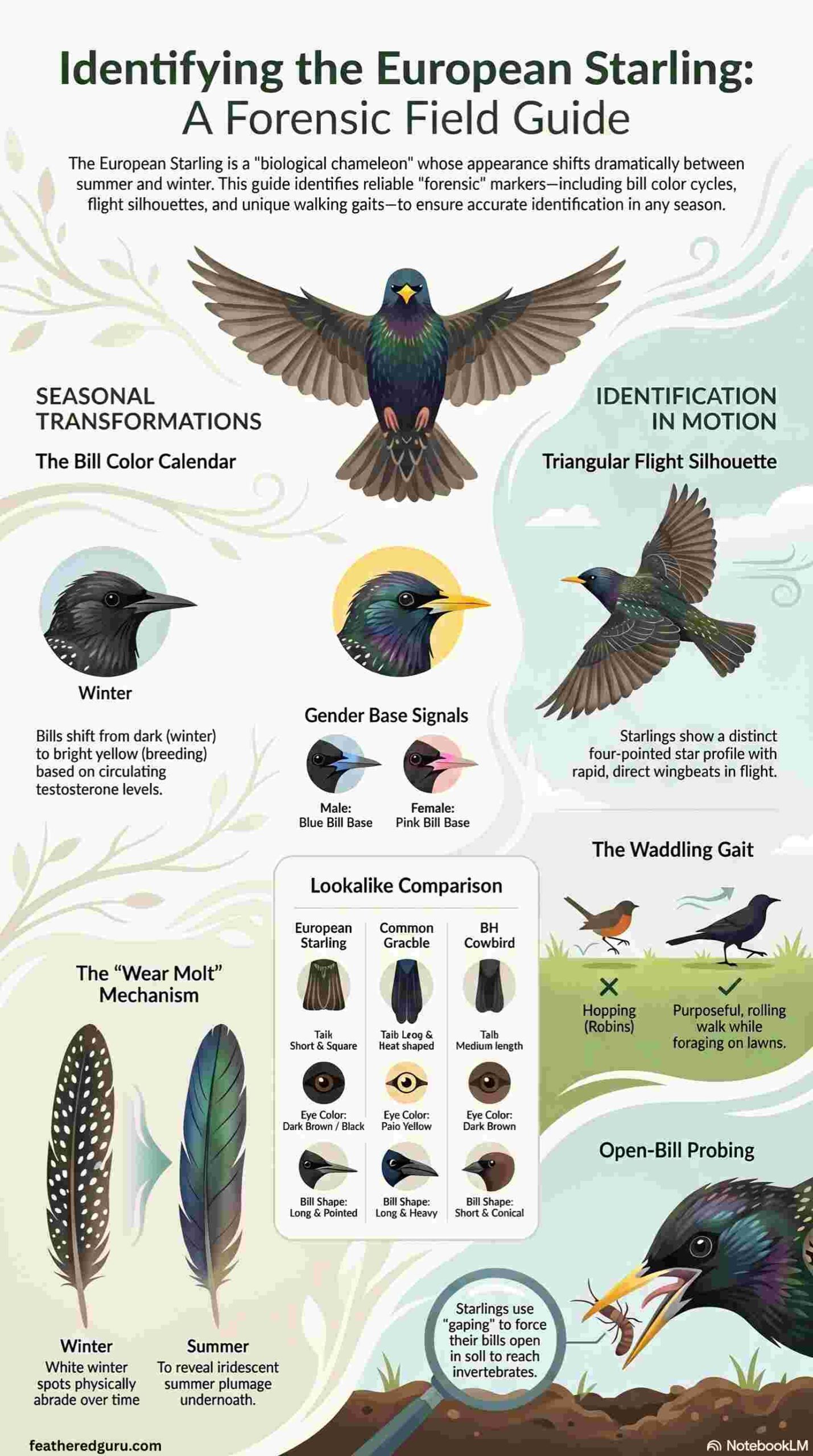
To help you quickly confirm an identification in the field, we have distilled the most important seasonal markers and behavioral cues into a forensic summary. Save or pin this infographic to keep these diagnostic field marks handy for your next birding session.
Mastering Your Final European Starling Identification Routine
Accurate identification is the essential first step for any effective backyard bird management strategy. To ensure you are not accidentally deterring native species, you must check for five specific forensic markers to confirm a European Starling identification.
Look closely at the outline of the body to spot a stocky, short-tailed frame with a long pointed bill. This unique shape immediately eliminates grackles, cowbirds, and native thrushes. Check the feathers for an iridescent green and purple gloss in the summer months. During the winter, look for white spangled spotting across the chest.
Verify the color of the beak against the current season. Look for a bright yellow bill in the spring and early summer or a dark brown or black bill in the autumn and winter. Observe how the bird moves along the ground. A bird that walks or waddles while probing the soil is likely a starling, while native thrushes typically hop across lawns.
Listen for a messy mix of high whistles and mimicry interspersed with unique mechanical clicking and rattling sounds. These distinct industrial noises separate them from local songbirds.
While one marker alone may not be definitive, the full combination remains completely unmistakable. When you see a stocky, short-tailed, yellow-billed bird walking and probing the turf while making mechanical clicks, you have a positive identification of a European Starling.
For the management steps that follow from a confirmed identification, see our detailed guide on how to deter starlings from bird feeders to protect your equipment. You can also explore our technical guides covering European starling nesting habits and the behavior of other invasive backyard birds to secure your property.