
Reader Transparency: This birding guide contains paid affiliate links. If you click a link and make a purchase, I may receive a small commission at no extra cost to you. As an Amazon Associate, I earn from qualifying purchases. Your support helps keep Feathered Guru flying!
Finding the best birding binoculars under $200 requires analyzing true optical materials science. Budget optics range from stable, functional tools to inferior rigs utilizing cheap glass and inadequate prism coatings. For senior birders managing declining contrast sensitivity, pupil dilation capacity, and chromatic resolution, this quality difference is critical. Choosing an engineered instrument determines whether backyard observation remains an enjoyable hobby or causes severe ciliary eye strain.
This guide applies strict physics analysis to three verified value-class models: the Celestron Nature DX 8×42, Nikon Prostaff P3 8×42, and Vortex Crossfire HD 10×42. We pinpoint where each chassis exceeds retail standards and where it approaches the boundaries of senior visual adequacy. Every technical measurement cited is drawn directly from official manufacturer product documentation or peer-reviewed optical research papers


Direct Hit: The Optical Floor for Budget Searchers
Sub-$100 binoculars compromise glass purity, causing severe visual fatigue. Seniors managing age-related changes require an instrument that preserves a true circular exit pupil using BaK-4 prisms and fully multi-coated air-to-glass paths.
- The Budget Entry Standard: Celestron Nature DX 8×42 (Phase-corrected BaK-4 glass — closest close-focus tracking at 6.5 feet).
- The Ergonomic Value Challenger: Nikon Prostaff P3 8×42 (Slightly lighter frame — massive 20.2mm eye relief for eyeglasses).
- The Long-Range Value Alternative: Vortex Crossfire HD 10×42 (Higher 10x magnification — backed by an unconditional lifetime warranty).
The Technical Masterclass: An Engineering Analysis of the Budget Optical Floor
Full Audio Synthesis: Listen to our clinical gear analysts unpack the research dossier in full detail while you scroll. This 49-minute audio briefing covers prism glass degradation thresholds, thin-film silver alloy transmission losses, and internal chassis collimation alignment safeguards for senior birders.
The Budget Optical Floor: Visualizing Glass Quality and Exit Pupil Light Loss
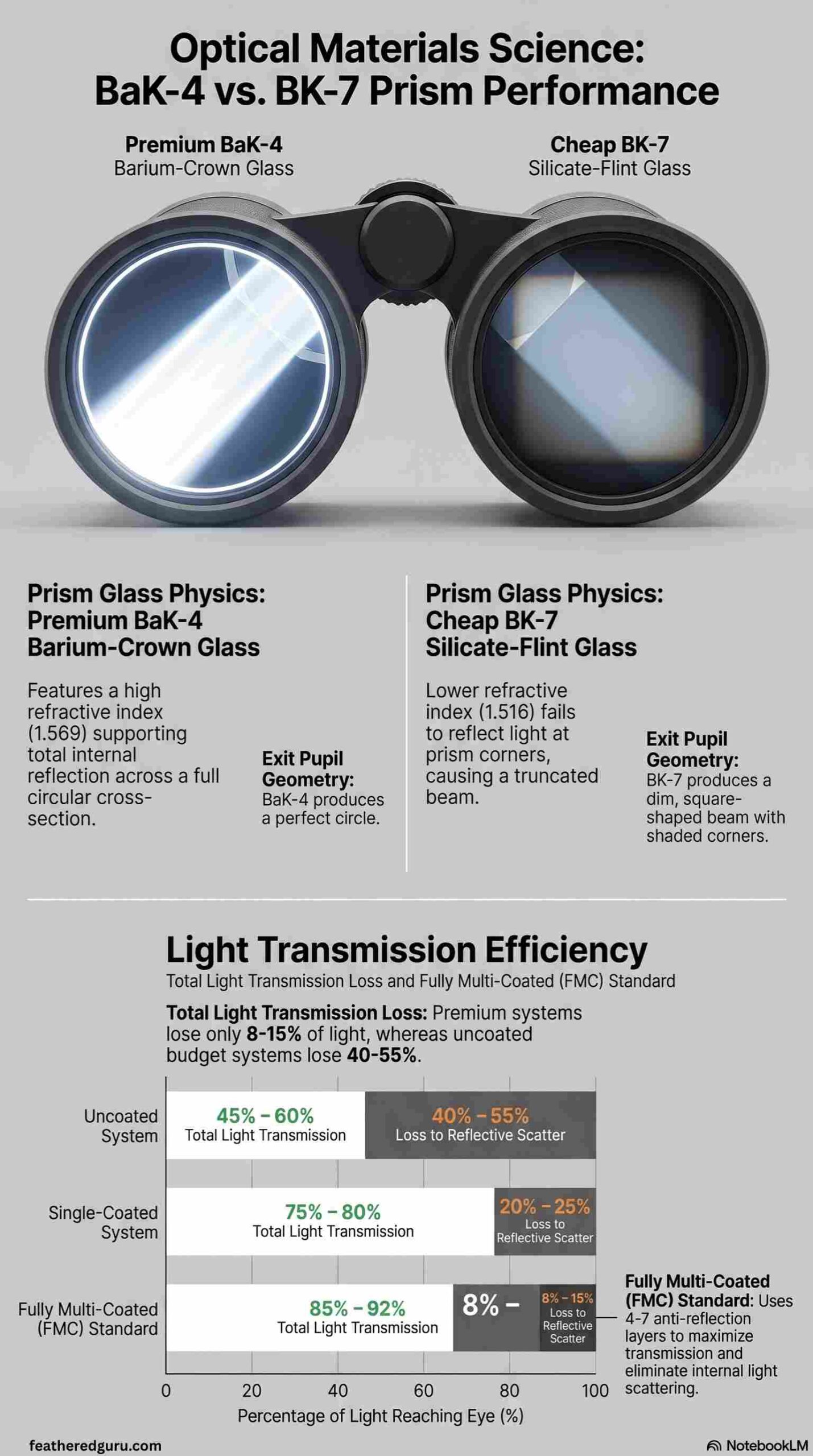
Optical Breakdown: Technical blueprint illustrating how the lower refractive index of BK-7 silicate-flint glass cuts off the perimeter of the light beam, transforming a circular exit pupil into a restricted, square shape.
This visual matrix demonstrates how upgrading to phase-coated BaK-4 barium-crown glass recovers full light transmission, providing senior eyes managing senile miosis with the critical brightness needed to track objects in low-light environments.
The Physics of the Optical Floor: Where Budget Manufacturers Cut Corners
Within the sub-$200 price range, manufacturers face a defined set of cost constraints that force specific trade-off decisions. The components most commonly degraded to achieve a low retail price are prism glass type, lens coating layer count, prism reflective coating chemistry, and internal chassis material quality. Each of these trade-offs has a measurable, documented effect on optical performance.
Why Do Cheap Binoculars Look Blurry or Dim?
Cheap binoculars appear blurry or dim because they utilize inferior BK-7 silicate-flint glass prisms rather than premium BaK-4 barium-crown glass prisms. Furthermore, they rely on basic single-layer anti-reflection coatings instead of fully multi-coated optical surfaces.
Both manufacturing cutbacks drastically reduce overall light transmission and compromise the circular exit pupil geometry, producing a dim image with severe edge darkening and low contrast.
BaK-4 barium-crown glass has a refractive index of approximately 1.569 and is optically dense enough to support total internal reflection across the full circular cross-section of the light beam passing through the prism. BK-7 silicate-flint glass has a lower refractive index of approximately 1.516, which is insufficient to support total internal reflection at the prism corners when the binocular is used at a wide field angle.
The result is that the exit pupil, the circular beam of light emerging from the eyepiece, is cut off at its edges with BK-7 prisms, producing a squarish or D-shaped exit pupil cross-section rather than a fully circular one. This truncated exit pupil delivers less total light to the eye and creates the characteristic edge dimming seen in budget binoculars.
For senior users whose pupil aperture has already reduced through Senile Miosis, the truncated BK-7 exit pupil further reduces the effective overlap between the binocular’s light beam and the eye’s receiving aperture.
Internal Light Scattering from inadequate anti-reflection coatings is the second major source of budget binocular dimness. Each air-to-glass surface in an uncoated or single-coated optical system reflects approximately 4 to 5 percent of incident light back out of the system rather than transmitting it forward.
A full-size binocular contains 12 to 16 air-to-glass surfaces in its complete optical path. An uncoated system would lose 40 to 55 percent of entering light to reflective scatter across these surfaces. A single-coated system reduces this to approximately 20 to 25 percent total loss.
A Fully Multi-Coated system, in which four to seven anti-reflection layers are applied to each surface, reduces total transmission loss to 10 to 15 percent, with premium systems achieving 85 to 92 percent total light transmission.
All three models reviewed here use fully multi-coated optics, distinguishing them from lower-tier competitors that use “multi-coated” as a designation that applies coatings to only some surfaces.
Physiological Constraints: Why Low-Cost Optics Accelerate Senior Eye Strain
The optical limitations of budget binoculars interact with specific age-related changes in visual physiology to produce compound effects on viewing comfort and eye fatigue that are more severe for senior users than for younger users with the same optical equipment.
Can Cheap Binoculars Damage Your Eyes?
No. Budget binoculars do not cause structural or permanent clinical eye damage. However, instruments with poor optical collimation alignment, high chromatic aberration, or inadequate prism light transmission force your visual system into high-effort compensatory processing.
This sustained muscle compensation rapidly accelerates ciliary visual fatigue, triggers headaches, and causes prolonged strain for individuals managing Presbyopia or Age-Related Macular Degeneration.
Clinical Evidence: A comprehensive lifespan study published in Frontiers in Neuroscience evaluating healthy participants from ages 5 to 93 documented precise baselines for age-related changes in pupil dynamics. The researchers confirmed that senile miosis, which is the progressive reduction in maximum pupil diameter traditionally associated with the elderly, begins much earlier in life soon after full pupillary maturation is reached in youth.
This continuous physiological decline means that light transmission thresholds drop steadily over several decades, rather than experiencing a sudden onset late in life. The study documented a continuous decline in pupil size from peak values reached in early adulthood, driven by decreased central inhibition of the parasympathetic Edinger-Westphal nucleus with increasing age.
For senior birders, this progressive visual barrier underscores why using budget optics with low light transmission rates can accelerate ciliary eye strain well before age 60. The practical consequence is that senior users require a larger, brighter exit pupil from their optics to compensate for what their diminished pupil dilation can no longer accomplish independently.
Further research published in Vision Research on aging, senile miosis, and spatial contrast sensitivity at low luminance found that older adults’ loss in contrast sensitivity increased with increasing spatial frequency. The data established that this degradation became significantly more pronounced with any corresponding decrease in ambient luminance levels.
Contrast Sensitivity represents the visual system’s ability to distinguish an object from its background when the luminance difference between them is small. This is precisely the challenging condition encountered when observing birds against shadowed foliage, dark tree bark, or overcast skies.
This documented compound loss in both contrast sensitivity and pupil dilation capacity means that senior birders have less optical system tolerance for the internal light scattering and prism transmission losses that characterize budget optical designs.
A binocular delivering 82 percent light transmission may be adequate for a 30-year-old user. However, that same instrument may produce a perceived dim, flat image for a 70-year-old whose reduced pupil dilation and contrast sensitivity leave less physiological margin to compensate for transmission losses.
Furthermore, Chromatic Aberration from budget objective lenses compounds this eye strain problem through an entirely different mechanism. When a low-cost lens fails to focus all wavelengths of light to a common focal point, it produces color fringing, creating colored halos visible at high-contrast edges.
The visual cortex attempts to resolve these fringing artifacts by continuously recalibrating its interpretation of the image. This intense processing demand generates a characteristic binocular-induced headache after extended viewing sessions.
Users managing Age-Related Macular Degeneration, in which central photoreceptor function is already compromised, face a much higher processing load from chromatic aberration artifacts because the foveal region used for fine detail analysis is already operating well below normal sensitivity.
Structural Survival: Collimation Safeguards and Alignment Risks
Optical collimation, the precise parallel alignment of both barrels’ optical axes, is the structural foundation on which all other optical performance rests. A binocular that is out of collimation delivers two images that cannot be fused by the visual system without sustained effort, producing the double vision and rapid eye fatigue that renders an instrument unusable.
How Do You Check If Cheap Binoculars Are Broken Internally?
The most reliable field method for identifying internal structural failure is the collimation blinking test. Hold the binoculars at arm’s length, focus on a sharp horizontal plane like a roofline, and alternately close each eye.
If your target displays a vertical offset greater than a 0.5 meter-angular discrepancy at 100 meters, your optical axes are misaligned. This mechanical deviation indicates complete collimation failure and requires professional laboratory service.
The Alignment Shift Vulnerability in budget binoculars originates in the chassis material and internal component mounting tolerances. Premium binoculars use magnesium alloy or forged aluminum chassis with prism mounting systems that use precision mechanical stops and adhesive securing to hold prism position under impact.
Budget binoculars use injection-molded polycarbonate or low-grade aluminum internal housings whose dimensional tolerances are wider, meaning prism mounting positions are less precisely defined at the factory and more susceptible to shift when the instrument is subjected to mechanical shock.
A single drop onto a hard surface at a height of one meter can shift the prism position in a budget binocular sufficiently to produce visible double vision, while a premium binocular with the same objective drop may show no measurable collimation change.
The Double Vision Phenomenon produced by even mild collimation error is disproportionately disabling for senior users. Binocular vision fusion requires the visual cortex to merge the images from both eyes into a single coherent percept.
When the two images are slightly displaced vertically or laterally, the extra-ocular muscles must apply a sustained corrective vergence effort to achieve fusion.
This sustained muscular effort, called Fusional Vergence Demand, is measurable as increased intraocular pressure and ciliary muscle tension, and it depletes the fusional reserve faster in users whose binocular coordination has already declined with age.
The Value-Class Top Picks: Technical Hardware Analysis
The table below summarizes the key specifications for each model drawn from verified manufacturer documentation:
| Model | Weight | Eye Relief | Field of View | Exit Pupil | Close Focus | Optical Prism Tech |
|---|---|---|---|---|---|---|
| Celestron Nature DX 8×42 | 24.9 oz (705g) | 17.5mm | 388 ft | 5.25mm | 6.5 ft | Phase Coated + BaK-4 Prisms |
| Nikon Prostaff P3 8×42 | 20.3 oz (575g) | 20.2mm | 377 ft | 5.3mm | 9.8 ft | Silver-Alloy Prism Mirror |
| Vortex Crossfire HD 10×42 | 23.0 oz (652g) | 15.0mm | 325 ft | 4.2mm | 6.0 ft | Fully Multi-Coated Roof Prism |
Celestron Nature DX 8×42: The Budget Entry Standard
– Phase-coated BaK-4 prisms for crisp resolution
– Fully multi-coated optics for bright images
– Waterproof and nitrogen-purged rugged casing
– Close 6.5-foot focus ideal for birding
The Celestron Nature DX 8×42 serves as the definitive baseline standard for the entry value tier. It stands out as a highly sophisticated optical instrument in the sub-$150 price segment, earning independent recognition across the birding community as a premier selection for budget-conscious hobbyists.
According to the official Celestron Nature DX specification sheet, the instrument features phase-coated BaK-4 prisms, Fully Multi-Coated optics across all air-to-glass surfaces, a comfortable 17.5mm eye relief, and a class-leading 6.5-foot close focus distance.
Its calculated 5.25mm exit pupil falls perfectly within the optimal tracking range required by seniors managing age-related pupil dilation reduction, delivering a bright image in low-light environments. The inclusion of a specialized Phase-Correction Coating on the BaK-4 prisms is a major engineering milestone at this accessible price tier.
Traditional roof prism binoculars split light beams into two separate paths that travel slightly different physical distances before recombination. Without specialized phase correction, this subtle path-length difference introduces a phase shift that visibly degrades image contrast and blurs fine edge resolution.
Phase-correction coatings resolve this issue by applying a specialized thin-film retardation layer to the prism surface. This structural barrier compensates for the phase difference, fully restoring image contrast to the level achievable in non-split optical setups. Locating this advanced feature in a budget-friendly instrument represents a significant structural value advantage for senior observers.
The underlying polycarbonate chassis weighs 24.9 oz (705g), featuring full nitrogen purging and protective O-ring sealing for waterproof performance. The 29mm focus wheel diameter is slightly narrower than the oversized wheels found on luxury models, presenting a minor mechanical resistance limitation for individuals with hand stiffness.
Expert Note: For an exhaustive analysis of mechanical friction thresholds and to review our lab’s top-rated hardware configurations for senior joint conservation, examine our full engineering dossier: Best Ergonomic Binoculars for Arthritic Hands: The Focus Wheel Blueprint.
Nikon Prostaff P3 8×42: The Ergonomic Value Challenger
– Multi-coated lenses provide bright, crisp views
– Long eye relief perfect for eyeglass wearers
– Lead- and arsenic-free
– Eco-Glass parts used safely
– Rubber-armored body for tough outdoor conditions
The Nikon Prostaff P3 8×42 delivers the longest eye relief of the three models at a massive 20.2mm, establishing it as the most spectacle-compatible option in the value tier. According to official engineering documentation published by Nikon, the chassis weighs a light 20.3 oz (575g) while providing a 377-foot field of view at 1,000 yards, a comfortable 5.3mm exit pupil, and a stable 9.8-foot minimum focus distance.
This rugged, fiberglass-reinforced polycarbonate housing stands out as the lightest frame among the reviewed models, presenting a significant mechanical advantage for senior birders managing localized neck or shoulder fatigue.
The critical optical distinction found in this model centers entirely on its specialized prism coating chemistry. The manufacturer utilizes a highly reflective silver-alloy mirror coating on the internal surfaces of the roof prism assembly rather than the luxury dielectric alternatives.
Silver-alloy thin-films bounce approximately 95 to 96 percent of incident light across the visible spectrum, whereas premium dielectric layers achieve a near-perfect 99.9 percent light transmission threshold. This slight performance variance causes a minor cumulative loss of brightness that partially offsets the instrument’s excellent, anti-reflective multi-coated lenses.
For senior users whose primary physical requirements prioritize maximum eye relief and minimal musculoskeletal strain, the ultra-lightweight polycarbonate body addresses those personal comfort goals beautifully. The nitrogen-purged casing is fully waterproof down to 3.3 feet for up to 10 minutes, protecting your long-term investment from sudden weather changes.
Expert Note: For a complete anatomical breakdown of vertex distance mechanics and to review our lab’s top-rated hardware configurations for spectacle wearers, examine our full clinical dossier: Best High Eye Relief Binoculars for Birders Wearing Glasses or Bifocals.
Vortex Crossfire HD 10×42: The Long-Range Value Alternative
– HD glass lenses cut color blurring
– Rubber-armored chassis ensures non-slip handling
– Waterproof and fogproof outdoor resilience
– Twist-up eyecups adjust quickly for glasses
The Vortex Crossfire HD 10×42 stands as the definitive long-range outlier in this value tier. It delivers a powerful 10x magnification rather than the traditional 8x configuration, shifting its primary use-case profile toward open-country tracking.
According to the official Vortex Optics Crossfire HD specification sheet, the instrument features an optimized HD Optical System, Fully Multi-Coated lenses, and a durable single-hinge roof prism chassis. It backs these parameters with an adjustable 15mm eye relief and a stable 325-foot field of view at 1,000 yards.
The production weight of 23.0 oz (652g) positions this instrument as the heaviest chassis among the three reviewed models. Its calculated 4.2mm exit pupil is notably tighter than the 5.25mm or 5.3mm exit pupils of competing 8x setups.
This reduced light transmission stands as the most critical senior-compatibility limitation of this model, demanding a higher ambient light environment to prevent sudden ciliary eye strain.
The primary differentiating value proposition of this model centers entirely on its structural consumer protections. The unconditional Vortex VIP Lifetime Warranty is completely transferable and fully covers physical gear failure.
This policy replaces shattered optics or structural housing damage resulting from accidental field drops without requiring a proof of purchase or registration card.
For senior birders whose baseline grip security may be compromised by hand stiffness, eliminating the long-term financial risk of accidental damage is a powerful quality-of-use factor that a raw numbers chart cannot capture.
Furthermore, the impressive 6.0-foot close focusing distance ensures this high-magnification optic remains exceptionally practical for short-range backyard patio birding and immediate window feeder tracking
The 10x magnification advantage becomes relevant primarily for open-habitat birding at extended distances. For advice on the birding contexts where this long-range capability is most valuable, see our article on spring birdwatching tips for beginners.
Forensic FAQ: Maximizing Value and Identifying False Affordability
Is an Automatic or Fixed-Focus Binocular Safe for Seniors on a Budget?
Fixed-focus binoculars are entirely inappropriate for senior backyard birding due to severe mechanical and visual limitations. These focus-free instruments set their objective lenses permanently at infinity, relying entirely on the human eye’s natural accommodative flexibility to sharpen close subjects Advanced Presbyopia eliminates precisely this accommodative capacity.
Consequently, an aging observer receives sharp distant views, but a blurry image at any distance below a 20-to-30-foot close-focus boundary. Because most backyard configurations place active feeders within a six-to-twenty-five-foot tracking zone, these rigid optical blocks are fundamentally incompatible with near-range observation.
Furthermore, because they lack manual focal mechanisms or right-eye diopter rings, they cannot compensate for common between-eye refractive differences. A center-focus chassis with a dedicated diopter adjustment remains the only clinically sound design to preserve balanced, strain-free viewing.
For a comparison of all relevant ergonomic features across multiple binocular categories, see our complete series including best lightweight binoculars for seniors and best image stabilized binoculars for seniors with hand tremors.
Why Do Some Cheap Binoculars Advertise High Magnification Like 20×50?
Cheap binoculars advertising 20x or higher magnification exploit a common consumer bias to disguise an optically unusable product. At this extreme power level, a typical handheld tremor of 0.5 degrees translates into 10 degrees of apparent image movement. This math makes sustained observation of a moving bird impossible without electronic stabilization.
Furthermore, a 20×50 configuration chokes the exit pupil into a tiny 2.5mm beam. This light path is significantly smaller than an aging observer’s dark-adapted pupil aperture in any real-world setting outside direct sunlight.
This highly restricted exit pupil drastically chokes light transmission, delivering a dim, low-contrast image that triggers immediate ciliary eye strain. It also severely reduces head positioning tolerance, causing distracting edge vignetting with the slightest physical movement.
Below the $150 price point, high-magnification optics uniformly utilize cheap BK-7 glass, single-coated lenses, and uncompensated chromatic aberration. Technical analysis indicates that any budget instrument advertising magnification above 10x fails basic visual adequacy metrics and should be treated with extreme skepticism.
Can You Bird Successfully With a Sub-$100 Binocular?
A sub-$100 binocular can only support casual, daylight-only tracking of stationary subjects at medium distances, but it completely fails the requirements of serious hobbyists. Under optimal conditions, such as bright daylight and clear sightlines from 30 to 100 yards, cheap glass can produce a baseline acceptable image.
However, when confronting real-world birding variables like canopy shadows, dawn or dusk low-light windows, and near-range feeder tracking, these structural limitations become an immediate barrier. The accumulated optical trade-offs of cheap BK-7 prisms, partial coatings, and loose housing tolerances make it impossible to preserve a bright, sharp, and stable image.
To protect aging vision from chronic visual fatigue, you must cross the optical floor threshold, which corresponds to the $100 to $120 price point. This financial boundary is where phase-coated BaK-4 prisms and fully multi-coated lens stacks become consistently available to guarantee reliable performance.
Because senior visual physiology provides less compensatory reserve to override optical defects, the gap between adequate and inadequate gear is experienced acutely. The baseline Celestron Nature DX 8×42 represents the verified entry point of this accessible optical floor, providing senior birders with a balanced, strain-free viewing experience.
Medical Disclaimer: The technical, optical, and physiological information provided in this guide (including references to senile miosis, age-related macular degeneration, spatial contrast sensitivity degradation, and the visual processing load placed on ciliary muscles and the visual cortex) is for general educational and informational purposes only. It is based on optical physics specifications, manufacturer engineering data, and peer-reviewed ophthalmic and neuroscience research. This content is not a substitute for professional medical advice, clinical vision testing, diagnosis, or treatment. Always consult a qualified ophthalmologist, optometrist, or medical professional regarding specific eye health, prescription lens adjustments, or chronic visual fatigue concerns.