
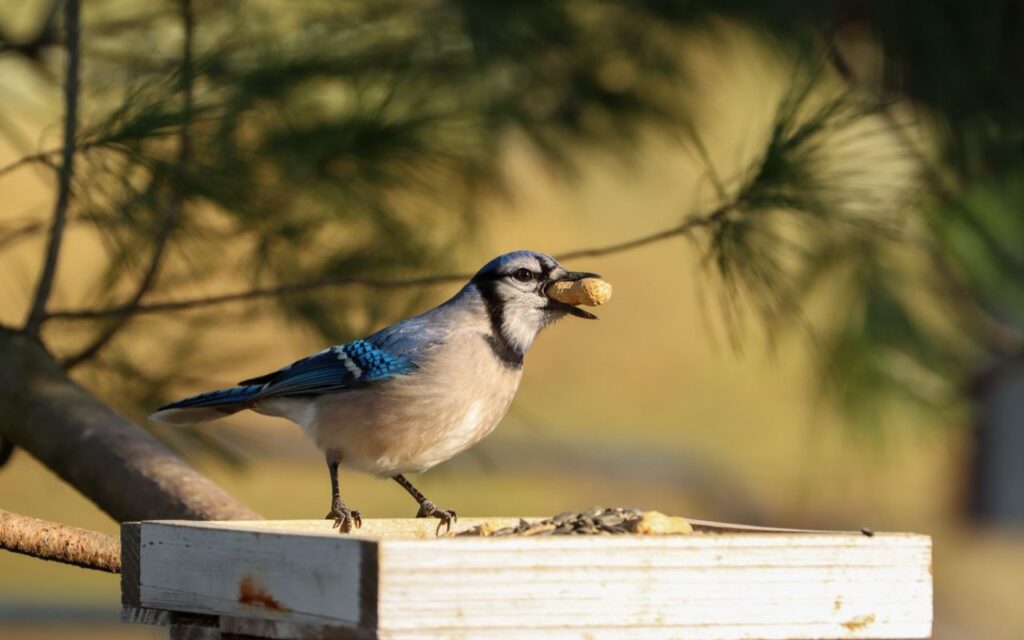
Watching a Blue Jay methodically toss premium nuts off your platform tray can easily make it look like these corvids are just destructive backyard gluttons. Homeowners routinely look out at their messy property lines and assume this frustrating food-sorting behavior is done out of pure spite or selective pickiness.
In my years of backyard wildlife tracking, I have learned that this seemingly wasteful throwing habit is actually a brilliant piece of long-term winter survival strategy. If you look out your window and ask “why are blue jays throwing peanuts on the ground,” the real biological reason is to run a rapid weight and acoustic calculation to verify the food’s internal fat content before committing flight energy to hide it.
Why Do Blue Jays Sort and Discard Whole Peanuts?
The primary reason is acoustic internal mass assessment, where the bird rapidly rattles a peanut shell to judge the internal kernel weight based on the resonance and vibration of the seed inside the pod.
Because jays expend immense physical energy flying up to 2.5 miles to bury individual nuts, they use this rapid beak-clicking audit to discard lightweight, hollow, or insect-damaged shells to maximize their caloric return.
The High Stakes of Corvid Caching Economics
To understand why a Blue Jay throws a peanut to the ground, you first have to understand the intense energetic math of food caching. Blue Jays do not just eat food at your feeder; they are long-term winter survival hoarders. During the peak autumn and late summer months, individual jays will make over 1,000 trips a day to collect, transport, and hide calorie-dense nuts across vast geographic spaces.
This massive logistical operation requires a staggering amount of physical energy. A jay will routinely fly up to 2.5 miles away from your property lines to hide a single nut inside loose soil or leaf litter. Because their winter survival depends on the nutritional payout of these hidden stores, carrying a dud is an economic disaster for the bird.
Field research highlighted by the University of Illinois Extension demonstrates that a small flock of 50 jays can select, transport, and cache 150,000 acorns in just 28 days to prepare for freeze cycles.
If a jay spends valuable flight energy carrying a nut that contains a shriveled kernel, an infestation of weevil larvae, or a pocket of mold, it loses the energetic gamble. The sorting behavior you see at your platform trays is a rapid, high-stakes quality control screening designed to ensure every single flight delivers maximum fat content.
Rapid Auditory Rattling and Beak Mandible Physics
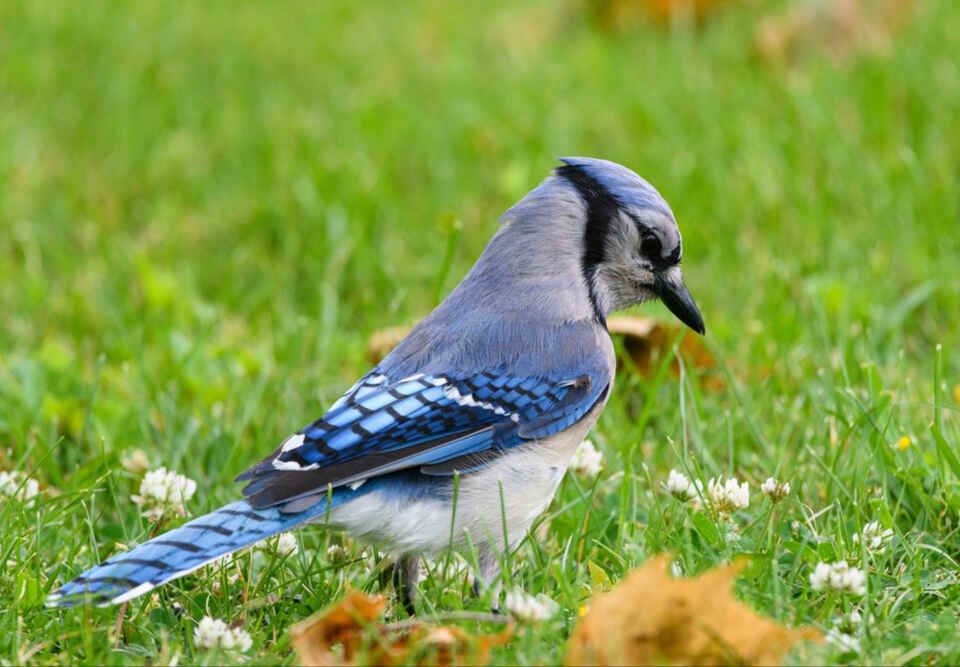
The exact physical mechanism jays use to audit a peanut shell is a sensory process known as acoustic monitoring. When a jay picks up a whole peanut shell, it doesn’t just judge it by human vision. It executes a lightning-fast “beak rattle.” By slightly loosening its bill grip and shaking its head vertically, the bird rattles the internal nut kernels against the dried outer woody walls of the pod.
This rapid percussion test gives the bird two critical pieces of real-time data:
- Resonance and Pitch: A full, heavy, moisture-rich kernel produces a distinct, low-frequency dull thud and a heavy mechanical resistance against the mandibles. A light, shriveled, or dead kernel rings with a hollow, high-pitched rattle.
- Kinetic Weight Shift: As the nut moves within the shell space, the bird’s sensitive beak nerves measure the precise weight shifting through the physical layout of the pod.
According to verified behavioral experiments highlighted by BirdNote, slow-motion cameras confirm that jays actively use these rapid beak-clicking movements to listen to internal sounds and feel for nut heaviness.
If the internal acoustics signal that the shell contains empty air pockets, moisture rot, or only one tiny seed instead of two large ones, the jay instantly discards it over the ledge. They are looking for the heavyweights of the batch.
The Gular Pouch and Multi-Nut Packing Mechanics
Another reason Blue Jays throw nuts around is that they are actively trying to solve a high-volume packing puzzle. Corvids are uniquely adapted with a distensible esophagus called a gular pouch. This elastic pocket beneath their tongue allows them to swallow and store multiple small seeds or whole shelled peanuts inside their throats simultaneously, keeping their beaks free to carry one final large item.
You can often hear them coordinating these foraging runs using distinct vocal patterns, which I break down in my guide to How to Identify Blue Jay Calls and Songs.
When a jay lands on your platform feeder, it often wants to optimize its commute by loading its gular pouch first. It will toss aside larger, awkward whole peanuts while searching for small, streamlined options that can slide smoothly into its throat pocket.
Once its internal throat capacity is fully maximized, it will then spend a few extra seconds auditing the remaining large whole peanuts to select the absolute heaviest pod to carry home externally in its primary beak mandibles.
How to Optimize Your Feeder Layout to Reduce Waste
Now that you know the raw evolutionary biology driving this sorting ritual, you can make three simple property upgrades to eliminate the mess and prevent your ground space from turning into an unorganized shell junkyard:
Embrace the Ground Feeders: Remember that the peanuts jays discard aren’t actually wasted. Ground-feeding specialists like Mourning Doves, Fox Sparrows, and Juncos do not have the heavy beak structure required to crack open whole shells. They actively wait below the platform zone for the scraps to rain down, cleaning up your yard lines naturally.
Switch to Pre-Shelled Peanut Halves: If you want to eliminate sorting entirely, remove whole peanuts from the menu and deploy raw, skin-on shelled peanut pieces. Because the visual and physical barriers are gone, jays can instantly see the kernel mass and will grab them sequentially without tossing a single piece aside.
Deploy Dedicated Sturdy Platform Feeders: Blue Jays are heavy, foot-long birds that require structural security to execute their acoustic shaking tests safely. Flimsy hanging tubes or swinging wire trays cause them to panic and drop food erratically. If they begin completely overtaking your yard, you can implement the specialized exclusionary tactics outlined in my guide on How to Keep Blue Jays Away From Bird Feeders.