
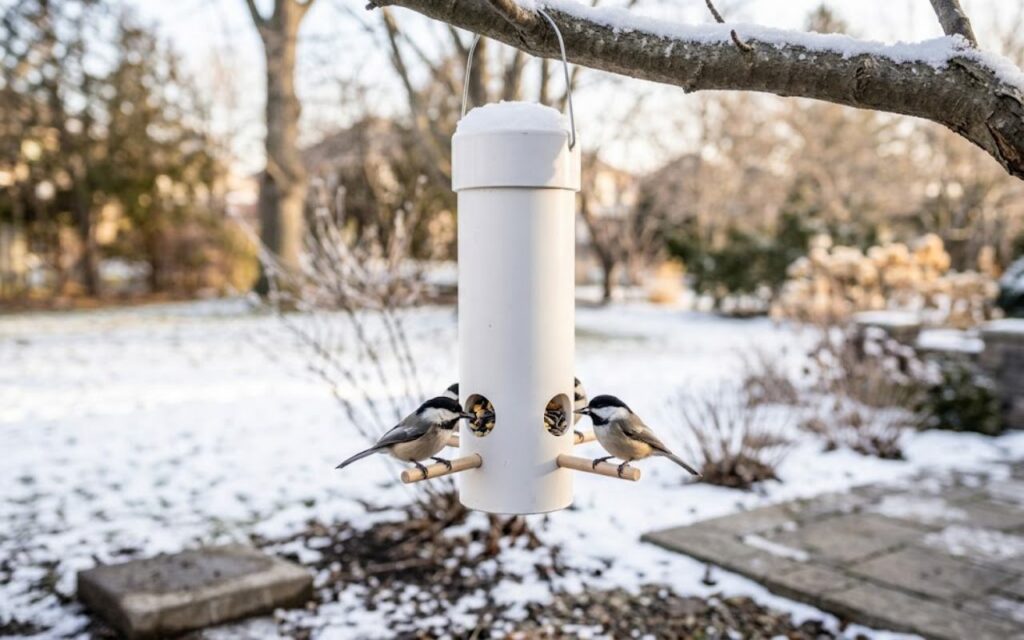
Learning how to build a PVC pipe bird feeder provides a high-capacity, weather-resistant solution capable of sustaining large winter flocks through extended periods of sub-freezing temperatures. Backyard enthusiasts frequently discover that commercial plastic tube feeders crack in deep freezes or empty within hours during heavy winter storms. Constructing a heavy-duty hopper from durable plumbing components stabilizes seed delivery while eliminating the relentless chore of twice-daily refills.
Sustaining high-metabolism winter flocks of Evening Grosbeaks, Northern Cardinals, and Pine Siskins requires addressing common mechanical failures found in amateur builds. Solving widespread issues like internal moisture entrapment, mammalian gnawing, and interior seed bridging ensures that your station remains a functional asset throughout the coldest months.
Schedule 40 Dimensions and Structural Load Distribution
Selecting the correct pipe schedule determines whether your hopper survives severe winter gales and nocturnal mammal raids. Thin-walled Schedule 20 drain pipe or standard drainage tubing easily cracks under freezing impacts and provides virtually zero defense against rodent teeth.
Solid core Schedule 40 PVC features a wall thickness of roughly a quarter of an inch (0.237 inches) in four-inch diameters, providing the rigid structural integrity needed to anchor heavy mounting hardware.
Weight distribution changes dramatically once a large vertical hopper reaches full capacity. A four-inch inner diameter PVC tube holds approximately 1.95 pounds of black oil sunflower seeds per linear foot.
Building a four-foot vertical column produces a total assembly weighing over 17 pounds once you factor in the heavy-walled pipe itself, the end caps, the seed column, and the steel mounting brackets.
- A four-foot section of solid core four-inch Schedule 40 PVC pipe
- Two heavy-duty two-hole galvanized steel conduit straps rated for four-inch pipe
- Heavy-gauge stainless steel wood screws or through-bolts for timber post mounting
- A four-inch PVC slip coupling to reinforce the port insertion zone
Mounting this assembly directly to a dedicated 4×4 pressure-treated timber post or a deeply sunk metal pole prevents catastrophic wind shear. Avoid hanging high-capacity PVC hoppers from tree branches using eye screws, as violent winter gusts will torque the fittings and snap the suspension wire.
Rigidly bolting the upper and lower thirds of the tube to a stationary vertical structure distributes the load evenly.ttings and snap the suspension wire. Rigidly bolting the upper and lower thirds of the tube to a stationary vertical structure distributes the load evenly.
Gravity Port Geometry to Eliminate Seed Bridging
The primary functional failure reported across backyard bird forums is seed bridging, where seeds lock together inside the pipe and stop dropping into the feeding access points. High-oil seeds like black oil sunflower have irregular shapes and rough hulls that easily wedge against interior tube walls when compressed by gravity.
Cutting arbitrary circular holes in the pipe walls worsens this issue, as birds hollow out the bottom layer and leave the remaining column stranded out of reach. Installing 45-degree PVC street elbows directly into the lower walls of the pipe establishes a dependable gravity-fed flow.
The angled throat of a 1.5-inch or 2-inch street elbow creates a downward slide that prevents the weight of the central seed column from compacting the feed at the access lip. This internal shelf allows seeds to slide forward only as birds consume them from the exterior opening.
- Two 1.5-inch 45-degree Schedule 40 PVC street elbows for feeding ports
- A hole saw matching the exact exterior diameter of the street elbow male end
- All-weather medium-bodied PVC solvent cement to weld port elbows permanently in place
- Two 3/8-inch diameter galvanized steel carriage bolts serving as indestructible metal perches
Drill the port holes four to six inches above the bottom base cap to maintain a small interior reservoir below the feed line. Insert the street elbows facing downwards at a distinct angle so rain and driven snow cannot blow into the seed column.
Drill horizontal pass-through holes directly beneath each elbow and secure the carriage bolts with locking nuts to create perches that squirrels cannot chew off.
Internal Condensation and Aflatoxin Mitigation Protocols
Sealed PVC tubes act as thermal barriers, establishing a sharp temperature differential between the cold outdoor air and the heat generated by dense, decomposing organic matter. When moist air enters through feeding ports during winter warm spells, interior condensation trickles down the smooth walls. This trapped moisture transforms a full seed reservoir into a toxic paste within days if internal ventilation remains absent.
Damp conditions inside grain reservoirs fuel Aspergillus flavus, a widespread fungal mold that produces lethal aflatoxins. Ingesting aflatoxin-contaminated seeds causes acute liver damage, immune suppression, and death in songbirds. Furthermore, wet seed cakes harbor Salmonella enterica, which spreads rapidly when large flocks gather around contaminated ports.
- Six 1/8-inch weep holes drilled through the bottom cap for emergency drainage
- A layer of non-corroding 0.25-inch galvanized hardware cloth set above the weep holes
- Shaded, north-facing post orientation to reduce direct solar heating cycles
- Seed mixes dominated by high-lipid black oil sunflower or safflower rather than moisture-absorbing millet
Place the wire hardware cloth inside the lower reservoir just above the drain holes to keep seed hulls from clogging the weep pathways. This creates a functional separation between fallen debris and the drain ports, allowing water to escape freely.
Never add chemical desiccants or moisture-absorbing silica packets into the tube, as birds can pierce the packets if the hopper runs low.
Predator Defense Mechanics and Hardware Torquing
Winter natural food scarcity drives raccoons, Virginia opossums, and gray squirrels straight toward high-capacity hoppers. The smooth exterior of PVC prevents squirrels from climbing the cylinder itself, but they easily leap onto the feeder from surrounding branches or drop down from rooflines. Once perched on feeding ports, rodents quickly gnaw soft plastic or thin-walled pipes to enlarge the openings.
Protecting the PVC from rodent damage requires defensive armor around high-contact zones. Wrapping feeding port rims with stainless steel hose clamps or fitting them with copper pipe collars creates an impenetrable physical shield against chewing. For pole-mounted designs, installing an authentic baffle remains non-negotiable.
- An 8-inch diameter, 24-inch long galvanized steel stovepipe baffle
- Stainless steel pipe clamps tightened over the exterior lip of all PVC elbows
- Heavy-gauge copper reduction rings glued into the feeding port openings
- A minimum four-foot vertical clearance between the ground and the lowest feeding port
Mount the stovepipe baffle at least four feet above the ground directly beneath the hopper assembly. Ensure the entire installation stands at least ten feet away from launch platforms like trees, deck railings, and shed roofs. This clearance defeats the horizontal jumping range of squirrels while keeping the feeder out of reach from standing raccoons.
Threaded Cleanout Engineering and Field Sterilization
Winter maintenance becomes impossible if the feeder cannot be opened, cleared, and refilled while wearing heavy gloves in freezing conditions. Standard push-fit slip caps often freeze permanently to the pipe body when moisture settles into the micro-gaps and expands into ice. Threading a mechanical cleanout fitting onto the top and bottom of the pipe guarantees access regardless of ambient ice accumulation.
A threaded female adapter paired with a countersunk cleanout plug creates an airtight, watertight seal that will not seize under frozen conditions. Applying a very light coating of food-grade mineral oil to the threads keeps moisture out of the threading tracks without introducing synthetic grease into the feeding zone. The top cleanout must feature a raised square nut, which allows you to break frozen seals effortlessly using an adjustable wrench.
- A four-inch Schedule 40 PVC female threaded adapter
- A four-inch PVC threaded cleanout plug with a raised square leverage nut
- A 1:9 unscented household bleach to water dilution for seasonal sterilization
- A long-handled stiff-bristle plumbing brush sized for four-inch cylindrical pipes
Every month, or immediately following prolonged rain-freeze cycles, empty any compacted seed remnants through the bottom ports. Scrub the entire interior barrel using the 1:9 bleach dilution to neutralize fungal spores, bacterial coatings, and mold residues.
Allow the Schedule 40 tube to air-dry completely in a heated garage before refilling it, as any residual interior moisture will immediately freeze into an anchor plate for new seed clogs.