
Reader Transparency: This birding guide contains paid affiliate links. If you click a link and make a purchase, I may receive a small commission at no extra cost to you. As an Amazon Associate, I earn from qualifying purchases. Your support helps keep Feathered Guru flying!
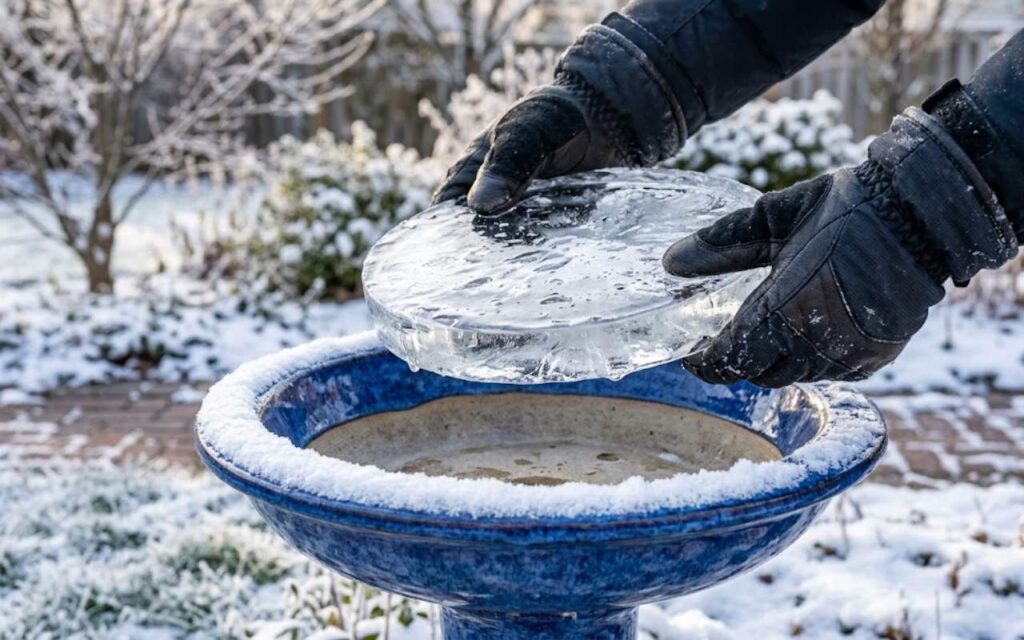
Many backyard birders attempt thawing winter water sources quickly, but pouring boiling water on a frozen bird bath is one of the most destructive mistakes you can make for your equipment and visiting wildlife. Learning how to safely unfreeze bird bath bowls without cracked materials requires looking past fast shortcuts.
This well-intentioned shortcut triggers violent thermodynamic reactions across common basin materials while putting vulnerable wild birds at serious physiological risk during sub-freezing weather.
Understanding the physics of localized heat transfer explains why sudden scalding temperatures ruin yard setups and endanger avian visitors. By examining material stress thresholds and bird survival biology, you can replace quick fixes with sustainable winter hydration strategies.
Thermal Shock Dynamics and Basin Material Fractures
Thermal shock occurs when rapid temperature differentials create uneven expansion rates throughout a rigid substrate. Pouring water at 212 degrees Fahrenheit onto frozen stone, ceramic, or glazed clay at 20 degrees Fahrenheit forces the surface layer to expand instantly while the underlying mass remains contracted.
This localized structural tug-of-war generates catastrophic mechanical stress that exceeds the tensile strength of the material. Concrete and cast stone basins are especially vulnerable due to their inherent porosity and trapped microscopic moisture pockets.
When water freezes within these micro-pores, it expands by approximately nine percent; introducing boiling water causes instantaneous thermal stress that manifests as spiderweb fractures or complete structural shearing across the basin floor.
Different basin materials exhibit specific failure profiles when subjected to extreme temperature deltas:
- Glazed ceramic develops micro-crazing in the protective vitreous layer before splitting completely across the basin center.
- Concrete and cast stone suffer delamination, surface flaking, and wide structural fissures along deep stress lines.
- Polycarbonate and molded plastics warp instantly, causing mounting bracket failures and seam detachment.
- Glass bird baths experience violent spiderweb cracking due to high thermal expansion coefficients and poor heat dissipation.
- Cast iron and heavy metals can crack internal rust barriers, accelerating oxidation and leaching metallic compounds into standing water.
Once a hairline crack forms in any porous basin, subsequent freeze-and-thaw cycles drive water deeper into the substrate. The next hard frost widens these micro-fissures, permanently ruining the water-holding integrity of your setup.
Feather Integrity and Plumage Hypothermia Hazards
Wild birds require open water for both hydration and feather maintenance during freezing temperatures, but hot water presents a hidden physiological hazard. Scalding water produces localized steam clouds that condense rapidly in frigid air, forming moisture droplets on visiting birds.
When down feathers become damp, their interlocking barbules collapse and eliminate the insulating air pockets essential for core body temperature regulation. Songbirds maintain an internal body temperature near 104 to 108 degrees Fahrenheit through dense feather down and high metabolic output.
If a bird bathes in water that remains too warm relative to the ambient air, the temperature disparity interferes with immediate post-bath preening. Damp plumage exposed to sub-freezing winds leads to sudden hypothermia, which frequently proves fatal for small passerines like goldfinches, chickadees, and nuthatches.
Furthermore, warm water alters the natural surface tension and dissolves critical uropygial gland secretions. Birds coat their feathers in preen gland lipids to maintain a hydrophobic, aerodynamic shell against sleet and snow. Stripping these essential oils leaves the bird completely uninsulated against winter elements.
Rapid Vapor Condensation and Surface Evaporation Losses
Backyard hobbyists often discover that pouring hot water into a cold basin paradoxically accelerates ice re-formation. Boiling water releases water vapor into dry winter air at an accelerated rate through latent heat dissipation.
This rapid vapor loss significantly reduces total fluid volume, leaving a shallower water column that freezes solid much faster than a standard pool. The physics behind rapid surface cooling involves increased convection currents within high-temperature fluids.
Hot water rises rapidly to the surface, shedding thermal energy to the surrounding atmosphere before collapsing downward as denser, cooled liquid. This aggressive convective cycle quickly equalizes the water temperature with the ambient sub-zero air.
A shallower, depleted basin creates a host of operational maintenance issues for winter wildlife monitors:
- Water depths plummet below the ideal one to two-inch bird safety margin within hours of application.
- Shallow sheets of water refreeze into smooth, hard glare ice that prevents small birds from perching securely.
- Dissolved oxygen levels fluctuate wildly, altering natural biofilm development and water palatability.
- Re-freezing creates an impenetrable surface dome that locks out thirsty birds until the next manual thaw.
Attempting to fight daily freeze cycles with repeated boiling refills produces an unsustainable cycle of rapid evaporation and solid refreezing. Consistent, gentle temperature management is required to maintain open surface water without depleting the basin.
Chemical Additives and Mineral Residue Complications
Frustrated yard managers often combine boiling water with domestic additives to delay ice formation, creating toxic hazards for local fauna. Adding common table salt, rock salt, or chemical de-icers to a bird bath is lethal because avian kidneys cannot process high sodium concentrations.
Salt poisoning induces severe cellular dehydration, neurological tremors, and rapid organ failure in small wild birds. Another persistent myth across amateur gardening boards recommends adding small amounts of glycerin to lower the water freezing threshold.
Glycerin is a hygroscopic sugar alcohol that adheres to avian plumage, gumming up the microscopic feather barbules like motor oil. Once a bird gets glycerin on its flight or down feathers, its waterproofing is destroyed, making flight impossible and fatal hypothermia inevitable.
Boiling tap water also concentrates non-volatile mineral deposits across the surface of the basin:
- Calcium carbonate and magnesium ions precipitate out of solution, forming tough, crusty limescale rings along the perimeter.
- Heavy mineral deposits degrade the textured footing birds need to access the water safely.
- Scale accumulations harbor pathogenic biofilms, including harmful bacteria and fungal spores such as Candida albicans.
- Concentrated mineral crusts accelerate the chemical breakdown of resin, sealant coats, and protective stone glazes.
Preserving avian health requires completely chemical-free water delivered at natural, ambient temperatures. Manual removal of surface ice sheets remains infinitely safer than introducing domestic pantry additives.
Submersible Heating Elements and Circuit Breaker Reliability
The safest, most energy-efficient method for keeping winter bird baths ice-free involves installing thermostatically controlled submersible de-icers. Unlike passive boiling water interventions, modern immersion heaters operate on low wattage and activate only when ambient temperatures drop below 35 degrees Fahrenheit.
These systems maintain open water without heating the liquid, preventing feather dampening and basin thermal shock. Hardware longevity depends entirely on matching the heating unit to your basin material and electrical infrastructure.
Submersible de-icers must be paired with an outdoor Ground Fault Circuit Interrupter (GFCI) outlet to eliminate shock hazards and nuisance power tripping caused by winter sleet infiltration. Using an inline moisture-sealed electrical gasket prevents blowing the master circuit during heavy snowmelt.
Selecting and maintaining the right winterization hardware ensures safe performance through sustained cold snaps:
- Aluminum or cast-zinc de-icers rated between 50 and 150 watts supply sufficient heat without wasting household power.
- Dedicated hardware-cloth shields or integrated riser legs prevent heating elements from making direct contact with plastic, resin, or fiberglass basins.
- A shallow, dark rubber pan or livestock feeding bowl can replace fragile ceramic basins entirely during sub-freezing months.
- Large, smooth river stones positioned on top of the de-icer element anchor the hardware against wind displacement and create safe perching perimeters.
- Routine cleaning with a nine-to-one water-and-vinegar solution dissolves hard mineral buildup around thermostat sensors to maintain accurate heat activation.
Investing in purpose-built, thermostatically regulated heating gear eliminates the structural and biological destruction caused by scalding water. Your backyard sanctuary stays fully functional, protecting fragile avian populations throughout the harshest winter freezes.