
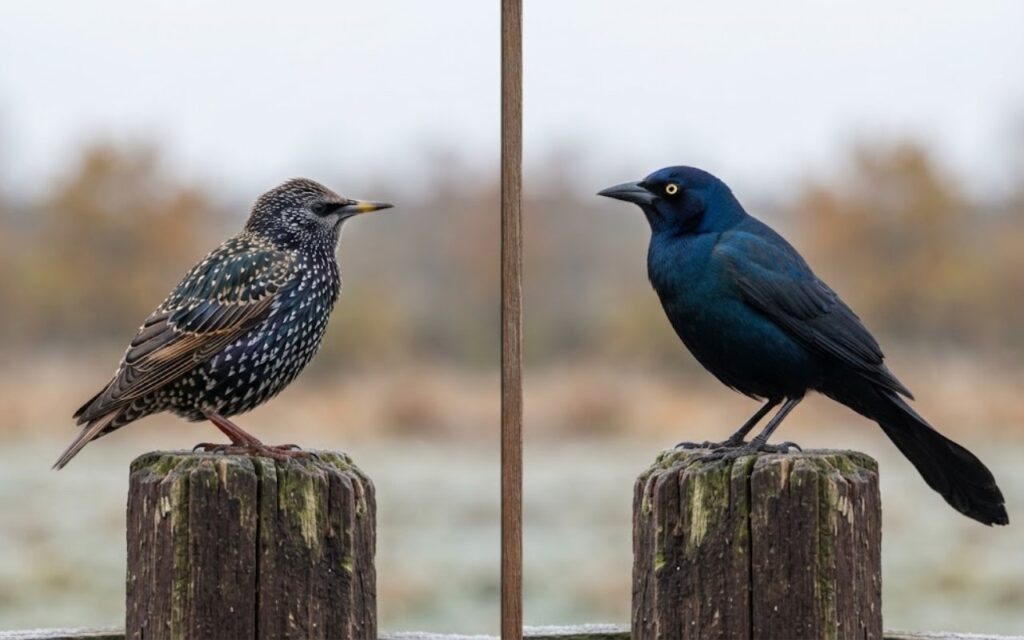
Distinguishing between a European Starling vs. Common Grackle can challenge even attentive backyard observers when light conditions mute their iridescent plumage. While both species often converge on suburban lawns and feeding stations in mixed flocks, they belong to entirely different avian families with distinct evolutionary adaptations, flight dynamics, and structural dimensions.
Understanding these foundational physical and behavioral markers allows birders to instantly identify each bird at a distance. Recognizing these traits also helps backyard enthusiasts implement targeted feeder modifications to manage their aggressive foraging habits effectively.
Quick-Glance Field Summary
Separating these two glossy, black-plumaged birds relies on evaluating overall body elongation, tail structure, and seasonal bill coloration. While starlings display a compact silhouette with a short, square tail and seasonal spotting, grackles exhibit a slender, long-tailed profile characterized by bright golden eyes and a heavy, dark bill.
- European Starling Length: 7.9 to 9.1 inches (20.1 to 23.1 cm)
- Common Grackle Length: 11.0 to 13.4 inches (27.9 to 34.0 cm)
- Starling Bill Anatomy: Slender, straight, bright yellow in spring and dark brownish-yellow in winter
- Grackle Bill Anatomy: Robust, downward-curved culmen, permanently black across all seasons
- Iris Coloration: Dark brown in starlings; piercing pale yellow to white in adult grackles
- Tail Silhouette: Short and squared-off in starlings; long, wedge-shaped, and distinctively keeled in grackles
- Feeder Exclusion Gauge: 1.5-inch wire mesh excludes adult grackles while allowing smaller songbirds to pass
Morphological Silhouettes and Keel-Tail Aerodynamics
On community forums like r/backyardbirds, new birders frequently express frustration when trying to separate these species in flat, overcast lighting. Experienced field observers consistently point out that silhouette analysis eliminates light-dependent guesswork. The European Starling (Sturnus vulgaris) possesses a short, compact body with a noticeably abbreviated, square tail that makes the bird appear almost tailless or chunky while walking.
In sharp contrast, the Common Grackle (Quiscalus quiscula) displays an elongated, lanky profile dominated by an expansive, paddle-shaped tail. During breeding display and sustained flight, the grackle folds its tail feathers downward along the central axis to form a distinct aerodynamic keel or “V” shape. This boat-tailed structural feature is entirely absent in starlings.
The wings also reveal critical aerodynamic differences during rapid flight across an open yard. Starlings exhibit pointed, triangular wings that produce a direct, rapid, and darting flight pattern reminiscent of a miniature falcon. Grackles fly with slower, rhythmic wingbeats, using their heavy tails as a broad rudder that often twists visibly in crosswinds.
| Field Identification Mark | European Starling (Sturnus vulgaris) | Common Grackle (Quiscalus quiscula) | Quick-Glance Identification Key |
|---|---|---|---|
| Tail Silhouette & Length | Extremely short, stocky, and squared-off; gives them a compact, triangular profile in flight. | Exaggerated, long, and paddle-shaped; folds into a distinct “V” or keel structure during flight. | Check the tail length; starlings look stubby and tail-less, grackles look long and sleek. |
| Iris & Eye Color | Dark brown to black; blends seamlessly into the dark head plumage with zero contrast. | Stark, piercing golden-yellow; creates a high-contrast glare against the dark face. | Look at the eye; if it has a glaring yellow ring, it is a grackle. |
| Winter Coat Texturing | Heavily spangled with white, arrow-shaped chevron tips across the entire body. | Solid, uniform dark metallic bronzy-purple; entirely free of spots or speckles year-round. | Spots vs Solid; winter starlings are densely dotted, grackles are perfectly smooth. |
Bill Morphology and Seasonal Plumage Transitions
Close examination of the bill provides immediate diagnostic confirmation regardless of distance. The European Starling has a straight, sharp, needle-like bill adapted for probing soil via an open-billed foraging technique known as zwingeln (or prying). This bill transitions dramatically with hormone shifts, shifting to a bright, vibrant yellow during the spring breeding season before darkening to charcoal brown in late autumn.
The Common Grackle carries an entirely static, formidable bill year-round. It features a heavy, dark black culmen with a slight downward hook at the tip, which gives the bird an aggressive, predatory facial expression. Grackles use this heavy bill to crack acorns, pry open pine cones, and consume agricultural grains that starling bills cannot mechanically crush.
Plumage transitions further separate the two species throughout the calendar year. In late autumn and winter, fresh starling feathers feature white and buff triangular tips, giving the bird a heavily speckled or snowy appearance.
As spring approaches, these white feather tips abrade through environmental friction, revealing a glossy, dark base without requiring a true molt. Grackles never develop white spots; their plumage remains uniform, transitioning only between iridescent sheens.
Microstructure Iridescence and Ocular Disparities
A thread on the American Birding Association community recently highlighted how beginner birders mistake structural color refractions for genuine pigment differences. Starlings and grackles do not produce blue or purple pigments; rather, microscopic melanin structures inside the feather barbules refract ambient sunlight.
Under direct solar radiation, the European Starling produces vivid oily green highlights around the neck, transitioning into purple-bronze highlights along the back and flanks.
The Common Grackle displays a far more intense, contrasting sheen split between its body zones. Grackles feature an intensely saturated purplish-blue head that contrasts sharply against a bronzy or deep bottle-green torso, depending on the subspecies. When overcast skies eliminate refractive light, the grackle simply defaults to a solid black presentation, whereas the starling often retains visible feather margins.
Eye coloration serves as an unambiguous field mark for birds perched within binocular range. Starlings possess dark brown irises, giving them a soft, uniform facial appearance. Adult Common Grackles display an intensely bright, pale yellow or creamy white iris that provides an unmistakable, piercing contrast against their dark facial plumage.
Foraging Mechanics and Turf Prying Adaptations
Behavioral observation across suburban lawns quickly reveals divergent feeding strategies driven by skull anatomy. Starlings are specialized subterranean probers equipped with hyper-developed jaw protractor muscles. These muscles allow them to push their bills deep into the turf and forcibly open their mandibles against the resistance of the soil, exposing hidden crane fly larvae, earthworms, and grubs.
Grackles forage primarily through surface manipulation, visual scanning, and ground sweeping. Rather than driving their bills deeply into compact soil, they use their bill to flick aside leaves, flip small rocks, and wade into shallow puddles to capture small invertebrates or minnows. Grackles also exhibit opportunistic feeding habits, frequently following agricultural mowers or raiding open compost bins.
- Starling primary diet: Soft-bodied soil invertebrates, leatherjackets, small fruits, tallow suet
- Grackle primary diet: Agricultural grain, hard seeds, acorns, large insects, small amphibians
- Starling ground gait: Fast-paced waddling with rapid, rhythmic head-bobbing
- Grackle ground gait: Deliberate, strutting stride with high leg lifts and an upright posture
These anatomical and behavioral distinctions explain why starlings systematically tear into fine lawn roots, while grackles focus their attention on surface debris and fallen seeds.
Feeder Bullying Interventions and Exclusion Hardware
Managing these birds at backyard feeding stations requires distinct mechanical and nutritional deterrents. Frustrated yard owners on r/birdwatching frequently report that grackles and starlings can clean out an entire hopper feeder within hours, driving away native songbirds like chickadees, nuthatches, and goldfinches.
Because the two species belong to different taxonomic families, their feeding tolerances and body sizes allow for targeted mechanical exclusion. Grackles have broad shoulders and long legs that prevent them from accessing tight spaces.
Installing a wire exclusion cage with a 1.5-inch grid around a tube feeder allows goldfinches and titmice to enter freely while physically barricading the larger grackles. Starlings can sometimes squeeze through 1.5-inch mesh due to their smaller frames, but they struggle severely with targeted orientation styles.
- Upside-down suet feeders: Highly effective at minimizing starling damage. While starlings possess locking feet capable of clinging upside down momentarily, their higher weight-to-foot-strength ratio makes prolonged inverted feeding highly uncomfortable. They will quickly abandon the site in favor of easier ground options. Conversely, the clumsy, rigid body frame and large mass of the grackle deter them from attempting inverted feeding entirely.
- Pure safflower seed conversions: Grackles generally dislike the bitter chemical compounds in safflower, and starlings cannot efficiently crack the tough hulls.
- Elimination of cracked corn: Removing millet and cracked corn blends removes the single largest dietary attractor for both species.
- Counter-weighted perches: Setting a hopper feeder’s spring-loaded balance mechanism closes seed access to heavier grackles while staying open for lighter cardinals.
Implementing raw safflower seed in hopper stations immediately forces both species to forage elsewhere. Additionally, substituting rendered suet blocks with pure spicy pepper suet deters non-avian pests, while mechanical weight-sensitive perches systematically shut out grackles based entirely on their heavier physical footprint.