
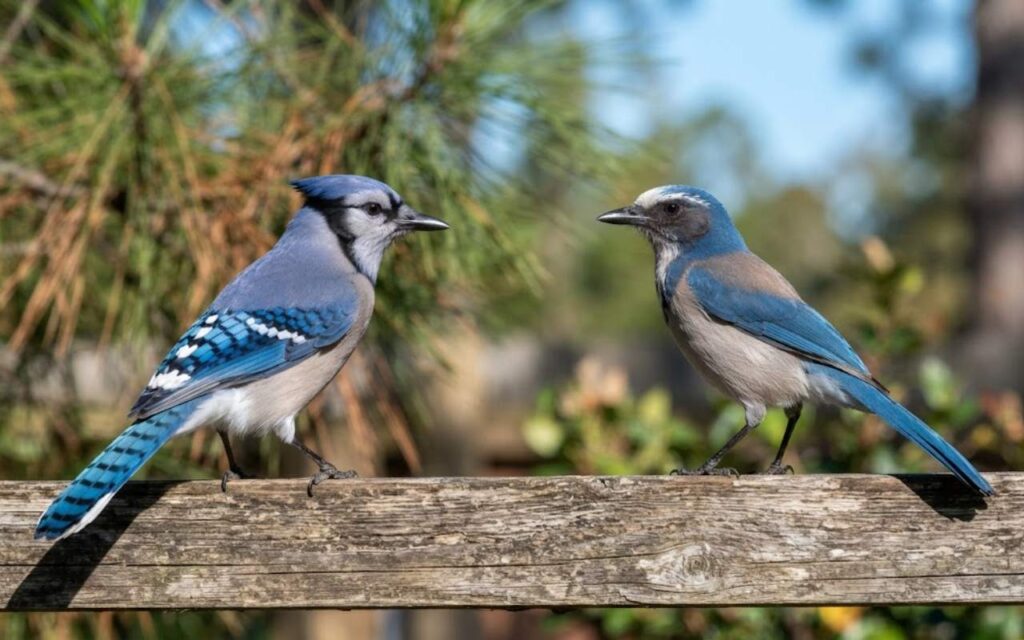
Distinguishing a Blue Jay vs. Florida Scrub-Jay in the field comes down to recognizing structural head shape, plumage contrast, and strict regional habitat limitations. While both belong to the Corvidae family, their silhouettes, social structures, and habitat dependencies could not be more distinct. Misidentifications routinely occur in the central Florida peninsula where their ranges overlap.
Novice birders often mistake molting or juvenile Blue Jays for Florida Scrub-Jays, confusing plumage wear with the distinct matte coloration of Florida’s only endemic bird species. Observing how these birds interact with their environment instantly clarifies their identity. A systematic field breakdown prevents false reports in localized conservation databases.
Quick-Glance Field Summary
Accurate identification relies on checking for the presence of a head crest and wing bars, alongside verifying hyper-local scrub oak habitat. If a crestless blue corvid is spotted outside the Florida peninsula or deep inside mature hardwood forest canopy, it is almost certainly a worn Blue Jay.
- Silhouette: Blue Jay features a prominent erectile crest; Florida Scrub-Jay has a smooth, rounded head with no crest.
- Wings and Tail: Blue Jay displays bold white wing bars and white rectrix tips; Florida Scrub-Jay possesses completely unbarred, plain blue wings and tail.
- Chest Markings: Blue Jay has a distinct, solid black necklace; Florida Scrub-Jay has a faint, grayish-blue breast band fading into a pale belly.
- Mantle Color: Blue Jay shows lavender-blue across the back; Florida Scrub-Jay features a dull, brownish-gray saddle contrasting against blue wings.
- Vocalizations: Blue Jay produces loud, ringing bell calls and harsh jeers; Florida Scrub-Jay delivers rasping, scolding churring sounds.
- Geographic Range: Blue Jay occupies all of eastern North America; Florida Scrub-Jay occurs strictly in the Florida peninsula.
Crestless Crown Silhouette and Facial Contrast
The most immediate structural marker in the field is the top of the head. Blue Jays (Cyanocitta cristata) possess a prominent erectile crest that raises and lowers depending on agitation, alertness, or social display. In contrast, the Florida Scrub-Jay (Aphelocoma coerulescens) has an entirely smooth, flat, rounded crown that never produces an upright crest.
On wildlife forums like Reddit’s r/whatsthisbird, community members frequently post photos of late-summer Blue Jays suffering from severe molts, asking if the bare-headed birds are scrub-jays.
Even a completely bald Blue Jay reveals dark skin and residual facial geometries that do not match the distinctive dusky blue-gray auricular mask and whitish, frosted forehead patch of an adult Florida Scrub-Jay. This frosted gray-white patch spans its forehead and crown, merging seamlessly into a distinct superciliary line above the eye.
The lores and throat further separate the two corvids under close binocular study. Blue Jays feature a thick, jet-black bridle running from behind the crest, across the nape, and downward into a continuous breast collar.
Florida Scrub-Jays completely lack black pigment on the throat and breast, displaying a soft, hazy blue-gray bib that diffuses gently into a pale belly without forming a hard black boundary line.
| Field Identification Mark | Blue Jay (Cyanocitta cristata) | Florida Scrub-Jay (Aphelocoma coerulescens) | Quick-Glance Identification Key |
|---|---|---|---|
| Head Crest Silhouette | Prominent, pointed crown crest that raises or lowers based on emotional state. | Completely smooth, flat, and rounded head profile; lacks any crest structure. | Look at the crown; Blue Jays are crested, Scrub-Jays are completely sleek and round. |
| Wing & Back Patterns | Intricate black bars and bright white wing panels; white tips on the tail feathers. | Plain, solid blue wings with zero white panels or black bars; dull grey back mantle. | Check for wing blocks; Blue Jays have checkers and white bars, Scrub-Jays are solid. |
| Geographic Range | Extremely broad; spans across the eastern United States and parts of southern Canada. | Hyper-localized; endemic strictly to the state of Florida’s sandy scrub oaks. | Location matrix; if you are outside of native Florida scrub, it is not a Scrub-Jay. |
Wing Bar Patterns and Mantle Saddle Differentiation
Examining the upperparts reveals striking differences in feather patterning. Blue Jays exhibit heavy black barring and prominent white patch blocks on their secondary flight feathers and greater wing coverts. The outer tail feathers also terminate in broad white corners that flash noticeably when the bird takes flight.
The Florida Scrub-Jay exhibits zero white markings anywhere on its wings or tail. Its secondary feathers and rectrices are a uniform, dusty cerulean blue with subtle grayish undertones. When flying away from an observer, a scrub-jay presents a solid blue tail wedge, completely devoid of white terminal corners.
Back coloration provides an immediate resting field mark for perched birds. Blue Jays carry an even wash of purplish or slate-blue across their mantle, seamlessly uniting their wings and back plumage.
Florida Scrub-Jays display a stark, contrasting brownish-gray saddle across the center of the back, creating a two-tone appearance against their blue wings and tail.
Hyper-Local Pyrogenic Scrub vs. Ubiquitous Canopy Range
Habitat choice provides an almost foolproof method for field separation. Florida Scrub-Jays are extreme habitat specialists restricted entirely to early-successional, pyrogenic scrub ecosystems.
They require low-growing scrub oaks, such as Quercus inopina (scrub oak), Quercus chapmanii (Chapman oak), and Quercus geminata (sand live oak), thriving only where periodic fire keeps the canopy under ten feet tall.
Blue Jays are consummate generalists found throughout suburban yards, dense mixed pine-hardwood forests, and urban parks across eastern North America. They spend considerable time foraging in tall tree canopies, such as mature southern live oaks (Quercus virginiana) and longleaf pines (Pinus palustris).
While sand live oaks (Quercus geminata) remain stunted in nutrient-poor scrub soil, the massive canopy of a true southern live oak (Quercus virginiana) is the absolute domain of the Blue Jay. If you see a blue bird high in a mature forest canopy, it is a Blue Jay.
A birder in central Florida observing an open scrub habitat along the Lake Wales Ridge or within the Merritt Island National Wildlife Refuge may encounter both species side by side.
However, the scrub-jay rarely ventures more than a few yards from low oak thickets with open sand patches. Blue Jays move freely between suburban bird feeders, golf course edges, and deep mature woodlands without hesitation.
Cooperative Family Sentinels and Backyard Feeder Interactions
Social dynamics and foraging behavior differ fundamentally between these two species. Florida Scrub-Jays operate in strict, cooperative family units consisting of a monogamous breeding pair and up to several non-breeding helper offspring.
These family groups maintain a constant sentinel system where one bird perches atop an elevated oak stem scanning for Cooper’s Hawks while others forage on the ground.
Blue Jays do not practice cooperative breeding with helper birds at the nest. They form loose, shifting flocks during migration and winter foraging, but breed as solitary territorial pairs. Their flock dynamics lack the organized sentinel rotation and cooperative territory defense seen in resident scrub-jay clans.
Ground movement also highlights structural differences. Florida Scrub-Jays spend hours hopping across bare white sand, searching for fallen acorns to cache in sub-surface sand deposits.
Blue Jays readily utilize hanging hopper feeders and seed trays, carrying multiple acorns or sunflower seeds in their expandable gular pouch before flying off to stash them in tree crevices or leaf litter.
Conservation Status and Human Habituation Pitfalls
The two species occupy radically divergent conservation categories. The Blue Jay population is secure, resilient, and expanding across residential areas throughout North America.
The Florida Scrub-Jay is federally listed as Threatened under the Endangered Species Act, suffering dramatic population declines caused by real estate development and chronic fire suppression.
Local wildlife groups, including volunteers monitoring sanctuaries in Brevard and Highlands counties, frequently caution visitors about the scrub-jay’s natural curiosity. Florida Scrub-Jays possess an inquisitive, fearless disposition and will readily approach humans, sometimes landing directly on hats or optics.
Community discussions on regional birding boards frequently warn against offering peanuts or snacks to scrub-jays, as this habituation disrupts their natural acorn-caching cycles and leads to nestling mortality.
- Avoid offering hand-fed peanuts, which encourages birds to nest near roadside edges where vehicular collisions occur.
- Maintain a minimum observation buffer of at least twenty feet to prevent disrupting sentinel alert behaviors.
- Log scrub-jay sightings promptly into eBird and notify local conservation managers if pairs appear in recovering scrub tracts.
- Clean personal optics using lens wipes rather than high-contrast camera attachments that may frighten territorial sentinels.
Reporting genuine Florida Scrub-Jay observations requires verifying that the bird lacks crests and white wing bars, while inhabiting low-growth oak scrub. When field characteristics remain ambiguous, photographic documentation of the upper wing and mantle provides regional biologists with the proof required to validate sightings.
Understanding these distinct morphological and behavioral boundaries ensures high-accuracy field records across Florida’s threatened habitats.