
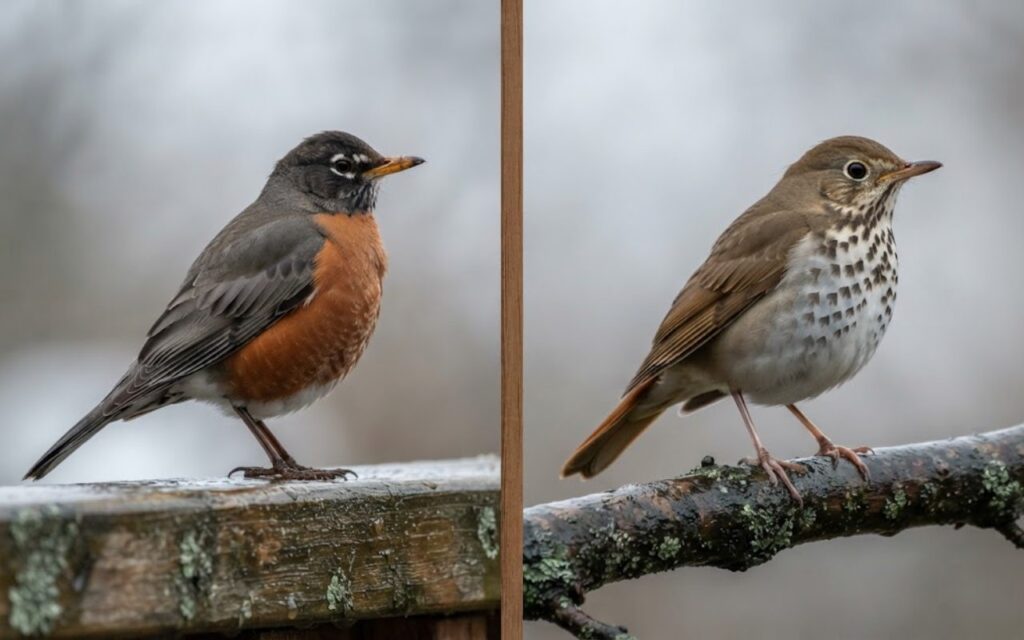
Telling the difference between an American Robin vs. Hermit Thrush comes down to body structure, chest patterns, and subtle field behaviors. Both birds belong to the thrush family, yet they occupy distinct niches in size, demeanor, and habitat use across North America.
Many birders stumble when spotting these species in thick shadows or during seasonal plumage shifts. Sorting out their field marks requires looking beyond basic brown feathers to identify specific plumage borders and diagnostic movements.
Quick-Glance Field Summary
Quickly separating these two thrushes relies on comparing overall body bulk and breast coloration, alongside specific tail movements. A Robin displays a heavy brick-red or spotted juvenile chest with broken eye crescents, whereas a Hermit Thrush shows a pale, distinctly spotted breast, a stark rufous tail, and a complete pale eye-ring.
- Overall Length: American Robin measures 7.9 to 11.0 inches; Hermit Thrush measures 5.5 to 7.1 inches.
- Body Mass: American Robin weighs 77 to 85 grams; Hermit Thrush weighs 23 to 35 grams.
- Eye Ring Pattern: Robin has broken white crescents; Hermit Thrush has an unbroken, distinct pale eyering.
- Tail Contrast: Hermit Thrush features a distinctly reddish-rufous tail contrasting with an olive-brown back; Robin has an even, dark gray-black tail with white outer corner tips.
- Signature Movement: Hermit Thrush performs a rapid upward tail cock followed by a slow drop; Robin runs, stops upright, and tilts its head.
Spotting the Obvious Size and Silhouette Differences
When viewing these birds side by side, their physical proportions settle most disputes instantly. An American Robin is a large, sturdy thrush that sits heavy on the ground and dominates open spaces. In contrast, a Hermit Thrush is roughly the size of a white-throated sparrow, exhibiting a much lighter and slender build.
Forum contributors on r/whatsthisbird often note that photos without size references create unnecessary confusion between the two. In the field, a robin appears long-bodied with an expansive chest and a proportionately longer tail. A Hermit Thrush looks delicate, compact, and alert, often holding its head tucked closer to its shoulders.
Placing their physical dimensions against familiar backyard landmarks helps nail down identity from a distance. A robin routinely weighs more than double the mass of a Hermit Thrush. This substantial weight difference completely alters how each bird perches on slender twigs or hops across wet leaves.
| Field Identification Mark | American Robin (Turdus migratorius) | Hermit Thrush (Catharus guttatus) | Quick-Glance Identification Key |
|---|---|---|---|
| Breast & Underbelly Pattern | Solid brick-red or uniform rich orange breast with zero spots; white lower belly. | White or cream breast heavily marked with dark, bold arrow-shaped spots. |
Look at the chest; if it has a heavy pattern of dark spots on white, it is a Hermit Thrush.
|
| Tail & Rump Contrast | Uniform dark charcoal-gray tail that matches the back mantle coloration exactly. | Distinctly warm, reddish-brown rufous tail that contrasts sharply against a dull brown back. |
Check the tail color; if the tail is noticeably redder than the back, it is a Hermit Thrush.
|
| Habitual Tail Movement | Maintains a stable tail position while perching; occasionally pumps tail downward upon landing. | Habitually flicks or jerks its tail rapidly upward, then lowers it very slowly. |
Watch the movement; an abrupt, quick upward tail flick followed by a slow drop signals a Hermit Thrush.
|
Watching How They Move on the Ground and Flick Their Wings
Behavioral habits reveal the true identity of these thrushes long before you can see fine plumage details. The Hermit Thrush uses a unique tail-cocking motion that serves as a gold standard field mark. When nervous or newly perched, it rapidly flips its reddish tail upward at a sharp angle and then lowers it very slowly.
A Hermit Thrush also pairs this tail pumping with soft, nervous wing-flicking while searching for food. It flicks both wings slightly outward from its sides in rapid, twitchy bursts. A robin does not exhibit this coordinated wing-flick and slow-drop tail sequence.
American Robins use a distinctly confident ground-foraging rhythm. They sprint across lawns in short bursts, abruptly halt, stand rigidly upright, and tilt their heads downward to pinpoint earthworms. A Hermit Thrush prefers quiet ground hops beneath thick cover, pausing in a low crouch rather than an upright stance.
Telling Them Apart by Chest Markings and Eye Rings
Adult plumage presents clear color contrasts if you look directly at the face and underparts. An adult American Robin shows a rich brick-red breast, a dark gray-to-black hood, and segmented white crescents around the eye. A Hermit Thrush features an off-white to buff breast covered in distinct, dark teardrop-shaped spots that fade toward the belly.
The facial patterns offer one of the most reliable static marks for quiet perched birds. A Hermit Thrush possesses a bold, complete, pale buff eye-ring that gives it a wide-eyed, gentle expression. An adult robin has a split eye-ring broken cleanly at the front and back edges.
The upperparts provide another definitive diagnostic field mark. A Hermit Thrush displays a two-toned back profile, with a dull olive-brown back contrasting sharply with a bright rufous rump and tail. An American Robin shows uniform dark slate-gray across the mantle, back, and tail, broken only by small white corners on the outer tail feathers.
Solving the Tricky Juvenile Robin Confusion
Late summer brings a flood of backyard forum posts where birders misidentify spotted fledglings. A juvenile American Robin does not have the solid orange chest of its parents; it sports a heavily speckled, brown-and-buff breast. This transitional plumage leads dozens of novice observers on r/birdwatching to assume they have discovered a rare thrush.
To clear up this confusion, check the bird’s back and upper wing coverts. Juvenile robins carry noticeable pale spotting and whitish streaks across their upper backs and scapulars, which Hermit Thrushes never show. Hermit Thrushes maintain a clean, solid, unstreaked olive-brown mantle in all independent plumages.
Look also at the general posture and overall bulk of the fledgling. Even a young robin that has recently left the nest carries the long bill and hefty chest profile of a robin. A juvenile robin also shows faint washes of peach or rusty orange bleeding through the lower breast, which never appears on a Hermit Thrush.
Listening to Calls and Checking Winter Habitat Clues
Vocalizations and seasonal territory habits create clear distinctions between both birds throughout the year. The American Robin delivers a cheerful, rolling caroling song that rises and falls in loud liquid couplets. A Hermit Thrush produces a haunting, flute-like song that begins with a single clear whistle before spiraling into ethereal, complex minor chords.
Backyard observers often track these birds during cold snaps when their diets shift from insects to wild berries. Active discussions on regional wildlife forums highlight how Hermit Thrushes tend to be solitary, secretive visitors around low winterberry, sumac, or holly patches. They make a dry, low-pitched “chuck” note when disturbed from leaf litter.
American Robins, on the other hand, spend winter traveling in loud, nomadic flocks that sweep into fruiting ornamental trees. They announce their presence with sharp alarm notes and piercing flight calls. If you spot a solitary, quiet thrush skulking on the forest floor in mid-winter, you are almost certainly looking at a Hermit Thrush.