
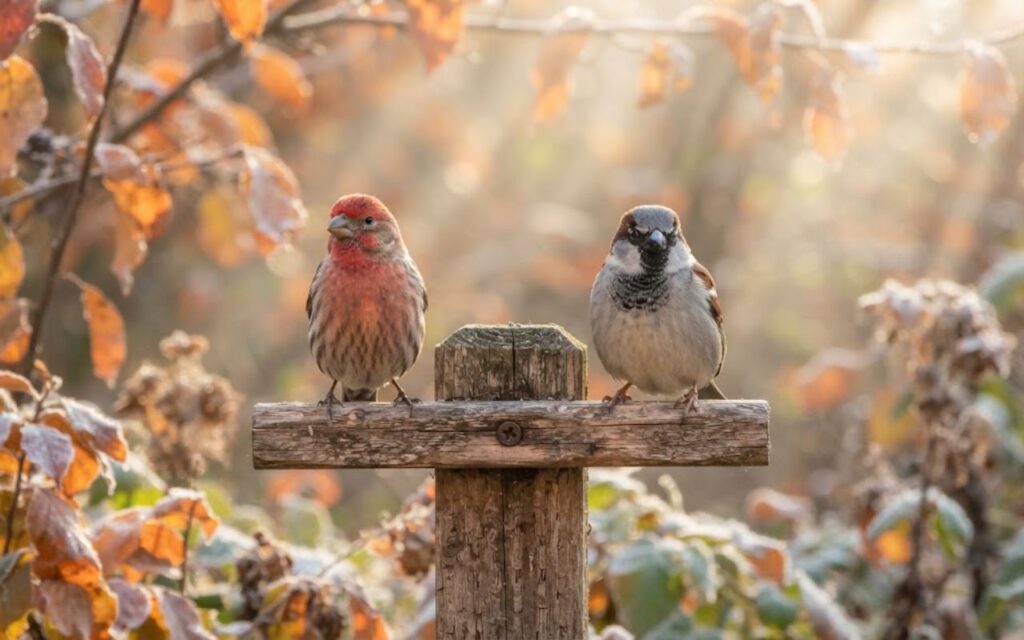
Telling a House Finch vs. House Sparrow apart at your feeder station can be frustrating when dozens of small brown birds swarm your seed trays at once. Both species thrive in suburban yards and readily crowd backyard perches, yet they belong to entirely different bird families with distinct behaviors, diets, and field marks.
Once you learn how to scan specific physical traits like bill shape, chest streaking, and crown coloration, sorting them out takes only a split second. Paying attention to these differences also helps you protect native cavity nesters and adjust your feeder setup to discourage aggressive nuisance flocks.
Quick-Glance Field Summary
Identifying these two birds relies on checking bill curvature, chest streaking, and distinct head patterns. While male finches show reddish feathering and female finches display heavy belly streaks, house sparrows feature unstreaked bellies, black bibs on males, and distinct buffy eye-lines on females.
- Bill morphology: House Finch has a curved upper culmen; House Sparrow has a straight, stout conical beak.
- Breast patterns: House Finch has blurry, distinct brown streaks across the belly; House Sparrow underparts are completely plain and unstreaked.
- Male coloration: House Finch shows red or orange on the forehead and breast; House Sparrow shows a slate-grey cap, chestnut nape, and black throat bib.
- Female head patterns: House Finch has a plain, nondescript grey-brown face; House Sparrow has a bold buffy eyebrow stripe running behind the eye.
- Feeder preference: House Finch favors black oil sunflower and safflower; House Sparrow heavily prefers cracked corn, white proso millet, and bakery scraps.
Look at the Beak Shape and Head Feathers First
The fastest way to separate these two birds is by examining the profile of the beak. A House Finch has a gently rounded upper bill edge, known to ornithologists as a curved culmen, which gives the beak a blunt, swollen appearance. In contrast, the House Sparrow possesses a classic conical bill with a straight profile, designed like a pair of heavy-duty pliers for splitting tough agricultural grains.
Male birds show stark differences in color that make them simple to identify from a distance. A male House Finch displays bright raspberry or strawberry-red wash across its forehead, throat, and upper breast, occasionally showing orange or yellowish tones based on local dietary carotenoids. His crown remains brownish red, blending back into a streaky brown back.
The male House Sparrow carries no red plumage whatsoever. Instead, he features a solid ash-grey crown cap bordered by rich chestnut-brown feathers behind each eye. His most famous field mark is a jet-black bib covering his throat and upper chest, which expands in width and visual prominence as winter feathers wear down into spring breeding condition.
| Field Identification Mark | House Finch (Haemorhous mexicanus) | House Sparrow (Passer domesticus) | Quick-Glance Identification Key |
|---|---|---|---|
| Plumage Accents & Color | Bright strawberry-red or orange-red wash across the head, throat, and upper rump. | Vibrant chestnut-brown back and eye stripes; entirely lacks any red or pink body tones. | Check for red; if it has a colorful red brow and chest wash, it is a House Finch. |
| Breast & Flank Markings | Densely covered in thick, blurry brown vertical streaks running down across the white belly. | Plain, solid dingy-grey breast accented by a stark black bib collar under the lower beak. | Look at the belly; finches are heavily streaked, while sparrows show a solid grey breast with a black bib. |
| Bill Geometry & Profile | Short, stubby, grey conical bill with a distinctly curved upper culmen line. | Thick, heavy, blunt conical bill; turns solid black on males during spring breeding cycles. | Beak check; House Sparrows have significantly thicker, blunter, and heavier seed-cracking bills. |
Check the Chest Streaking on Drab Female Birds
Community discussions on bird identification forums like r/backyardbirds reveal that female identification causes the vast majority of backyard confusion. Dozens of weekly forum posts feature photos of plain brown birds at hopper trays, where beginners mistakenly label female finches as sparrows. The secret to separating them instantly lies in looking directly at the belly feathers.
A female House Finch has thick, blurry brown streaks running all the way down her chest, sides, and belly against a dirty white background. Her face is exceptionally plain and uniform, lacking any distinct lines, whisker marks, or eyebrow patches. This clean, patternless face combined with a heavily streaked underside is diagnostic for the species.
Female House Sparrows are the exact opposite when it comes to patterning. Their breasts and bellies are totally smooth and dingy grey-buff without a single dark streak. On their heads, female sparrows show a prominent, pale buff-colored eyebrow stripe that extends backward from the eye, bordered below by a subtle dark eyeline.
Spot Differences in How They Move and Eat
Watching how birds behave around food offers clear identification clues before you even lift a pair of binoculars. House Finches are acrobatic, calm feeders that readily perch on hanging wire mesh, narrow perches, and tube feeders. They take individual seeds, roll them in their bills to crack the hulls, and quietly discard the chaff without disturbing neighbor birds.
House Sparrows display a much more frantic and aggressive feeding style. They prefer flat surfaces, platform trays, and ground feeding, where they use a double-scratch motion to sweep debris aside. Sparrows often flick their bills sideways through mixed blends, actively tossing valuable seeds onto the ground to search for cheap millet and cracked corn.
Nesting habits also separate the two species completely. House Finches build neat, open-cup nests using fine twigs and grass on building ledges, inside hanging porch ferns, or in dense conifers. House Sparrows are aggressive cavity nesters that pack messy piles of straw, feathers, and trash into natural hollows, frequently displacing native bluebirds and swallows.
How to Deter House Sparrows from Bird Feeders Safely
Suburban birders often complain on wild bird forums about massive House Sparrow flocks dominating their feeders and running off native songbirds. Because the House Sparrow is an introduced Old World species in North America, hobbyists frequently use physical deterrents to push them out. One widely tested community solution discussed on r/birdfeeding is the monofilament fishing line rig, commonly called a magic halo.
House Sparrows possess wider wingspans relative to their body mass and show extreme caution around vertical obstacles. Installing vertical strands of weighted monofilament fishing line spaced three inches apart around a feeder repels sparrows effectively. House Finches, being nimble and adapted to dense brush, routinely drop right between the lines without hesitation.
Modifying your seed menu also shifts feeder dominance in favor of finches. House Sparrows possess weaker jaw muscles and struggle to crack tough seed coats, while finches easily slice through thick shells.
- Safflower seed: Thick white hull that House Finches crack easily, but House Sparrows routinely avoid.
- Nyjer seed: Tiny thistle seed best served in fine-mesh socks or specialized tube feeders that finches adore and sparrows ignore.
- Black oil sunflower: High-fat seed accessible to finches that discourages sparrows when served in hanging tube ports without perching trays.
Switching completely away from grocery store mixed blends eliminates the white millet, milo, and cracked corn that attract nuisance sparrow flocks in the first place.
Stop Backyard Disease Outbreaks and Clean Feeders Properly
Feeding both of these gregarious species requires vigilant sanitary practices due to their high susceptibility to contagious pathogens. House Finches are notoriously vulnerable to avian conjunctivitis, caused by the bacterium Mycoplasma gallisepticum. Infected finches develop swollen, crusty, watery eyes that leave them blind, disoriented, and easy targets for local predators.
House Sparrows tend to harbor and spread Salmonella enterica, which contaminates wooden seed trays through wet droppings during rainy weather. If you notice a bird sitting puffed up and lethargic on your perches, take down all feeding equipment immediately. Leaving contaminated feeders hanging allows rapid transmission through crowded perching surfaces.
- Soak all feeder parts for ten minutes in a standard solution of one part household bleach to nine parts cool water.
- Scrub perches, ports, and seed trays using a stiff wire brush to remove caked fecal matter and stuck hulls.
- Rinse every component with clean water and let parts dry completely in the sun before refilling with fresh seed.
Avoid using boiling water to sanitize plastic tube feeders. High water temperatures easily warp polycarbonate plastic reservoirs and cause feeding ports to crack around the screw mounts. Storing seed in airtight metal containers also prevents moisture accumulation, stopping dangerous Aspergillus flavus mold from generating toxic aflatoxins in your backyard feed supply.