
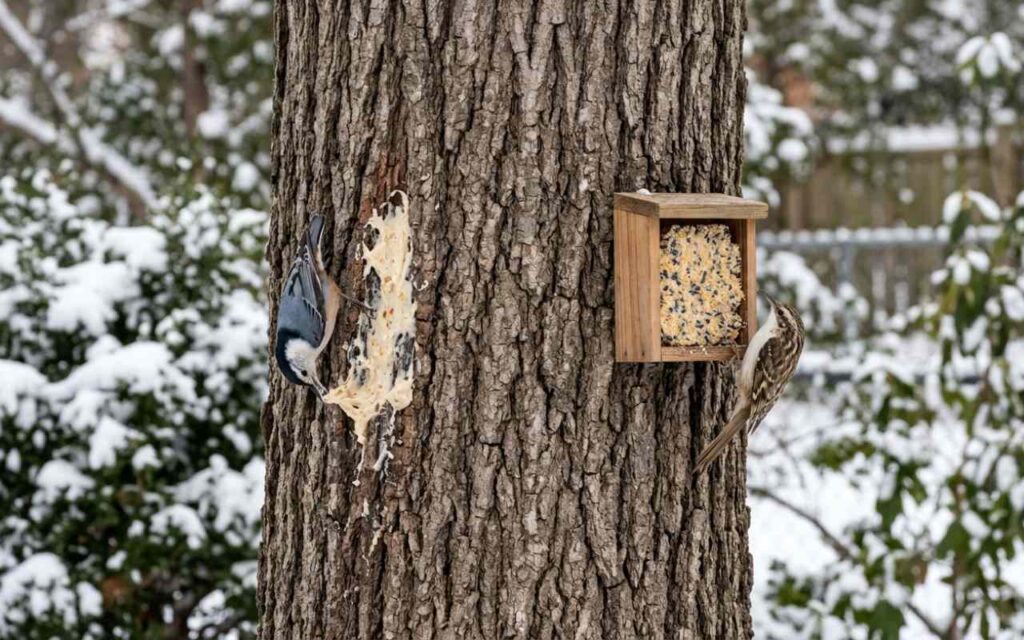
Learning how to attract nuthatches and creepers to your feeders requires matching your setup to how these two acrobatic bark-foragers climb trees. While nuthatches spiral headfirst down trunks looking for seeds and insects, Brown Creepers brace their stiff tail feathers against rough bark and spiral upward from the base of a tree, meaning both species often bypass standard hanging tube feeders unless food is placed right along their vertical climbing path.
By offering spreadable suet directly on rough tree trunks at safe predator-proof heights, serving hulled sunflower chips alongside whole peanuts, and mounting tail-prop feeders near evergreen or hardwood cover, you can turn your yard into a reliable stop for White-breasted Nuthatches, Red-breasted Nuthatches, and elusive Brown Creepers.
Quick-Glance Summary: Nuthatch vs. Brown Creeper Feeder Preferences
| Feature | Nuthatches (White- & Red-Breasted) | Brown Creepers |
|---|---|---|
| Trunk Climbing Direction | Spirals headfirst downward using strong toes | Spirals upward from base using stiff tail as a prop |
| Bill Shape & Eating Style | Straight chisel bill; wedges seeds in bark to hammer open | Slender, downcurved bill; probes crevices for tiny morsels |
| Top Feeder Foods | Black oil sunflower, shelled peanuts, suet, mealworms | Spreadable suet/lard, suet cakes, fine sunflower chips |
| Best Feeder Style | Wire mesh cylinders, hopper trays, hanging suet cages | Bark-smeared suet, trunk-mounted cages, tail-prop feeders |
| Peak Feeder Season | Year-round (heaviest in fall and winter) | Late fall through early spring when bark insects are dormant |
1. Smear Spreadable Suet Directly onto Deep-Furrowed Tree Bark
Because Brown Creepers spend almost their entire lives hugging rough tree trunks rather than landing on thin plastic perches, smearing spreadable suet (a soft blend of rendered beef fat, peanut butter, and fine seed meal) directly into bark crevices is the fastest way to bring them to your yard.
- Best Tree Bark for Holding Suet. Apply the paste to deeply furrowed, dry bark like mature red oak, white oak, sugar maple, or eastern white pine. Smooth-barked trees like beech or young birch lack deep crevices, causing suet to slide off during warm afternoons or wash away in freezing rain.
- How to Apply It Safely. Press a 2- to 3-inch patch of spreadable suet or homemade peanut butter-cornmeal paste (1 part plain unsalted peanut butter mixed with 4 parts yellow cornmeal so it never sticks to delicate bills) into bark furrows at least 6 to 7 feet off the ground. Placing suet higher up keeps foraging birds safely out of reach of stalking outdoor cats and slows down raccoons.
- Bark Hygiene & Rotation. Scrape away any old, uneaten suet with a plastic putty knife before applying a fresh batch, and rotate spots around the trunk every couple of weeks so damp residue never molds in the bark crevices.
- Squirrel Deterrent Tip. If gray squirrels immediately strip your bark suet, switch to capsaicin-infused (hot pepper) spreadable suet, which deters mammals while remaining completely safe for birds, which lack the mammalian pain receptors triggered by chili peppers.
2. Mount Suet Cages Directly Against Mature Tree Trunks
Swinging wire suet cages hanging from open shepherd’s hooks work fine for agile chickadees, but Brown Creepers strongly prefer stationary vertical surfaces that mimic solid tree trunks.
- Best Placement. Strap or screw a standard wire suet cage flush against the trunk of a mature deciduous or evergreen tree on the sheltered side away from prevailing winter winds, mounted 6 to 7 feet high. In yards with regular tree cover, creepers traveling with mixed winter flocks of chickadees and Downy Woodpeckers often locate trunk-mounted suet within days of a cold snap.
- Temperature Safety. Use standard rendered beef suet in cool fall and winter weather, and switch to no-melt suet cakes when daytime temperatures climb above 70°F (21°C) so dripping fat never coats bird plumage.
3. Use Tail-Prop Suet Feeders for Vertical Balance
Unlike nuthatches, which rely entirely on an enlarged hind toe to grip bark without tail support, Brown Creepers have long, stiff, pointed tail feathers that act like a third leg to brace their bodies vertically.
- Why Design Matters. Standard short square suet cages leave a creeper’s tail hanging awkwardly in midair. Choosing a tail-prop suet feeder with an extended wooden paddle below the suet cake lets creepers and small woodpeckers brace their tails comfortably and feed longer without burning extra energy.
4. Serve Fine Hulled Sunflower Chips Instead of Large Whole Seeds
Brown Creepers have slender, delicate, downcurved bills designed for plucking tiny spiders and insect eggs out of bark cracks rather than hammering open tough shells. According to the Cornell Lab of Ornithology Brown Creeper guide, a tiny creeper burns 4 to 10 kilocalories per day and supplements its winter insect diet with fine seeds and suet.
- Best Seed Texture. Fill a shallow trunk-mounted tray or cling-mesh feeder with hulled sunflower chips (finely chopped sunflower hearts) rather than large striped sunflower seeds. Nuthatches will eagerly scoop up the chips as well, while creepers can swallow the small, shell-free morsels effortlessly.
5. Stock Whole Black Oil Sunflower Seeds and Shelled Peanuts for Nuthatches
While Brown Creepers need tiny shell-free crumbs, nuthatches get their name (“nut-hackers”) from their habit of carrying whole seeds to nearby trees, wedging them tightly into bark fissures, and hammering them open with their stout bills, a signature behavior detailed in the Cornell Lab White-breasted Nuthatch guide.
- Top Nuthatch Staples. Offer whole black oil sunflower seeds, safflower seeds, or unsalted shelled peanut splits in a wire mesh cylinder feeder or open wooden platform tray.
- Caching Behavior. Expect nuthatches to make rapid back-and-forth trips all autumn as they hide hundreds of individual sunflower seeds and peanut pieces behind loose bark flakes for winter survival.
6. Add Live or Rehydrated Mealworms in Shallow Dishes
Both nuthatches and creepers are primarily insectivores during spring and summer, hunting bark beetles, caterpillars, ants, and spiders. Offering mealworms bridges the gap when natural insect activity slows down.
- How to Serve Them. Place live mealworms, or freeze-dried mealworms soaked in warm water for 10 minutes, in a small, smooth-sided ceramic or plastic cup attached directly to a tree trunk or platform feeder edge.
7. Hang Feeders Within 10 Feet of Mature Evergreen or Hardwood Trees
Neither nuthatches nor Brown Creepers like flying long distances across open lawns, where they are vulnerable to Sharp-shinned and Cooper’s Hawks.
- Safe Corridor Rule. Hang your feeders within 6 to 10 feet of mature conifers (white pine, spruce, hemlock) or rough-barked hardwoods (oak, hickory, maple). This gives nervous birds an immediate escape route and lets creepers hop straight from natural tree trunks onto your feeding station.
8. Preserve Rough-Barked Trees and Dead Wood Snags
If your yard only has smooth-barked young saplings, creepers and nuthatches will rarely linger. Both species rely on deep bark crevices for food and cavities or loose bark flaps for shelter.
- Habitat Boosters. Where safely away from structures, leave standing dead wood snags or rough-barked mature trees intact. Brown Creepers build hammock-shaped nests tucked directly behind peeling bark flaps on dead or dying trees, while nuthatches excavate or claim small tree cavities.
9. Offer Moving Water in a Shallow Birdbath
Clean, ice-free water attracts bark-foraging birds that might otherwise pass high overhead without noticing seed feeders.
- Best Birdbath Setup. Choose a shallow birdbath (1 to 2 inches deep) with a textured rim for secure footing, and add a solar dripper, battery-operated water wiggler, or submersible winter de-icer. Place the bath near low evergreen shrubs so wet birds have immediate cover while preening.
10. Eliminate Broad-Spectrum Yard and Tree Pesticides
Because Brown Creepers and nuthatches rely heavily on overwintering insect eggs, pupae, and bark beetles hidden under tree bark, spraying trees or lawns with synthetic insecticides eliminates their primary natural food source.
- Backyard Rule. Skip chemical canopy sprays and broad-spectrum lawn insecticides year-round, and leave fallen leaves around tree bases so native moths and beetles can complete their life cycles.
Frequently Asked Questions
Why do Brown Creepers rarely visit standard hanging bird feeders?
Brown Creepers are specialized bark foragers that spiral upward on wide, stationary tree trunks using their stiff tail feathers for support. Because swinging plastic tube feeders lack vertical tail braces and typically hold large in-shell seeds, creepers usually ignore them unless you smear spreadable suet on tree bark or mount a tail-prop suet feeder directly to a trunk.
How do you tell a nuthatch apart from a Brown Creeper on a tree trunk?
Watch which direction the bird moves. Nuthatches have blue-gray backs, white or rusty bellies, short tails, and move headfirst down tree trunks, whereas Brown Creepers are streaky bark-brown above with white undersides, long stiff tails, and always spiral upward from the bottom of a trunk to the top.
What is the best time of year to attract Brown Creepers to feeders?
Late fall through early spring (November to March) is the best time to see Brown Creepers at backyard feeders. During freezing weather when bark-dwelling spiders and insects are scarce, creepers readily visit trunk-mounted suet cakes, spreadable bark butter, and fine sunflower chips.