
Most people fail to attract robins because they make one key mistake. They fill tube feeders with sunflower seeds and wonder why robins never visit. American robin nesting behavior shows that these soft-billed omnivores need diets incompatible with most commercial birdseed. Their conical bills are made for grabbing earthworms and berries, not cracking hard seeds. The issue is a misunderstanding of robin biology, not a flaw in your backyard. Success comes from following strategies based on robin-specific foraging, nesting, and seasonal needs.
This guide highlights three pillars of robin attraction. Food focuses on protein-rich options like mealworms and earthworms, plus seasonal fruits. Water should be shallow (1–2 inches) with drippers or misters birds can detect from far away. Habitat design favors open-front nesting platforms and landscaping with native berry-producing plants for year-round support. Combined, these strategies can turn a robin-absent yard into one bustling with activity in a single breeding season 😄.
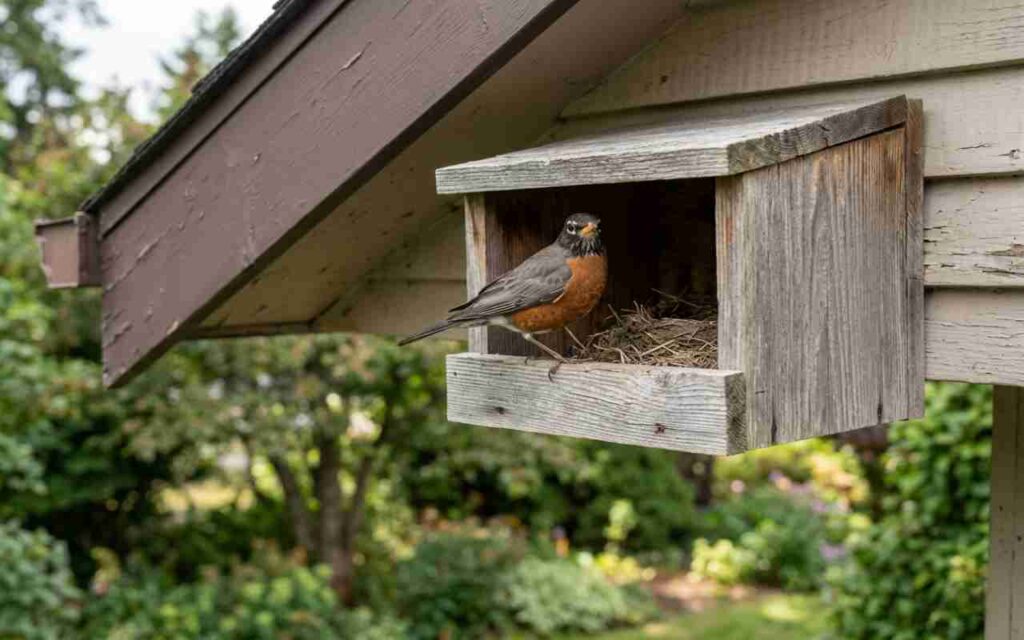
Quick Answer: To support American robin nesting behavior, install an 8×8 inch open-front nesting shelf 5–15 feet high under an eave. Provide a nearby mud-puddle station (2-sq-ft) for nest construction and offer protein-rich foods like soaked mealworms to fuel the female during the 2–6 day build.
Visual Guide: Supporting American Robin Nesting Behavior Step-by-Step
While understanding their habits is the first step, seeing the process in action clarifies exactly where and how to intervene. Check out our whiteboard explainer video below for a deep dive into the ‘mud-mortar’ engineering and architectural secrets of the American robin nesting behavior needed for a successful brood.
Show Transcript:
0:00
All right, let’s get into it. Today we’re talking about one of the most familiar backyard birds in North America, the American robin. But this isn’t just about the bird itself. We’re diving into the remarkable structure it builds, a true masterpiece of natural engineering that may be sitting right outside your window.
0:19
You’ve probably seen it a hundred times. A messy-looking cup of grass and twigs tucked into a porch light or the fork of a tree. It’s so common most people barely notice it. But that simple robin nest is actually a marvel of composite construction, shaped by biology, physics, and even complex social behavior.
0:46
So who builds it? Not a team. Not a pair. The architect is a single, highly skilled female robin. The male may bring materials occasionally, but she is the sole engineer. The finished nest measures about 6 to 8 inches across and 3 to 6 inches high, and she completes it in just 2 to 6 days.
1:24
The key ingredient isn’t just twigs. It’s mud. And this is where the real engineering begins. A robin nest is a three-layer composite structure, and each layer serves a specific purpose.
1:45
Step one is the outer foundation, made of coarse grass and twigs. The female shapes it using her body, pressing and turning to mold the cup. Step two is the mud core. She gathers soft mud, often from worm castings, and forms a dense inner bowl that provides structural strength. Step three is the insulating lining, a soft layer of fine dry grass that cushions and protects the eggs.
2:19
That mud core is critical. Without moist soil, a female robin cannot build a stable nest. Access to mud is one of the biggest environmental challenges robins face in early spring. No mud means no nest.
2:38
Inside that engineered cup are the iconic robin eggs, known for their vivid robin’s egg blue color. That shade comes from a pigment called biliverdin, produced when the female breaks down old red blood cells. Her body deposits this pigment onto the eggshell during formation. The more biliverdin available, the deeper the blue.
3:13
The color isn’t just decorative. It provides UV protection for the developing embryo, acting like natural sunscreen. But darker pigment also absorbs more heat, so the shade represents a balance between protecting DNA and preventing overheating in an open nest.
3:34
There’s another layer to this story. Research from 2011 found that male robins use egg color as a health signal. Brighter blue eggs indicate higher antioxidant levels and better female condition. In response, males bring more food to the chicks after hatching. Paler eggs can signal lower condition, and males may invest less. The egg color directly influences parental behavior.
4:13
Once the nest is built and the eggs are laid, the real work begins. A typical clutch contains three to five eggs. The female incubates them for about two weeks. After hatching, the nestlings remain in the nest for another two weeks.
4:39
Even after leaving the nest, young robins are not fully independent. Fledglings spend up to two additional weeks on the ground, relying on their parents for food and protection. This stage is especially vulnerable.
4:53
Despite the impressive engineering and parental effort, the average nest survival rate is only about 40 percent. More than half of robin nests fail due to predators, bad weather, or disturbance. Nesting is a high-risk phase in the life of backyard birds.
5:14
That brings us to a common myth. If you touch a robin nest or a baby bird, will the parents abandon it because they smell you? The answer is no. Robins have a weak sense of smell and do not abandon nests due to human scent.
5:32
The real danger comes from repeated visits. Frequent human activity can create visible paths that attract predators like crows and squirrels. The safest approach is always to observe from a distance.
5:49
A 2022 study revealed something surprising. While American robins are known as tree nesters, some build nests directly on the ground. Interestingly, the daily survival rate of ground nests was nearly identical to nests in trees. This shows just how adaptable robin nesting behavior can be.
6:14
So what can you do to help? Supporting backyard robins is simple. Provide a small patch of moist soil in spring for mud collection. Keep cats indoors, especially from April through July when fledglings are on the ground. Install an 8 by 8 inch nesting shelf under an eave to offer a stable site.
6:38
You can also reduce window reflections to prevent males from exhausting themselves fighting their own reflection. At the end of the season, clean old nests from shelves to remove parasites before the next breeding cycle.
7:03
In the end, the female robin is the master architect. She knows exactly how to build and where to place her nest. Our role is not to manage her work but to remove unnecessary obstacles and provide a few helpful resources.
7:18
The next time you see a robin nest, you might look at it differently. Not as a messy clump of grass, but as a triumph of natural engineering and a small, ongoing story of survival playing out in your own backyard.
Strategic Feeding: The Protein and Fruit Protocol
The Soaked Mealworm Hack: Mimicking Live Prey
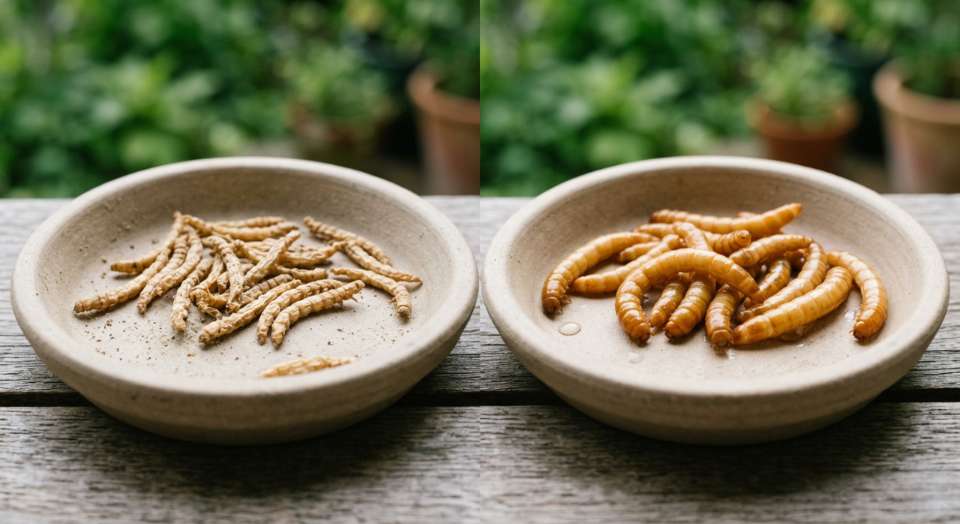
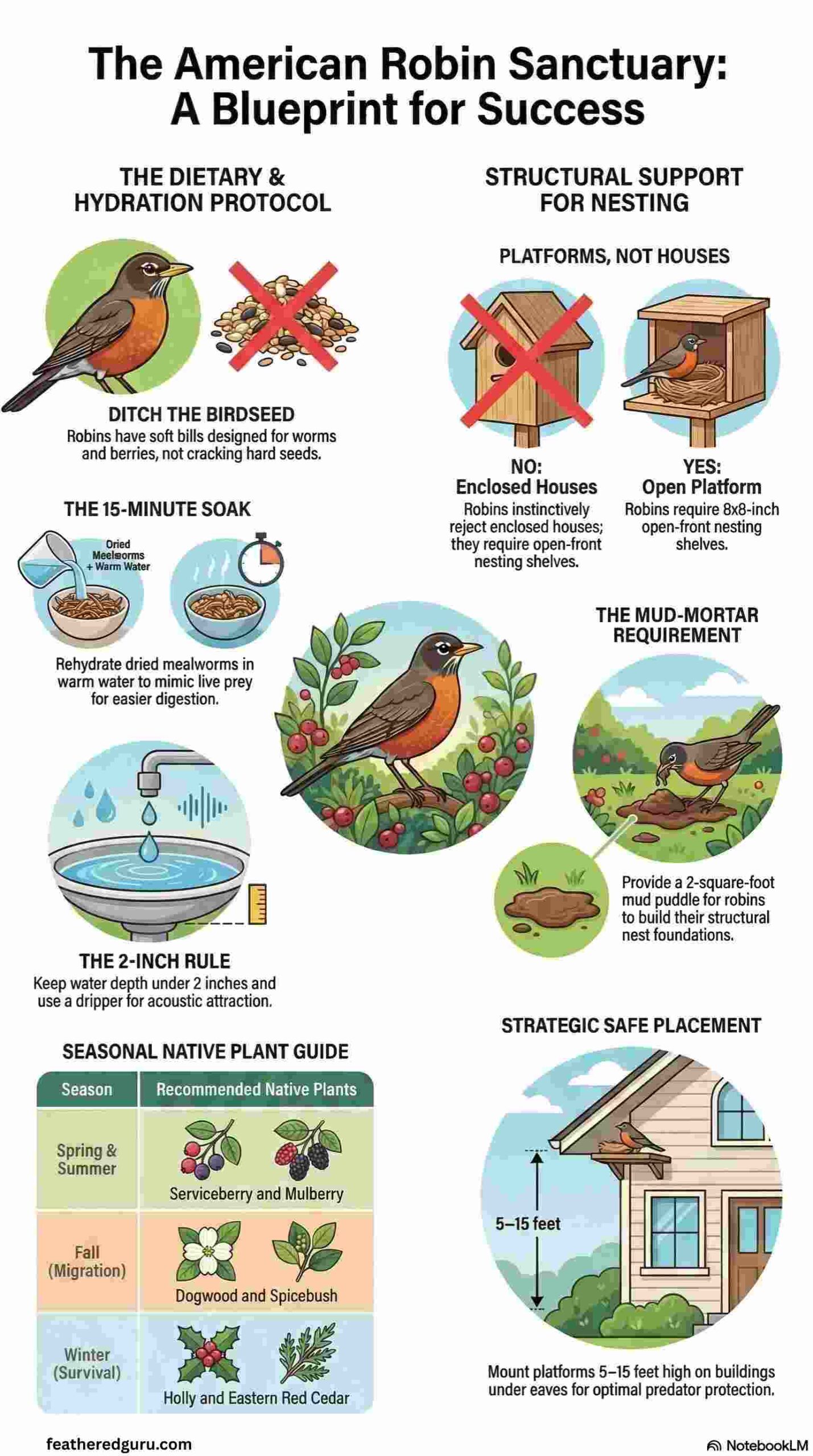
Dried mealworms require rehydration before robins can safely consume them. According to Cornell Lab of Ornithology feeding research, mealworms can be an excellent source of protein, calcium, and vitamins for a great many birds, but mealworms are only as healthful as the diet they are fed. The 15-minute warm water soak transforms dried mealworms into approximations of live prey that are easier to digest.
The rehydration protocol involves placing dried mealworms in a bowl, covering them with warm (not hot) water, and allowing 15-20 minutes soaking time. Drain excess water before offering. The softened mealworms plump to nearly live-prey consistency, making them easier for robins to digest and reducing the moisture they extract from birds’ bodies during digestion.
Live mealworms provide superior nutrition but require refrigerated storage and regular feeding to maintain viability. The wiggling movement attracts robins visually, triggering stronger feeding responses than static dried offerings. For consistent robin attraction, alternate between live and properly soaked dried mealworms based on availability and budget constraints.
Earthworm Magnetism: The Dawn Puddling Technique
Earthworms emerge to the soil surface during overnight hours when dew, rain, or irrigation maintains surface moisture. According to Cornell Lab’s Birds of the World research on American robin diet, robins are known to forage for earthworms more frequently in early morning and late afternoon and to eat more fruit later in the day. The morning puddling technique exploits this natural behavior. Water lawn areas thoroughly in late evening (after 8 PM), creating saturated soil conditions that keep earthworms near the surface through dawn hours when robins forage most actively.
The moisture gradient drives earthworm movement. Worms require moist environments for respiration through their skin. When surface soils retain adequate moisture, worms remain accessible to surface-foraging birds. As soils dry through morning, worms retreat deeper where robin bills cannot reach them. The deliberate evening watering extends the morning feeding window when earthworms remain available.
Target specific lawn sections rather than entire properties. Focus watering on areas visible from windows where you can observe robin feeding behavior. The concentrated puddling creates earthworm-rich foraging zones robins learn to visit predictably each morning, establishing feeding territories in your yard.
Fruit Selection: Soaking Dried Fruit First
Fresh fruit attracts robins more effectively than dried alternatives, but dried fruits work when fresh options are unavailable or cost-prohibitive. Soaking dried fruit (raisins, currants, cranberries) for several hours rehydrates them to fresh-fruit texture. The soft consistency allows easier consumption while the moisture content provides hydration robins need alongside calories.
Chopped apples represent ideal fresh fruit offering. Cut into quarters or eighths, exposing flesh robins can easily peck. Replace daily to prevent spoilage and fermentation. Winter feeding requires checking for freezing and removing solid-frozen pieces that robins cannot consume.
Blueberries, both fresh and frozen-then-thawed, provide nutrition robins recognize from wild berry consumption. The small size suits robin bill dimensions perfectly. During winter, frozen blueberries thawed to room temperature provide acceptable substitutes for unavailable fresh berries.
Winter Energy: No-Melt Suet and Bark Butter
Winter ground-foraging becomes impossible when snow covers lawns and frozen soil prevents earthworm access. No-melt suet formulations remain solid during warm weather while maintaining accessibility during cold periods. The concentrated calories (approximately 85% fat by weight) support thermoregulation during temperature extremes.
Bark butter, a spreadable suet product, appeals to robins more than traditional suet blocks. Smear bark butter directly on tree bark, fence posts, or specialized feeders. The spreadable consistency allows robins to peck small amounts while perched rather than requiring them to cling to traditional suet cages designed for woodpeckers.
Platform Feeding: Ground and Tray Feeders Required
Robins forage on or near ground level, lacking the aerial acrobatics required for hanging tube feeders. Platform feeders (large flat trays elevated 2-6 feet) or ground feeding trays provide appropriate feeding surfaces matching robin natural foraging behavior. The open design allows robins to hop onto feeding surface, scan surroundings for predators, and feed comfortably without squeezing into confined spaces.
Ground feeding carries predation risks from cats and other mammals. Elevate feeders minimally (2-4 feet) on posts or stumps, providing some safety while maintaining the low-level feeding robins prefer. Position feeders with clear sightlines in multiple directions, allowing robins to detect approaching threats while feeding.
Hydration Science: The Shallow and Sound Method
The 2-Inch Rule: Leg Anatomy Constraints
According to Cornell Lab robin attraction research, the water should be no deeper than 1 inch (2.5 cm) at the edges, sloping to a maximum of 2 inches (5 cm) deep in the middle of the bath, and offering a birdbath with shallow water is particularly attractive to robins. Their leg length and foraging posture evolved for ground feeding, not for wading in deep water. Robins avoid basins exceeding 2-3 inches depth, perceiving them as drowning hazards or unsuitable for their body proportions.
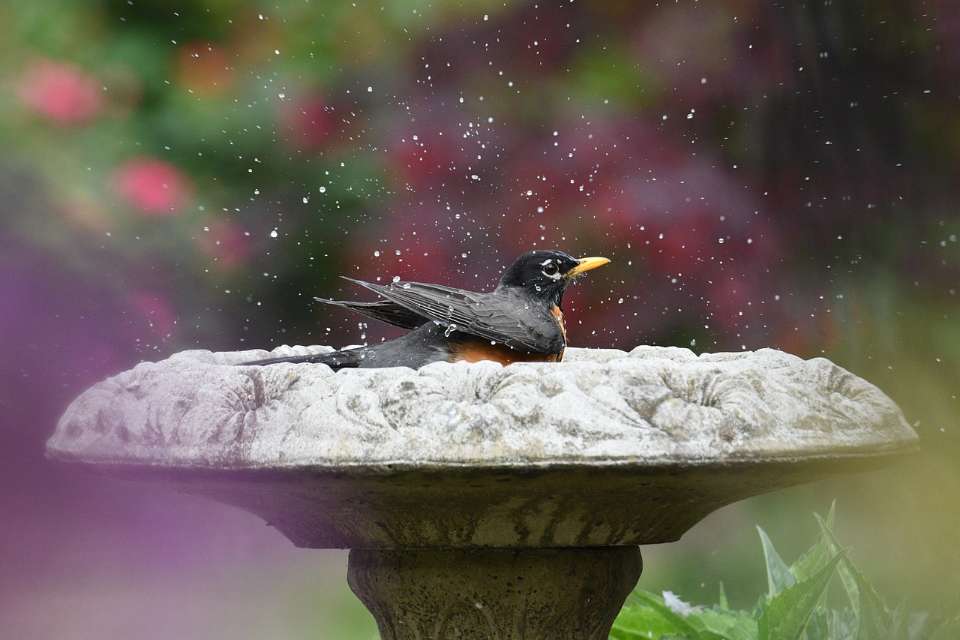
The ideal bird bath provides graduated depth from 0.5 inches at edges to maximum 2 inches at center. This design accommodates robin bathing behavior where birds stand in shallow areas and splash water over their bodies rather than fully submerging. The gentle slope allows robins to wade progressively deeper while maintaining secure footing.
Modify deep bird baths by adding rocks, stones, or submerged platforms creating shallow areas within deeper basins. The additions must provide stable, non-slip surfaces preventing injury. Flat river rocks 3-6 inches diameter work well, creating islands and shallow zones robins use confidently.
Acoustic Attraction: The Sound of Splashing Water
Moving water produces acoustic signatures that static water lacks, dramatically increasing detection distances and attraction effectiveness. Drippers create rhythmic water droplets falling into bird baths at rates of 1-3 drops per second. The consistent plink-plink-plink sound carries considerable distances, advertising water presence to robins foraging nearby. Solar-powered and battery-operated drippers attach to existing bird baths without complex plumbing.
Misters spray fine water droplets creating both sound and visual shimmer that attracts robins. The mist settles on leaves and grass, creating water droplets robins consume while foraging. Some robins bathe directly in mist streams rather than using standing water, making misters dual-purpose installations serving both drinking and bathing needs.
The Heated Advantage: Winter’s Critical Resource
Heated bird baths provide liquid water when natural sources freeze solid. According to Cornell Lab research on winter robin behavior, although robins are considered harbingers of spring, many American robins spend the whole winter in their breeding range, with the number of robins present in northern parts of the range varying each year with local conditions. The heated bath becomes the limiting resource determining whether robins can overwinter successfully in your area.
Winter bathing maintains feather condition essential for insulation. Dirty, matted feathers lose loft and insulating capacity, increasing heat loss and caloric requirements. Robins bathe year-round, including during freezing weather, to maintain feather functionality. The heated bath allows necessary bathing without hypothermia risk from wet feathers exposed to freezing air.
Nesting Architecture: Shelves vs. Houses
The Birdhouse Error: Why Robins Never Use Enclosed Houses
American robins are platform nesters, never using traditional enclosed birdhouses with small entrance holes. Their evolutionary history involves nesting on horizontal surfaces (tree branches, building ledges, rock outcroppings) rather than in tree cavities. The instinctive nesting behavior rejects confined spaces, making enclosed birdhouses completely ineffective for robin attraction regardless of entrance hole size or interior dimensions.
The biological basis involves predator detection and escape route availability. Robins build open cup nests allowing 360-degree visual monitoring of surroundings while incubating or brooding. Parent birds detect approaching predators and execute rapid escape flights impossible from enclosed cavities with single entrance/exit points. The platform nesting strategy reflects this predator-avoidance adaptation.
The 8×8 Inch Nesting Shelf: Exact Specifications
According to platform nesting research from 70birds, the robin platform has an 8 inch by 8 inch base, approximately an 8 inch ceiling, an open front and partially open sides. This dimension range accommodates the substantial mud-and-grass nest robins construct (typically 6-8 inches diameter) while providing overhead and side protection from weather.
Construction materials include cedar, pine, or other untreated softwoods. Use corrosion-resistant screws and hardware preventing rust that weakens structures and potentially harms birds. The design features three walls (back and two sides) with completely open front providing unobstructed access and exit. Roof extends 2-3 inches beyond front edge, creating weather protection while maintaining open access.
Interior surfaces should be rough or grooved, allowing nestling robins to grip surfaces when learning to climb from nest to fledging. Smooth surfaces create slipping hazards that can injure or trap young birds attempting to leave the nest box.
Nesting Material Stations: Mud Puddle and Grass Bundles
Robin nests incorporate substantial mud for structural support, requiring access to moist soil during construction periods (April through July in most regions). Create designated mud puddle areas by keeping 2-3 square foot sections of bare soil consistently moist through daily watering. The female robin collects mud, forming it into cup shape that hardens as it dries, creating the nest foundation.
Offer dried grass clippings, small twigs (4-6 inches length), and natural plant fibers in visible bundles near potential nesting sites. Avoid synthetic materials (string, yarn, dryer lint) that absorb water, fail to dry properly, and can tangle around nestlings’ legs or necks creating death traps.
Safe Placement: 5-15 Feet Under Eaves
Robins will nest in an open-front nesting shelf (minimum size 7 x 8 inches). According to robin nesting platform research, these should be installed on the sides of buildings, under eaves, or on posts, mounted 5 to 25 feet high. The 5 to 15 foot range provides the optimal balance between predator protection and accessibility for maintenance. Avoid mounting shelves directly above active light fixtures to prevent fire hazards caused by nesting materials reacting to heat.
Mount platforms on building walls rather than trees. Tree-mounted platforms provide climbing access for squirrels, snakes, and raccoons that prey on eggs and nestlings. Building-mounted platforms create isolated ledge situations similar to cliff crevices robins evolved to use, with predator access limited to aerial routes (jays, crows) robins can defend against through aggressive mobbing behavior.
Install platforms under eaves, soffits, or porch roofs providing weather protection. The overhead cover shields nests from direct rain and intense sun while maintaining the open-front design robins require. Position platforms where adults have clear flight paths to and from the nest without navigating through dense vegetation or tight spaces.
Landscape Engineering: Building a Living Pantry
The 4-Season Plant List
Strategic native plant selection creates year-round food availability matching seasonal robin dietary needs. Spring and summer plantings emphasize early-ripening fruits providing nutrition during breeding season. Fall plantings focus on lipid-rich berries fueling migration. Winter plantings feature persistent fruits remaining edible through freezing weather.
Spring/Summer selections include serviceberry (Amelanchier species) ripening in June, providing early-season fruit when robins feed nestlings. Mulberry (Morus species) produces abundant berries June through July, creating concentrated food sources during peak breeding activity.
Fall selections emphasize high-fat fruits. Flowering dogwood (Cornus florida) berries contain 30-40% lipid content, providing concentrated calories for pre-migration fattening. Spicebush (Lindera benzoin) similarly offers lipid-rich berries robins preferentially consume during fall migration periods.
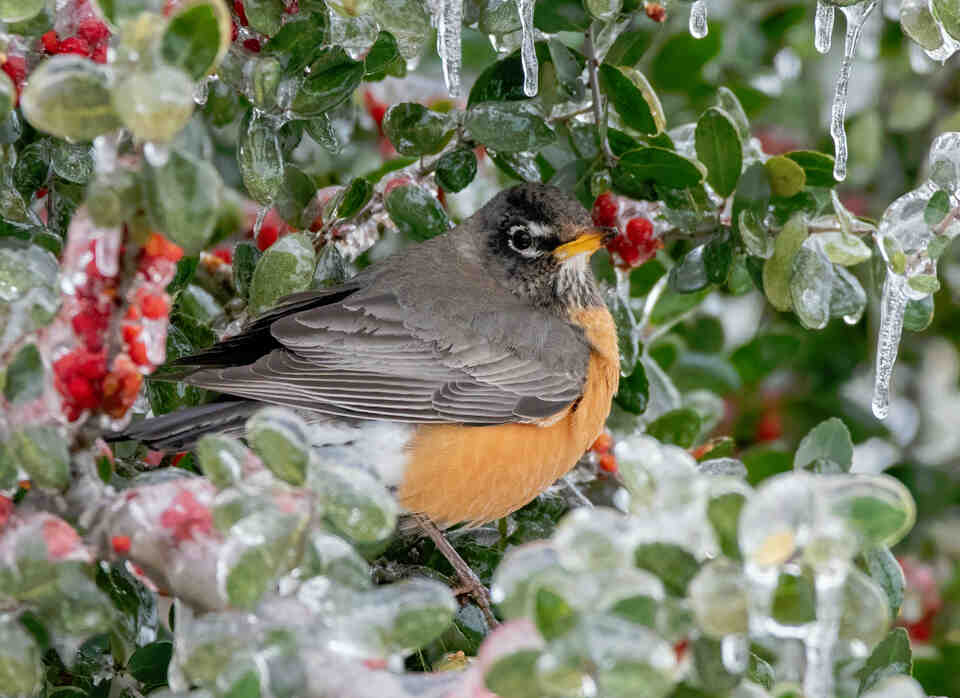
Winter selections include Eastern red cedar (Juniperus virginiana) and American holly (Ilex opaca), both producing persistent berries remaining accessible and edible through snow and freezing temperatures. Winterberry (Ilex verticillata) similarly provides reliable winter food persisting into late winter when other sources are depleted.
The Lazy Gardener Strategy: Leaf Litter as Beetle Factory
Leaf litter creates habitat for beetles, grubs, and other invertebrates robins consume during spring and summer. The decomposing leaves provide food and shelter for insect populations that robins harvest by flipping leaves and probing beneath organic debris. According to research on robin foraging, areas with leaf litter support 3-5 times higher invertebrate densities than bare ground or mulched areas.
Designate corner areas, fence lines, or beneath shrubs as no-rake zones where leaves accumulate naturally. The organic matter decomposes gradually, releasing nutrients while supporting invertebrate populations. Robins learn to patrol these areas systematically, flipping leaves to expose hidden prey.
The Pesticide Death Trap: Chemical Lawn Treatment
Chemically treated lawns eliminate the earthworms, beetles, caterpillars, and other invertebrates comprising 40-60% of robin diets during breeding season. According to research on pesticide impacts, broad-spectrum insecticides reduce invertebrate populations by 90%+ within treated areas, creating ecological deserts where robins cannot meet nutritional requirements for successful reproduction.
The toxins bioaccumulate through food chains. Robins consuming contaminated invertebrates ingest pesticide residues that impair reproduction through eggshell thinning, embryo mortality, and nestling developmental problems. Yards attempting robin attraction while maintaining chemical lawn care programs fail regardless of how many mealworms or nesting platforms are provided.
Transition to organic lawn management emphasizing soil health, proper watering, and tolerance for beneficial insect populations. According to Audubon Society research on robin diet, robins consume more than a hundred kinds of insects and other invertebrates beyond just earthworms. The seemingly imperfect lawn with clover, dandelions, and visible insect activity supports robin populations far more effectively than chemically maintained monoculture grass devoid of life.
Troubleshooting: Keeping Robins Safe
Reflection Aggression: Window Territory Wars
Male robins attack windows during breeding season (March through July), perceiving their reflections as territorial intruders. The aggressive display behavior involves repeated flying at windows, pecking glass, and calling aggressively at the perceived rival. The behavior stems from testosterone-driven territoriality rather than confusion, explaining why it intensifies during peak breeding periods.
UV-reflective decals make glass visible to birds while remaining nearly transparent to human viewers. Apply decals in patterns covering window surfaces with dots or shapes spaced 2-4 inches apart. The UV reflectivity breaks up the mirror-like reflection showing the robin its own image, eliminating the visual stimulus triggering aggressive response.
Cat Predation: Ground-Feeding Vulnerability
Outdoor and feral cats kill hundreds of millions of birds annually in North America, with ground-feeding species like robins particularly vulnerable. According to American Bird Conservancy research on cat predation, even well-fed cats will hunt and kill, with hunting behavior independent of hunger. The ground-foraging behavior robins employ makes them easy targets for stalking cats.
Keep pet cats indoors during dawn and dusk hours when robins forage most actively. Install bell collars on outdoor cats, providing acoustic warning when cats stalk birds. The bells must be properly adjusted, remaining audible through cat movement without being so loose they fail to ring or so tight they cause discomfort.
Window Strike Prevention: Zen Curtains and Screens
Window strikes kill birds when they perceive reflected sky, trees, or vegetation as flight paths. Robins prove particularly susceptible during spring migration and fall dispersal when unfamiliar birds fly through territories at high speeds. The collisions often cause fatal head trauma or broken necks even when birds initially appear to recover.
Zen curtains (vertical paracord strands spaced 2-4 inches apart hanging in front of windows) create visible barriers birds recognize as obstacles. The cords move in wind, enhancing visibility through motion. External screens or netting positioned 3+ inches from window surfaces create cushioning zones that prevent fatal impacts when birds strike them.
Expert FAQs
Do Robins Eat Sunflower Hearts?
Robins occasionally consume sunflower hearts but show minimal interest compared to finches, chickadees, and other seed-eating species. The soft-billed morphology makes seed processing difficult even with pre-shelled options. When robins visit feeders offering sunflower hearts, they typically consume them opportunistically when preferred foods (mealworms, fruit) are unavailable rather than selecting them preferentially.
Can I Feed Robins Bread?
Never feed robins bread or bread products. The refined carbohydrates provide empty calories lacking protein, fats, vitamins, and minerals robins require. Regular bread consumption causes malnutrition despite birds appearing to eat enthusiastically. The condition known as angel wing (wing deformities in developing birds) results from calcium/protein deficiencies caused by bread-heavy diets displacing nutritious foods. Bread also expands in digestive systems, creating false satiation preventing consumption of adequate nutrition.
Why Did My Robins Disappear in July?
Post-breeding dispersal occurs after final broods fledge (typically late June through July in northern regions). Adult robins abandon breeding territories, becoming nomadic and secretive during annual molt. The simultaneous wing feather replacement impairs flight capability, making robins vulnerable to predation. They hide in dense vegetation, foraging quietly rather than singing and displaying as during breeding season. The apparently disappeared birds remain in the general area but become nearly invisible through behavioral changes. Expect their return to visibility by late August or September when molt completes.
At-a-Glance: The American Robin Nesting Success Checklist
Mastering the shift from site selection to fledgling support is easier when you can see the entire cycle in one place. Use our comprehensive infographic below as a quick-reference guide for nesting shelf dimensions, mud-station setups, and the critical ‘Safe Placement’ checklist to ensure your yard remains a successful robin sanctuary
Conclusion: The Year-Round Sanctuary
Successful robin attraction requires understanding their biology and providing resources matching their specific requirements throughout annual cycles. The three-pillar approach (food, water, habitat) works synergistically rather than independently. Protein-rich food offerings without adequate water sources fail. Perfect nesting platforms without invertebrate-rich foraging areas fail. Comprehensive strategies addressing all three pillars simultaneously create robin-attractive properties supporting breeding pairs and potentially year-round populations where climate permits.
Implementation priority depends on current season. Spring setup emphasizes nesting platforms and protein sources supporting breeding. Summer focuses on water features and berry-producing plants. Fall plantings establish fruiting shrubs providing future food sources. Winter maintenance ensures heated water and supplemental feeding during harsh weather.
Patience proves essential. First-year efforts may attract single pairs or occasional visitors. Second and third year properties with maturing fruiting plants, established invertebrate populations, and proven nesting sites support multiple robin territories and consistent year-round presence where climate allows. The investment compounds annually as robins remember successful breeding sites and return to proven territories generation after generation.
For additional information on supporting robin populations, explore guides on identifying American robins, understanding seasonal robin diets, and selecting native plants for birds. Learning about bird-friendly garden design principles and preventing window strikes provides broader context for creating comprehensive bird habitat supporting robins alongside other desirable species.
Robin Success Checklist
Immediate Actions (Today):
- Check bird baths for 1-2 inch maximum depth (add rocks if too deep)
- Soak dried mealworms 15 minutes before offering
- Identify potential nesting platform locations under eaves
- Remove or modify any enclosed birdhouses (robins won’t use them)
This Week:
- Install or order 8×8 inch open-front nesting platform
- Add dripper or mister to existing bird bath
- Create designated mud puddle area for nest building
- Stop chemical lawn treatments permanently
This Month:
- Plant native berry-producing shrubs (serviceberry, dogwood, winterberry)
- Establish leaf litter zones in corners and under shrubs
- Install platform or tray feeder for mealworm/fruit offerings
- Apply UV decals to windows if robins show territorial aggression
This Season:
- Monitor nesting platform usage (do not disturb active nests)
- Maintain consistent mealworm/fruit offerings during breeding
- Keep bird bath clean and filled (change water every 2-3 days)
- Document robin presence and breeding success for year-over-year comparison