
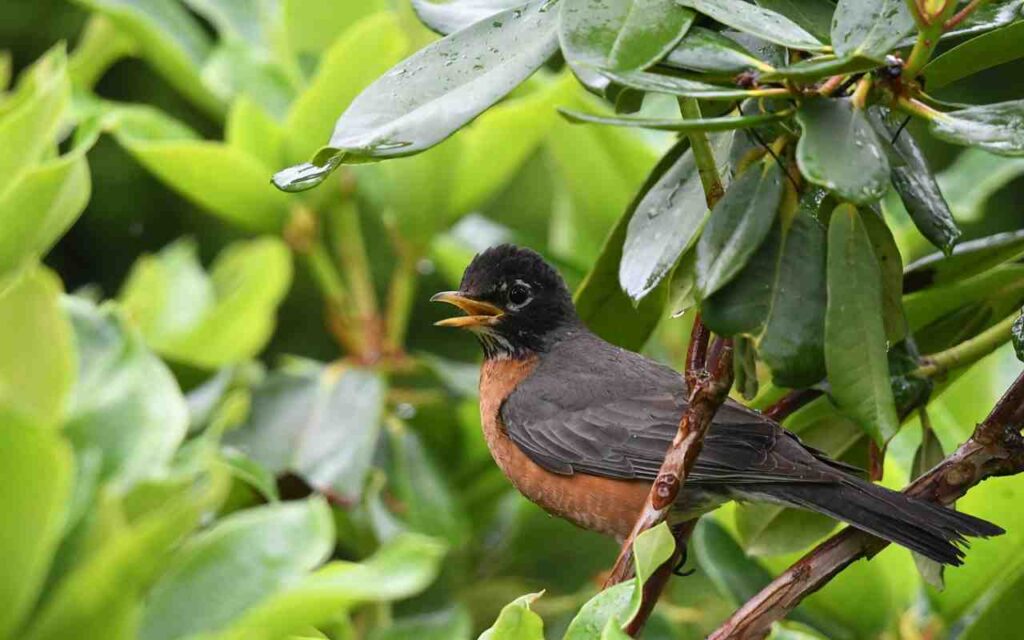
Understanding American Robin songs and calls transforms a simple backyard melody into a sophisticated window into avian social dynamics. While most recognize the iconic dawn chorus starting as early as 4:30 AM, few grasp the full acoustic repertoire used for territorial defense, mate attraction, and fledgling coordination.
From sharp alarm notes signaling predator presence to subtle contact calls for group cohesion, American Robin songs and calls function as nature’s real-time social network. This guide decodes these acoustic fingerprints, providing an informed interpretation of bird behavior and seasonal transitions 🙂.
Visual Guide: Decoding American Robin Songs and Calls
To help you visualize the patterns behind these vocalizations, I’ve created a whiteboard-style explainer below. This video maps out the structure and social meaning of American Robin communication, providing a clear mental framework before we dive into the specific details of each individual call.
Show Transcript:
0:00
All right, let’s jump right in. We’re talking about a bird you probably see every day, the American robin. They’re on your lawn, in your trees, everywhere. But what most people miss is that they’re having complex conversations right in front of us. Today, we’re decoding that hidden language.
0:17
You know the robin’s classic spring song. But inside those notes is a world of territory disputes, predator warnings, and even quiet, intimate exchanges that almost no one notices. That bright morning carol is just the public broadcast. Beneath it is a much more sophisticated system of communication.
0:47
Let’s start with the famous caroling song. It’s made up of clear, whistled phrases lasting two to three seconds, followed by short pauses. From March through July, this is the sound of a male robin claiming territory and attracting a mate. It’s his personal billboard to the neighborhood.
1:20
Each male has what researchers call an acoustic fingerprint, a unique vocal signature that identifies him to other robins. Many add sharp, squeaky notes sometimes nicknamed “broken glass” syllables for extra flair. Repertoire size also matters. A more varied and complex song signals higher quality to females.
1:53
But robin life isn’t just pleasant singing. They live in a dangerous world and rely on precise alarm calls. There are two distinct warnings, depending on where the threat comes from.
2:07
For ground predators like cats, snakes, or even people, robins give a low, repeating “tut” or “peek.” It’s easy to locate and effectively broadcasts the predator’s position to other birds nearby.
2:24
For aerial threats like hawks, they switch strategies. The call becomes a thin, high-pitched “seet.” It’s difficult for a hawk to pinpoint but carries clearly to smaller birds, signaling them to freeze and take cover.
2:42
If danger escalates near a nest, the robin uses the “whinny” call, a rapid descending sound that sends everyone scattering. When they go on the offensive, you’ll hear the loud, chaotic “yell” or “drive” call during active mobbing of a predator.
3:11
Beyond these public alarms lies a quieter world of communication. Robins use subtle sounds for close-range interactions most of us never hear.
3:25
One is the whisper song, a soft, rambling version of the main song used in courtship or tense standoffs. While foraging, they give a quiet “cuck” to stay in contact without drawing attention. Fledglings add high-pitched, stuttering begging calls to demand food from parents. These are the everyday sounds of robin life.
3:56
To really understand robin communication, you need to know the calendar. Song peaks in spring, then fades by July during molt, when robins grow new feathers and become secretive. A lighter return of singing often happens in September as territories are reestablished.
4:33
Location matters too. Urban robins adapt by singing at higher pitches to cut through traffic noise. Artificial light also pushes their dawn chorus earlier than robins living in rural areas.
4:51
A key skill is telling a robin from similar-sounding birds like thrushes. Thrush songs are faster and more continuous. The robin’s song has clear pauses between phrases. Listening for those breaks is the simplest way to tell them apart.
5:13
Here’s how to practice. Start by mastering the classic song and the “tut” alarm call. Then connect the sound to behavior. If you hear a “tut,” look for tail flicking or a nearby predator. Bird ID apps like Merlin can also help train your ear.
5:40
Next time you step outside, remember your backyard isn’t silent. It’s a busy social network filled with warnings, negotiations, and courtship. Now that you know part of the language, the question is simple: what will you overhear tomorrow?
Decoding the Cheerily Song: More Than Just a Melody
The Structure: 10-Syllable Caroling Phrases
According to Cornell Lab of Ornithology’s comprehensive robin sound documentation, the musical song of the American robin is a familiar sound throughout much of North America, described as a string of 10 or so clear whistles assembled from a few repeated units, often described as cheerily, cheer up, cheer up, cheerily, cheer up. The song structure consists of discrete syllables organized into repeated phrases, with each phrase containing approximately 2-3 seconds of vocalization separated by brief pauses.
Males produce songs primarily during breeding season (March through July) to establish and defend territories while attracting mates. The singing occurs most intensively during dawn hours beginning around 4:30-5:00 AM, continuing intermittently throughout morning and resuming briefly in evening. Peak singing activity corresponds with territorial establishment in early spring and initial courtship, declining after pairs form and nesting begins but continuing at reduced rates through multiple breeding attempts.
Song complexity varies between individuals, with some males producing simple 2-3 syllable types while others generate 6-8 distinct syllables assembled in varying combinations. The repertoire size influences female attraction and territory defense effectiveness, with larger repertoires generally signaling higher-quality males.
Listen to high-fidelity caroling phrases at the Macaulay Library.
The Broken Glass Syllable: High-Pitched Notes
Within the musical caroling phrases, robins intersperse distinctive high-pitched notes described as sounding like broken glass or squeaky hinges. These sharp, thin syllables contrast with the rich, fluty whistles comprising most of the song. The broken glass notes occur irregularly within song sequences, adding variation and potentially conveying individual identity information.
The acoustic structure involves rapid frequency modulation creating the squeaky quality. These syllables occupy higher frequency ranges (4-8 kHz) compared to the primary caroling notes (2-4 kHz), making them particularly distinctive when heard within song context. The function remains incompletely understood but likely relates to individual recognition, allowing neighbors to distinguish between familiar territory holders versus unfamiliar intruders.
Pro Listening Tip: Because these “broken glass” syllables hit a high frequency of 4–8 kHz, they can be difficult to hear on standard phone speakers. Click the “Cheerily” sound button above to listen to the Macaulay Library recording (Asset 426253381). For the best results, use headphones and listen specifically at the 0:05 and 0:09 second marks for a faint, scratchy “tiz-it” or a dry, squeaky “crinkle” at the very end of the clear whistle. That is the “broken glass” in action.
Song Variations: Acoustic Fingerprints
Individual robins develop unique song signatures through learning and improvisation during their first year. Young males listen to adult tutors during their first spring, memorizing song structures they later reproduce with individual modifications. According to research on robin vocal development, these acoustic fingerprints allow territory neighbors to recognize individuals by voice, reducing unnecessary territorial conflicts between established neighbors while triggering strong responses to unfamiliar singers indicating potential territory usurpers.
Geographic variation exists across robin populations, with regional dialects detectable by analyzing syllable types and phrase structures. Western populations show slight differences from eastern populations, though variation between individuals within populations generally exceeds variation between regions, making dialects subtle compared to some other songbird species.
Pro Tip: The “City Singer” Phenomenon
Recent studies in urban ecology show that American Robins in loud cities actually change their “acoustic fingerprints” to be heard over traffic. If you live in a noisy neighborhood, listen for robins singing at a higher pitch and starting their dawn chorus up to 45 minutes earlier than their forest-dwelling cousins. This “frequency shifting” is a prime example of how individual signatures adapt to their environment.
The 4 Essential Alarm Calls and How to React
The Peek or Tut: Low-Grade Ground Predator Alerts
According to Cornell Lab documentation on robin alarm calls, American robins often make a mumbled cuck or tuk to communicate with each other, and sharp calls described as yeep or peek serve as alarm calls. The tut or peek call consists of single, relatively low-frequency notes (1-2 kHz) produced in series when robins detect ground predators including cats, dogs, snakes, or approaching humans.
The calling pattern involves regular repetition at 1-2 second intervals, continuing as long as the perceived threat remains present. Multiple robins often join in the calling, creating chorus effects that advertise predator location to other birds in the area. The calls serve dual functions of warning conspecifics while potentially harassing predators through persistent vocal attention.
When hearing tut calls in your yard, scan ground level for cats or other terrestrial predators. The calling robin typically perches 3-15 feet high with clear sightlines to the threat, looking downward while vocalizing. Other birds in the area often freeze or move to higher perches in response to the alarm calls.
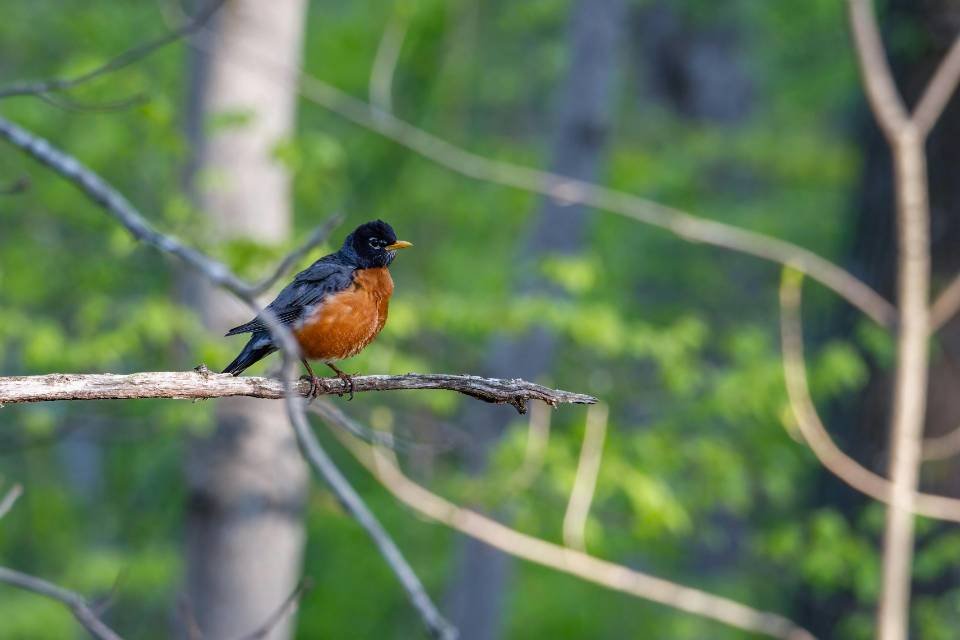
Hear the sharp, repetitive ground predator alarm at the Macaulay Library.
The Whinny Call: High-Grade Agitation and Flight Signals
The whinny call represents escalated alarm indicating severe disturbance or immediate danger. The vocalization consists of rapid series of notes delivered in descending pitch, creating a whinnying or laughing quality. Robins produce whinny calls when flushed from nests by predators, during aggressive territorial encounters, or when threats approach too closely for comfort.
The acoustic structure involves 5-10 notes delivered within 1 second, with frequency dropping from approximately 4 kHz to 2 kHz across the call duration. The rapid delivery and pitch change convey urgency distinguishing whinny calls from slower, more monotone tut calls used for lower-grade threats.
Behavioral responses to whinny calls include immediate flight to cover by nearby robins and heightened vigilance from other bird species recognizing the cross-species alarm signal. When you hear whinny calls, expect to see robins and other birds departing the immediate area or seeking dense cover until the threat passes.
Listen to the rapid, laughing-quality agitation call at the Macaulay Library.
The Seet: Thin Aerial Alarm for Hawks and Falcons
The seet call serves specialized function as aerial predator warning. According to Cornell Lab research on bird alarm call networks, seet calls are high-pitched calls given when a raptor is in flight, and for the raptor it’s hard to tell where these sounds are coming from, but small birds hear it and know immediately what to do: duck into cover or freeze. The vocalization occupies extremely high frequency (7-9 kHz) approaching the upper limits of human hearing, creating the thin, whistle-like quality often compared to dog whistles.
The high frequency provides acoustic camouflage making the sound difficult for raptors to localize while remaining detectable to other songbirds with acute high-frequency hearing. The calls lack the frequency modulation and harmonic structure characterizing most robin vocalizations, consisting instead of pure tones lasting 0.5-1 second.
Robins producing seet calls typically freeze with upward gaze, body compressed against perch to minimize visual profile. Other birds respond similarly, creating sudden silence and stillness across the area as multiple species heed the warning. Scan the sky when hearing seet calls to potentially observe the raptor that triggered the alarm response.
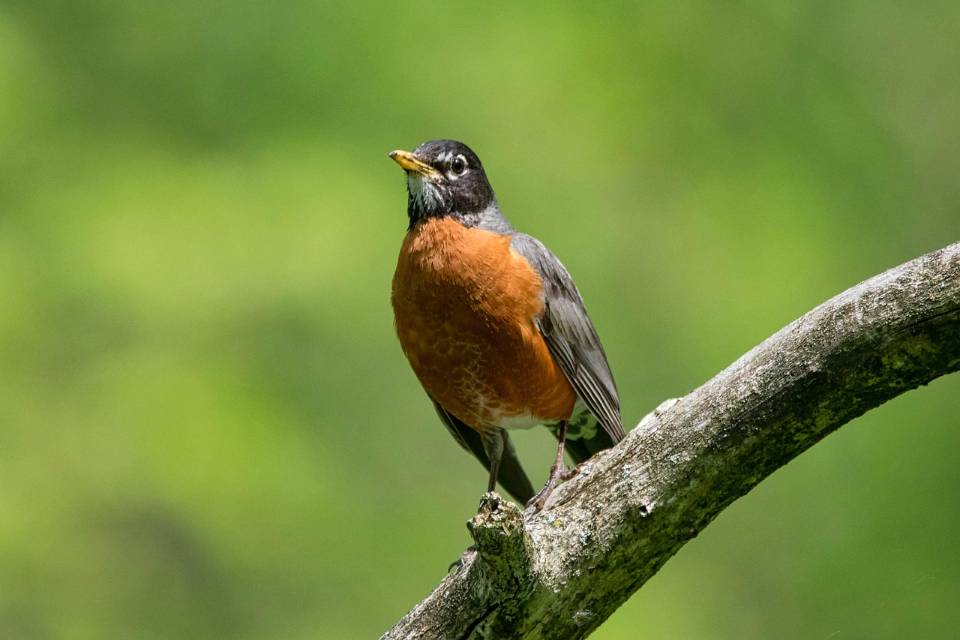
Hear the high-pitched aerial alarm used for hawks and falcons.
The Yelling Drive: Defensive Vocalizations
The yelling drive consists of loud, harsh calls produced during aggressive chases and physical altercations with territorial intruders or nest predators. The vocalizations lack the musical quality of songs or the structured repetition of standard alarm calls, instead comprising variable harsh notes delivered continuously during pursuit or attack.
Male robins direct yelling drives at rival males encroaching on territories during breeding season. Both sexes produce these calls when mobbing nest predators including jays, crows, cats, or snakes. The acoustic aggression often coordinates group mobbing, with multiple robins joining in the harassment through vocal and physical intimidation.
Hear the aggressive scolding used to drive away hawks, owls, and crows.
The Secret Sounds Most Guides Ignore
The Whisper Song: Courtship and Fighting Tune
The whisper song or hisselly song represents a rarely discussed vocalization produced during intimate interactions between paired birds or aggressive encounters at close range. According to research on robin vocal behavior, males produce soft, rambling songs incorporating fragments of their normal caroling mixed with harsh notes and mimicked sounds from other species, delivered at volumes barely audible beyond a few feet.
The context includes courtship interactions where males sing softly to females during close-range interactions preceding copulation. Males also produce whisper songs during boundary disputes with territorial neighbors, delivering the soft vocalizations during tense face-offs that may escalate to physical combat. The quiet volume prevents broadcasting the interaction widely while maintaining acoustic communication between the directly involved individuals.
Hear the rare, quiet “hisselly” calls used during courtship and close-range disputes.
The Mumbled Cuck: Contact Calls for Group Cohesion
The mumbled cuck or tuk serves as low-intensity contact call maintaining awareness of flock-mate locations during foraging and migration. Unlike the sharp, repeated tuk alarm calls, these contact versions sound softer and more variable in delivery, produced sporadically rather than in regular series.
Robins foraging in loose flocks during migration and winter use these calls to track each other’s positions while moving through vegetation or across open ground. The calls allow coordination of group movements without the energetic cost and predator attraction risk of continuous loud vocalizations. Listen for these subtle sounds when observing winter robin flocks feeding on berry-laden shrubs.
Hear the subtle, low-pitched contact calls used to maintain group cohesion.
Begging Calls: High-Pitched Fledgling Chirps
Juvenile robins produce distinctive high-pitched begging calls signaling hunger and location to parents. The calls consist of rapid series of short chirp notes at frequencies of 4-6 kHz, delivered in stuttering bursts lasting several seconds. The intensity and rate increase with hunger level, creating escalating urgency that parents respond to by increasing feeding rates.
Fledgling robins continue producing begging calls for 2-3 weeks after leaving the nest, following parents while calling persistently. The vocalizations help parents locate fledglings hidden in dense vegetation while advertising need for continued provisioning. The begging calls gradually decrease in frequency and intensity as young birds develop independence and begin self-feeding.
Hear the high-pitched chirps used by fledglings to signal hunger to parents.
Robin Body Language and Sound Synchronicity
The Tail-Lift and Flick with Tuk Calls
According to Cornell Lab behavioral documentation, American robins are easy to spot with their warm orange underparts, gray upperparts, and quick hopping movements on lawns and other open ground. The tail movements synchronize closely with tuk alarm calls, with each vocalization accompanied by rapid tail jerk upward followed by slower lowering. The visual and acoustic signals combine to create multi-modal communication enhancing message transmission.
The tail flicking serves multiple functions including balance maintenance, visual signaling to conspecifics, and possibly startling cryptic prey. When combined with alarm calling, the movements draw visual attention to the calling bird, helping direct flock-mates’ attention toward the threat being advertised vocally.
Sky-Gazing: Freezing and Head-Tilting During Seet Calls
Robins detecting aerial predators freeze immediately while producing seet alarm calls, assuming rigid postures with bodies compressed and heads tilted sharply upward to track the raptor’s flight path. The behavioral response reduces movement-based detection by the predator while maintaining visual monitoring of the threat.
The head tilt maximizes visual coverage of the sky using the lateral eye position characteristic of robins. The upward gaze continues throughout the alarm call production, creating distinctive posture easily recognized by human observers as indicating overhead predator presence even when the vocalization is too high-pitched for easy human detection.
The Wing-Droop: Signaling Aggression
Aggressive robins about to engage in physical encounters droop their wings slightly away from the body while puffing body feathers, creating enlarged appearance intended to intimidate rivals. The posture often accompanies harsh vocalizations during territorial disputes, serving as visual threat display before potential combat.
The wing-droop combined with yelling calls signals high probability of physical attack if the rival fails to retreat. Subordinate birds typically flee when confronted with this display from dominant territory holders, while matched rivals may both adopt the posture before engaging in aerial grappling or ground combat.
Environmental and Seasonal Shifts in Vocalization
Urban vs. Rural: Higher and Earlier Songs
According to research published on urban bird song modification, city birds sing higher-frequency songs than their conspecifics in non-urban habitats, interpreted as an adaptation to counteract masking by traffic noise. American robins show particularly strong urban song modification compared to rural populations, with city birds singing at frequencies shifted 200-400 Hz higher than rural counterparts.
The adaptation allows urban robins to reduce acoustic masking by low-frequency anthropogenic noise concentrated below 2 kHz. By shifting song frequencies upward into 3-5 kHz ranges less affected by traffic noise, urban birds maintain communication effectiveness despite degraded acoustic environments. The modification occurs through individual learning and adjustment rather than genetic changes, with rural robins relocated to cities adjusting their songs within weeks.
Urban robins also begin singing earlier in the morning relative to sunrise compared to rural birds. According to research on circadian rhythm shifts, artificial night lighting in cities triggers earlier dawn chorus onset, with some urban robins beginning singing 30-60 minutes before rural populations despite identical sunrise times. The early singing potentially compensates for reduced communication effectiveness during peak traffic hours later in morning.
The Seasonal Timeline: July Silence and September Return
Robin singing follows predictable seasonal patterns driven by breeding cycles and molting schedules. American robins sing mainly from late April through mid-July. The singing intensifies during March through May during territorial establishment and initial breeding attempts, continues through June as pairs raise second broods, then declines sharply in July as breeding season ends and annual molt begins.
The July silence results from simultaneous cessation of territorial defense and onset of feather replacement. Molting birds become more secretive and less vocal, hiding in dense vegetation during the vulnerable period when flight capability is impaired by missing wing feathers. The reduced singing creates a perception that robins have disappeared despite their continued presence in territories.
Brief singing resumes in September after molt completion, likely serving to reestablish winter territories or maintain pair bonds in populations that remain paired year-round. This fall singing is less intense and consistent than spring breeding season singing but provides acoustic presence maintaining territorial claims before winter.
Comparison: Robin or Imposter?
Robin vs. Black-Headed Grosbeak
Black-headed grosbeaks produce songs remarkably similar to American robins, creating frequent misidentification in western regions where both species occur. Birders often describe the Black-headed Grosbeak as a ‘Robin that has had too much to drink’ because its song is faster, more blurred, and lacks the Robin’s steady rhythm.
According to Cornell Lab comparison of grosbeak and robin songs, male black-headed grosbeaks produce rich caroling warbles similar to robins but slightly faster, sweeter, more mellow and higher pitched. The grosbeak song flows more continuously without the distinct pauses separating robin phrases.
The key distinction involves song rhythm and phrasing. Robin songs consist of discrete phrases separated by brief silences, creating start-stop pattern. Grosbeak songs flow more continuously with less distinct phrase boundaries, sounding more warbled and less caroled. Grosbeaks also incorporate more variety within songs, producing complex sequences that shift patterns frequently compared to the more stereotyped robin phrases.
Visual confirmation helps when songs sound ambiguous. Black-headed grosbeaks show distinctive plumage with orange underparts, black heads (males), and massive bills compared to robin’s red breast, gray upperparts, and relatively slender bill.
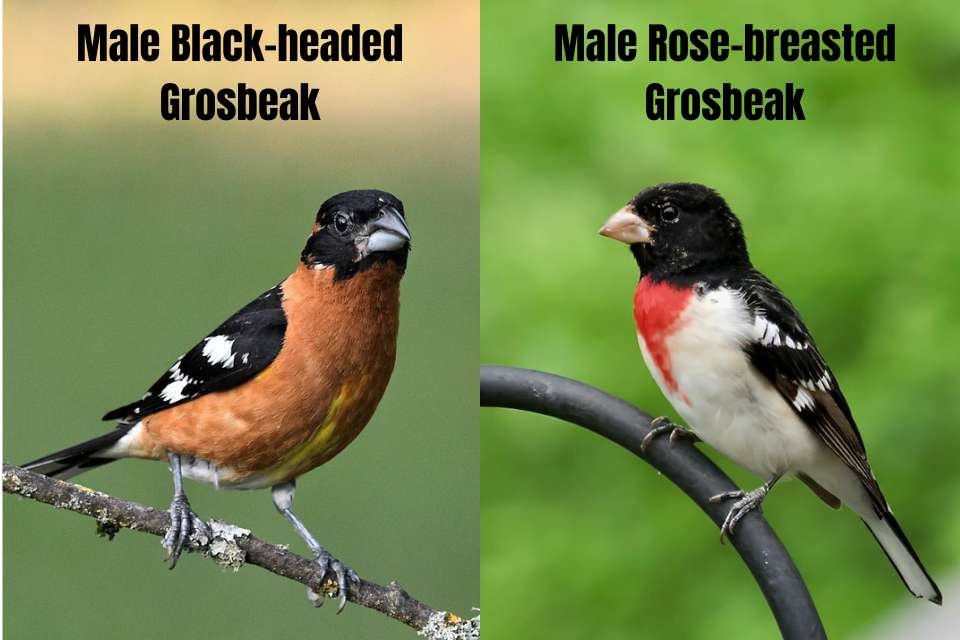
Robin vs. Rose-Breasted Grosbeak
If you hear what sounds like an American Robin who took professional opera lessons, you are likely listening to a Rose-breasted Grosbeak. These birds produce songs that are remarkably similar to robin caroling but with an enhanced, sweeter musical quality. The grosbeak songs sound sweeter, more varied, and more continuously delivered than robin songs, incorporating wider frequency ranges and more complex note structures.
According to comparative analyses, rose-breasted grosbeak songs average longer duration (4-6 seconds) compared to robin phrases (2-3 seconds), delivered with fewer pauses creating impression of extended performance. The grosbeaks incorporate buzzy notes and complex trills absent from robin repertoires, adding textural variety beyond the pure whistles characteristic of robins.
Range differences aid identification, with rose-breasted grosbeaks breeding in northeastern and north-central regions overlapping robin range only partially. In overlap zones, careful listening for continuous delivery, buzzy notes, and sweeter tone distinguishes grosbeaks from robins when visual confirmation is impossible.
| Bird Species | Mnemonic Nickname | Sound Quality |
|---|---|---|
| American Robin | “Cheer-up, cheerily” | Clear, rhythmic, steady pauses |
| Black-headed Grosbeak | “Drunk Robin” | Rushed, “tumbling,” and sweet |
| Rose-breasted Grosbeak | “Robin with opera lessons” | Purer, smoother, and longer |
| Scarlet Tanager | “Robin with a sore throat” | Burry, raspy, and hurried |
Cheat Sheet: American Robin Sounds at a Glance
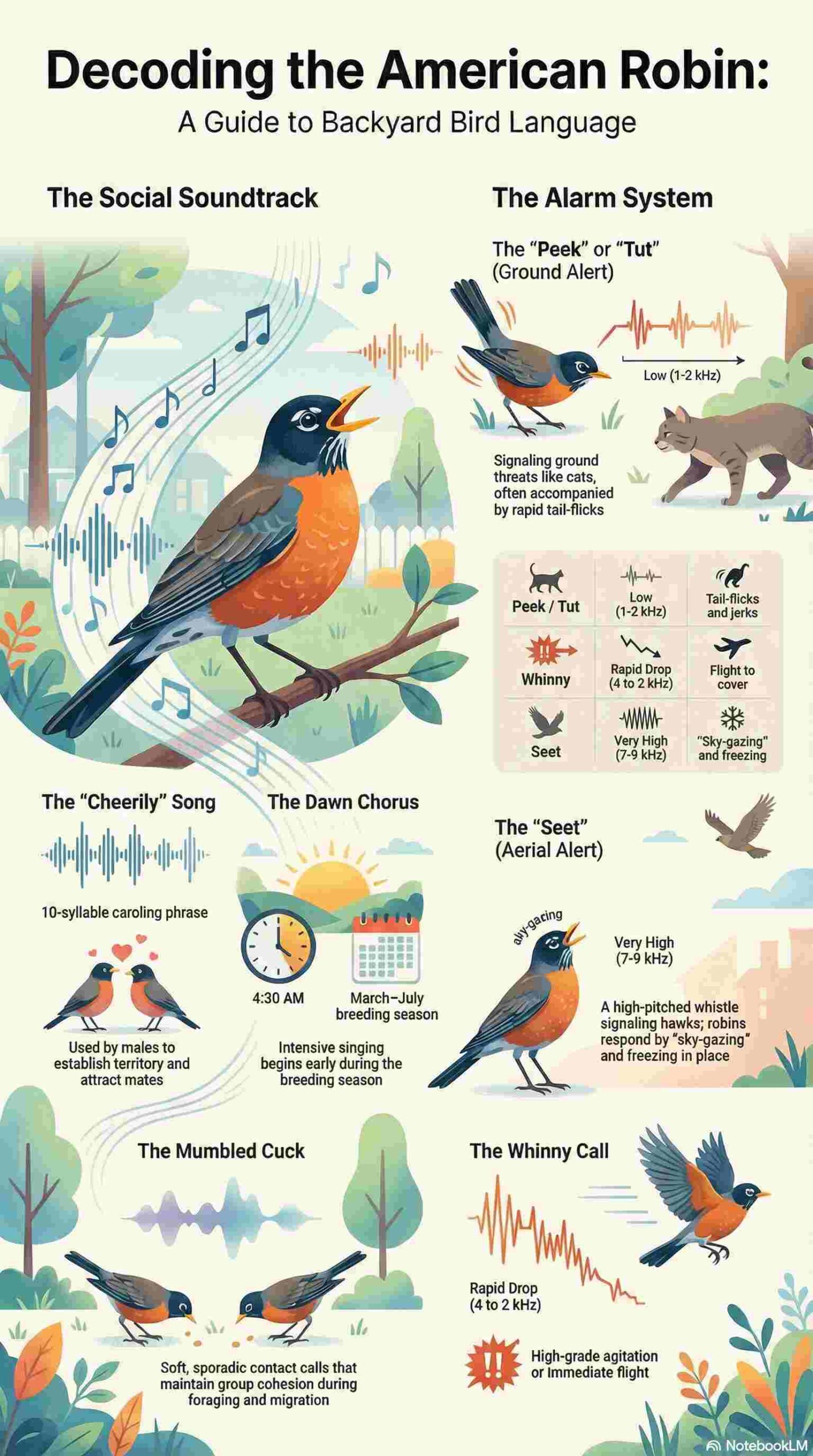
To help you identify these birds in the field, I’ve created a quick-reference infographic below. This visual ‘cheat sheet’ summarizes the 7 key American Robin vocalizations and their meanings, making it easy to decode backyard bird language in seconds.
How to Become a Backyard Bird Whisperer
Tools for Identification and Learning
According to Cornell Lab’s Merlin Bird ID application, the Sound ID feature allows real-time identification of singing birds by analyzing acoustic characteristics and matching them to species-specific sound libraries. The application identifies American robins and distinguishes them from similar species including grosbeaks, providing confidence for learning vocal identification.
The Macaulay Library houses the world’s largest collection of natural sound recordings, including thousands of American robin vocalizations spanning songs, calls, and regional variations. According to the library documentation, users can search recordings by vocalization type, behavior context, and geographic location, enabling targeted learning of specific sounds and comparison between individual variations.
Practice strategies for developing identification skills include:
- Focus on common vocalizations first (cheerily song, tut alarm calls) before attempting rarer sounds
- Record local robins and compare recordings to reference libraries, noting individual variations
- Observe behavioral context when robins vocalize, connecting sounds to activities like territorial defense, predator warnings, or fledgling feeding
- Learn grosbeaks and other similar species to develop discrimination skills
- Practice year-round, noting seasonal changes in vocal activity and repertoire use
Interpreting Backyard Robin Activity
Understanding robin vocalizations transforms passive observation into active interpretation of backyard ecology. When robins begin singing intensively in your yard during March or April, males are establishing breeding territories. The presence of multiple singing males indicates your property spans parts of several territories, while a single singer suggests one pair claims the entire space.
Tut alarm calls direct attention to ground predators requiring removal or monitoring. Cats triggering persistent alarm calling indicate predation risk to all ground-feeding birds, suggesting need for cat management strategies. Seet calls reveal raptor presence useful for identifying local hawk and falcon activity patterns.
The July silence followed by September song resurgence confirms robins have successfully completed breeding and molting cycles. Winter observations of robin flocks using contact calls while feeding on berry-laden shrubs demonstrate the shift from breeding territoriality to nomadic social foraging characterizing non-breeding season.
For additional information on American robin behavior and ecology, explore guides on attracting robins to your backyard, understanding seasonal robin diet shifts, and identifying American robins. Learning about bird-friendly garden design and native plant selection for birds provides broader context for supporting robin populations through comprehensive habitat management supporting their complete life cycle needs.