
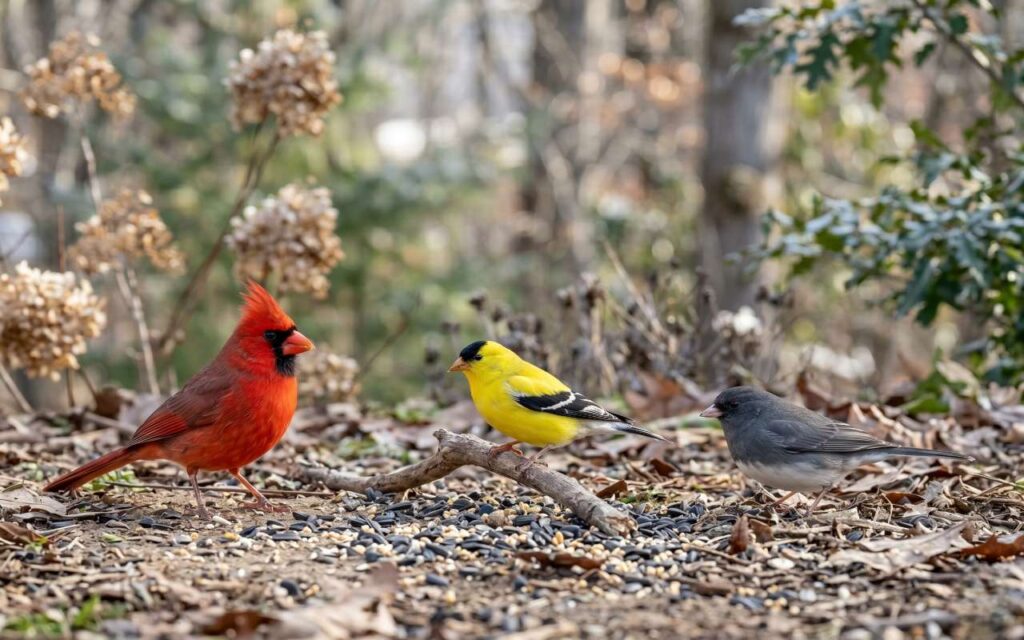
Welcome to the definitive backyard bird checklist designed to track the adaptable, resourceful avian species colonizing our residential landscapes. These everyday visitors are drawn to specific property features like lawn edge structures, canopy cover, and supplemental feeding stations.
Learning to monitor these common birds transforms a basic yard into a continuously active data collection site. This specific tracking routine is highly rewarding because of the massive biological diversity these familiar species represent.
The checklist spans three distinct size classes and features at least four unique bill archetypes engineered for specialized foraging. The columns track both ground-foraging and aerial foraging guilds across your daily observation counts.
You will easily learn to differentiate year-round residents from seasonal migrants navigating local property columns. The guide balances common native species alongside highly adaptable introduced ones.
Mastering this core index builds your visual identification vocabulary and deepens your data collection confidence. It establishes a permanently useful foundation to track both regular and occasional yard visitors throughout the changing seasons.
Quick Answer: How Do You Use a Backyard Bird Checklist?
To use a backyard bird checklist effectively, systematically log the regular native and introduced species visiting your feeding stations across different seasons. Documenting key diagnostic traits like bill archetypes and size classes during your morning counts helps you easily track migratory shifts and map out local population trends with absolute accuracy.
Bird Identification Video Tutorial
Before diving into our full textual data grids below, watching these key species sketched out in real time provides instant identification clarity. This quick illustrated tutorial breaks down complex plumage details and diagnostic facial markers into clear, simple drawings to help you master your morning property counts on your first reading.
Show Transcript:
0:00
You know, for years I’d look out my kitchen window and honestly see nothing but mowed grass and decorative bushes. I was totally guilty of passively lumping
0:08
every single passing bird into this generic, boring yard bird category. But recently, I actually started paying
0:15
attention and it hit me like a ton of bricks. My basic suburban yard isn’t just landscaping. It is a thriving,
0:22
incredibly dynamic field site. So, welcome to today’s explainer. I’m going to walk you through my personal backyard avian awakening and share exactly how I
0:31
learned to decode the amazing little visitors right outside my door. So, the big question that kicked off this entire journey for me was pretty simple. Who
0:39
exactly is visiting my backyard? I wanted real specific identities for the everyday birds I used to just completely ignore. I mean, I knew they weren’t some
0:47
rare deep forest species, but they were out there every single day interacting, competing, and surviving right under my nose. That curiosity really pushed me to
0:56
look closer at what made this specific group of birds so incredibly successful in my own neighborhood. What I quickly discovered is that the birds dominating
1:05
my property are absolutely not sensitive wilderness specialists that need completely untouched forest to survive.
1:11
Actually, quite the opposite. I was watching a core community of incredibly adaptable generalists. They have this highly specific set of ecological
1:19
tolerances, meaning they are totally comfortable with human activity at close range. They’ve successfully colonized our residential landscapes. Realizing
1:27
that these birds are essentially urban survival experts completely shifted my entire perspective. So, it made me wonder why did they choose my yard
1:35
specifically? Well, when I started digging into suburban bird ecology, I found three core landscape features that essentially turned my property into a
1:44
total bird magnet. First, the edge structure between my lawn and shrubs that gives them open foraging with an immediate safe escape route. Second, the
1:53
mature canopy cover I have provides vital shelter. But the third one absolutely blew my mind. My supplemental feeding stations. There was actually a
2:01
landmark study in Frontiers in Ecology that proved our backyard feeders aren’t just cute little conveniences. They are massive environmental forces that
2:09
actually alter avian population dynamics on a landscape scale. Armed with that knowledge, I realized I needed a way to
2:16
identify my visitors fast. Because let’s be real, birds do not sit around waiting for you to flip through a field guide.
2:22
So, I developed a four-pillar tracking loop based on professional ornithological methods. I call it my 3-second quick scan. Every morning, I do
2:31
this rapid top-to-tail sweep. Step one, I check the bill’s depth and curve to figure out the family. Two, I scan the face for specific patterns. Three, I check the breast and flank for streaks.
2:42
And four, I evaluate the tail length.
2:45
Just 3 seconds and boom, I have a confident ID. Let me tell you just how perfectly this works. I used to get so incredibly tripped up by the small
2:53
reddish streaky birds crowding my tube feeders. But applying my quick scan gave me this massive aha moment. I realized I was actually looking at house finches,
3:02
not purple finches. How? By dropping my eyes straight to step three, the flank.
3:08
I noticed that the house finch has these crisp brown vertical streaks running right along a bright white flank.
3:13
Whereas the purple finch completely lacks those clean white borders on its side panels. That one tiny detail spotted in literal seconds completely
3:21
solved my finch confusion forever. And then of course there are the house sparrows. These guys absolutely dominate my feeders. They show up in these loud
3:29
rowdy flocks of up to 20 individuals just camping out at the seed ports.
3:33
Using my scan, I learned to instantly spot their social dynamics, mainly because the males and females look wildly different. I look for the adult male rocking his diagnostic black throat
3:42
bib, that chestnut brown nape, and a slate gray crown. Meanwhile, I’ll spot the female wearing a very uniform buffy brown with a pale eyebrow line and absolutely zero breast markings.
3:51
Honestly, it’s like watching two completely different species hanging out together. Now, while those sparrows lazily camp on the feeder, I take
3:58
absolute delight in watching the black-capped chickadees because they operate with a completely different kind of energy. I watch them execute this highly
4:06
kinetic move called the snatch and retreat. They fly in direct, make contact with a perch for barely 2 to 4 seconds just to grab a single sunflower
4:14
seed, and then immediately zip away to a sheltered branch to safely crack it open. It’s a totally distinct behavioral niche compared to my perching birds, and
4:22
it is so fun to watch. This whole process really taught me that identification isn’t just about plumage.
4:28
It is entirely about movement, too. Take the American robin for example. I used to just look for a red breast and call it a day. But now, I watch its specific
4:36
hunting strategy. I’ll see it execute this incredibly distinct 24-inch run and stop sprint across my turf. It’s this rapid horizontal burst followed by an
4:45
abrupt stop where it stands completely erect and then does a dramatic lateral head tilt to visually hunt for earthworms. Once I recognized that exact
4:52
sprint and pause rhythm, I realized I could ID a robin from across the yard without even seeing its colors. Now, contrast that graceful robin run with
5:00
the European starling. Starlings occupy a pretty similar size bracket, but when I started watching their ground game closely, I noticed a really unique
5:08
mechanical behavior called gaping. I watched them insert their closed, pointed bills directly into the soil and then forcefully open their mandibles to
5:16
pry a search hole apart to expose hidden insects. Seeing that specialized open bill probing technique gives me an
5:23
instant behavioral ID cue before I even have to look at a single feather. I also rely heavily on body posture to separate
5:30
the ground foragers beneath my hanging cedars. Early in the morning, I can instantly distinguish between the northern cardinals and the mourning doves just by seeing how they hold themselves.
5:38
I look for the cardinal’s very erect upright stance as it searches for seeds.
5:42
But when I spot a mourning dove, I see what’s called horizontal branch compression. It basically holds its slender body completely parallel to the ground upright versus horizontal. It’s a
5:51
split-second structural clue that works no matter how terrible the morning lighting is. Okay, let’s scale things up to the larger birds for a second because this was incredibly validating for me.
6:01
I’ve always suspected the American crows and blue jays in my yard were exceptionally smart. They just always seem to be calculating their next move.
6:08
Well, I found a landmark study in the journal Science that essentially proved it. They stated that corvids demonstrate advanced cognitive capacities, including
6:17
future planning, causal reasoning, and perspective taking. Now, I watch my local corvids literally checking to make sure they are unobserved before caching
6:25
their acorns. It is literally like having feathered masterminds in the garden. And because they’re so intelligent and highly social, they are
6:32
constantly communicating. I realized I can actually read the mood of the blue jays at my feeder just by looking at their heads, specifically the angle of
6:40
their prominent pointed crests. If I see a fully raised crest, I immediately know there’s alarm or some serious flock aggression happening. But if I look out
6:48
and see a completely flattened crest, it tells me they are in a state of totally relaxed foraging. It’s a built-in emotional barometer that I can read from
6:55
50 ft away. But of all the large birds, the one that shocked me the absolute most was the northern flicker. I mean, I always assumed woodpeckers stayed
7:04
vertical on tree trunks, right? So, imagine my surprise when I found this massive 12 1/2 inch brown barred woodpecker just hopping around directly
7:11
on my lawn. It turns out flickers are highly specialized ground foragers. I watched in pure awe as it used a massive 2-inch barbed tongue coated in sticky
7:21
saliva to extract underground ant colonies right out of my soil. It completely shattered all my assumptions about where a woodpecker is supposed to
7:28
be. As I kept tracking my yard every day, I started noticing these dramatic shifts as the seasons changed. In the
7:36
summer, the American goldfinch is this brilliant lemon yellow. But by winter, I watched them undergo a complete molt into
7:43
a dull olive brown. I actually read a fascinating paper in the journal Nature that established this yellow summer coloration is an honest biological signal of the bird’s nutritional health.
7:54
Meanwhile, my insect eating eastern phoebe completely disappeared down south while active flocks of dark-eyed juncos arrive from the north to take their
8:02
place. Speaking of those winter arrivals, the dark-eyed junco has quickly become my absolute favorite frosty morning visitor. When they
8:10
forage, I listen for this continuous high-pitched smacking chip call ringing out across my hedges. But my absolute favorite thing to watch for is their
8:18
signature wing flash. When a flock of juncos gets startled and flushes off my frozen lawn, they suddenly display these bright white outer tail feathers for
8:26
just a fraction of a second during takeoff. It’s an unmistakable flashing visual confirmation of exactly who is leaving the yard. You know, a lot of
8:34
people stop bird watching when it gets cold. But what I’ve come to appreciate about winter is that it’s actually the best time for me to practice my identification skills. When those summer
8:43
migrants leave, the year-round permanent residents like my cardinals, nuthatches, and jays completely take over the feeding zones. Because the exact same
8:52
individual birds return day after day without the distraction of a diluted species pool, I get highly favorable extended looks at them. It is the
9:00
perfect isolated environment for me to really hone that 3-second quick scan.
9:04
Eventually, all this daily observation just pushed me to take things a step further. I realized my backyard joy could actually mean something bigger.
9:12
So, I started logging all my daily quick scans into the eBird platform. The Audubon Society notes that active citizen science participation has direct
9:20
real-world preservation value. By officially documenting what I see, I’m translating my local morning coffee routine into a continent-scale
9:28
population tracking grid that informs actual conservation policies. It really makes me feel incredibly connected to the larger natural world. Once I
9:36
realized that the familiar birds in my yard are actually complex, highly intelligent survivors navigating a massive ecological landscape, I could
9:44
literally never look at them the same way again. So, I want to leave you with a bit of a challenge. What unseen ecological drama is playing out right
9:51
outside your window today? I highly encourage you to step outside, try using my 3-second quick scan, and unlock the incredible secrets of your own local
10:00
avian community. Thanks for joining me on this explainer, and hey, happy tracking.
What Are the Most Frequent Backyard Birds in North America?
The suburban residential landscape has created a distinct avian community that differs substantially from both undisturbed forest interiors and open agricultural plains. According to long-term population data curated by the North American Breeding Bird Survey, a core group of highly adaptable generalist species consistently dominates human-modified residential zones across the continent.
Extensive analysis of these survey routes confirms that the American Robin, European Starling, American Crow, and House Sparrow rank among the most frequently detected backyard birds. This widespread presence directly reflects their exceptional biological ability to thrive within urban ecosystems.
The Suburban Avian Core
The foundational checklist for most North American backyards includes approximately twelve to fifteen species that appear with high predictability across all seasons in residential areas east of the Rockies, with parallel assemblages in western and Pacific coastal zones. These common birds found in backyards do not distribute themselves randomly across developed neighborhood zones.
They share a highly specific set of ecological tolerances: comfort with human activity at close range, the ability to exploit a diverse range of food resources, flexibility in nesting substrate choice, and a behavioral repertoire plastic enough to adjust foraging strategies when primary food sources shift seasonally.
The primary species dominating this eastern native backyard bird species checklist consist of these common regional yard visitors:
- House Sparrow
- House Finch
- American Goldfinch
- Black-capped Chickadee
- American Robin
- European Starling
- Northern Cardinal
- Mourning Dove
- American Crow
- Blue Jay
- Northern Flicker
- Dark-eyed Junco
- Song Sparrow
Western yards replace several of these with close regional equivalents to match changing elevation gradients. The Mountain Chickadee substitutes for the Black-capped in higher elevations, and the Lesser Goldfinch joins or replaces the American Goldfinch in southwestern yards. The underlying structural logic of this checklist, however, remains the same across regions.
Why Do Certain Birds Thrive in Backyards?
Research on suburban bird ecology consistently identifies three core landscape features that accurately predict high avian species richness and localized abundance in residential settings. The first major visual indicator is a dynamic lawn-to-shrub edge structure across your property columns.
The specialized transition zone between mowed turf grass and dense evergreen shrub cover provides both an open foraging ground and rapid escape cover within a few wing-beats of each other. The second primary landscape feature is canopy cover density.
Properties featuring mature deciduous trees support significantly higher abundances of cavity-nesting and bark-foraging species than completely treeless yards. The third critical element is the supplemental feeding station, which fundamentally alters the natural food availability landscape of a suburban neighborhood.
A landmark study published in the journal Frontiers in Ecology and the Environment documented that supplemental feeding at garden stations demonstrably influences avian population dynamics at a broad landscape scale, not just at the individual feeder level. This extensive ecological tracking confirms that backyard feeding stations function as massive environmental forces rather than passive convenience features.
Consequently, the specific bird species that most fully exploit all three of these suburban landscape elements consistently appear at the absolute top of your native checklist. Recognizing these environmental magnets ensures you understand exactly why certain families dominate your local bird logs throughout the year.
How Do I Identify the Most Common Yard Birds?
Identifying common birds found in backyards relies on using the four-pillar ornithological tracking system developed through professional field identification research. This comprehensive framework evaluates size baselines, bill geometry, behavioral kinetics, and habitat choices simultaneously to ensure accurate species assignment.
Gathering these fast structural clues allows for a highly confident tracking loop within seconds of an observation. The complete forensic framework behind this tracking approach is documented fully in our parent Backyard Bird Identification Guide, which serves as the master reference for applying this diagnostic routine across your property.
The Quick-Scan Checklist Method
For everyday checklist species that appear repeatedly at your feeding stations, the four-pillar routine can be compressed into a rapid visual sweep. This high-velocity structural analysis takes approximately three seconds to execute from start to finish.
Beginning at the tip of the beak, the observer notes bill depth and curvature to immediately assign an accurate family membership. The tracking loop then moves to the head to scan the facial field mark topology for a clean supercilium, eye line, or crown pattern.
Next, you evaluate the breast and flank regions to isolate any sharp streaking or solid-color contrast boundaries. Finally, your eyes drop to the tail feathers to log the relative length ratio and check for any terminal white banding.
This swift visual path consistently yields enough data to assign a visitor to a known checklist species without requiring a slow full-body examination. Practicing this top-to-tail sweep on familiar yard residents builds the observational speed needed to accurately verify brief or partially obscured sightings.
What Are the Common Small Birds in My Yard?
The most frequent small birds visiting North American properties cluster into two distinct functional guilds across your feeding stations. These groups consist of seed-cracking perching birds that exploit tube feeders and acrobatic clinging birds that work suet cages.
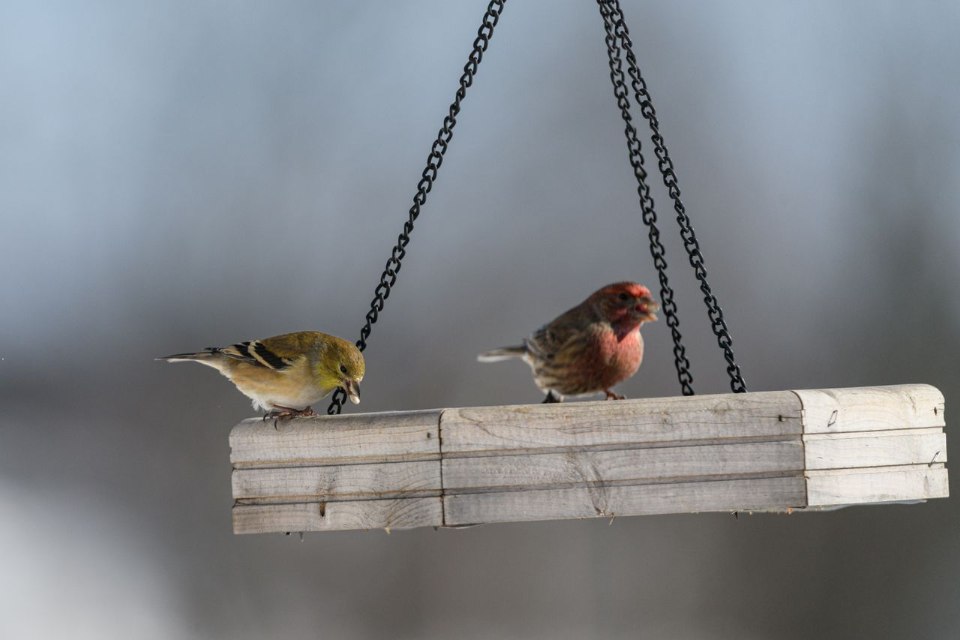
The four specific species that dominate this small-bird category across the broadest geographic range are the House Sparrow, House Finch, American Goldfinch, and Black-capped Chickadee. Recognizing these distinct groupings allows you to instantly determine an unknown visitor’s behavioral niche before checking fine plumage colors.
The Sparrow and Finch Core
The House Sparrow measures approximately 6.3 inches in total length and presents a classic heavy conical bill. This robust seed-cracker features a thick base depth exceeding 40 percent of total head width.
Adult males in breeding plumage carry a diagnostic black throat bib covering the upper breast, a rich chestnut-brown nape, and a slate-gray crown. Conversely, female House Sparrows are uniformly buffy-brown with a pale eyebrow line and zero breast markings.
These highly social birds typically arrive at your stations in loose, noisy flocks of 5 to 20 individuals. They remain committed, long-duration feeder occupiers that crack seeds right at the platform rather than employing a rapid snatch-and-retreat foraging strategy.
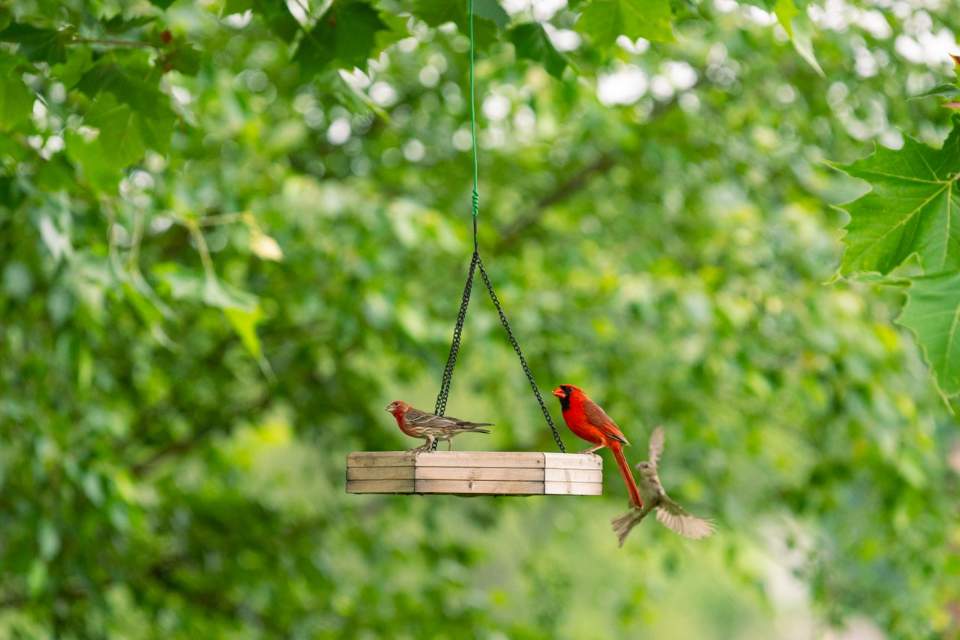
The House Finch is slightly smaller in total body mass and carries a shallower, more gently curved conical bill. This subtle structural variation gives the head a noticeably rounder, less angular silhouette profile than its sparrow neighbors.
Adult males display raspberry-red coloration concentrated on the forehead, throat, and upper breast. They also feature clean, well-defined brown parallel streaks running vertically along a bright white flank background.
This crisp flank pattern is the absolute primary separator from the Purple Finch, which lacks clean white borders along its torso side panels. Female House Finches are uniformly streaked brown overall and completely lack any reddish hues.
This plain plumage makes bill geometry the absolute primary tracking tool for identifying female-plumage birds. Much like sparrows, House Finches are dedicated social feeders that happily tolerate tight crowding at individual seed ports for several minutes at a time.
The Colorful Small Visitors
The American Goldfinch produces one of the most dramatic seasonal plumage transformations of any North American backyard bird. During summer, the breeding male displays brilliant lemon-yellow body plumage contrasted sharply by a jet-black forehead patch and black-and-white wings.
By October, a post-nuptial complete molt replaces every single yellow feather with a dull olive-brown alternative. This striking seasonal transformation is driven entirely by carotenoid pigment deposition during their late-winter molting cycles.
Functional research published in the journal Nature established that this carotenoid-based plumage coloration operates as an honest biological signal of overall male quality. The exact intensity of the yellow coloration directly reflects the individual bird’s structural nutritional health during feather development.
At feeding stations, American Goldfinches function as committed, long-duration perchers. They show a strong dietary preference for nyjer seed dispensed from specialized sock-style feeders or small-port tube feeders.
The Black-capped Chickadee represents a completely distinct behavioral profile within this small-bird category. Measuring roughly 5.25 inches in total length, it operates as the smallest common feeder bird across most regional properties.
Its primary diagnostic field marks consist of a cleanly defined black cap, a matching black bib, and a stark white cheek patch. This high-contrast arrangement produces a bold three-color head pattern that remains highly visible at a considerable distance.
At your feeding stations, these energetic birds execute a textbook snatch-and-retreat foraging strategy. This rapid movement path involves a direct flight approach, a brief 2 to 4 second contact with the seed perch, and the selection of a single sunflower seed.
The bird then departs immediately to a nearby sheltered branch to safely crack and process its food. This rapid cycling behavior cleanly distinguishes chickadees from all other garden visitors, while additional natural history detail on this species is fully documented at Black-capped Chickadee Facts.
What Medium-Sized Birds Frequently Visit Backyards?
The medium-sized bird category occupies the intermediate size bracket between your House Sparrow reference benchmark and the large American Crow. This transitional group is anchored perfectly by the American Robin at approximately 10 inches in total length.
The four highly adaptable species that dominate this intermediate category in regional residential zones are the American Robin, European Starling, Northern Cardinal, and Mourning Dove. Recognizing these distinct structural sizes helps your tracking loop instantly rule out smaller finches or larger birds of prey within the first second of observation.
The Lawn and Ground Foragers
The American Robin is one of the most instantly recognizable medium-sized birds across North America, carrying a diagnostic orange-red breast against a dark gray-brown back. The complete visual separation and field mark breakdown of this common species is covered fully at How to Identify an American Robin.
The robin’s ground movement kinetics operate as one of the most diagnostic behavioral field marks for any backyard species. It employs a distinctive run-and-stop hunting strategy on open lawn turf, running 12 to 24 inches in a rapid horizontal burst.
It then stops abruptly and stands fully erect in a classic vertical thrush posture before tilting its head laterally to visually locate earthworms below the soil surface. This tilted, alert stance between running bursts creates an unmistakable behavioral signature that remains highly visible from across your property.
The European Starling occupies a similar size bracket to the robin but presents a fundamentally different silhouette and behavioral profile. Starlings are characterized by a short, square tail accounting for approximately 20 percent of their body profile.
They feature a long, pointed yellow bill in breeding condition and an iridescent black-green plumage heavily speckled with white triangular spots. Starlings forage across open turf grass using a highly specialized open-bill probing technique.
They insert the closed bill into the soil surface and then force their mandibles apart to pry open a search hole. This foraging strategy is called gaping, a unique mechanical behavior among common yard birds that provides an instant behavioral identification cue.
The Flashy and Vocal Core
The Northern Cardinal is the most visually distinctive medium-sized resident across regional residential areas. The adult male’s entirely red plumage, black facial mask, and prominent pointed crest create a high-contrast field mark combination with zero ambiguity.
The female cardinal is no less structurally unique with her warm buff-tan body and reddish tinges on the wings and tail. Combined with the same deep orange conical bill that characterizes both sexes, this framework provides clear identification in all light conditions.
Cardinals are predominantly ground feeders in yard settings, preferring to forage below feeding stations for fallen seed rather than perching on hanging tubes. They are early morning and late evening foragers, with peak activity documented consistently in the hour after sunrise and the hour before sunset. Detailed guidance on their specific dietary preferences is available at What Do Cardinals Eat.
The Mourning Dove presents a strikingly different behavioral profile from the cardinal despite occupying a similar size bracket. Doves measure approximately 12 inches in total length, but their slim body plan and long pointed tail create a highly slender overall impression.
Their primary diagnostic field marks are a delicate black facial spot below the eye and a soft pinkish-buff breast coloration. They also feature an iridescent neck patch that produces a striking pink-to-green color shift depending entirely on your viewing angle.
Mourning Doves perch with a characteristic horizontal branch compression posture where the body is held parallel to the perch rather than erect. This creates a distinctly different silhouette from the upright cardinal or robin across your property columns.
They are strictly ground feeders that consume fallen millet and cracked corn rather than trying to balance at tube feeders. Their specialized ground foraging behavior and back-yard dietary preferences are covered in detail at What Do Mourning Doves Eat.
What Large Birds Are Commonly Found in Backyards?
The large-bird category encompasses species at or above the intermediate size range that visit North American residential properties with high regularity. The three primary species dominating this heavy-bodied bird tier are the American Crow, Blue Jay, and Northern Flicker.
All three species carry robust bill structures and produce loud, unmistakable acoustic signatures across your property columns. They possess highly specific behavioral patterns that make them instantly identifiable even at great distances where fine physical field marks are difficult to resolve.
The Intelligent Corvid Presence
The American Crow is the largest common yard bird on the eastern checklist, measuring 17 to 21 inches in total length. It features entirely glossy black plumage, a heavy straight bill suited for omnivorous foraging, and a fan-shaped tail that distinguishes it from the wedge-tailed Common Raven.
Crows are highly social birds that typically appear in tight family groups of 2 to 15 individuals within residential settings. They regularly produce a familiar, resonant call that many backyard observers easily recognize before ever seeing the bird in transit.
These intelligent birds forage across open lawns using a powerful walking stride to search your grass lines. They use their heavy bills to actively investigate leaf litter, probe turf, and manipulate large food items that smaller songbirds cannot process.
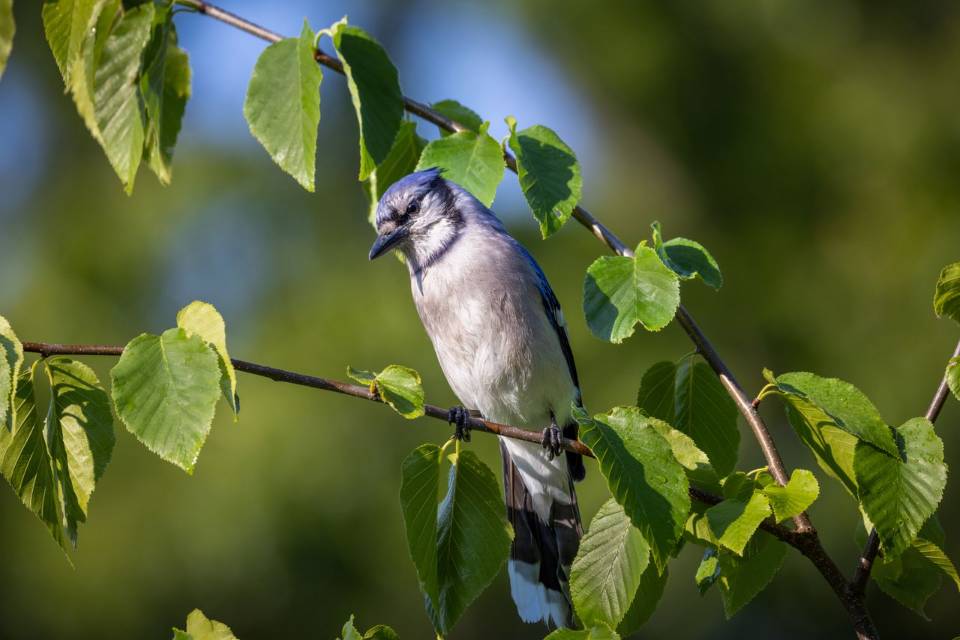
The Blue Jay operates as the most visually striking large bird in your regional backyard community. At approximately 11 inches in total length, it is smaller than a crow but substantially larger than a robin to anchor the upper end of the medium-to-large transition zone.
The Blue Jay’s diagnostic field marks include electric blue upperparts, black-and-white wing barring, and a distinct black necklace across the breast. It also carries a prominent pointed crest that raises and lowers in direct response to its current behavioral state.
A fully raised crest indicates immediate alarm or flock aggression, while a completely flattened crest indicates relaxed foraging. Reading this specific crest angle provides an instant behavioral assessment at any distance where the bird’s head profile is visible.
Long-term species profiles published by the Audubon Society Blue Jay Guide confirm that Blue Jays rank among the most cognitively sophisticated backyard visitors. They display well-documented food-caching behaviors and maintain complex alarm-call repertoires that include the mimicry of hunting hawk calls.
The extreme intelligence and social complexity of these species were rigorously documented in a landmark study published by the journal Science. Controlled experimental evidence established that corvids demonstrate advanced cognitive capacities including future planning, causal reasoning, and perspective-taking.
Blue Jays in North American backyards regularly display several of these advanced mental capacities in highly observable forms. Food-caching individuals consistently check that they are completely unobserved before burying acorns, and they will re-cache food items if they detect an intruder watching.
Understanding these advanced behaviors makes watching your local corvids an incredibly rewarding tracking experience. Additional guidance on drawing these colorful birds to your stations is available at How to Attract Blue Jays to Your Yard.
The Large Ground Woodpecker
The Northern Flicker is the only woodpecker that forages primarily on the ground rather than on vertical tree trunks. This specific behavioral distinction makes it one of the most surprising large birds that backyard observers encounter on their lawn turf.
At approximately 12.5 inches in total length, the flicker is substantially larger than both downy and hairy woodpeckers. It carries a distinctive field mark combination consisting of a brown-barred back, a black breast crescent, and a red or black mustache stripe depending on sex and subspecies.
Furthermore, it displays a diagnostic white rump patch that flashes conspicuously during takeoff and low-level level flight. Unlike typical bark-foraging woodpeckers, the flicker has evolved a diet heavily dependent on ground-dwelling ants and beetle larvae found in loose soil and decaying wood.
The flicker’s long, barbed tongue extends approximately 2 inches beyond the bill tip and is coated in sticky saliva. This highly specialized apparatus is specifically adapted for extracting massive ant colonies from their underground chambers.
This dietary specialization perfectly explains the flicker’s lawn-foraging behavior across your property columns. It is not a traditional feeder bird but is heavily drawn to yards by the simultaneous presence of mature nesting trees and open turf grass.
Why Do I See Different Common Birds in the Winter?
You see different common birds in your yard during the winter because two simultaneous biological processes alter the species composition of your local bird community between late October and March. The first major shift is continental migratory departure, which causes insectivorous summer residents to vacate their breeding territories and move south along established flyways.
Species like Eastern Phoebes, Baltimore Orioles, Gray Catbirds, and Wood Thrushes completely leave your residential neighborhood during this window. The second parallel biological process is the seasonal migratory arrival of hardy northern birds into your local ecosystem.
Species that breed in deep boreal forests and northern tundra habitats move south into temperate residential zones when their summer food supplies freeze or disappear entirely. The continent-wide database hosted on the official Project FeederWatch Identification Portal thoroughly documents these seasonal community shifts across North American zip codes.
This specialized tracking grid provides real-time population data and visual filters that reflect exactly these shifting migratory dynamics across your property columns. Recognizing this cyclical winter pattern prevents confusion when completely new flocks suddenly emerge at your feeding stations during the first heavy frost.
The Arrival of Winter Dark-Eyed Juncos
The Dark-eyed Junco stands as the signature winter arrival across most regional property grids, appearing at feeding stations from late October through early April. These hardy visitors measure approximately 6.3 inches in total length and showcase a highly striking color contrast.
They feature slate-gray or warm brown upperparts and hoods that finish abruptly against a clean white lower belly. This crisp plumage border creates an immediate silhouette marker that simplifies tracking even in dark winter weather conditions.
Their most iconic field identification asset is a pair of bright white outer tail feathers that hide while perching but flash open conspicuously during sudden flights. This fraction-of-a-second wing flash provides unmistakable visual confirmation when a flock flushes off your lawn turf.
Juncos are strictly ground foragers that prefer to scratch and hop through fallen seed below platform stations rather than trying to balance on elevated tube perches. They typically navigate residential columns in active, loose flocks containing 5 to 25 wintering individuals.
While foraging, they produce a sharp, high-pitched smacking chip call that rings out continuously across your hedges. This specific vocal signature differs completely from the standard chip notes of any other common native sparrow tracking grid.
How Migratory Shifts Change Your Checklist
Beyond the arrival of winter-specialist species like juncos, the transition to cold weather brings several major changes to your neighborhood tracking log. White-throated Sparrows and White-crowned Sparrows arrive steadily from northern breeding grounds to join ground-feeding stations.
Yellow-rumped Warblers remain significantly later into autumn than other warbler species because of their unique ability to digest waxy berry coatings. They appear in dense shrubs and suet feeders well into November, occasionally overwintering entirely in southern zones.
American Goldfinches retain active residency year-round across most of their range but shift completely into a dull olive-brown winter plumage. This radical molt makes them look like entirely unfamiliar visitors to observers who know them only in their brilliant summer dress.
The year-round resident species become proportionally more dominant in your yard’s bird community during the winter months. This shift occurs because the summer migrant species that diluted their relative abundance during the spring and summer have fully departed.
Cardinals, chickadees, house finches, house sparrows, crows, blue jays, and nuthatches now control the local feeding zones. This winter consolidation of resident species creates excellent conditions for precision identification practice right across your property columns.
The exact same individual birds return to your feeding stations daily to forage. They can be observed under extended, highly favorable conditions that field birders navigating wild, deep forest habitats rarely experience.
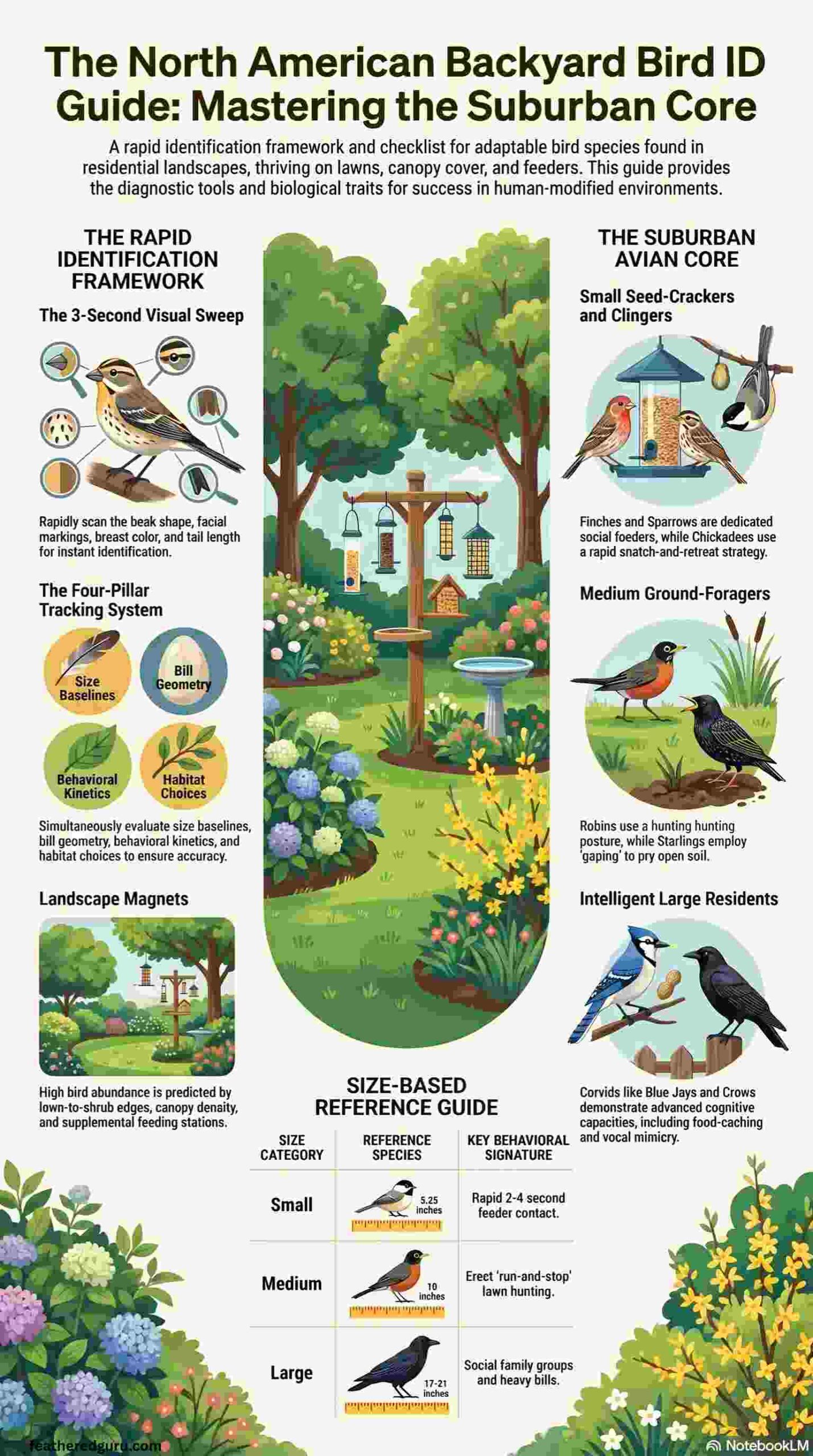
Visual Identification Breakdown: At-A-Glance Reference Chart
Reviewing a complete anatomical comparison map makes tracking confusing plumage marks much faster for backyard observers. This custom backyard bird identification infographic maps out distinct size classes, bill geometries, and plumage contrast lines across all common residential species to streamline your morning tracking counts.
Building Your Personal Tracking Log
The foundational checklist documented in this guide represents the starting point of a genuinely productive backyard birding practice rather than its endpoint. Every species described here carries natural history depth well beyond the field marks used to identify it, flashing specialized nesting behaviors and seasonal movements that unfold continuously through sustained observation.
The structured framework described in this guide and detailed in our master Backyard Bird Identification Guide provides the exact observational blueprint needed to move smoothly from casual noticing to systematic documentation. Logging every confirmed identification through the official eBird Platform transforms your individual yard observations into part of a continent-scale citizen science database.
This global grid actively tracks critical population trends, range shifts, and phenological changes across all species on this checklist. Conservation programs published by the Audubon Society emphasize that this active citizen science participation has direct, real-world preservation value.
Population trend data generated by backyard tracking networks directly informs species protection policies and habitat conservation priorities at federal and state levels. Pairing your visual identification skills with high-utility resources like suet cakes and fresh water converts a passive yard into a high-productivity wildlife corridor.
The bird species on this foundational checklist collectively represent the full range of bill archetypes and foraging behaviors that characterize North American avian life. Mastering them thoroughly is a permanently useful foundation on which every advanced identification skill and every meaningful yard count is built.
If you want to review the core behaviors and habitat setups for these species in deeper detail, refer back to our foundational Common Backyard Birds Guide. Connecting your systematic daily tracking data with these primary field-craft profiles creates an ironclad diagnostic routine to master your morning property counts flawlessly.