
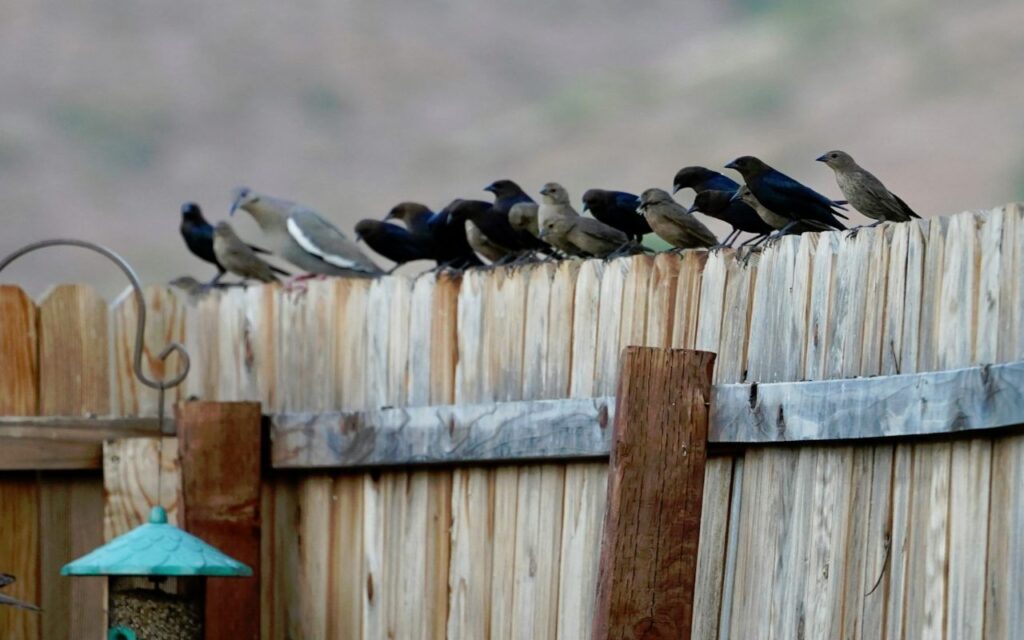
A backyard bird identification guide is a structured forensic framework that trains your eye to decode four overlapping backyard bird species field marks simultaneously: silhouette, bill geometry, plumage borders, and kinetic signature. Gathering these fast structural clues lets you identify birds in your yard in less than three seconds.
This practical visual blueprint translates complex field research into clear, teachable diagnostic principles you can internalize within a single season of focused watching. Mastering these simple tracking shortcuts teaches you to read every yard visitor as a living biological document rather than a frustrating mystery solved by pure luck alone.
Quick Answer: What Is the Easiest Way to Identify Backyard Birds?
The easiest way to identify birds in your yard is to decode four overlapping backyard bird species field marks simultaneously: structural silhouette, precise bill geometry, exact plumage contrast boundaries, and their kinetic motion signature. Evaluating these rapid structural indicators in a deliberate top-to-tail sequence allows you to confidently categorize unknown yard visitors within three seconds without relying on variable feather colors.
Bird Identification Made Simple: A Video Guide to Tracking Yard Visitors
Visual Guide: Watch this quick video explainer to see exactly how to identify common birds by looking at their body shapes, beak styles, and movement patterns. This detailed briefing shows you how to spot hidden physical markers and read different flight paths, helping you confidently tell look-alike birds apart without needing a lucky close-up view.
Show Transcript:
0:00
Okay, let’s jump right into this explainer because I am so excited to share exactly how I completely transformed my frustrating, honestly
0:07
secondskind of chaotic backyard bird watching into this incredibly precise, lightning fast biological tracking system. If you’ve ever stood there staring out your
0:16
kitchen window, totally wondering what on earth is eating your bird seed, you are absolutely in the right place.
0:21
Today, I’m going to walk you through exactly how I learned to read field marks like an actual forensic investigator. I’ll totally admit my early days of backyard birding were just
0:30
incredibly frustrating. I kept asking myself, why am I so bad at identifying the birds literally in my own backyard?
0:37
Well, I realized my process was terrible. I used to just stare at a bird’s main overall color, panic, and then helplessly flip through a massive
0:44
guide book just praying I’d find a matching picture. And obviously, by the time I actually found the right page, the bird was long gone. I was basically
0:51
relying entirely on getting lucky close-ups. And frankly, it just wasn’t working at all. But then my massive breakthrough happened. I had this real
1:00
light bulb moment where I finally stopped guessing and I started reading every single yard visitor as a living biological document. I realized that if
1:07
I wanted to actually get good at this, I needed a systematic evidence-based tracking routine. I had to stop relying on random chance and start actually
1:15
looking at the structural clues nature was literally handing to me. To pull this off, I started training my brain for an ornithological concept called
1:24
gestalt recognition. Now, what does that mean? It’s basically the ability to immediately perceive the entire organism before you consciously analyze even a
1:33
single feather. I mean, it sounds a little like magic, right? But it’s actually this highly learnable cognitive shortcut. By breaking the process down,
1:40
I developed a system that literally lets me identify a bird in under 3 seconds.
1:45
So, here is exactly how I do it. I built this brand new four-step tracking routine, and I run through this every single time something lands in my yard.
1:54
First, I evaluate size and shape. That takes me about 1 second. Then, I scan color patterns for maybe 2 to 4 seconds.
2:00
After that, I watch their behavior for about 5 to 15 seconds. And finally, I passively assess the habitat context.
2:06
You know, where exactly in my yard are they hanging out? Let’s break down exactly how I applied this first step to my own yard. To really conquer size, the
2:14
first thing I did was stop guessing inches. Let’s be real, we humans are terrible at guessing inches from 20 ft away. So instead, I just started
2:22
comparing every unknown bird silhouette to three mental benchmarks I created. My small baseline is the 6.3 in house
2:29
sparrow. My medium baseline is the 10-in American robin, and my large baseline is the heavy 17 to 21in American crow. Now,
2:37
any bird that shows up gets instantly slotted into one of these brackets. So, if it’s larger than a robin but smaller than a crow, boom, I instantly know I’m
2:45
likely looking at a hawk or maybe a large woodpecker right in second. But here is where I realized I had this massive almost unfair advantage over
2:54
fielders out in the wild. I don’t just have mental benchmarks. I have physical ones. I started using my own backyard infrastructure as instant calibration
3:03
scales. Think about it. My wooden fence rails are exactly 1 and 1/2 to 2 in thick. The wire mesh on my sew it cages exactly a 1 and 1/2 in opening. The
3:11
feeder purchase are right around 3/8 to 1/2 in. I suddenly realized I could accurately estimate a bird’s entire length or how thick its beak is just by
3:19
seeing it next to my sew cage without ever needing to touch the bird. And speaking of beaks, oh man, looking closer at the head literally changed
3:26
everything for me. I started noticing that beak geometry isn’t just random.
3:30
It’s this incredibly specialized tool shaped by millions of years of diet. If I see a deep conicle bill, I immediately know it’s a seed crushing finch or gross
3:38
beak. If I see a slender needleike bill, that’s a warbler or ren designed for probing for insects. And a flat chisel
3:44
hammer is undeniably a woodpecker. By the way, fun fact, I learned that woodpecker bill architecture is so structurally incredible that it safely
3:52
absorbs 1200 gs of deceleration force. I mean, that is just wild. But even within those broad categories, I realized the
3:59
beak tells a much deeper story. For example, I started noticing the relatively shallow, gently curved bill of my house finches. And then I compared
4:07
it to the dramatically deeper, bright orange red bill of the northern cardinal, which is structurally engineered for cracking much tougher seeds. So just by looking at the beak
4:15
depth, I’m sorting these birds into specific families before I even glance at their feathers. Once I’ve nailed down their size and beak shape, my eyes
4:22
immediately dart to color patterns. But specifically, I check seven precise facial zones. Instead of getting distracted by broad overall background
4:30
colors, which trust me is a classic beginner mistake I used to make constantly, I’m hunting for the super psyllium, which is basically the bird’s eyebrow. I check for an ey line, the mer
4:39
stripe, which kind of looks like a mustache. I’m actively looking for contrasting borders and lines, not just asking, is it brown? Scanning this
4:46
facial topology narrows my candidate list from, say, 15 possible species down to just two or three in about 3 seconds.
4:53
Now, what if I don’t get a good look at the face? Like say the bird is turned away from me. In that case, I immediately hunt for sharp color
5:01
boundaries on the body. Two massive clues that always help me out are wing bars and rump patches. I’ll look for the presence or absence of contrasting
5:09
horizontal lines on the wings. Or my absolute favorite, that bright lemon yellow rump patch that instantly, without fail, gives away a yellow rumped
5:17
warbler as it flies away from me. It’s literally like a flashing neon sign that you can read from clear across the yard.
5:24
But what if the bird isn’t sitting still? Well, that brings me to behavior.
5:28
And I found this fascinating. I realized I could identify a bird just by watching how it crossed my lawn. Sparrows, finches, and junkos, they do this
5:37
distinctive two-footed bounding hop, mostly because they evolved to live up in shrubs and trees. But ground feeders like my American robins and morning
5:45
doves, they walk using alternating strides. Just noting that simple hop versus walk instantly cuts my list of potential species completely in half.
5:54
Looking up, I started mapping their flight paths, too, because physical flight constraints create these highly predictable kinetic signatures. My
6:02
American goldfinches always undulate in this rhythmic rising and falling bounding wave. Once you see it, it’s unmistakable. But then you look at my European starings and morning doves.
6:12
They shoot across the yard in this incredibly fast, straight, direct horizontal line with continuous wing beats. So now I can identify them in
6:20
midair before they even land. Even at the feeder itself, their personality is such a massive clue. Take my black
6:27
capped chickadees. They always execute this rapid 2 to 4 second snatch and retreat. They dive in, grab one single
6:35
seed, and instantly fly off to a hidden branch to eat it. But my house finches and goldfinches, oh, they are entirely committed to what I call the social sit.
6:44
They will stubbornly sit right there on the perch for minutes at a time, just feasting, and they completely refuse to leave even if other birds show up. So,
6:53
the absolutely crucial point here is that this exact framework finally helped me separate my trickiest look alikes.
6:59
Let’s take the house finch versus the purple finch. They both just look like small reddish birds, right? But using my system, I now check the flank streaks.
7:07
The male house finch has these clean brown streaks on a white background along with a curved upper bill. Knowing that, I can easily separate it from the
7:16
purple finch, which has this messy, completely rosy raspberry wash all over its flank and a very straight flat bill.
7:23
So, no more guessing for me. And how about the most famous look alikes of all, the Downey versus the hairy woodpecker? I mean, their black and white plumage is literally identical.
7:32
So, what did I do? I completely stopped looking at their backs. It’s a trap.
7:37
Instead, I just check the bill to head ratio. The Downeyy’s stubby little bill is less than 40% of its total head depth. But the Harry’s massive spike of
7:45
a bill is equal to or even greater than its entire head. It’s just a single structural measurement, but it works perfectly every single time. I even
7:53
learned to effortlessly tell my native chipping sparrows apart from those invasive house sparrows. Again, I train myself to look past the general brown
8:01
bodies. The chipping sparrow has this really crisp rufus crown, a clean white eyebrow, and a totally unmarked pale gray breast. But the stocky male house
8:10
sparrow, he sports a dark gray crown, and this massive, super obvious black throat bib. Plus, once I started paying attention, I noticed the house sparrow
8:18
has a much thicker, heavier seed cracking beak. You know, applying this journey also totally cured my panic over those weirdl looking birds that showed
8:26
up in my yard every summer. Honestly, I used to think they were sick. But applying my new approach, I learned that those short-tailed fluff balls with the
8:35
weird yellow gape flanges on their mouths, they’re literally just fledglings begging their parents for food. And my completely bald northern cardinals, they aren’t diseased at all.
8:44
I realize they are just going through a totally normal, healthy midsummer mol where they happen to drop all their head feathers at once. I also finally stopped
8:53
accidentally reporting new species in the winter, realizing that birds, well, they change clothes. My brilliant lemon
9:00
male American goldfinch naturally molts every single autumn into this dull olive brown camouflage. I discovered
9:08
it’s this deliberate evolutionary trade-off to hide from raptors against the bare winter landscape. It’s the exact same bird in my yard. He’s just
9:16
wearing a totally different survival suit. So, now that I’ve transformed my own chaotic yard into this structured, highly predictable ornithological study
9:24
site, I have a challenge for you. Take these four pillars, size, color boundaries, behavior, and habitat, and go look out your window. Apply this
9:32
forensic framework today. Stop guessing based on overall colors, and tell me, armed with this totally new vision, who is actually visiting your backyard right now.
9:42
End.
What Is the Easiest Way to Identify Backyard Birds?
The overarching methodology used by professional ornithologists to identify an unknown bird in the field rests on four sequential diagnostic pillars. According to The Cornell Lab of Ornithology, these primary foundational tracking pillars consist of Size and Shape, Color Pattern, Behavior, and Habitat context.
These categories do not operate as independent checklists, but rather form an interlocking identification loop where each unique data channel actively validates or challenges adjacent structural observations. Size and shape provides the underlying structural skeleton of an identification before fine plumage color details are even resolved by the human eye.
Color pattern systematically narrows the remaining candidate pool by isolating sharp coloration contrast boundaries within that physical matrix. Behavior permanently locks in the identification by matching the visitor’s real-time movement physics to the known kinetic signature of a specific avian family.
Finally, habitat context eliminates outliers by filtering for species that realistically occupy that precise microenvironment. Applied in sequence, these four structural criteria transform every backyard encounter from a guessing game into a systematic, evidence-based tracking routine.
The core mechanism behind this multi-channel reading is gestalt bird identification, an ornithological concept describing the immediate mental perception of a whole organism before any individual plumage mark is consciously analyzed.
Expert field observers develop this cognitive shortcut through focused repetition, but every distinct layer of that perceptual strategy remains fully learnable as a deliberate, step-by-step diagnostic framework.
The Four Pillars of Field Identification
Each foundational tracking pillar operates on a completely different observational timescale. Size and shape typically delivers a usable structural answer in approximately one second.
Color pattern requires two to four seconds of focused scanning to isolate sharp coloration contrast boundaries. Behavior yields its diagnostic family verification over the first five to fifteen seconds of active tracking.
Habitat context is assessed passively before an unknown visitor even arrives on your property. This baseline evaluation is completed simply by noting where in the yard the bird appeared and what specific vegetative microhabitat structure it chose.
When all four data channels are read in this precise sequence, the tracking loop is typically complete. This automated recognition happens before most observers would even consider reaching for a printed field guide.
The true reward for mastering this interlocking system is genuine observational fluency across your entire property. This cognitive shortcut grants you the ability to identify yard visitors under difficult low-light conditions or at significant distances.
It even allows you to track species during the fraction-of-a-second flight gap that occurs between a feeder post and a dense perimeter shrub. Every element of that perceptual speed is built from this same four-part diagnostic framework applied repeatedly until the tracking steps become fully automatic.
How Do You Measure a Bird in Your Yard?
Backyard observers have a significant identification advantage that field birders in open habitat lack by utilizing fixed reference objects. A standard wooden fence rail is typically 1.5 to 2 inches thick, providing an immediate structural baseline.
A cylindrical feeder perching rod is commonly 0.375 to 0.5 inches in diameter. A suet cage wire mesh opening spans approximately 1.5 inches across its entire grid.
These fixed measurements serve as instant calibration scales on any smartphone viewport or binocular field of view. This spatial layout allows the observer to estimate a bird’s total length or bill depth with reasonable accuracy without ever touching the subject.
Anchoring size estimates to familiar backyard structures is one of the fastest ways to compress the candidate pool during an identification. For example, a bird whose total body length spans roughly four suet cage wire openings from bill tip to tail tip measures approximately 6 inches.
This calculation places the unknown visitor squarely in the sparrow-to-warbler size range. Conversely, a bird whose bill depth clearly exceeds one suet cage wire opening carries a structural thickness far too deep for any warbler or sparrow.
This immediate anatomical realization points your tracking loop straight toward the finch or grosbeak families. Recognizing these structural proportions allows you to eliminate dozens of mismatched species before evaluating fine plumage colors.
How Do I Identify a Bird by Its Silhouette?
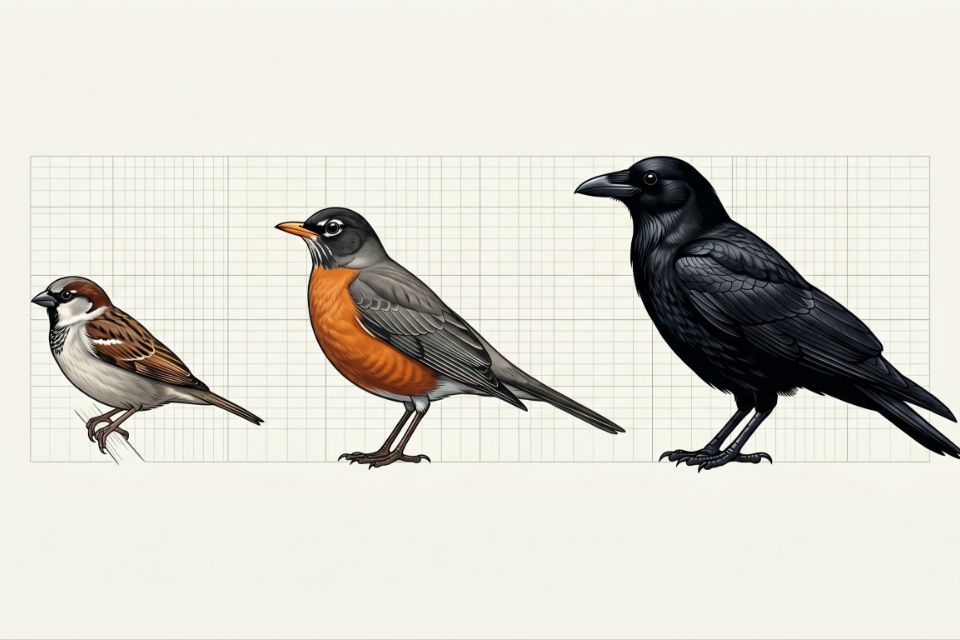
Differentiating bird species by size and shape requires anchoring every unknown visitor against three baseline benchmarks that most North American backyard observers already know by sight. These three benchmark species form what ornithologists call a relative size reference ladder.
Before any color or bill detail is examined, comparing an unknown visitor to these three standards assigns it to a specific category. This structural scaling process places the bird into one of five usable size brackets consisting of very small, small, medium, large, and very large.
What Are the Core Sizing Benchmarks?
The House Sparrow anchors the small baseline at approximately 6.3 inches in total length and 0.9 ounces in body mass. Any backyard visitor noticeably smaller than this species falls into the micro-bird category occupied by kinglets, gnatcatchers, or warblers.
The American Robin anchors the medium benchmark at approximately 10 inches in total length and 2.7 ounces in weight. This intermediate sizing reference point represents a structural mass that almost every North American observer recognizes instantly.
The American Crow anchors the large benchmark at approximately 17 to 21 inches in total length and up to 22 ounces. Evaluating an unknown bird against this heavy corvid profile eliminates the largest categories of family misidentification before fine plumage marks are even examined.
Positioning every unknown visitor relative to these three baselines eliminates massive chunks of misidentification early. For example, a visitor clearly larger than a robin but smaller than a crow occupies the hawk or woodpecker size class.
Conversely, a visitor sharing the exact length of a sparrow but displaying a noticeably thinner body depth falls into the warbler or vireo range. These broad structural comparisons keep your tracking loop accurate without requiring a lucky close-up glance.
Beyond raw physical length, the tail-to-torso ratio provides a secondary silhouette marker of equal diagnostic field value. A Northern Mockingbird’s tail accounts for roughly 50 percent of its visible silhouette, whereas a European Starling’s short tail accounts for only 20 percent of its outline.
This structural proportion is readable at great distances where feather coloration and bill shapes are completely unresolvable. Recognizing these mass differences makes torso scaling a critical early-stage filter during low-light or distant backyard sightings.
How Does Bird Posture Help with Identification?
Structural body posture produces an equally diagnostic silhouette signature that remains visible in heavy shade or deep backlighting. A vertical alert posture is characteristic of species in the thrush family, including the American Robin, which stands erect with its spinal column nearly perpendicular to the ground when scanning for prey.
This upright stance creates a distinctive tall, slender silhouette profile that stands out cleanly along open lawns or fence lines. By contrast, a horizontal branch compression posture is characteristic of flycatchers and doves, which sit with the body held parallel and close to the perch.
This low position produces an elongated, horizontal silhouette that minimizes their physical exposure to wind and airborne predators. Warblers hold an intermediate posture, typically angled at 45 degrees across branches while actively gleaning insects from the undersides of foliage.
Conversely, sparrows adopt a hunched, compact posture that compresses their visible neck length to nearly zero, creating a highly spherical silhouette profile. Recognizing these postural signatures allows observers to assign an unknown bird to its approximate family in the first second of observation.
This rapid identification happens well before any fine plumage detail or feather coloration boundary can be resolved by the human eye. The detailed breakdown of the American Robin’s characteristic upright posture and its separation from similarly-sized thrushes is covered fully at How to Identify an American Robin.
How Do You Identify Birds by Beak Shape?
Among all the anatomical field marks available to a backyard observer, bill geometry provides the most reliable and family-specific diagnostic signal. The architecture of a bird’s bill is the product of millions of years of evolutionary pressure from a single source: what the bird eats and how it captures that food.
Research published in the Journal of Experimental Biology demonstrates that bill depth, width, and curvature are the primary functional predictors of maximum bite force performance. These precise morphological dimensions confirm that mandible shape is a direct dietary adaptation rather than an arbitrary anatomical variation.
Understanding three primary bill archetypes covers the vast majority of species that visit North American backyards. Recognizing these distinct structural silhouettes allows you to instantly determine an unknown bird’s family branch before checking any fine plumage colors.
How Do Finches Crack Open Seeds?
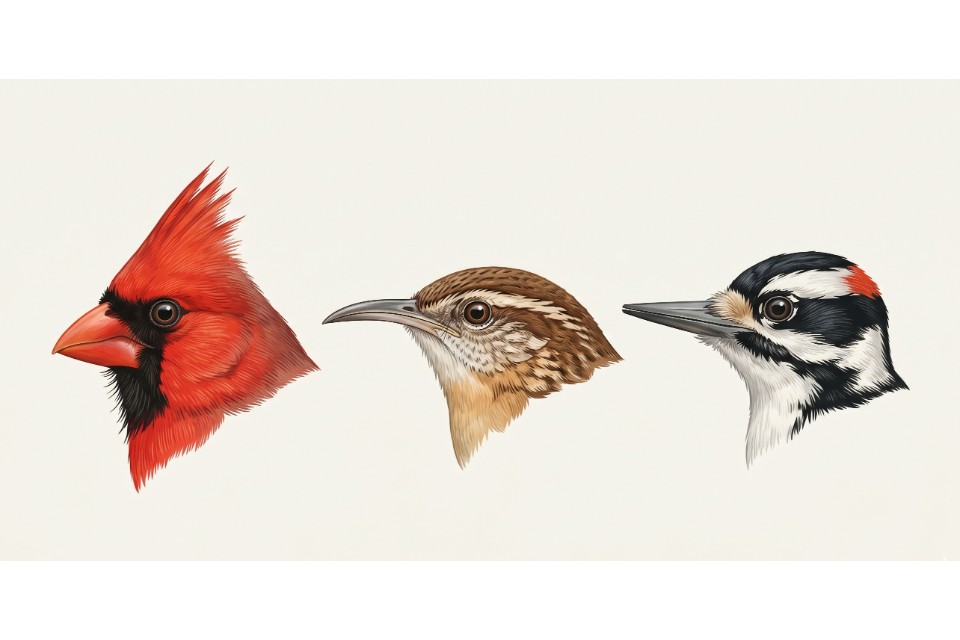
The conical bill is the diagnostic marker of the seed-cracking finch family and its close relatives. This specific bill type is characterized by a deep, laterally compressed triangular cross-section and a strongly curved upper mandible called the culmen.
This anatomical layout creates a thick base depth that exceeds the bill’s visible length in large-billed species like Evening Grosbeaks and Northern Cardinals. The mechanical advantage generated by this triangular geometry allows these birds to apply immense crushing forces that would be completely impossible with a thinner bill profile.
The evolutionary relationship between bill depth and dietary specialization is clear. According to the journal Science, landmark field research on character displacement demonstrated that even microscopic differences in bill depth produce measurable variations in the range of seed sizes a bird can crack efficiently.
This functional separation explains why closely related species that share territory consistently diverge in bill geometry over evolutionary time. In the North American backyard context, this biological principle explains the visible gradient from the relatively shallow House Finch bill through the moderate Cardinal bill to the massively deep Evening Grosbeak bill.
Each distinct mandible shape is precisely calibrated to crush a progressively tougher seed hull without fracturing the underlying bone structure. Within this broad conical bill category, bill-to-head proportions provide the absolute key separator between look-alike yard species.
House Finches show a relatively shallow, gently curved conical bill that appears small relative to total head size. Conversely, Northern Cardinals show a dramatically larger, deeper conical bill with an orange-red coloration that contrasts sharply with the surrounding facial plumage.
Evening Grosbeaks carry the most extreme conical bill variant in the eastern backyard context, displaying a massive bill depth that approaches or exceeds the bird’s total eye diameter. Evaluating these broad structural outlines allows you to confidently categorize seed-eating species before checking fine wing bars or tail stripes.
What Kind of Birds Have Slender Needle-Like Bills?
The slender needle-like bill defines the insectivore guild within backyard bird communities. This specific bill type is characterized by a fine pointed tip, minimal lateral compression, and a straight or gently down-curved culmen line.
The physical length of this beak typically exceeds the bird’s total head depth by a factor of 1.5 to 2. Species carrying this delicate instrumentation include Carolina Wrens, Brown Creepers, and the entire warbler family.
The functional logic behind this shape is straightforward. Forcing a thin rigid probe into bark fissures, leaf litter crevices, or rolled leaf tubes requires precision and a narrow profile rather than massive crushing force.
The curvature of the culmen adds a critical secondary diagnostic layer within this category. Carolina Wrens show a moderately down-curved bill that allows them to probe deeply under loose backyard bark flaps and into curved branch channels.
Conversely, Brown Creepers show an even more pronounced downward curve structurally adapted for following the contour of a tree trunk while scaling upward. Straight, fine bills in the exact same size class indicate warblers foraging directly on the surface of leaf tissue rather than probing into tight substrate.
Matching the degree of culmen curvature to the most likely foraging substrate immediately separates look-alike species that share this needle-bill archetype. This anatomical evaluation allows you to confidently sort insect-eating birds before checking for subtle facial markings or tail bands.
How Do You Identify a Woodpecker by Its Bill?
Woodpecker bills represent one of the most structurally extreme bill architectures in the bird world. The chisel hammer bill is characterized by a straight, laterally flattened profile and a blunted chisel-edged tip.
This specific blueprint sits on a skull-reinforced base that distributes immense impact energy across specialized bone structures rather than concentrating force at a single point. According to the journal PLOS ONE, advanced skull bone mapping demonstrated that this integrated shock absorption architecture comfortably manages deceleration forces exceeding 1,200 g.
This incredible anatomical layout allows the bird to execute high-speed drumming sequences without sustaining traumatic head injuries. The diagnostic field feature for the most common look-alike pair in the backyard woodpecker guild is the bill-to-head ratio.
Downy Woodpeckers show a petite bill that measures significantly less than half the total visible head depth from forehead to throat. Conversely, Hairy Woodpeckers show a robust bill that matches or exceeds that total head depth line completely.
This substantial spike-like proportion appears almost disproportionately large relative to the bird’s overall body framework. Tracking this single measurement resolves the identification in all light conditions and at any angle where the head profile is visible.
What Are the Most Important Field Marks on a Bird?
The most common mistake made by beginning backyard observers is attempting to identify birds by their dominant background color. Instead, highly accurate tracking relies entirely on scanning the precise contrast boundaries where two adjacent color fields meet.
A House Sparrow and a Song Sparrow both appear broadly brown at a casual glance. Similarly, a Purple Finch and a House Finch both appear superficially reddish to an untrained eye.
The actual diagnostic information is carried exclusively by the exact edges, stripes, and transition zones between these adjacent color regions within the plumage. According to field identification guidelines published by the Audubon Society, structural and boundary-based features consistently outperform color alone as primary tracking criteria.
This baseline visual reliance becomes especially critical when managing variable outdoor light conditions or heavy backlighting across your property. Focusing on these sharp borders allows you to instantly separate close look-alike species before getting distracted by changing feather hues.
How Do You Read Bird Facial Patterns?
The avian head contains the highest density of diagnostic field marks per square centimeter of any body region. Learning the precise anatomical terminology for these specific zones unlocks the precision vocabulary needed to separate look-alike species reliably.
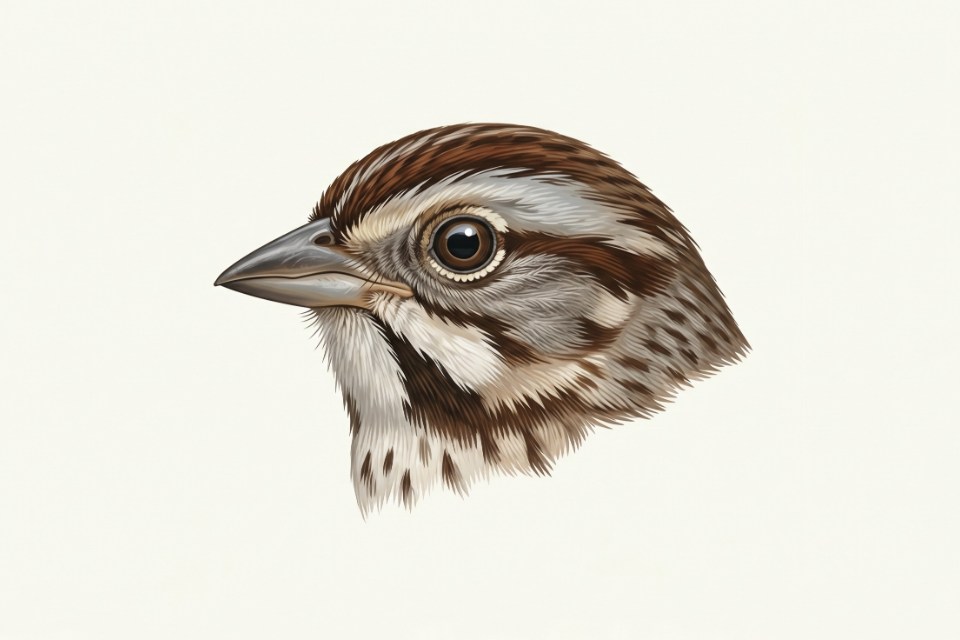
The supercilium is a horizontal eyebrow stripe running above the eye from the bill base toward the rear of the crown. A bold white eyebrow line on a White-throated Sparrow separates it instantly from similar sparrows that lack this feature.
The eye line runs horizontally through the center of the eye, creating the diagnostic dark mask of species like the Common Yellowthroat. Conversely, the malar stripe runs diagonally downward from the base of the lower mandible, defining a mustache region on species like Lincoln’s Sparrow.
The crown stripe runs longitudinally along the top of the head and is frequently split by a median line in many sparrow species. Surrounding the iris, the eye ring forms a complete or partial ring of contrasting color present in Nashville Warblers and most vireos.
The loral region between the eye and the bill base frequently carries a contrasting dark or pale patch that contributes to the diagnostic facial mask pattern. Finally, the ear patch behind the eye completes the seven-zone facial topology that fully characterizes any backyard bird’s head pattern.
Reading these seven facial zones in deliberate sequence during a field encounter provides more identification data than studying the bird’s entire body plumage. A systematic head scan takes approximately three seconds and typically narrows a candidate list from fifteen possible species down to two or three.
What Do Wing Bars and Rump Patches Tell You?
Beyond the head, two additional color contrast zones carry outsized diagnostic importance across your property. These critical visual landmarks consist of wing bars and rump patches.
Wing bars are bright, contrasting horizontal bands formed by the white or buff tips of the upper wing feathers. The number of visible wing bars, their width, and their color contrast against the surrounding wing panel separate dozens of superficially similar species.
For example, two bold white wing bars on a species with olive-green upperparts immediately narrows the candidate pool to a small set of warblers and vireos. Conversely, one weak, buffy wing bar on a brown-streaked bird points your tracking loop straight toward specific sparrow species.
The complete absence of wing bars on an otherwise warbler-shaped bird eliminates most of the wood-warbler family entirely. This visual exclusion instantly directs your attention toward vireos, gnatcatchers, or kinglets instead.
Rump patches, the contrasting color field visible just above the base of the tail during flight, provide an equally powerful in-flight identification marker. The bright lemon-yellow rump of the Yellow-rumped Warbler is visible at distances where all other field marks are completely unresolvable.
This sharp coloration contrast makes it one of the most reliable in-flight identification cues in the backyard bird community. Similarly, the white rump patch of the Northern Flicker flashes conspicuously as the bird takes flight from a lawn foraging position.
This bright flash provides an instant identification even when the bird’s face and breast pattern are not visible. This highly reliable distance data is consistently cataloged across the official AllAboutBirds species species index.
How Can You Tell a Bird Species by Its Movement?
Movement operates as a highly reliable field mark across your entire property. Every avian family produces a characteristic kinetic signature in its locomotion, foraging posture, and flight trajectory that is as diagnostic as any plumage feature.
Biomechanical overviews published in the Journal of Experimental Biology document that these shared flight constraints create highly predictable, family-specific motion dynamics that aid in field recognition. These underlying biological constraints mean that flight path geometry is not a learned behavioral habit but a physical consequence of the bird’s body architecture.
This strict mechanical dependency makes movement styles a fully reliable, unshakeable diagnostic signature for the observer. Furthermore, long-term backyard data collected by Project FeederWatch documents behavioral patterns for common feeder species that precisely align with these kinetic tracking principles.
Does the Bird Hop or Walk on the Ground?
Ground movement patterns provide one of the fastest initial family-level identifications available to a backyard observer. A hopping gait is the primary locomotion mode of perching birds that spend most of their lifecycles in shrubs and canopy trees.
During this movement, both feet leave the substrate simultaneously with each forward bound. House Sparrows, White-throated Sparrows, American Goldfinches, and Dark-eyed Juncos all utilize this specific bounding motion exclusively when foraging on the ground.
Conversely, a walking stride is the natural gait of ground-feeding species that evolved primarily for terrestrial movement. In this mode, one foot advances forward while the opposite foot remains planted to maintain balance.
American Robins demonstrate this by running and stopping in characteristic fast bursts when hunting earthworms in lawn turf. European Starlings walk with a highly deliberate, slightly waddling stride across open, flat grass surfaces.
Common Grackles stride confidently across open lawns without hopping. Similarly, Mourning Doves walk with a distinctive head-bobbing gait that is perfectly synchronized to each forward step.
Identifying the specific gait pattern within the first second of a ground observation immediately assigns the bird to a broad locomotion class. This rapid behavioral filter instantly narrows your candidate species list by half before you evaluate any physical plumage colors.
What Is the Difference Between Bounding and Direct Flight?
Flight path geometry provides reliable family-level identification at distances where no fine physical detail is resolvable against the sky. An undulating bounding flight is the characteristic trajectory of most finches and woodpeckers across your property.
This specific motion is produced by alternating rapid powered flap bursts with closed-wing glide phases. This combination creates a distinctive rise-and-fall wave path that remains highly visible even in low-light conditions.
American Goldfinches serve as the classic backyard example of this style. Their pronounced, rhythmic wave pattern makes their flight trajectory instantly recognizable from a distance of over 200 meters.
Woodpeckers demonstrate a deeper, slower variation of this wave by utilizing longer closed-wing glide phases between their flap bursts. This structural adaptation creates a more exaggerated, plunging trajectory than the tight, rapid undulation pattern of small finches.
Conversely, a direct level flight with continuous wingbeats is the signature trajectory of Mourning Doves, European Starlings, and most blackbirds. These species travel in straight horizontal lines across the yard without any rising or falling dips.
They utilize rapid, uninterrupted wing motions that frequently produce an audible rushing sound at close range. Pigeons and doves also generate a sharp, structural wing-clap sound at the exact moment of takeoff.
This sudden sound acts as a highly distinctive acoustic signature before the bird is even visually located. Recognizing these two primary flight path styles allows you to instantly categorize birds in transit before they ever land on a feeder or branch.
How Do Different Birds Act at a Feeder?
Feeder interaction style operates as one of the most precisely reproducible behavioral field marks available to the backyard observer. Black-capped Chickadees and their close relatives execute a characteristic snatch-and-retreat foraging strategy at your feeding stations.
The bird approaches the station in a rapid direct flight line, grips the perch rod with both feet, and selects a single seed with a quick head turn. It then departs immediately to process and crack that seed on a nearby sheltered tree branch.
The entire feeder contact phase lasts approximately 2 to 4 seconds from arrival to departure. This specific behavioral pattern repeats with remarkable consistency across all individuals within the chickadee family.
House Finches and American Goldfinches, by contrast, are committed social feeders that occupy perch rods for extended durations. They sit at feeder ports for 30 seconds to several minutes while actively cracking and consuming seeds in place.
These finches tolerate close proximity to other birds and will actively resist leaving the station even when intruders attempt to displace them. Conversely, nuthatches approach bird feeders by landing directly on the main housing frame rather than the perch rod.
They then execute a distinctive headfirst downward walk along the vertical surface to reach the food access point. This inverted postural behavior is completely diagnostic to the nuthatch family and immediately separates them from all other feeder visitors.
Finally, Carolina Wrens approach your stations using a low, bouncing flight path that terminates on a branch just below the food tray. They pause briefly before hopping vertically upward to the seed level, a characteristic trajectory not seen in any other common garden bird.
How Do You Tell Look-Alike Bird Species Apart?
Certain backyard species pairs generate a massive share of identification confusion because they share identical territory, similar size, and superficially overlapping plumage. Resolving these tricky look-alike pairings requires focusing your diagnostic attention on a very small number of high-precision anatomical features rather than attempting a broad, whole-bird comparison.
The most commonly confused species pairs in backyard settings each possess a single, reliably visible key marker. Isolating these hyper-specific checkpoints allows you to resolve the identification loop in all light conditions before getting distracted by general body colors.
How Do I Tell a House Finch From a Purple Finch?
This pair generates consistent identification confusion because both species show red-washed males at backyard feeders throughout much of the eastern and central United States. The resolution depends on two features examined in sequence.
First, check the flank streaking pattern. The male House Finch shows clean, well-defined brown streaks on a white flank background that run in parallel lines from the breast down to the undertail coverts. The male Purple Finch shows a rosy-raspberry wash that suffuses the entire breast and flank region, with much less distinct streaking and no clean white background field.
Second, check the culmen line (the top ridge of the upper mandible). The House Finch culmen shows a gentle, continuous curve from base to tip. The Purple Finch culmen shows a nearly straight, flat profile that gives the bill a more angular appearance when viewed from the side.
Female plumage in this pair is resolved by the same culmen check combined with facial pattern contrast: female Purple Finches show a bolder white supercilium and more defined malar stripe than the duller, more uniformly streaked female House Finch.
The complete separation of these two species is documented at House Finch vs. Purple Finch.
This specific pair generates consistent identification confusion because both species show red-washed males at backyard feeders across overlapping winter territories. Resolving this tricky look-alike dilemma depends entirely on checking two distinct physical features in a clear, sequential order.
First, evaluate the flank streaking pattern along the side of the bird’s lower torso. The male House Finch shows clean, well-defined dark brown streaks on a white background that run in crisp parallel lines down to the undertail feathers.
Conversely, the male Purple Finch displays a rosy-raspberry wash that completely suffuses the entire breast and flank region. This deep pink coloration leaves much less distinct streaking and wipes out any clean white background field.
Second, check the culmen line along the top ridge of the upper mandible. The House Finch bill shows a gentle, continuous downward curve from the base of the forehead to the tip.
By contrast, the Purple Finch culmen shows a nearly straight, flat profile that gives the beak a highly angular appearance when viewed from the side. This difference in bill shape remains readable even at a distance when body colors are obscured by heavy shade.
Female plumage in this pair is easily resolved by this same bill-shape check combined with facial pattern contrast. Female Purple Finches show a bolder white eyebrow line and a highly defined mustache marking compared to the uniformly blurred face of the female House Finch.
The complete visual separation and field mark breakdown of these two winter visitors is documented fully at House Finch vs. Purple Finch.
What Is the Easiest Way to Tell a Downy From a Hairy Woodpecker?
This specific pair represents the most consistently cited look-alike challenge in North American backyard birding. Both species display completely identical plumage patterns, showcasing black-and-white laddered backs, pure white breasts, and a bright red rear crown patch on adult males.
Resolving this tricky visual puzzle depends entirely on a single structural measurement that works at any angle where the head profile is visible. The Downy Woodpecker’s bill measures shorter than approximately 40 percent of the total head depth from forehead to throat, giving it a stubby appearance.
Conversely, the Hairy Woodpecker’s bill is roughly equal to or greater than that total head depth line. This substantial spike-like proportion appears almost disproportionately large relative to the bird’s overall body framework.
A secondary supporting field mark is the presence or absence of black spots on the outer white tail feathers. Downy Woodpeckers typically show small black marks on these outer feathers, whereas Hairy Woodpeckers show clean, unspotted white outer tail feathers.
The full visual separation and comprehensive field mark breakdown of these look-alike drillers is covered fully at Downy vs. Hairy Woodpecker.
How Can You Distinguish a Chipping Sparrow From a House Sparrow?
These two sparrow species are superficially similar in size and share identical foraging habitats across much of North America. However, they belong to completely different bird families, and their structural differences are clearly visible once you know which specific landmarks to examine.
The native Chipping Sparrow shows a crisp, bright rufous-chestnut crown in breeding plumage paired with a clean white eyebrow line. It features a precise black eye line running through the face and an unmarked, pale gray breast with zero streaking.
Conversely, the male House Sparrow displays a dark gray crown bordered by rich chestnut-brown upperparts. It is characterized by a massive black throat bib covering the breast and a stockier, more compact body framework.
Female House Sparrows are plain buffy-brown overall, completely lacking the rich rufous crown or clean gray breast of the Chipping Sparrow. The underlying bill geometry alone separates these two species at any distance where the head profile is visible.
The House Sparrow’s beak is a classic heavy conical seed-cracker with a base depth that exceeds 40 percent of total head width. By contrast, the Chipping Sparrow carries a much finer, more slender conical bill with a base depth under 25 percent of its head width.
This substantial difference in bill thickness remains readable even in heavy shade when plumage colors are completely unresolvable. The subtle juvenile and winter plumage variations of House Sparrows that can add confusion to this pairing are documented in detail at House Sparrow Juvenile vs. Adult Identification.
For a broader visual survey of the most common species likely to visit your property across all four seasons, the organized reference database at Common Backyard Birds provides a full overview sorted by family and seasonal occurrence.
Why Do My Backyard Birds Look Different in the Winter?
Backyard birds change their visual appearance in the winter because they undergo a post-nuptial complete molt during the late summer months. During this hormonal transition driven by shortening daylight hours, the bird systematically replaces every feather across its entire body framework.
According to field research resources published by the Audubon Society, this post-breeding molt produces a fresh set of feathers with vastly different visual characteristics than the high-contrast breeding plumage it replaces. This natural transition is detailed extensively across the official Audubon Bird Molt Guide, which outlines the deliberate evolutionary trade-off between spring reproductive signaling and winter survival.
The American Goldfinch provides the most dramatic example of this seasonal shift in the backyard context. During the summer, the adult male carries brilliant lemon-yellow body plumage contrasted sharply by a jet-black cap and matching wing panels.
By October, that same individual replaces every yellow feather with a dull, muted olive-brown alternative. This dramatic dulling serves a direct survival function across your property by reducing the bird’s visual contrast against a bare gray-brown winter landscape.
This natural camouflage decreases their conspicuousness to hunting raptors while they forage in open, weedy perimeter fields. The following spring, a second cycle called a pre-nuptial partial molt fully restores that brilliant breeding plumage in preparation for territory establishment.
Other common yard species demonstrate more subtle seasonal shifts within their winter flocks. Male House Finches retain their classic red coloration year-round but display a slightly reduced color saturation in fresh winter plumage.
Similarly, American Robins in winter flocks frequently appear slightly duller and more frost-tipped than breeding spring individuals. Recognizing these shifting plumage cycles prevents the common mistake of reporting an entirely new species when a familiar garden bird simply appears in its winter camouflage.
What Do Fledglings and Molting Birds Look Like in Mid-Summer?
Mid-summer conditions regularly produce two distinct categories of unusual-looking birds that generate significant concern among backyard observers. Both of these physical appearances are completely normal results of developmental biology and require no human intervention whatsoever.
Fledglings are juvenile birds that have successfully left the nest within the previous 1 to 14 days but have not yet completed their initial plumage cycle. They are instantly identifiable by a distinctly short tail and soft, loosely textured feathers that give them a highly fluffy appearance.
Furthermore, they display a visible gape flange, which is the fleshy yellow or pale skin fold located at the corners of the bill where the mandibles meet. This feature is accompanied by a persistent food-begging posture involving rapid wing-quivering and an open-mouthed crouch directed toward parent birds.
Juvenile plumage across most backyard species includes soft brown mottling and heavy breast spotting that serves as disruptive camouflage against low-lying garden shadows. Young American Robins are frequently misidentified as an entirely separate species because their heavily spotted breasts bear no resemblance to the adult’s solid brick-orange underparts
Similarly, molting adults in mid-summer can appear dramatically disheveled and alarming to observers who have not encountered this seasonal transition. Northern Cardinals are the species most frequently reported as sick during their annual complete molt cycle.
This occurs because they commonly lose all of their head feathers simultaneously, producing a completely bald dark-skinned head that contrasts starkly with the bird’s bright red body plumage. This stark structural baldness is entirely temporary and resolves within 2 to 3 weeks as new contour feathers emerge safely from their follicles.
Other species undergoing symmetric feather replacement may show ragged wing or tail profiles with obvious gaps where primary flight feathers have been shed. A molting bird that is foraging normally, moving fluidly, and maintaining an alert posture is biologically healthy and requires no assistance across your property.
Why Does the Same Bird Look Bigger on Cold Mornings?
Mid-summer conditions regularly produce two distinct categories of unusual-looking birds that generate significant concern among backyard observers. Both of these physical appearances are completely normal results of developmental biology and require no human intervention whatsoever.
Fledglings are juvenile birds that have successfully left the nest within the previous 1 to 14 days but have not yet completed their initial plumage cycle. They are instantly identifiable by a distinctly short tail and soft, loosely textured feathers that give them a highly fluffy appearance.
Furthermore, they display a visible gape flange, which is the fleshy yellow or pale skin fold located at the corners of the bill where the mandibles meet. This feature is accompanied by a persistent food-begging posture involving rapid wing-quivering and an open-mouthed crouch directed toward parent birds.
Juvenile plumage across most backyard species includes soft brown mottling and heavy breast spotting that serves as disruptive camouflage against low-lying garden shadows. Young American Robins are frequently misidentified as an entirely separate species because their heavily spotted breasts bear no resemblance to the adult’s solid brick-orange underparts.
Similarly, molting adults in mid-summer can appear dramatically disheveled and alarming to observers who have not encountered this seasonal transition. Northern Cardinals are the species most frequently reported as sick during their annual complete molt cycle.
This occurs because they commonly lose all of their head feathers simultaneously, producing a completely bald dark-skinned head that contrasts starkly with the bird’s bright red body plumage. This stark structural baldness is entirely temporary and resolves within 2 to 3 weeks as new contour feathers emerge safely from their follicles.
Other species undergoing symmetric feather replacement may show ragged wing or tail profiles with obvious gaps where primary flight feathers have been shed. A molting bird that is foraging normally, moving fluidly, and maintaining an alert posture is biologically healthy and requires no assistance across your property.
Bird Identification at a Glance: A Quick Reference Chart
Visual Guide: Look over this complete one-page infographic checklist summarizing the four main tracking steps, beak shapes, and sizing benchmarks detailed throughout this guide. This handy visual blueprint maps out every major body silhouette and plumage checkpoint, helping you confidently verify any unknown yard visitor in less than four seconds.
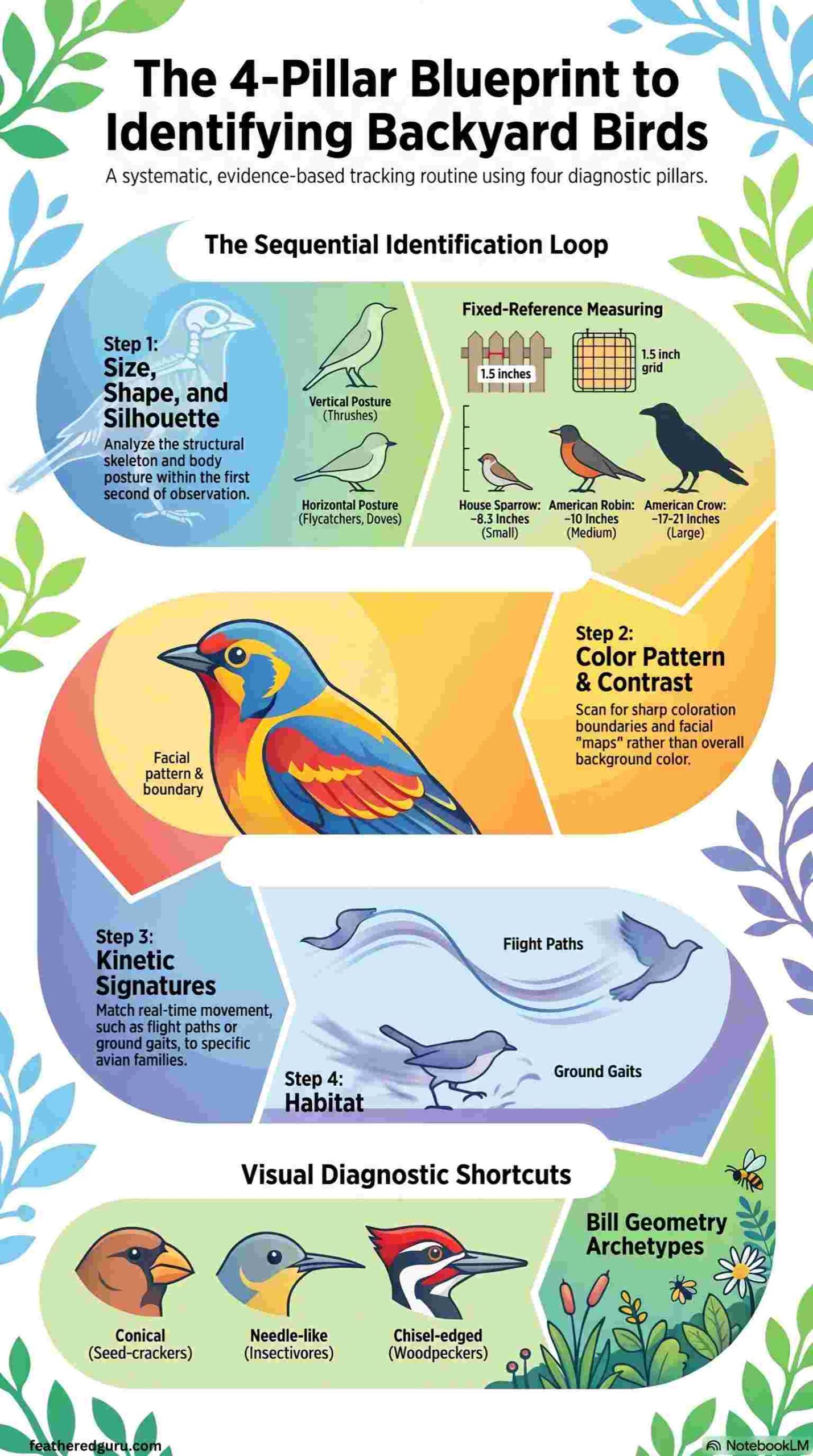
Conclusion: Mastering the Avian Blueprint
Transformed backyard bird identification goes far beyond matching random illustrations in a generic reference book. It requires understanding how an entire biological system, shaped by millions of years of evolutionary pressure, maps onto the living frame of every visitor.
When an observer learns to track forensic bill geometry, map coloration contrast boundaries across a seven-zone facial topology, and read kinetic flight signatures, the guessing ends permanently. Comparing structural silhouettes against a relative size reference ladder allows you to assign any unknown visitor to an accurate family branch within your first second of active tracking.
The four-pillar framework translates directly into a practical four-second identification sequence executable at any feeding station across your property. Step one assesses the broad size class, step two identifies the specific bill archetype, step three scans the facial field marks, and step four locks in a matching behavioral signature.
The tricky look-alike separations described in this guide resolve consistently once the correct diagnostic checkpoint is known and specifically examined. The seasonal plumage changes and mid-summer molting anomalies that generate confusion each year become expected, understandable biological events rather than alarming mysteries.
Pairing this forensic visual framework with sound-analysis digital tools like the Merlin Bird ID mobile application extends your tracking capability to species heard but not seen. Logging confirmed sightings through citizen-science networks creates a personal data record that deepens your observational discipline.
Together, this visual tracking framework, digital confirmation tools, and structured observation habits permanently transform a passive yard into a high-production ornithological study site. Implementing these advanced metrics ensures you generate meaningful, highly accurate data about your local bird populations every day of the year.