
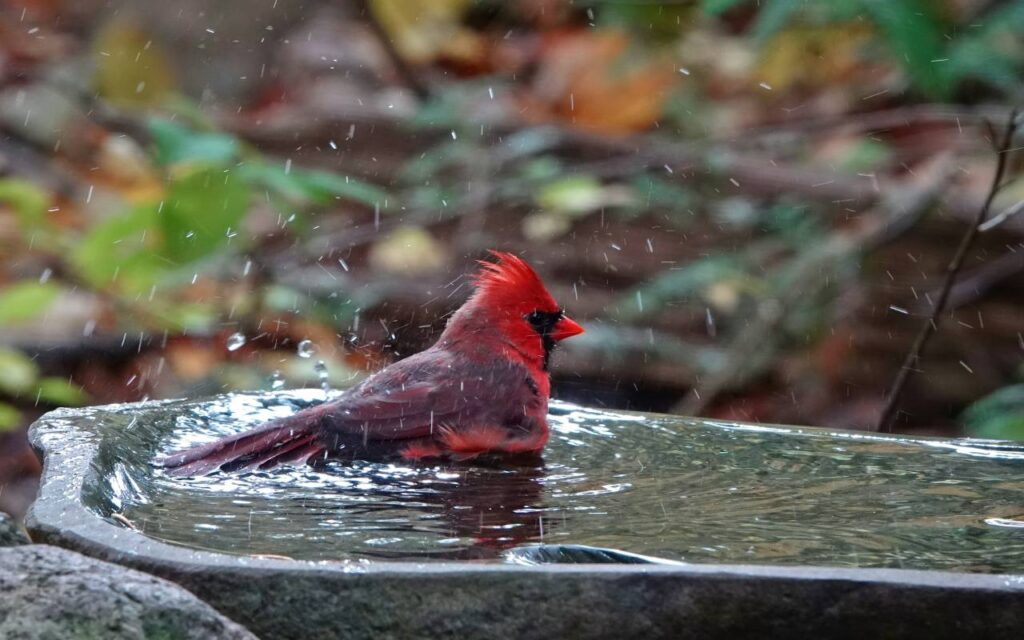
Where you place your winter water source determines whether your bird bath location becomes a vital wildlife sanctuary or remains completely overlooked during the coldest months. While seed feeders draw common granivores, open water acts as an irresistible beacon for striking species like Eastern Bluebirds, Cedar Waxwings, and Townsend’s Solitaires that rarely visit standard feeders.
Positioning a winter water source requires balancing thermodynamic realities with avian survival instincts. A misplaced basin can freeze prematurely, exhaust electrical connections, or expose vulnerable, damp birds to ambush predators when their flight performance is temporarily compromised.
Solar Exposure and Thermal Microclimates
Direct southern or southeastern exposure provides essential passive solar heating that reduces electrical demands on immersion de-icers and prevents rapid surface skimming.
Morning sun is especially critical because winter passerines, such as American Goldfinches, ramp up shivering metabolic capacity in their pectoralis muscles by 20 to 30 percent overnight to endure sub-freezing temperatures, leaving them desperate for early hydration.
Placing a basin where it catches dawn rays allows solar energy to clear frost before the ambient air warms. Wind exposure severely accelerates heat loss through evaporative cooling and convective dissipation, quickly outmatching basic 50-watt and 75-watt heating elements.
A steady winter breeze across an open, unsheltered deck rail will lower surface water temperatures drastically, causing perimeter ice rings that crowd out smaller species. You must isolate your bath within a natural thermal pocket that shields the water surface while keeping it exposed to direct overhead sunlight.
- Southern exposure maximizing solar radiation between 8:00 AM and 1:00 PM.
- Natural windbreaks to the north and northwest, utilizing evergreen boughs, outbuildings, or privacy fences.
- Elevated thermal mass underneath the base, such as dark flagstone or brick pavers that absorb daytime heat.
Placing dark, smooth river stones inside the basin further concentrates this passive heat absorption during peak daylight hours. These stones also break surface tension and prevent broad sheets of water from transferring heat directly to the moving air.
Staged Perching Architecture and Ambush Buffer Zones
Wet feathers drastically reduce an avian’s lift efficiency, leaving birds temporarily impaired until they shake off moisture, preen, and realign their feather barbules. If a winter bird bath sits directly inside dense brush, ground predators like domestic cats can stalk unseen within striking distance.
Conversely, if you position the basin in a completely barren expanse of open turf, birds are acutely vulnerable to aerial raptors like Cooper’s Hawks and Sharp-shinned Hawks. The most effective configuration incorporates intermediate staging perches situated precisely 10 to 12 feet away from the water perimeter.
This specific clearance provides an unobstructed flight path while giving skittish species a secure vantage point to assess safety, preen, and dry their plumage. Deciduous trees, patio trellises, or low-canopy native dogwoods serve as ideal staging structures.
- Horizontal staging perches positioned 10 to 12 feet away from the rim.
- Clear ground sightlines extending at least 6 feet around the bath base to eliminate blind ambush spots.
- Perch branch diameters ranging between 0.25 inches and 0.75 inches to accommodate the foot anatomy of colorful perching birds.
Ground-level clearings should be mulched or cleared of tall dead grasses to deny ground predators any structural concealment. When birds feel confident that approaching predators will be spotted early, their dwell time at your water station increases dramatically.
Polarized Light Glint and Aerial Flight Corridors
Migrating and overwintering flocks locate ephemeral water resources from high altitudes by detecting the unique polarization of light reflecting off an open surface. A bird bath tucked underneath a wide patio roof, dense porch awning, or heavy evergreen canopy remains invisible to flocks navigating overhead flight corridors.
To catch the attention of high-flying Scarlet Tanagers, Pine Grosbeaks, or Cedar Waxwings, the basin surface must remain visible to the open sky. Flight corridors typically align with neighborhood tree lines, riparian edges, and suburban woodland fringes.
Placing the bath directly adjacent to these natural transit routes captures nomadic flocks that move continuously in search of residual winter berries. The movement of water amplifies this aerial detection, as ripples shatter and reflect ambient light far more effectively than stationary sheets of ice.
- Unobstructed overhead sightlines at an upward angle of at least 45 degrees.
- Alignment with prevailing canopy corridors where fruit-bearing trees like serviceberry or crabapple stand.
- Mechanical water agitation, using a low-voltage dripper or water circulator rated for sub-freezing conditions.
Agitated water creates concentric ripples that project high-contrast visual flashes into the upper canopy. This refraction signals reliable, unfrozen water across long distances, drawing in colorful species that would otherwise bypass your property.
Window Strike Geometry and Architectural Hazards
Placing a bird bath near residential viewing windows provides exceptional photographic angles of vivid plumage, but improper spacing introduces lethal impact hazards. Audubon and field collision research establish that strike avoidance requires strict adherence to the 3-foot or 30-foot rule. A bird bath placed within 3 feet of a window prevents birds from building sufficient flight speed to suffer fatal collisions if startled off the basin.
Conversely, a basin positioned beyond 30 feet from structural glass gives panicked birds adequate airspace to identify reflections and alter their evasive flight trajectory. The zone between 4 feet and 29 feet represents a severe danger zone where sudden evasive maneuvers often terminate in high-speed window impacts. If your ideal thermodynamic location falls inside this risk corridor, external physical mitigation is non-negotiable.
- Placement strictly within 3 feet of the glass pane, or extended past 30 feet into the yard.
- Exterior vertical markers or non-reflective tape spaced no wider than 2 inches apart across large panes.
- Non-reflective exterior insect screening to cushion unintended impacts and eliminate mirror reflections.
Double-hung windows that reflect surrounding bare branches are particularly treacherous when birds flush sideways in cold weather. Treating exterior glass surfaces ensures that bright visitors, such as vibrant Northern Cardinals, safely access your water supply.
Electrical Delivery Routing and Rapid Basin Evaporation
Operating a winter bird bath relies on stable electrical delivery that does not fail during catastrophic freeze events. Standard outdoor extension cords routed through snowbanks frequently trigger Ground Fault Circuit Interrupter (GFCI) breakers due to moisture intrusion at the connection point.
Forum hobbyists and field operators prevent this by encasing plug unions inside water-resistant cord gaskets and elevating junctions completely off the frozen ground. Heated bird baths experience aggressive evaporation rates because the substantial delta between water temperature and frigid, dry air pulls moisture away rapidly.
Shallow basins can dry out within 24 to 36 hours, leaving heating elements exposed to dry-firing, which melts plastic rims and burns out internal thermal fuses. To maintain functionality, select a system that regulates temperature accurately without aggressive boiling cycles.
- Heavy-duty, outdoor-rated 12-gauge or 14-gauge extension cords with integrated weather seals.
- Water depths strictly maintained between 1 and 2 inches to prevent deep saturation of bird plumage.
- Thermostatically controlled de-icers that engage only when ambient water drops below 35 degrees Fahrenheit.
Never introduce toxic chemical additives like automotive antifreeze or glycerin to suppress freezing temperatures. Glycerin breaks down the microscopic barbules of bird feathers, saturating their insulating down and inducing fatal hypothermia within hours. Rigid mechanical maintenance, combined with secure electrical routing and deliberate basin placement, guarantees a resilient, bird-safe winter sanctuary.