
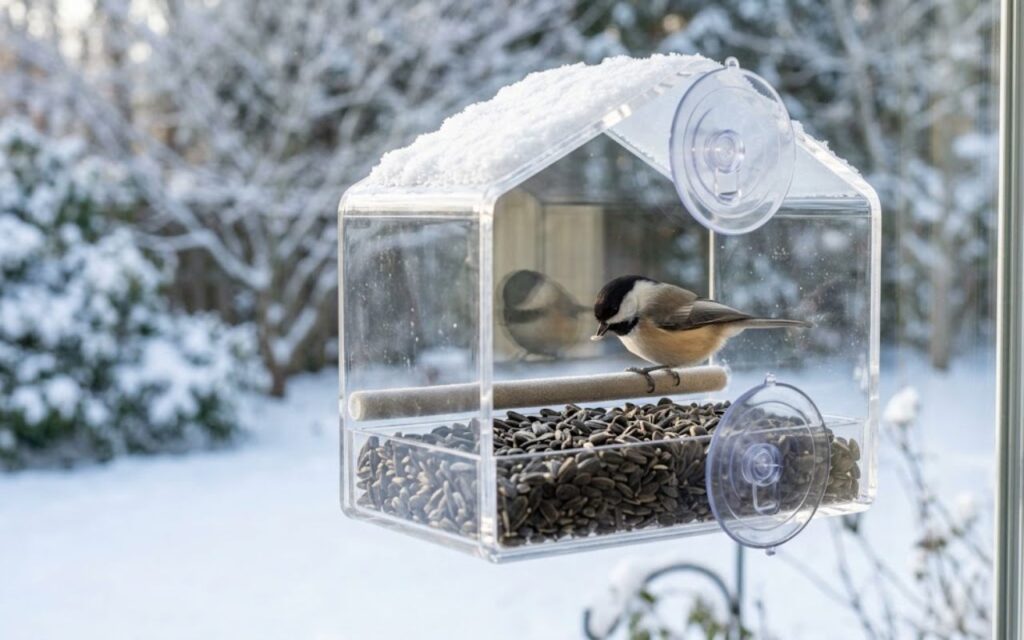
Applying the proper bird feeder distance from window glass rule for winter bird feeding can mean the difference between supporting backyard wildlife and causing fatal glass collisions. Backyard birders frequently debate whether placing feeding stations directly against exterior walls compromises avian safety or creates pest issues.
Understanding the balance between structural shelter and window strike mechanics is essential as winter temperatures drop. Field trials consistently show that specific proximity zones directly control flight velocity and collision safety.
The Physics of Impact: Audubon Window Velocity and the Lethal Middle Zone
Ornithological safety standards establish that bird feeders must sit either within three feet of a glass window or farther than thirty feet away from the structure. The zone between three and thirty feet represents a severe strike hazard for winter passerines.
When a foraging bird is startled by a predator within this middle zone, it accelerates directly into exterior glass that mirrors the open sky or surrounding vegetation. Birds striking glass within the three-foot threshold rarely sustain serious physical trauma.
Because they take off from a resting position so close to the glass pane, they cannot build enough forward momentum to cause intracranial hemorrhages or broken coracoids. In contrast, birds accelerating across ten to twenty feet reach flight velocities approaching thirty miles per hour before impact.
- Distances under three feet eliminate the flight runway necessary for high-velocity blunt-force trauma.
- Distances between ten and twenty feet produce the highest incidence of fatal avian window strikes.
- Distances beyond thirty feet give birds sufficient visual clearance and reaction time to identify reflections and alter their flight paths.
Maintaining the three-foot perimeter requires precise placement relative to window panes. If you cannot place your feeder flush against the glass or sill, you should relocate the entire feeding station deep into the yard beyond the thirty-foot boundary.
Foundation Microclimates: Thermal Radiance and Snowpack Hazards Near Exterior Walls
Placing feeders within three feet of your home takes advantage of structural thermodynamics during sub-freezing temperatures. Heat loss through foundation walls, brick veneer, and double-pane glass creates a localized microclimate that can register several degrees warmer than the exposed yard.
Small passerines like black-capped chickadees and golden-crowned kinglets utilize these thermal pockets to conserve valuable metabolic energy during extreme cold snaps. Exterior walls also function as critical windbreaks against prevailing winter gusts.
Feeders positioned on the leeward side of a residence experience reduced convective heat loss, preventing lightweight seeds from blowing away and keeping resting perches shielded from wind-driven sleet.
- Leeward wall placement reduces wind chill stress on small birds by breaking sustained winter gusts.
- South-facing brick or masonry foundations absorb ambient solar radiation and radiate gentle thermal warmth well into twilight hours.
- Roof eaves and soffit overhangs prevent heavy snow loads from burying seed ports and perches.
However, structural proximity creates specific localized hazards that require vigilant monitoring. Snow shedding from steep roof pitches can crush feeding apparatuses or trap feeding birds beneath heavy drifts. Additionally, uninsulated gutters often leak freezing water into hopper reservoirs, soaking seed and setting the stage for dangerous pathogen blooms.
Rodent Ingress and Structural Hull Accumulation Beneath Sills
Operating a feeding station within three feet of your foundation dramatically increases the risk of structural rodent infiltration. As birds discard seed husks, organic debris accumulates directly against the sill, siding, and foundation vent lines.
Deer mice, white-footed mice, and brown rats readily exploit deep snowpack to construct hidden subnivean tunnels directly to these high-calorie food piles.
Once rodents establish winter transit tunnels to fallen seed beneath the snow, they quickly locate microscopic gaps around foundation penetrations, sill plates, and dryer vents. Furthermore, decomposing seed waste trapped against wet siding promotes wood decay and compromises building envelopes.
- Accumulations of damp sunflower hulls create acidic organic mats that rot wood siding and foster mold.
- Subnivean rodent tunnels allow vermin to access basement entry points under the complete visual protection of snowdrifts.
- Moisture accumulation in discarded seed waste fosters Aspergillus flavus, a toxic fungus that produces lethal aflatoxins in wild birds.
To mitigate rodent access and fungal contamination, operators of wall-mounted or window-adjacent feeders must adjust their feed selection. Transitioning entirely to hulled sunflower chips, cracked corn, and peanut kernels eliminates the structural debris pile altogether.
Without protective hulls dropping to the ground, birds consume the entire ration directly from the feeding platform. Combining huskless feeds with wide-brimmed catchment trays suspended beneath the feeder stops stray morsels from ever touching the soil or snow.
Winter Predator Ambush Tactics and Sightline Clearance Requirements
Positioning feeding stations near residential structures profoundly alters the tactical landscape for winter predators. Sharp-shinned hawks and Cooper’s hawks frequently use architectural roof peaks, garage corners, and solid fence lines as visual blind spots.
These agile accipiters fly low to the ground and execute sudden turns around structural edges, surprising clustered flocks before the birds can scatter. Ground-level threats also capitalize on residential architectural features.
Domestic and feral cats regularly use decorative foundation evergreens, heat pump enclosures, and porch steps as ambush points to stalk birds feeding on the ground or low perches.
- Dense evergreen foundation plantings within ten feet of a feeder provide predatory cats with prime strike concealment.
- Sharp architectural corners create blind spots that hunting accipiters exploit for surprise high-speed horizontal swoops.
- Open feeder perimeters require a clear visual sightline of at least ten to twelve feet in all directions.
To protect winter flocks from surprise attacks, you must adjust the nearby ground-level topography. Trim back the lower limbs of ornamental shrubs located within ten feet of the feeding station to eliminate ground-level hiding spots.
If you maintain brush piles to provide songbirds with emergency winter cover, place them twelve to fifteen feet away from the feeder. This spacing provides fleeing songbirds with a reachable sanctuary while denying lurking predators a launch point for sudden strikes.
Hardware Mounting Solutions: Window Suction Trays Versus Baffled Yard Systems
Choosing between close-range mounting and deep-yard placement dictates your winter hardware strategy. For setups adhering to the under-three-foot rule, heavy-duty clear acrylic window feeders equipped with commercial-grade suction cups perform exceptionally well.
These units place birds directly against the glass, eliminating velocity hazards entirely while offering unobstructed viewing opportunities. Winter window installations require careful mechanical preparation to avoid sudden failure during hard freezes.
Cold temperatures cause cheap rubber cups to lose elasticity, harden, and detach from the glass pane under the combined weight of snow and seed.
- Clean both the glass surface and the interior suction cups with isopropyl alcohol before mounting to ensure an airtight seal.
- Apply suction cups when ambient temperatures are above freezing, or warm the rubber with warm water prior to attachment.
- Select window models with removable interior seed trays so you can clean and refill food without disturbing the suction base.
If you opt for the beyond-thirty-foot parameter, you must rely on a freestanding pole system to maintain safety and exclude mammals. Freestanding poles should feature a heavy-gauge steel sectional mast paired with a torpedo or stovepipe baffle installed at least four and a half feet above the ground.
For additional window strike prevention on panes facing distant yard feeders, install external visual deterrents. Paracord curtains, closely spaced exterior screens, or ultraviolet liquid markers spaced two inches apart effectively break up mirror reflections, ensuring your distant feeding station remains completely safe throughout the winter season.