
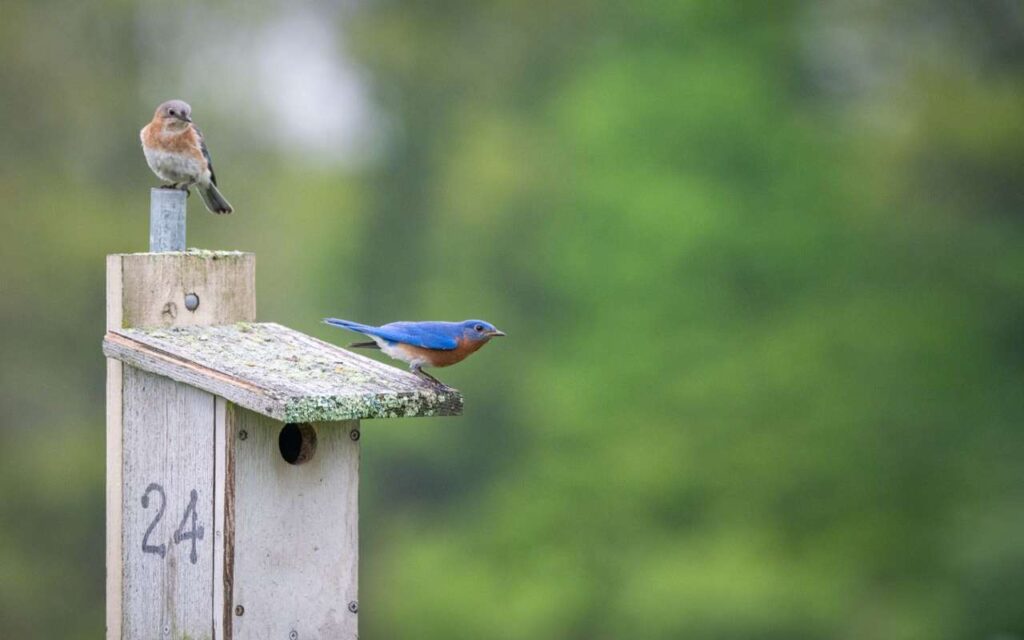
Evaluating an eastern bluebird male vs female profile reveals one of the most sexually dichromatic birds in North America, meaning the sexes look strikingly different. This vivid difference in breeding adults becomes complex to read in juveniles, late-summer molting birds, and winter-veiled males whose cobalt plumage is masked by brownish feather tips. Knowing what to look for at each life stage transforms a simple backyard sighting into a sophisticated field study.
This guide covers every dimension of Eastern Bluebird sexual dimorphism: the physics of structural feather color, the precise field marks separating females from juveniles, and the seasonal molting cycles. We also analyze the specific behavioral signals that confirm gender at a distance, alongside the field markers that prevent Eastern females from being confused with Western or Mountain Bluebird counterparts.
Quick Answer: How to Identify Male vs Female Bluebirds
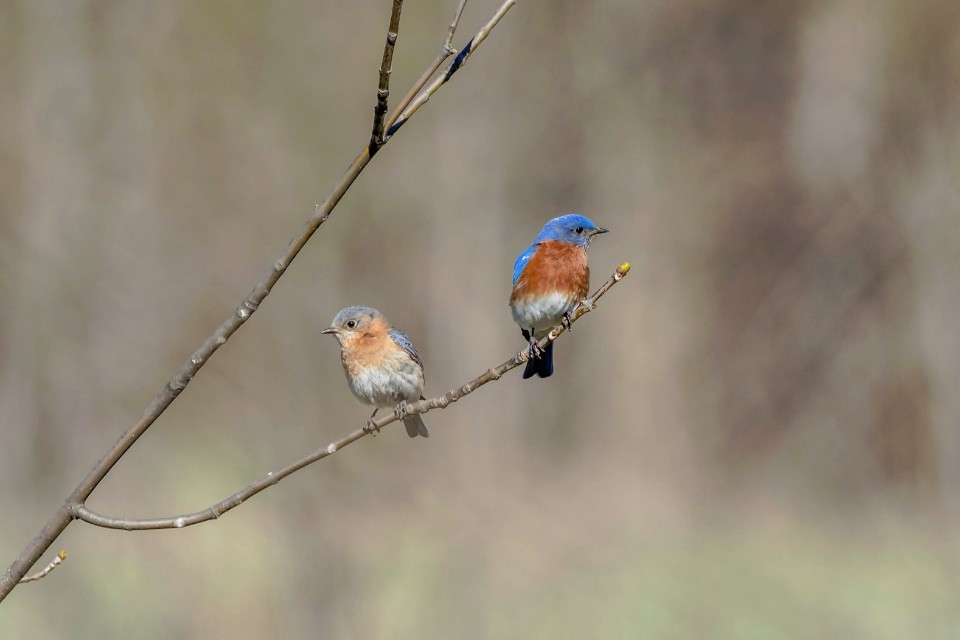
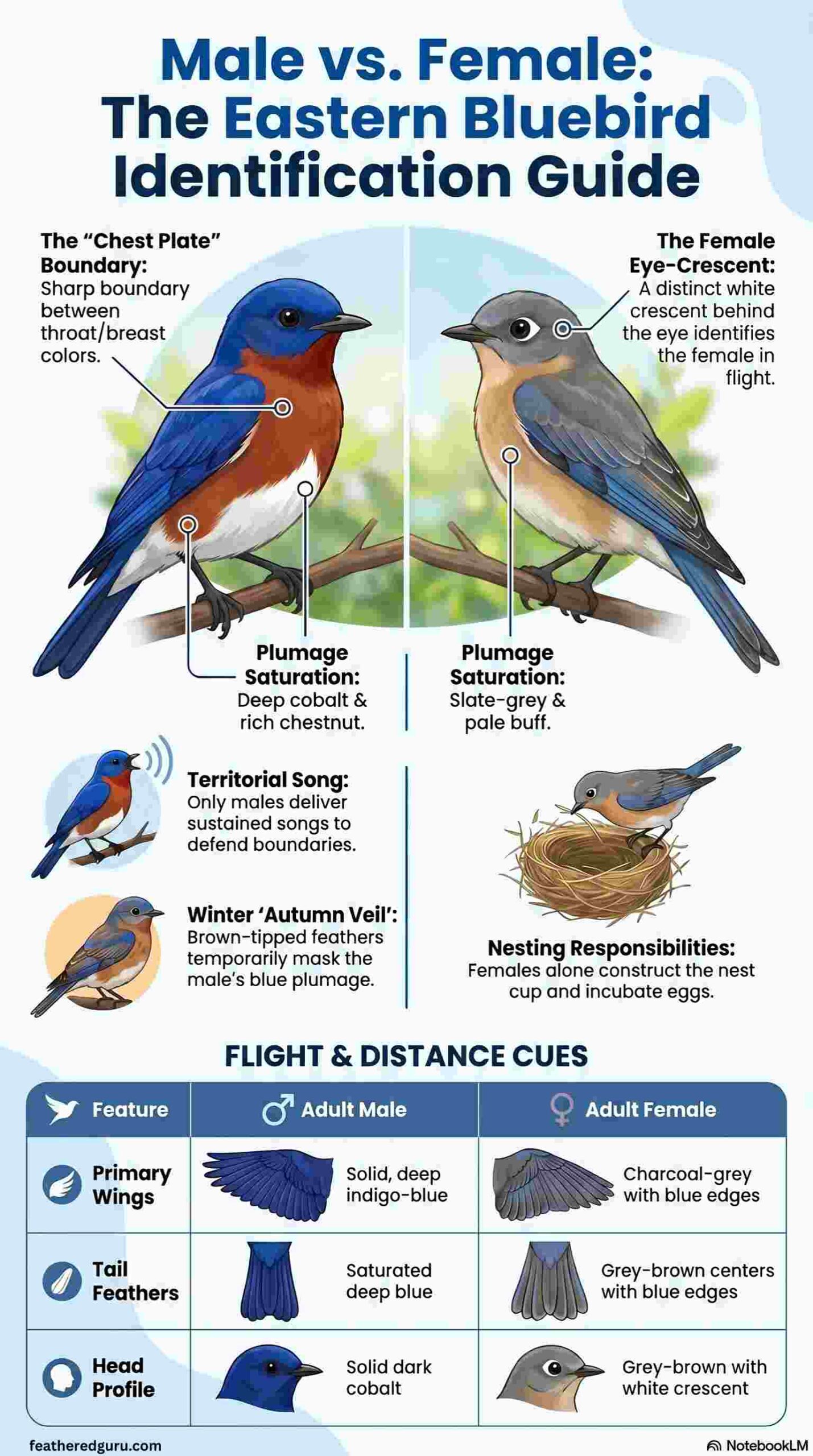
To identify male vs female Eastern Bluebirds instantly, look at the intensity of their plumage coloration. Adult males exhibit a brilliant, deep cobalt-blue back, crown, and wings paired with a rich, dark rust-chestnut breast. In stark contrast, adult females display a muted slate-grey crown, soft grayish-blue back, and a significantly paler, buff-orange throat and breast with no sharp color boundaries.
Bluebird Identification Masterclass: A Visual Guide to Male and Female Differences
Visual Guide: Watch this comprehensive video breakdown analyzing the microscopic feather mechanics, evolutionary coloration trade-offs, and geographic range mismatches of Sialia sialis in the field. This detailed explainer briefing illustrates exactly how to track adult plumage saturation and sexual dimorphism boundaries using high-magnification spotting scopes, helping you confidently separate winter-veiled males and speckled juveniles at long distances.
Show Transcript:
0:00
Welcome to this explainer. I’m excited to jump into this one with you because I learned some pretty surprising things while putting it together.
0:06
Today we’re heading into the field to decode the biology and hidden clues of one of our most familiar but surprisingly tricky backyard birds: the eastern bluebird.
0:13
If you’ve spent time watching them, you know they’re stunning. But their appearance can be misleading.
0:18
We’re going to break down how to identify their genders and life stages like a pro.
0:23
Have you ever looked at two eastern bluebirds and thought, “Aren’t they both males?”
You’re not alone. Even experienced birders get tripped up here.
0:31
Adult males are bright cobalt blue with a rich rusty-orange chest. But females, juveniles, and winter males can all look surprisingly similar.
0:40
Sometimes males even lose their bold look temporarily, which adds to the confusion.
1:01
Here’s the roadmap for this explainer: vibrance test, physics behind blue feathers, juveniles and winter plumage, field behavior clues, and common identification traps.
1:20
This is the fastest way to tell adult males and females apart.
1:24
Males are vivid: deep cobalt blue with a bright rusty-orange chest and a sharp color boundary between throat and breast.
1:43
Females are softer and muted, with gray-blue tones and pale orange on the chest. The transition is blurred rather than sharp.
1:55
Once you train your eye to see that chest contrast, identification becomes much easier.
2:09
In flight or quick movement, there’s another clue.
2:13
Females often show a faint white eye ring, creating a soft pale crescent around the eye. Males usually lack this contrast.
2:35
The blue color isn’t pigment. It’s structural.
2:44
Eastern bluebirds don’t have blue pigment in their feathers at all.
2:51
Instead, microscopic keratin structures scatter light in a way that produces blue.
3:11
Males have more organized feather structures, which makes their color appear brighter and more intense.
3:29
In sunlight, flying males can flash a strong electric blue from wings and tail.
3:41
Females have less structured feathers, appearing more gray with only subtle blue edging.
3:50
This is where things get messy.
3:54
In late summer, adults, juveniles, and molting birds all mix together.
4:10
Juveniles look very different: spotted chests, speckled backs, and brown-gray tones.
4:21
Some young males show partial blue patches, like an unfinished paint job.
4:30
Key rule: adult females never have spots. If you see spotting, it’s a juvenile.
4:44
Winter males are another common mistake.
4:49
After molting, males develop pale feather tips that dull their blue color.
5:16
These tips wear off over winter, gradually restoring their bright blue by early spring.
5:39
Even in winter, a useful clue is the rump and tail.
5:45
Males often retain brighter blue in that area even when the rest of the body looks muted.
6:03
You don’t always need feathers to identify them.
6:09
Behavior is a strong indicator.
6:13
Females build nests, weaving grass and shaping the nest cup.
6:27
Males defend territory and feed the female during incubation.
6:41
A clear sign is a male passing food to a female at the nest box without entering it.
6:52
Calls are also different.
6:54
Males sing long, soft, repeated songs from high perches.
7:11
Females mostly make short calls and alarm notes.
7:24
In some regions, female eastern bluebirds are easily confused with western and mountain bluebirds.
7:44
They can look very similar at a glance.
7:48
One key difference helps: throat color.
7:52
Eastern bluebird females have warm orange buff throats.
7:55
Western and mountain bluebird females tend to have gray-white throats.
8:05
Once you understand all of this, you stop just seeing birds and start reading behavior.
8:16
Molting cycles, nesting roles, feather wear, and juvenile transitions all tell a deeper story.
8:30
The more you observe, the more detail you start to notice.
8:41
Thanks for watching this explainer. See you in the next one.
What Is the Main Difference Between a Male and Female Eastern Bluebird?
The primary difference between a male and female Eastern Bluebird is plumage color intensity. Adult males display a deep cobalt-blue back, crown, and wings paired with a saturated rust-chestnut breast and white belly. Adult females display a muted slate-grey crown, soft grayish-blue back with pale blue wash, and a significantly paler buff-orange breast.
The difference in color saturation between the sexes is not simply a matter of more or less pigment. The male’s blue is not produced by any blue pigment at all. According to research published in Applied Microscopy on melanin-based structural coloration in birds, blue color in feathers results from coherent scattering of light from quasi-ordered arrays of beta-keratin nanostructures in feather barbs.
The nanoscale architecture of the feather barb, specifically the dimensions and regularity of the air-filled cavities within a spongy keratin matrix backed by a melanin absorption layer, determines which wavelengths of light are constructively reflected toward the observer. There is no blue pigment involved. The blue is a physical property of light interaction with nanostructure, not a chemical deposit.
Research published in Behavioral Ecology and Sociobiology on the rearing environment and structural coloration in Eastern Bluebird nestlings confirmed that the spongy medullary nanostructure of Eastern Bluebird feather barbs is composed of a keratin cortex overlying a layer of melanin granules surrounding large central vacuoles. The study established that the brightness of the structural blue correlates directly with the overall precision and thickness of this keratin cortex.
Male Eastern Bluebirds have feather barbs with a more precisely ordered nanostructure than females, producing more coherent reflectance, more saturated color, and higher UV-blue brightness. The female’s paler, grayer-blue back still contains the same structural architecture, but with less precision in the nanostructure, producing a less saturated, less vivid reflection across the same wavelength range.
The male’s chestnut breast is produced by a completely different mechanism. Research published in Behavioral Ecology (Oxford Academic) confirmed that the chestnut coloration in male Eastern Bluebirds is produced by a combination of pheomelanin and eumelanin pigments deposited directly in the feather cells.
The saturation of the male’s chestnut breast therefore operates independently of the structural blue mechanism, and the two ornamental color systems, structural blue and pigment-based chestnut, each signal different aspects of male quality to prospective mates.
The female’s paler buff-orange breast contains phaeomelanin at lower concentrations than the male, producing the less saturated, more washed appearance that persists across all seasons.
The fastest field identification cue at distance is the chest plate contrast boundary. A male perched on a fence post or wire shows an abrupt, sharply defined line between the deep cobalt blue of the throat and the rich rust-chestnut of the breast.
A female shows a gradual, diffuse transition from her grayish throat to her pale buff-orange breast with no sharp boundary. This contrast differential is visible at 50 to 80 yards with naked eye in good light, making it the most reliable long-distance gender separator available.
Eastern Bluebird Male vs. Female: What Do They Look Like in Flight?
A male Eastern Bluebird in flight shows solid, deep indigo-blue primary wing feathers and tail feathers that flash vividly from above in sunlight [PAA]. A flying female shows dull charcoal-grey primary and secondary wing feathers with narrow, subtle blue highlights visible only along the outer edges of the flight feathers in good light.
According to the Audubon Society’s Eastern Bluebird field guide, both sexes show blue in the wings and tail, but the male’s blue is rich and bright while the female’s is paler and duller. In practice, a male Eastern Bluebird banking overhead in direct sunlight produces an unmistakable flash of electric blue across the entire dorsal surface.
A female banking in the same conditions shows a pale grey-brown back with a faint blue wash that is easily overlooked at distance. The tail of the male, when fanned during landing or display, shows the same saturated deep blue across all rectrices. The female’s tail shows blue along the edges with grey-brown centers, most visible when the tail is spread.
For senior observers scanning field perches from 30 to 100 yards, the most reliable aerial gender cue other than back color is the white eye-ring. Adult female Eastern Bluebirds have a distinct white crescent that sweeps beneath and behind the eye against the grey-brown head. This white mark remains sharply visible during flight tracking even when body color is difficult to resolve.
Adult males lack this white eye contrast. The male’s dark cobalt head and throat form a single dark profile against which no pale crescent is visible. When tracking a bird in the scope or binoculars as it moves from perch to perch, the presence of a white eye-crescent identifies a female before any body plumage is resolved clearly.
How Do You Tell a Female Bluebird From a Juvenile Bluebird?
Adult female Eastern Bluebirds have uniform, unspotted, smooth slate-grey and soft blue feathers across the entire back. Juvenile Eastern Bluebirds of either sex display heavily speckled brownish-grey and white camouflage patterning across the back and scalloped white spotting on the breast, resembling a small thrush more than an adult bluebird.
According to Sialis.org’s comprehensive Eastern Bluebird biology reference, juveniles look almost like another species, featuring distinctive spots on their chest and a white eye ring. Young males can be differentiated during this transitional phase because they display more blue in their wing and tail feathers before completing their seasonal molt into adult plumage.
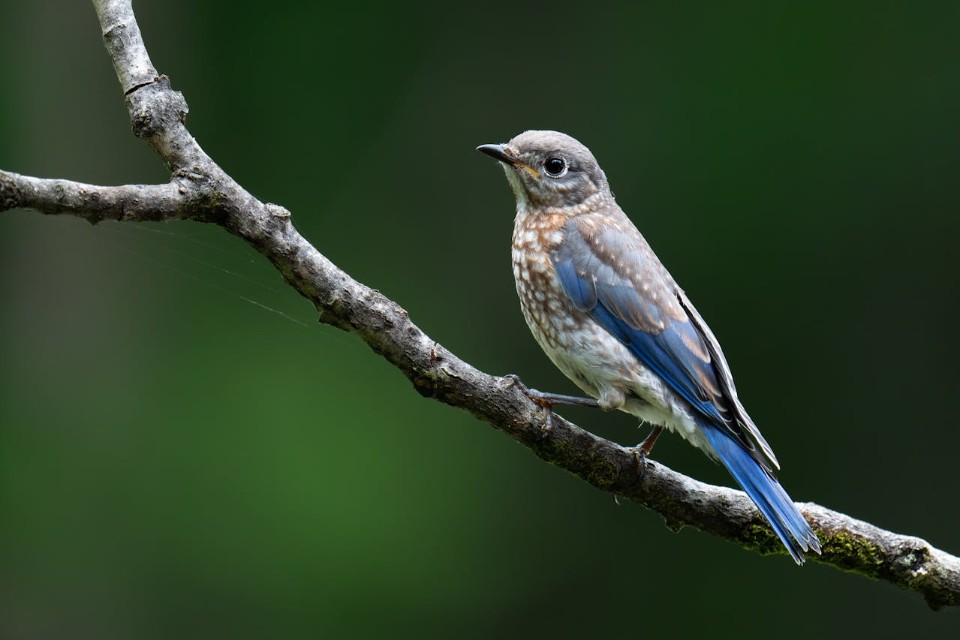
Juvenile bluebirds of both sexes are born with natal down and begin developing their spotted juvenile plumage within the first week of life. This cryptic patterning serves as a predator avoidance mechanism, breaking up the bird’s outline against leaf litter and bark when fledglings are at their most vulnerable stage.
The molt windows from June through September create the most identification-challenging period of the year. During this window, a single flock can contain adult males in full or worn breeding plumage, adult females in worn summer plumage, and juveniles at various stages of replacing their spotted feathers with adult-type feathers.
The reliable audit during this period is the wing covert tips. In juveniles still carrying spotted plumage, the greater wing coverts show pale white or buff spots at their tips that create a scaled appearance along the wing edge. Adult females have uniformly colored greater coverts without tip spotting. A bird that otherwise resembles a female but shows scaled wing coverts is a juvenile in transition.
Late-summer juvenile males produce the most confusing intermediate appearance. As their first adult feathers replace the juvenile plumage, iridescent blue feathers begin emerging in patches on the back and wing coverts while the rest of the body still carries spotted juvenile brown. These birds show an irregular mosaic of blue, brown, and spotted feathers that resembles neither an adult male nor a female.
The diagnostic feature separating a transitional juvenile male from an adult female is the presence of white structural spots on the still-developing juvenile feathers: an adult female carries no spots anywhere on her back or flanks regardless of season or wear.
For more on attracting and supporting this species through its full life cycle, see our article on how to attract Eastern Bluebirds to your yard.
Can You Identify Bluebird Gender by Their Nesting Behaviors?
Yes. Female Eastern Bluebirds are solely responsible for constructing the nest cup and incubating the eggs. The male delivers nesting material to the cavity entrance and performs wing-waving courtship displays to attract the female to the site, but he does not construct the nest cup structure and does not incubate. Any bird observed carrying dry grass or pine needles into the cavity and arranging material is confirmed female.
The division of nesting labor is precise and well-documented. The male’s role in nest initiation is to locate and defend the cavity, display at the entrance to attract a mate, and occasionally carry grass to the cavity entrance as a courtship signal that the site is active and defended.
Once the female accepts the site, she takes over all construction, weaving the cup from dry grasses, pine needles, and fine plant material over a period of three to seven days.
Incubation is performed exclusively by the female, confirmed across multiple detailed breeding studies including data assembled in the Birds of the World account for the species. The research notes that scattered claims of male incubation are almost certainly based on observations of male attentiveness near the cavity or females briefly leaving the nest.
Once incubation begins, the male transitions immediately into a dedicated sentinel and forager role. He positions himself on an elevated perch 20 to 50 feet from the nest box, singing intermittently to maintain territorial boundaries and watching for aerial and ground predators.
The male actively hunts for caterpillars, beetles, and grubs, bringing this food directly to the incubating female at the cavity entrance. This vital behavioral exchange allows her to remain safely on the eggs and maintain a constant incubation temperature without requiring extended, exhausting foraging absences.
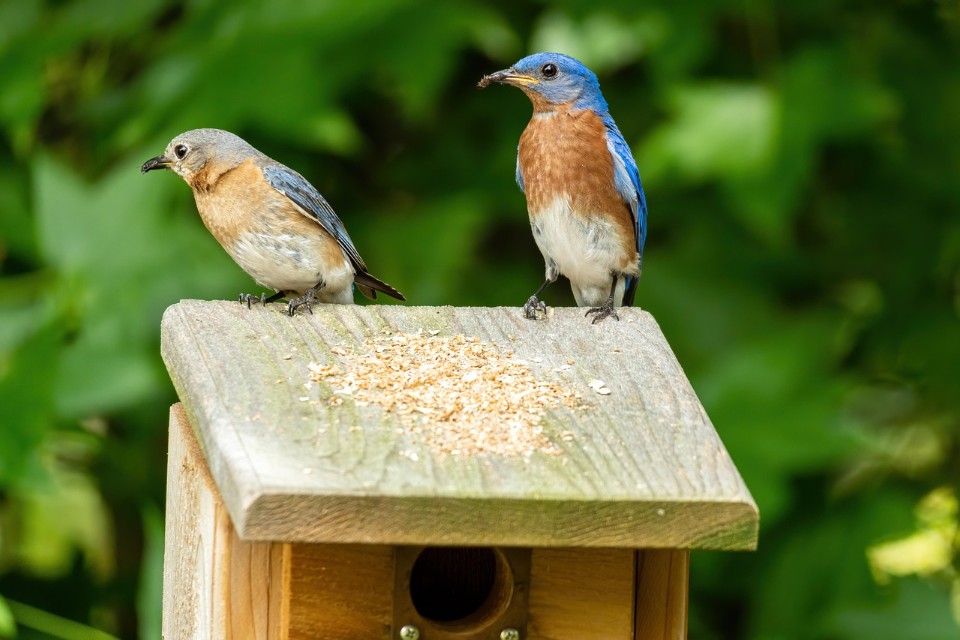
This food-delivery behavior is one of the most reliable gender confirmation markers available to the backyard observer. Observing a bright blue bird hovering at the cavity entrance with an insect, or standing confidently on the roof carrying prey, serves as an unshakeable indicator that you are watching the male provisioning his mate.
For a complete guide to nest box specifications that support this behavior, see our article on how to attract Eastern Bluebirds to a birdhouse.
Why Do Winter Male Bluebirds Look Like Females?
Winter male Eastern Bluebirds look duller and more female-like because their post-breeding molt in late summer produces new feathers with brownish-buff tips that partially mask the cobalt blue underneath. Throughout winter, normal wear and friction progressively erode these tips, gradually uncovering the brilliant cobalt-blue base by late February or March.
This process is identical in mechanism to the wear-based plumage transition documented in European Starlings, in which the same feather changes from spotted to iridescent through tip abrasion rather than through a second molt. In male Eastern Bluebirds, the fresh fall feathers are fully grown with blue bases and brown or buff tips.
The brown tips reduce the overall color saturation of the male’s dorsal surface, making the back look muted and greyish-brown rather than cobalt. The rust-chestnut breast is similarly veiled by pale buff feather fringes that soften the contrast boundary with the throat.
A male in fresh October plumage may superficially resemble a bright female, particularly at distance, with only the slightly more intense blue of his rump and outer tail feathers distinguishing him from his mate.
The mechanism of tip erosion revealing structural blue underneath is supported by research published in Proceedings of the Royal Society B (PubMed Central) on keratin cortex thickness and structural color, which confirmed that keratin cortex thickness plays a significant role in determining the position of the major reflectance peak in nanostructured feathers.
As the buff-tipped outer keratin layer abrades away, the underlying cortex of optimal thickness is progressively exposed, shifting the reflectance peak back toward the cobalt-blue wavelengths and restoring full color saturation. This is a physical process driven entirely by mechanical wear rather than any hormonal or metabolic signal.
The ecological function of this autumn veil is camouflage during winter resource competition. Bluebirds form loose winter flocks that travel between berry sources. The reduced color saturation of freshly molted males makes them less conspicuous to aerial predators such as Cooper’s Hawks, which are visual hunters that target bright, contrasting prey.
As winter progresses and feather tips erode, the male’s cobalt blue reemerges progressively, reaching full breeding-season intensity by late February in the southern range and March in the northern range, aligned with the onset of territorial song and nest site competition.
The identification implication is that a flock observed in November containing what appears to be multiple females may include several adult males in fresh-feathered condition.
The most reliable separator is tail and rump color: even in fresh fall plumage, the male’s rump retains more saturated cobalt blue than the female, and the outer tail feathers of the male show brighter blue than the female’s grey-edged outer rectrices.
How Do Male and Female Bluebird Calls Differ?
Both male and female Eastern Bluebirds use the same soft, melodic “chur-wi” or “tu-a-wee” contact call, but only the male sings prolonged, multi-phrase territorial songs used to claim and maintain territory boundaries. Females produce short chattering alarm notes and brief contact calls but do not deliver sustained territorial song sequences outside rare nest-defense contexts.
According to Cornell Lab’s All About Birds Eastern Bluebird sounds page, the Eastern Bluebird’s song is a fairly low-pitched, warbling sequence that lasts approximately two seconds and is made up of several phrases consisting of one to three short notes. Unpaired males typically deliver these whistles from high perches to attract mates, while paired males sometimes sing a much softer version of the song while females are laying eggs.
The most common call for both sexes is a soft, low-pitched “tu-a-wee” with a querulous tone, and males’ calls are typically slightly longer than females’. The male’s territorial song, most active from March through June, is delivered from a prominent perch with the bill barely open, a distinctive posture noted in multiple behavioral accounts including the Sialis.org bluebird biology reference.
Males sing most intensively in the early morning hours, with song frequency declining through mid-morning and resuming briefly in late afternoon. The purpose of this sustained singing is dual: it advertises to neighboring males that the territory is occupied and actively defended, and it functions as a mate quality signal to prospecting females, whose preference for more complex or more frequently delivered song has been documented in songbird mate choice research.
Female Eastern Bluebirds do occasionally sing, but the behavior is restricted to specific contexts. According to Sialis.org, females may sing from within or near the nest box during active nest defense against intruding females. This defensive singing is notably softer and shorter than the male’s territorial sequences, typically consisting of a few phrases rather than the extended, multi-phrase bouts of the male.
The acoustic difference in practice is straightforward: any bird delivering extended, repeated, multi-phrase song from an exposed perch from a distance of 15 to 30 feet above the ground is a male. Short, chattering burst vocalizations from within or immediately adjacent to the nest box are consistent with either sex.
Eastern Bluebird vs. Western and Mountain Bluebirds: Gender Mismatches
An Eastern Bluebird female can be separated from female Western and Mountain Bluebirds by her throat color: Eastern females have a distinctive warm, buff-orange wash extending from the breast up through the chin and throat [PAA]. Mountain Bluebird females and Western Bluebird females have a uniformly grey-white throat with no orange or buff component, making the throat the fastest single-field-mark separator in overlap zones.
The geographic overlap zone where identification challenges arise is primarily the central Great Plains, where Eastern and Mountain Bluebird ranges meet in a broad transition band running through Oklahoma, Kansas, Nebraska, and the Dakotas. In this zone, wintering flocks of Eastern Bluebirds may mix with resident Mountain Bluebirds, producing identification challenges particularly for female-plumaged birds.
Male Mountain Bluebirds are entirely sky-blue with no orange or chestnut anywhere on the body, making them distinct from male Eastern Bluebirds even at a glance. Female Mountain Bluebirds, however, share the general pattern of grey-blue plumage and can cause confusion at distance until the throat is examined. The Mountain female’s completely grey-white throat, with no warm buff or orange tones, is the diagnostic separator.
Western Bluebirds present a more complex comparison because male Western Bluebirds do carry an orange-chestnut breast that overlaps in color with male Eastern Bluebirds. The separation is in the back color: male Eastern Bluebirds have a solid cobalt-blue back, while male Western Bluebirds have a blue back that is typically slightly duller and, in some individuals, shows a chestnut patch on the upper back between the wings.
Female Western Bluebirds are separated from female Eastern Bluebirds by their grey-white throat, as with Mountain females, and by the slightly less warm tone of their breast buff compared to the Eastern female’s distinctively orange-inflected buff.
The Audubon Society’s Eastern Bluebird field guide documents the range boundaries and notes that the Western Bluebird range is west of the Great Plains with limited overlap, making overlap zone identification relevant mainly to observers in the western Great Plains states and the Rocky Mountain foothills.
Forensic FAQ: Behavioral Anomalies and Identification Traps
Do Female Eastern Bluebirds Ever Sing to Claim Territory?
Female Eastern Bluebirds do occasionally sing, but this behavior is restricted to nest-box defense contexts during the breeding season. The song delivered by defending females is abbreviated, softer, and less structured than the male’s territorial song, typically triggered by the arrival of an intruding female at the active nest box boundary.
This behavior is rare enough that its observation can be considered diagnostically significant: a female-plumaged bluebird delivering even a brief song sequence at a nest box is almost certainly the resident female engaged in active conspecific defense rather than a male in fresh, dull-tipped plumage. Outside of active nest defense, female Eastern Bluebirds do not sing territorial sequences.
Can You Identify Bluebird Gender as Soon as the Eggs Hatch?
Bluebird chick gender cannot be determined at hatching or in the first days after hatching. All Eastern Bluebird nestlings hatch blind, naked, and covered in sparse patches of dark grey natal down. The primary feather sheaths begin developing between days three and five, but the feather tips remain enclosed within their sheaths until days eight to ten.
According to the Sialis.org bluebird biology reference, it is not until around day eight or nine that primary wing sheath pins begin to open, at which point developing blue feathers in male nestlings begin to show their structural color. Even at this stage, young males show pale, desaturated blue that is distinct from adult male coloration and may not be immediately obvious without careful comparison between nestlings within the same brood.
Bluebird Color Chart: How Male and Female Feathers Change by Season
Plumage Blueprint: Examine this structural infographic matrix mapping the shifting sexual dimorphism markers and feather reflectance parameters across the entire annual life cycle of Sialia sialis. This geometric chart illustrates the precise contrast boundaries of breeding adults, highlighting how the intense structural blue of the male crown transitions into the muted slate-grey tones of the overwintering female mantle.
Conclusion: The Dimorphic Advantage
Mastering Eastern Bluebird sexual dimorphism provides a functional toolkit that extends well beyond simple species identification. The ability to distinguish a fresh-plumaged winter male from an adult female at 50 yards, to separate a transitioning juvenile from a molting adult, to read a provisioning behavior sequence for confirmation of the incubating female’s position, and to identify a Mountain Bluebird female in a mixed wintering flock represents a genuinely advanced field competency that most casual birders never achieve.
Each of these skills connects to practical management outcomes. Knowing which individual in a nest box territory is the female allows the observer to track her condition, monitor her presence or absence during incubation, and detect early signs of nest abandonment or predator pressure. Knowing which flock members are winter-veiled males versus adult females allows accurate population monitoring across the non-breeding season.
The structural color physics that makes male plumage so vivid also makes its seasonal variation a reliable indicator of breeding timeline: the reappearance of full cobalt saturation in a resident male is a phenological marker that territory establishment and nest prospecting are imminent.
For the full context of how natural avian behavior impacts your backyard feeding setup, see our foundational research guide on What Do Eastern Bluebirds Eat? The Forensic Nutritional Blueprint.
To complete your operational field blueprint and safely support local breeding pairs during their nesting lifecycles, consult our laboratory guide on How to Attract Eastern Bluebirds to Your Yard.