
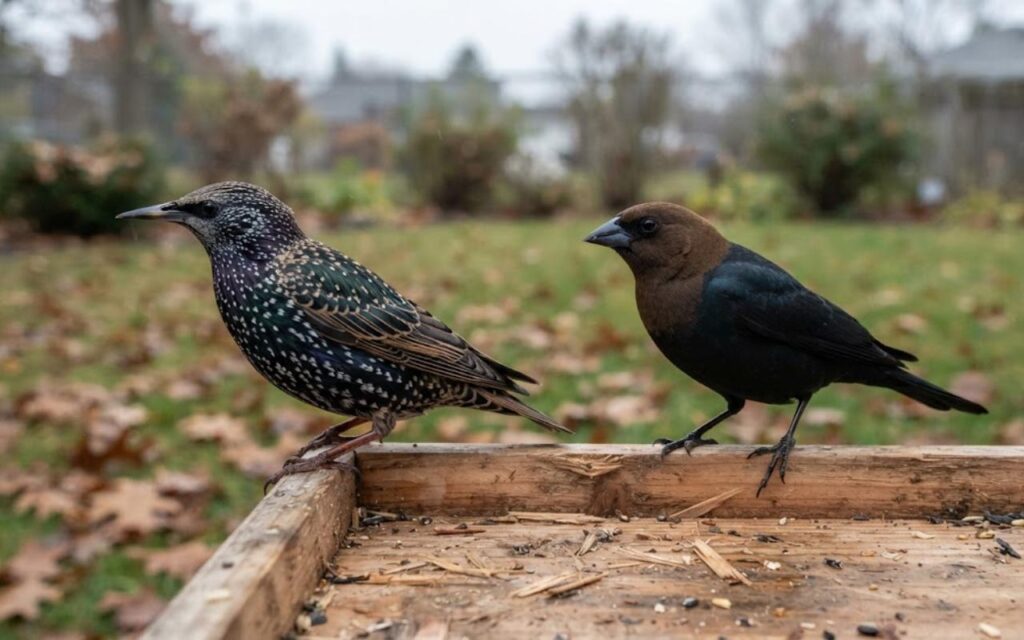
Mastering a reliable European Starling vs. Brown-headed Cowbird identification guide is essential for backyard naturalists seeking to manage aggressive flocking dynamics at feeding stations. While both species share a dark silhouette and a reputation for overwhelming residential yards, they belong to entirely distinct avian families with vastly different anatomical traits.
Misidentification runs rampant in late summer when juvenile molts blur the lines between dull brown plumage phases. Disentangling these two species requires examining bill morphology, structural proportions, and specific feeding postures rather than relying purely on plumage color.
Quick-Glance Field Summary
Distinguishing starlings from cowbirds relies on evaluating bill geometry and tail-to-body ratios rather than fleeting plumage color. Starlings possess long, needle-sharp forceps bills with short, truncated tails, whereas cowbirds display thick, conical seed-cracking bills paired with traditional long icterid tails.
- Starling Size: 7.9–9.1″ long | 59.5–96.4g
- Cowbird Size: 6.3–8.7″ long | 38–50g
- Starling Bill: Long, slender needle | Yellow (spring) or dark brown (winter)
- Cowbird Bill: Short, thick cone | Matte black year-round
- Starling Tail: Short, stubby square | Creates a triangular flight profile
- Cowbird Tail: Balanced, traditional length | Rounded tips with upward cocked posture
- Starling Coat: Iridescent purple-green | Heavily speckled with white winter stars
- Cowbird Coat: Males have a solid brown hood on a black body | Females are uniform drab gray
Bill Morphology and Skull Biomechanics: Conical Crushers vs. Prying Mandibles
The primary diagnostic feature between these two birds is the functional architecture of the bill. Brown-headed Cowbirds are members of the family Icteridae, possessing a short, stout, conical bill adapted specifically for crushing tough grain shells and weed seeds. This structure exerts substantial direct bite force at the base of the rhamphotheca, allowing the bird to crack millet, sunflower seeds, and waste grains with zero lateral motion.
In contrast, the European Starling belongs to the family Sturnidae and exhibits an elongated, sharp, forceps-like bill suited for an entirely different foraging technique known as open-bill probing or gaping (historically referred to as zirkeln).
The starling inserts its closed bill into turf or rotten timber and forcefully springs the mandibles open using unusually hypertrophied protractor and depressor musculature. This mechanical spreading allows the starling to expose soil invertebrates, leatherjackets, and beetle larvae that seed-eating birds cannot access.
A birder observing a profile silhouette should immediately check the culmen line. The cowbird culmen exhibits a slight downward curve that terminates abruptly in a stout point resembling a heavy sparrow or grosbeak bill. The starling culmen runs flat and narrow along a tapered trajectory, presenting an elongated dagger profile that is twice as long as it is deep at the base.
| Field Identification Mark | European Starling (Sturnus vulgaris) | Brown-headed Cowbird (Molothrus ater) | Quick-Glance Identification Key |
|---|---|---|---|
| Beak Profile & Color | Long, slender, and needle-like; bright yellow in spring, turning dark brown in winter. | Short, thick, conical, and heavy; dark slate-grey to black year-round. | Check the bill; starlings have thin yellow spears, cowbirds have thick seed-crackers. |
| Plumage & Texturing | Iridescent purple-green black; winter coat is heavily speckled with white star-like spots. | Males have a solid matte-brown head contrasting against a glossy, unspotted black body. | Look for spots; starlings are heavily speckled in winter, cowbirds are completely uniform. |
| Tail Proportions | Distinctly short, squared-off, and stubby; gives them a triangular profile in flight. | Moderate length, traditional songbird tail; often cocked upward when foraging on the ground. | Starlings look short-tailed and stocky; cowbirds have a balanced, longer tail profile. |
Adult and Juvenile Plumage Markers: Overcoming Molt and Mottling Confusion
A common complaint across community threads on r/backyardbirds involves confusing juvenile starlings with female cowbirds during midsummer. Juvenile starlings emerge from cavity nests clad in a uniform, unspotted dusty brown plumage with pale throats, leading many observers to mistakenly log them as female cowbirds.
However, the juvenile starling retains its distinctive elongated bill shape and short tail, quickly molting into a patchy mosaic of glossy, white-speckled adult feathers by late August.
Adult female Brown-headed Cowbirds remain an unstreaked, drab grayish-brown throughout the entire year, exhibiting very fine, faint streaking only along the breast under direct sunlight. Adult male cowbirds are unmistakable with their deep brown head contrasting against a glossy, iridescent black body that lacks any spotting or mottling. They maintain this clean plumage across all seasons without developing winter tips.
European Starlings undergo a complete post-breeding molt in late summer that covers their iridescent plumage with prominent white and buff V-shaped feather tips. Throughout the winter months, these pale tips gradually abrade, wearing away by spring to expose pristine iridescent green and purple breeding feathers underneath without a secondary molt.
A speckled bird is always a starling, as cowbirds never produce spotted or chevrone feather margins at any stage of life.
Foraging Dynamics and Feeder Selectivity: Suet Raiding vs. Ground Gleaning
Dietary selection reflects the differing metabolic and digestive designs of these two species. Field observers on birding forums frequently note that European Starlings congregate heavily around animal fat and soft suet, using their straight bills to rapidly sheer off greasy portions.
Their digestive systems lack the large gizzard necessary to grind fibrous seed hulls, compelling them to bypass whole sunflower seeds in favor of soft foods, cracked corn, and kitchen scraps.
Brown-headed Cowbirds behave as classic ground gleaners, associating with open pastures and backyard feeding stations where millet and cracked grain are abundant.
They utilize a distinct walking gait, nodding their heads rhythmically while scanning the substrate for loose seeds, insect eggs, and grasshoppers. Cowbirds rarely cling to hanging suet cages for extended periods because their feet lack the mechanical clamping grip found in sturnids.
- Preferred Starling Foods: Rendered tallow suet, mealworms, soft fruits, cracked corn, soaked kibble.
- Starling Ingestive Limits: Inability to efficiently crack whole, thick-shelled striped sunflower seeds or intact safflower seeds.
- Preferred Cowbird Foods: White proso millet, cracked maize, sunflower hearts, sorghum, small agricultural seeds.
- Cowbird Ingestive Limits: Weak bills relative to large cardinals, making them avoid unhusked safflower and large nuts.
When foraging in lawns, starlings move rapidly in erratic zig-zag paths, perpetually driving their beaks into the soil substrate to probe for grubs. Cowbirds maintain a steadier, linear stroll across short grass, gleaning surface insects and seed heads without disturbing the underlying topsoil.
Breeding Strategies and Ecological Impact: Cavity Nesting vs. Brood Parasitism
The reproductive biology of these birds represents two fundamentally divergent life histories that impact native ecosystems in distinct ways. The European Starling is an aggressive secondary cavity nester that outcompetes native woodpeckers, Bluebirds, and Tree Swallows for existing hollows. Starlings physically evict nesting native species, occasionally puncturing eggs or killing nestlings to claim dead tree snags, wooden nest boxes, and building eaves.
The Brown-headed Cowbird does not build a nest, incubate eggs, or rear its own young, functioning instead as an obligate brood parasite. A single female cowbird can deposit upwards of 30 to 40 eggs per breeding season across dozens of host nests, targeting vulnerable passerines like the Yellow Warbler, Red-eyed Vireo, and Willow Flycatcher.
The female cowbird removes or punctures host eggs before laying her own, which typically hatch faster than host eggs. Cowbird nestlings grow rapidly, out-competing host young for food deliveries through larger gapes and louder begging calls.
Starlings, while non-parasitic, affect wild populations through sheer territorial aggression and the depletion of natural tree cavities. Both species alter avian community densities, but starlings impact cavity-dependent birds while cowbirds decimate open-cup nesting songbirds.
Exclusion Cages and Feeder Architecture: Physical Deterrence Configurations
Backyard hobbyists wrestling with feeder monopolization have shared valuable mechanical fixes on local wildlife boards to filter out both species. A primary DIY strategy involves deploying a feeder shroud constructed from galvanized 1.5-inch hardware mesh or wire excluder cages.
This precise 1.5-inch grid dimension allows smaller native species like chickadees, titmice, and nuthatches to pass freely while physically blocking the larger pectoral girth of both starlings and cowbirds.
- Mechanical Inversion Hack: Upside-down suet feeders featuring solid overhead roofs and bottom-only wire access.
- Standard Exclusion Grid: 1.5-inch square vinyl-coated wire mesh cage.
- Starling Physical Limit: Breast width exceeding 1.75 inches prevents compression through 1.5-inch wire; weights exceeding 60 grams reliably trigger heavier pest exclusion mechanisms.
- Cowbird Physical Limit: Body mass limits entry through rigid 1.5-inch exclusion grids; can be discouraged via specific structural food exclusions rather than weight-sensitive perch fine-tuning.