
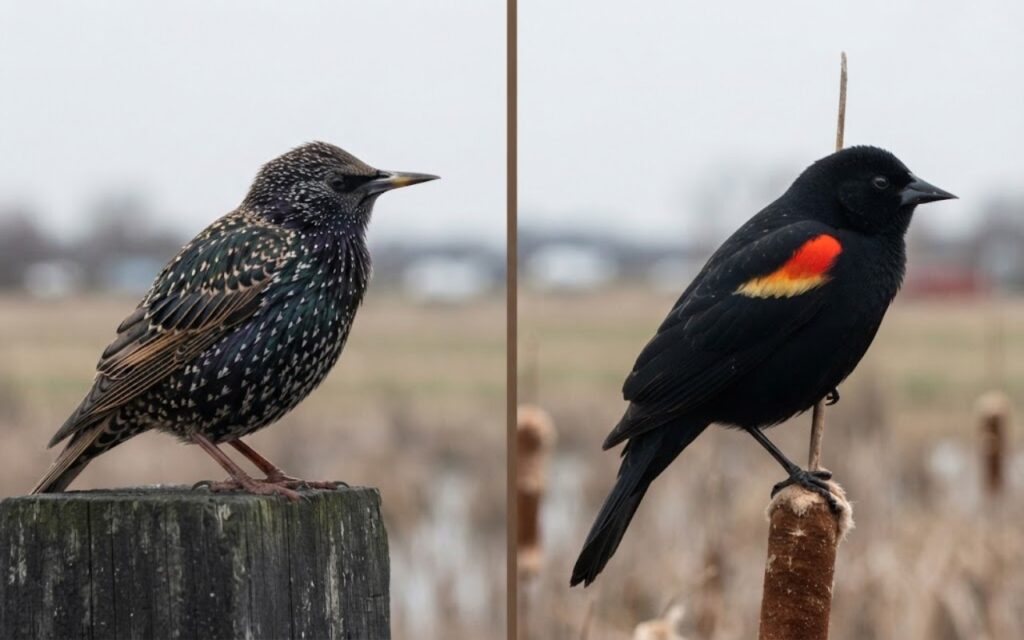
Mastering the European starling vs. red-winged blackbird identification challenge requires looking past superficial dark feathers and recognizing critical differences in body structure, seasonal molts, and flight behavior. Backyard birders frequently confuse these two widespread species across North American yards and wetlands. Distinct evolutionary adaptations produce entirely different silhouettes, bill shapes, and foraging strategies once you know where to look.
The confusion peaks during transitional seasons when juvenile and female plumages overlap with erratic winter molts. A female red-winged blackbird looks radically different from her glossy male counterpart, often leading observers to misidentify her as a starling or an oversized sparrow. Understanding the precise field marks of both species will instantly resolve these identification dilemmas.
Quick-Glance Field Summary
Distinguishing European starlings from red-winged blackbirds relies on evaluating bill morphology, tail-to-body length ratios, and seasonal plumage variations. Starlings feature short, squared tails with sharp, needle-like bills, whereas red-winged blackbirds display longer, rounded tails paired with heavy, acutely conical seed-cracking bills.
- European Starling length: 7.9 to 9.1 inches (20 to 23 cm)
- Red-winged Blackbird length: 6.7 to 9.1 inches (17 to 23 cm)
- Starling bill profile: Long, slender, dagger-like; yellow during spring breeding, turning dark horn-brown by autumn
- Red-winged Blackbird bill profile: Stout, conical, sharply pointed; uniformly dark blackish-brown year-round
- Starling tail structure: Notably short, flat, squared off at the tip; wings nearly reach tail tip when perched
- Red-winged Blackbird tail structure: Medium-long, rounded edge, extending significantly past wingtips at rest
- Starling winter plumage: Heavily speckled with white and buff chevron-shaped tips across dark iridescent feathers
- Female Red-winged Blackbird plumage: Broad brown-and-tan body streaks, pale eyebrow stripe, sometimes showing a salmon or yellow wash near the chin
Bill Morphology and Structural Silhouette Differences
Examining the head structure provides the fastest way to confirm species identity in the field. European starlings possess a long, narrow, flattened bill designed specifically for probing soil and lawn turf. In contrast, the red-winged blackbird has a conical, razor-straight bill with a flat top edge, perfectly adapted for husking seeds and manipulating marsh reed stems.
Silhouettes at rest reveal stark differences in proportional balance. Starlings appear compact and front-heavy, sporting an exceptionally short, squared tail that leaves their folded primary feathers almost flush with the tail tip. Red-winged blackbirds maintain a balanced, classic songbird profile featuring a longer, gently rounded tail that extends well beyond the tips of their folded wings.
A bird perching horizontally on a wire with an upright, sleek posture is almost always a blackbird. Starlings perch with a slightly hunched, stocky posture, often rotating their heads rapidly as they scan for food. Observing these structural outlines saves time when lighting conditions obscure feather colors.
| Field Attribute | European Starling (Sturnus vulgaris) | Red-winged Blackbird (Agelaius phoeniceus) | Field Identification Clue |
|---|---|---|---|
| Plumage Finish | Iridescent oily black with green/purple sheen; heavily speckled with light spots in winter. | Males are solid, uniform glossy-black; females are heavily streaked like oversized sparrows. | Look for spots vs solid coats; starlings are always speckled or highly metallic, never plain black. |
| Shoulder Accents | Completely lacks colored wing badges or contrasting shoulder bar markers. | Males carry a brilliant, blazing scarlet-red shoulder patch bordered cleanly by a yellow strip. | Red shoulder epaulets instantly confirm a male Red-winged Blackbird. |
| Bill Morphology | Elongated, thin, sharp, dagger-like probing beak; shifts yellow in spring, dark in winter. | Short, straight-edged, sharply pointed heavy black conical wedge. | Beak shape confirms families; starlings probe with needles, blackbirds split seeds with wedges. |
Breeding Gloss and Winter Plumage Transformations
Seasonal feather wear dramatically shifts the appearance of European starlings, confusing observers who expect uniform iridescent black plumage. Adult starlings undergo a single complete molt in late summer, emerging with fresh feathers tipped in white and buff. Over the winter, these bright tips gradually wear off against grasses and branches, revealing glorious purple and green iridescence by spring without growing new feathers.
Male red-winged blackbirds exhibit a uniform jet-black plumage highlighted by vibrant scarlet and yellow lesser wing coverts, commonly called epaulets. Territorial males puff these epaulets outward during breeding displays to intimidate rivals and attract mates. When feeding or resting quietly, however, a male can tuck these bright red feathers entirely beneath his black scapular plumage, leaving only a pale yellowish margin visible.
Female red-winged blackbirds cause the greatest backyard identification errors. Rather than sporting black plumage, females display a heavily streaked brown-and-white pattern reminiscent of a large grassland sparrow. On forums like Reddit’s r/whatsthisbird, community members routinely post photos of female red-wings, suspecting them to be rare thrushes or strange starling hybrids due to their sharp, pointed faces and pale facial stripes.
Feeder Excluder Cages and Backyard Foraging Competition
Aggressive feeding behaviors spark widespread complaints in online birding communities, where users report whole flocks monopolizing expensive seed blends. A frequent user observation shared on backyard wildlife boards involves starlings consuming pounds of suet within hours while red-winged blackbirds crowd open platform feeders. Managing these species requires deploying specific feeder hardware configured to avian anatomy.
Starlings possess weaker leg musculature and lack the stiffened tail support found in clinging birds like native woodpeckers. Inverted suet feeders with bottom-only access completely exclude starlings, because their feet struggle to hold their bodies upside down for prolonged feeding. Red-winged blackbirds rarely attempt to use hanging vertical suet feeders at all, preferring ground trays or wide hopper perches.
- Standard wire mesh excluder cage opening: 1.5 inches (3.8 cm)
- Upside-down suet cage clearance: Single-sided bottom wire grid
- Hopper perch length reduction: Under 1 inch to block starling balance
- Safflower seed deployment: High-lipid alternative rejected by both starlings and blackbirds
Installing 1.5-inch wire excluder cages around hopper feeders creates a selective barrier. Small songbirds like chickadees and finches slip through the mesh smoothly, whereas the broad shoulders and barrel chests of both starlings and red-winged blackbirds block entry.
Safflower seed serves as an effective dietary deterrent; due to its exceptionally hard outer shell and naturally bitter flavor profile, both starlings and red-winged blackbirds actively avoid it, leaving the high-protein grains for desirable backyard species like cardinals and grosbeaks.
Flight Dynamics and Murmuration Aerial Mechanics
In active flight, wing shape cleanly separates these two species at extended distances. European starlings feature short, triangular wings with sharp, swept-back tips that give them the aerial profile of a tiny four-pointed star. Their wingbeats are rapid, direct, and stiff, lacking deep undulations as they power straight through the air.
Red-winged blackbirds utilize a distinctly different aerodynamic technique. Their wings are broader and noticeably rounded, producing an undulating, dipping flight pattern punctuated by brief glides with folded wings. They rarely fly in tight, synchronized formations outside of seasonal roost movements.
Starlings are globally famous for their massive, fluid aerial flocks known as murmurations. These synchronized group flights twist and compress like living liquid through the sky to evade predatory falcons. While red-winged blackbirds join massive mixed flocks during autumn migration, their group flights remain loose, linear, and spread across broad horizons rather than performing coordinated aerial acrobatics.
Acoustic Mimicry and Territorial Display Vocalizations
Vocal repertoire provides definitive species confirmation when birds remain hidden within dense brush or marsh vegetation. European starlings are exceptional vocal mimics capable of replicating car alarms, squeaking door hinges, and other bird songs with uncanny accuracy. Their natural vocalizations consist of complex assortments of clicking, rasping, clacking, and high-pitched sliding whistles.
Red-winged blackbirds possess one of the most recognizable wetland vocal signatures in North America. The breeding male issues a loud, ringing “conk-la-ree” song accompanied by a forward bow and flared red epaulets. Both sexes also utilize sharp, metallic “chack” call notes to maintain flock contact and warn intruders away from nest sites.
- Starling vocal elements: Mechanical buzzes, high sliding whistles, and improvised environmental mimicry
- Male Red-winged Blackbird song: Musical, liquid “conk-la-ree” trill lasting approximately one second
- Blackbird alarm vocalization: Dry, abrupt “chack” or “tchehk” note given from elevated cattails or trees
- Starling foraging sounds: Soft, rapid chattering and bill-snapping while walking on turf
Backyard observers can pinpoint foraging starlings by the soft, continuous chatter emitted by flocks working across a lawn. Red-winged blackbirds feed with quiet vigilance, issuing sharp vocal alarms only when aerial predators appear or human observers encroach upon their marsh territories. Recognizing these sonic patterns transforms casual observations into confident, expert identifications.