
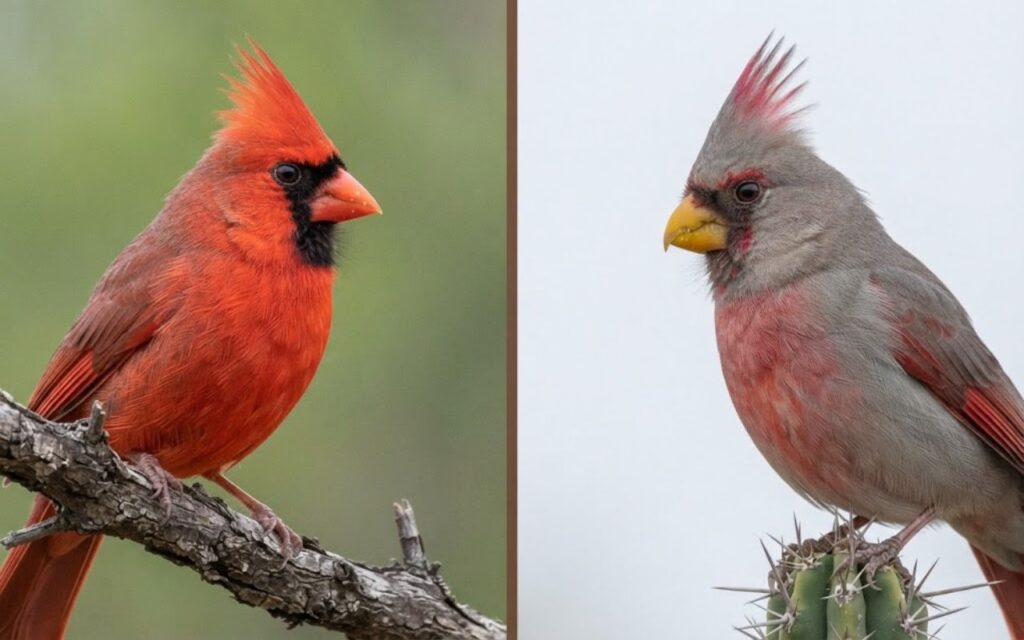
Mastering the Northern Cardinal vs. Pyrrhuloxia identification challenge requires looking past superficial crest shapes and zeroing in on distinct anatomical adaptations. While these two closely related species share territories across the arid scrub of the American Southwest and Northern Mexico, their evolutionary pathways have produced starkly different physical and ecological markers.
Birders frequently struggle to distinguish female Northern Cardinals from Pyrrhuloxias, especially when viewing lone birds under harsh desert sunlight at distance. Field forum discussions consistently show that relying solely on flashes of red plumage leads to misidentifications, making a structured assessment of beak shape, plumage distribution, and vocalization essential.
Quick-Glance Field Summary
Distinguishing between these two desert-edge cardinals hinges on evaluating beak morphology, body mass, and the specific distribution of gray versus brown body plumage. While both species possess prominent crests and red accents, the stubby yellow bill and lighter build of the Pyrrhuloxia cleanly separate it from the stout orange cone and heftier frame of the Northern Cardinal.
- Northern Cardinal Dimensions: Average length of 8.3 to 9.1 inches; weight ranges from 1.5 to 1.7 ounces with a 12-inch wingspan.
- Pyrrhuloxia Dimensions: Average length of 7.5 to 8.7 inches; weight is significantly lighter at 0.8 to 1.5 ounces with an 11-inch wingspan.
- Bill Shape: Pyrrhuloxia shows a strongly curved, parrot-like culmen; Northern Cardinal shows a straight-sided, heavy conical bill.
- Bill Color: Adult Pyrrhuloxia displays dull yellow to greenish-horn; adult Northern Cardinal displays bright orange-coral.
- Primary Body Tone: Pyrrhuloxia presents cold slate-gray or pewter; female Northern Cardinal presents warm buff-tan to olive-brown.
- Crest Profile: Pyrrhuloxia crest is tall, narrow, and whiplike with red tips; Northern Cardinal crest is broad, wedge-shaped, and dense.
- Range Overlap: Sympatric zones occur primarily in southern Arizona, southern New Mexico, and southwest to central Texas.
Bill Morphology and Culmen Curvature Diagnostic Differences
The most dependable morphological field mark separating these species is the structure of the bill. The Pyrrhuloxia, sometimes called the desert cardinal, possesses an exceptionally short, stout bill with a strongly convex upper mandible known as the culmen. This rounded, parrot-like jaw structure is an adaptation for snapping tough desert seeds such as mesquite beans and woody legumes.
In direct contrast, the Northern Cardinal features a classic heavy, conical finch bill designed for crushing a broader spectrum of seeds and fruits. The biting edges of the cardinal’s bill meet in a straight or slightly angled plane, lacking the pronounced curve of its desert cousin. Furthermore, the color differences between the bills of mature adults are definitive across all seasons.
Adult Northern Cardinals display a vibrant, saturated red-orange bill that stands out vividly against their facial feathering. Adult Pyrrhuloxias feature a distinctly pale bill ranging from dull ivory-yellow to greenish-horn, often taking on a brighter yellow hue during the breeding season.
Immature individuals of both species can present dusky gray-black bills, requiring birders to focus on bill curvature rather than color when observing fledglings.
| Anatomical Mark | Northern Cardinal (Cardinalis cardinalis) | Pyrrhuloxia (Cardinalis sinuatus) | Field Identification Clue |
|---|---|---|---|
| Beak Profile | Straight-edged, sharp, pointed conical triangle; bright coral-orange or red. | Short, stubby, strongly curved upper culmen; dull ivory-yellow or parrot-like. | Look at the beak curvature; a strongly curved yellow hook instantly confirms Pyrrhuloxia. |
| Male Base Plumage | Uniform, brilliant saturated crimson-red across the entire body. | Elegant slate-gray or brownish-gray body with a localized crimson chest strip. | Body color is absolute; a gray body with a red-tipped crest means Pyrrhuloxia. |
| Facial Mask | Crisp, heavy, solid ink-black mask completely encircling the beak base. | Muted, diffuse dark crimson-gray shading; lacks a hard black perimeter. | A heavy, solid black face mask always indicates a Northern Cardinal. |
Crest Geometry and Facial Plumage Contrasts in Arid Habitats
Crest structure provides an immediate visual cue when birds are perched atop desert vegetation like ocotillo or creosote. A Pyrrhuloxia holds a remarkably tall, slender crest that tapers to an abrupt, wispy point. This crest is frequently raised into an exaggerated, forward-leaning spike when the bird is alert or agitated, exposing crimson highlights on the central feather shafts.
The Northern Cardinal carries a much denser, broader crest with a triangular footprint that blends smoothly into the crown. Even when raised in alarm, the cardinal’s crest maintains a full, tufted appearance rather than a narrow tuft. The feathers creating the crest are uniform in base color with the rest of the head, lacking the thin, pencil-like profile of the Pyrrhuloxia.
Facial masks also create unmistakable contrasts between the species. The Northern Cardinal displays a solid, jet-black mask that encircles the bill and extends through the lores, chin, and throat, contrasting sharply with its red or buff face.
The Pyrrhuloxia lacks this comprehensive black bib, featuring instead a diffuse, broken dark patch around the eyes and lores, often accented by a localized wash of rose-red radiating around the bill base.
Breast Markings and Female Plumage Confusion at Backyard Feeders
Community discussions on platforms like r/birdwatching frequently highlight feeder misidentifications involving female Northern Cardinals and Pyrrhuloxias. In one Tucson feeder observation, a birder noted that female cardinals in bright desert sun often appear washed out, leading observers to assume they are seeing a rare Pyrrhuloxia.
A similar thread from the Texas Hill Country revealed that birders frequently overlook the warm, cinnamon undertones of female cardinals when focusing solely on the presence of red wing edges. To avoid this pitfall, observers must evaluate the primary body plumage under neutral light.
The female Northern Cardinal is wrapped in warm, earthy tones ranging from yellowish-buff to warm tan across the breast, flanks, and back. Even in worn summer plumage, the female cardinal retains a warm golden-brown base that is entirely absent in the Pyrrhuloxia.
The Pyrrhuloxia exhibits a cold, frosty palette dominated by crisp slate-gray and pewter tones. Male Pyrrhuloxias feature a striking, broken streak of rich rose-red running down the center of the breast and belly, resembling a red vest worn over a gray suit.
Female Pyrrhuloxias show this same cold gray body plumage, but their underparts are either plain or lightly suffused with pale rose along the mid-ventral line.
Vocalization Nuances and Acoustic Separation in Mesquite Scrub
In dense brush where visual contact is fleeting, auditory identification becomes the primary field technique. The territorial songs of both species utilize clear, liquid whistles, but their tempo, cadence, and frequency structure differ noticeably to an experienced ear. Northern Cardinals deliver a varied repertoire of rolling phrases, famously transcribed as cheerful, bouncing whistles that shift pitch mid-sequence.
The song of the Pyrrhuloxia is distinctly sharper, thinner, and more metallic than that of the cardinal. Its primary song consists of a straight, piercing whistle followed by a rapid series of dry, whip-like notes delivered on a single pitch. The notes carry a slightly burry or nasal quality, lacking the rich, resonant acoustic body that defines Northern Cardinal vocalizations.
Call notes offer an even more reliable separation metric for field observers working brushy washes. The standard chip note of the Northern Cardinal is a loud, hard, metallic click resembling the sound of two river stones snapping together. The Pyrrhuloxia delivers a softer, drier, and more chattering call that sounds like a blunt, wooden tap, which is far less penetrating than the cardinal’s sharp warning note.
Hybridization Realities and Field Scope Verification Protocols
In narrow contact zones across south-central Texas and northern Mexico, Northern Cardinals and Pyrrhuloxias occasionally interbreed, producing viable hybrid offspring. These hybrid individuals present an intermediate combination of field marks that can frustrate standard dichotomous key identification.
A hybrid bird may feature an intermediate orange-yellow bill with moderate curvature, paired with a splotchy, uneven mix of gray and brown body feathers. When assessing an ambiguous individual in overlapping zones like the Rio Grande Valley, birders should deploy high-magnification optics to verify structural markers.
Binoculars offering 8x or 10x magnification are often insufficient to resolve subtle bill curvature at distances exceeding 25 yards. Using a spotting scope with an objective lens of at least 65 millimeters allows for precise examination of the culmen profile and nostril feathering.
- Focus magnification on the junction where the upper mandible meets the forehead feathers to check culmen curvature.
- Examine the lower mandible for a straight baseline, which indicates a Northern Cardinal, or an upward curve, which indicates a Pyrrhuloxia.
- Inspect the flanks under diffuse light to eliminate false gray impressions caused by the blue sky reflecting off dusty feathers.
- Document the bird with high-shutter-speed audio-visual recordings to capture crest articulation and call note frequencies for regional eBird review.