
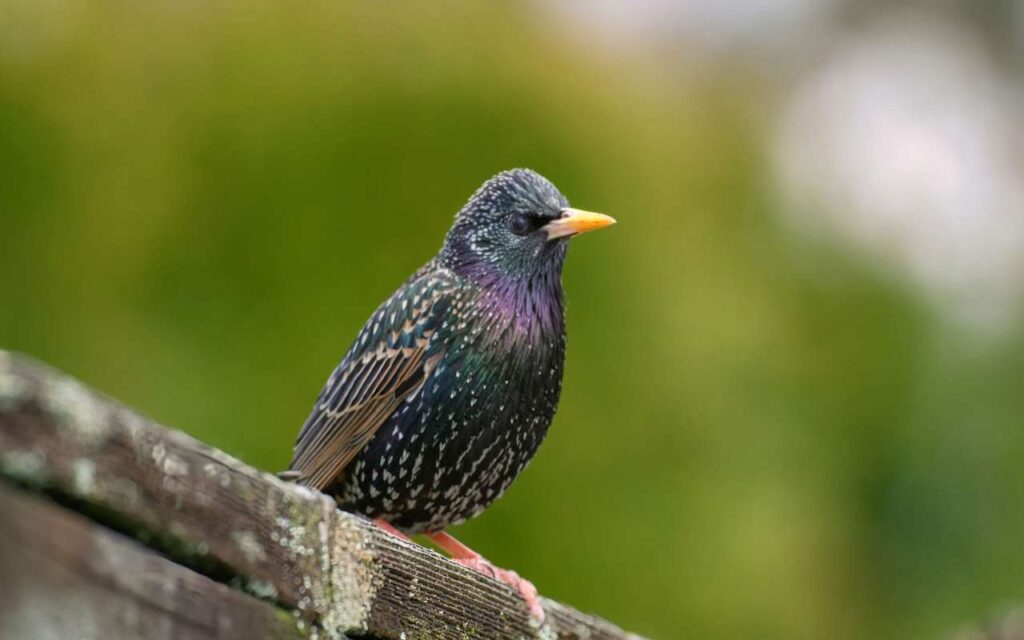
If you have watched a flock of European starlings (Sturnus vulgaris) empty a suet cage in minutes, you know these birds are uniquely equipped for feeder domination. To understand what European starlings eat in backyards, you must realize they are biological specialists anatomically designed to out-compete almost every native North American species.
This article takes a forensic approach to the starling problem. We examine the biology of how they eat, their high-energy targets, and how social signals turn a single scout into a massive flock. By understanding these biological vulnerabilities, you can implement evidence-based mechanical and nutritional strategies to reclaim your feeders.
Quick Answer: How to Stop Starlings from Eating All Your Bird Seed
To stop European starlings from dominating your feeders, switch to hard-shelled seeds like safflower, use 1.5-inch wire mesh cages as a size lockout, and utilize upside-down suet feeders to exploit their poor clinging ability. Removing access to high-fat “soft” foods like suet and mealworms is the most effective biological strategy to displace a starling flock.
Watch: How Starlings Use Biology to Dominate Feeders
To visualize these forensic advantages in action, watch our video analysis of the starling’s most complex biological adaptations. This breakdown demonstrates how their protractor muscles force open substrates, how they utilize thermal foraging in frozen soil, and the specific social signals they use to recruit a hundred-bird swarm in minutes.
Show Transcript:
0:00
Alright, let’s jump right in. If you have ever set up a bird feeder, you have probably dealt with this problem. You expect colorful backyard birds, but instead you get a flock of starlings that take over everything. That kept happening to me, so I decided to figure out exactly why.
0:20
This all started in my own backyard. I was watching with a cup of coffee as a brand new suet cake disappeared in about 10 minutes. It was not random feeding. It was fast, organized, and efficient. The birds were working together, and it was frustrating to watch.
0:40
Every morning looked the same. I imagined peaceful visits from woodpeckers and chickadees, but instead I had a loud, messy starling invasion. The birds I actually wanted could not get anywhere near the feeder.
1:02
At that point, I stopped guessing and started investigating. If I wanted to fix my bird feeder problem, I needed to understand starling behavior, their feeding habits, and what made them so effective at dominating feeders.
1:26
The first breakthrough came from understanding their beak. Starlings are not built to crack seeds like finches. Instead, they have powerful muscles that force their beak open. They stab into food and pry it apart, which makes them extremely effective at tearing into soft foods.
1:55
Compared to typical songbirds with seed-cracking beaks, starlings use a probing technique more like forceps. This explained why they targeted certain foods at my feeder.
2:12
They were not eating everything. They were choosing foods that matched their biology. Suet, peanut butter, and soft foods require no cracking and provide instant energy. I realized I was offering the perfect menu for starlings.
2:46
Then I looked deeper into why they prefer suet. Suet is extremely high in fat, which provides more than double the calories of protein or carbohydrates. For birds with high energy demands, it is the most efficient fuel available.
3:07
In winter, a starling’s metabolism can double just to maintain body heat. That aggressive feeding behavior is not random. It is survival. My feeder had become a high-calorie energy station.
3:35
I also realized my cheap bird seed mix was making things worse. It was full of white proso millet, a soft seed that starlings can eat quickly. I thought I was saving money, but I was actually attracting more of them.
3:56
The next question was speed. How did one starling turn into a flock of dozens so quickly? The answer is something called local enhancement. When one bird finds food, others see it feeding and immediately join.
4:21
This creates a rapid chain reaction. The presence of one feeding bird signals food availability to the entire group. That is why flocks appear so fast and overwhelm feeders.
4:46
This also explained why trying to scare them away did not work. As long as food was available, more birds would keep arriving. I was not solving the problem, just delaying it.
5:02
With this understanding, I built a system instead of relying on random fixes. I focused on using bird biology and feeder design to make my setup less attractive to starlings while still supporting smaller birds.
5:26
One of the most effective tools was a wire cage feeder. The key is a 1.5 inch opening. Smaller birds like finches, chickadees, and nuthatches can enter, but larger birds like starlings cannot fit through.
5:47
I also switched to an upside down suet feeder. Smaller birds can cling and feed, but starlings struggle to use it. This simple change made a big difference.
6:04
Changing the seed mix was another major step. I replaced soft seeds with harder options like safflower that starlings avoid but many native birds enjoy.
6:11
By combining feeder design, seed selection, and placement, I disrupted the feeding patterns that allowed starlings to dominate. The goal was not to eliminate them, but to redirect them.
6:18
In the end, my backyard changed completely. The feeders became quieter, cleaner, and more balanced. The birds I actually wanted finally had space to feed.
6:27
This whole process taught me that solving bird feeder problems comes down to understanding bird behavior. Once you work with their biology instead of against it, everything starts to fall into place.
How Do Starlings Empty Suet Cages So Quickly?
European Starlings use a biological technique called open-bill probing to dismantle suet cakes. By inserting their bill into the suet and using powerful protractor muscles to spring it open, they pry apart the high-fat block from the inside. This “prying” motion allows them to extract large volumes of fat much faster than native birds that can only peck at the surface.
The Protractor Muscle Mechanic
Most birds are built around powerful jaw-closing muscles. The European starling is different. Its most developed jaw muscles are the protractors, the muscles responsible for forcing the bill open against resistance. This means a starling can insert its closed bill into soil, suet, or bark, and then spring it open to create a cavity and extract food. As the bill opens, the eyes rotate forward to give the bird binocular vision directly down the length of the bill, allowing it to see what it has exposed.
According to Audubon’s coverage of avian gaping mechanics, birds built for this style of foraging have stronger muscles for opening the bill than closing it, and their skull shape allows them to focus their eyes directly down the length of the bill to see what the probing motion exposes.
The Missouri Department of Conservation notes that starlings have unusually adapted jaw muscles that work in the opposite way most birds do, using most of their strength to force the bill open rather than clamp it shut, which allows them to pry into soil and uncover hidden prey.
This single anatomical fact matters most when thinking about feeder strategy, because it means the bird is extracting food from locations and substrates that seed-cracking songbirds simply cannot reach.
In a frozen winter lawn, this ability lets starlings probe for crane fly larvae and other soil invertebrates that remain alive underground at temperatures where surface foraging by other birds becomes impossible.
According to research from the US Forest Service Pacific Southwest Research Station, controlled aviary experiments confirmed that starlings strongly prefer short grass without leaf litter, and that a single year of excluding mowing from a pasture was sufficient to deter starling foraging entirely. Translated to backyard management: a mowed, open lawn is an active invitation.
The Suet Siege Timeline
Understanding when starlings pivot from lawn foraging to feeder domination is useful for setting up a seasonal defense. During spring and summer, starlings are primarily insectivores, feeding on lawn invertebrates to meet high protein demands during breeding.
Research has found that European starlings increase body mass when food availability becomes unpredictable or energy demands rise, suggesting a flexible strategy to reduce starvation risk under uncertain conditions.
By mid-November in most of North America, the soil-invertebrate food base that starlings depend on during warmer months is largely unavailable. The birds shift aggressively to high-calorie, high-fat anthropogenic food sources: suet, peanut products, and livestock feed.
Research published in Bird Study (1973) found that European starlings rely heavily on grain and household waste during winter, allowing them to survive when natural food sources become scarce. This shift toward feeders is not random opportunism, but a predictable response to seasonal declines in natural protein and fat availability.
What Bird Seeds are Starlings Unable to Eat?
European Starlings are unable to eat hard-shelled seeds like safflower and striped sunflower because their bills are optimized for probing rather than cracking. Unlike songbirds with thick, conical beaks designed for crushing, starlings possess long, pointed, and soft-tipped bills that lack the mechanical force required to hull heavy seed coatings.
Soft-Bill Anatomy vs. Seed Crackers
Because the starling’s bill is optimized for probing rather than cracking, its anatomy creates a genuine nutritional preference. Songbirds like Northern Cardinals and grosbeaks have thick, conical bills and powerful crushing muscles designed to hull hard seeds. The starling’s bill is long, pointed, and relatively soft-tipped, more like a probe than a nutcracker.
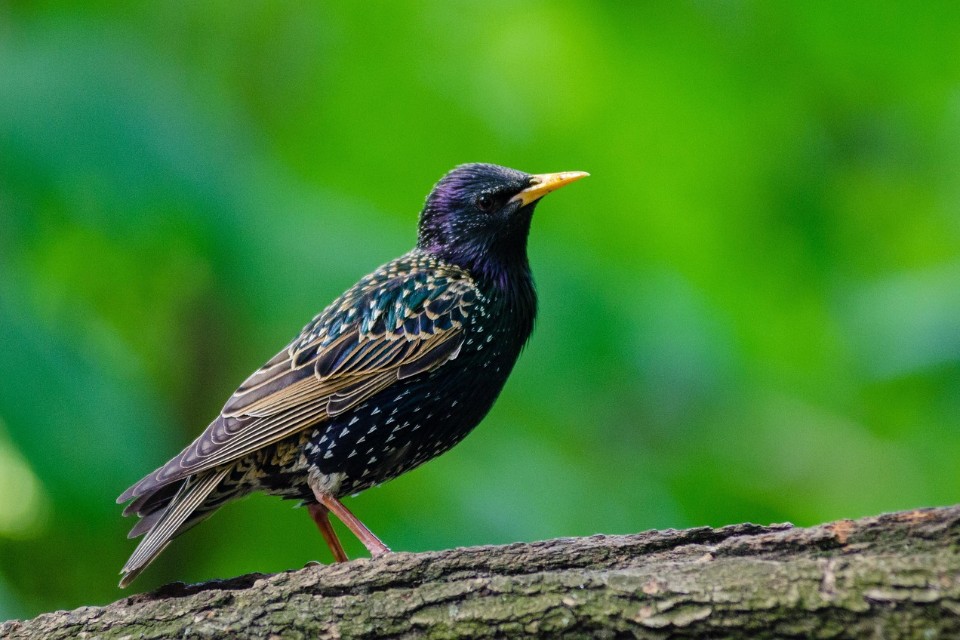
This is why starlings consistently target foods that require no hull removal: suet, mealworms, soft grain, and hulled sunflower hearts are all processed immediately on contact. When a starling does encounter a hard-shelled seed at a feeder, it often spends considerable time using its open-bill probing motion to work the seed apart, flinging surrounding material aside to find broken fragments or to search for something more accessible.
According to Cornell Lab’s All About Birds seed guide, safflower’s thick shell is hard for some birds to crack, and starlings, along with House Sparrows and squirrels, tend to avoid it. This shell-versus-bill mismatch is the biological foundation for the safflower deterrence strategy covered in Feeder Defense: Biological and Mechanical Deterrence.
What Do European Starlings Eat in Backyards?
European Starlings are opportunistic omnivores that prioritize high-calorie fats, soft proteins, and easily accessible grains. While they are famous for raiding suet and peanut butter, they also scavenge outdoor pet food, livestock feed, and kitchen scraps. Their diet shifts seasonally, moving from soil-based invertebrates in summer to calorie-dense “anthropogenic” foods provided by humans during the winter.
High-Energy Fats: The Science Behind Suet Preference
Starlings fixate on suet because it provides roughly 9 kilocalories per gram, offering double the energy of protein or carbohydrates. Because starlings are active energy managers, they prioritize these high-fat resources to meet the metabolic demands of cold weather. Since suet requires no hulling or cracking, it is the perfect fuel source for their soft-tipped probing bills.
Research from PeerJ (indexed on PubMed Central) found that European starlings under food insecurity increased energy storage efficiency rather than simply eating more, confirming they are active energy managers that prioritize calorie-dense foods precisely when access to natural invertebrates is unpredictable. Winter suet is exactly the type of high-density, reliable calorie source that the starling’s behavioral ecology predicts it will fixate on.
Scavenged Protein: Outdoor Pet Food and Food Scraps
Outdoor pet food and kitchen scraps serve as high-protein emergency resources that starlings can easily process with their open-bill probing motion. Beyond traditional bird feeders, starlings are urban specialists that scavenge dog kibble, livestock grain, and garbage. If these soft protein sources are available, a starling flock will return consistently to exploit the “easy” calories.
European starlings are documented consumers of these resources. According to Cornell Lab’s All About Birds, starlings will readily consume grains, seeds, nectar, livestock feed, and garbage when invertebrate prey is unavailable. Outdoor cat or dog food left on a porch or patio is a high-protein emergency resource from the starling’s perspective, and a flock that discovers it will return consistently.
This behavior is part of a broader pattern of urban adaptation. The open-bill probing motion that evolved for soil invertebrate extraction translates directly to processing soft foods of all kinds, from suet cakes to kibble to food scraps in partially open packaging.
Field research documents starlings following lawnmowers to catch disturbed insects, learning the schedules of outdoor dining areas, and opening garbage bags for food scraps. If you have outdoor pet food and a starling problem, the two are almost certainly connected.
Black-Oil Sunflower Seeds and Backyard Feeding Behavior
While starlings are not specialized seed-crackers, they will readily consume black-oil sunflower seeds if the shells are thin enough to be pried apart. Starlings are opportunistic feeders rather than selective ones; they focus on high-calorie availability rather than seed type. Because they can adapt to oil-rich seeds, simply switching seed types is often insufficient without also changing the feeder design.
According to Cornell Lab NestWatch, European starlings readily exploit human-provided foods, including suet, mealworms, grain-based mixes, and oil-rich seeds such as black-oil sunflower. Their feeding behavior is opportunistic rather than selective, meaning they focus less on seed type and more on consistent, high-calorie food availability.
Because of this flexibility, simply switching seed types is usually not enough to deter them. Effective reduction strategies focus on limiting access to high-energy foods like suet and mealworms, avoiding ground feeding, and using feeders with designs that exclude larger birds. These adjustments reduce overall feeding efficiency for starlings rather than targeting a single preferred seed.
Why Are Starlings So Aggressive at Bird Feeders?
European Starlings dominate feeders through a combination of social amplification and physical aggression. Their “social copy” behavior allows a single scout to recruit an entire flock in minutes, while their physical bulk and specialized “gaping” anatomy allow them to out-compete native species for high-fat resources like suet. Once established, their messy feeding habits create secondary pest problems by depositing large volumes of seed on the ground.
How Do Starlings Recruit Large Flocks So Quickly?
Starlings recruit flocks through “local enhancement,” where social learning increases their foraging efficiency by 6.67 times the individual rate. When one bird finds a food source, it broadcasts a visual signal that the rest of the flock interprets as reliable information. This social architecture turns a single scout into a massive “murmuration” of foragers that can empty a feeder before native birds can react.
The same social architecture that makes murmurations visually stunning also makes starling feeder invasions fast and difficult to stop. European starlings are exceptionally sensitive to social information from flock members.
Field research using starling decoys found that European starlings in recently established urban environments were more likely to respond to feeding cues from flock-mates than birds in long-established rural territories, a finding published in Animal Behaviour (Elsevier, 2010).The mechanism is local enhancement: when one starling lands and begins feeding, nearby birds interpret that behavior as reliable information that food is available and respond accordingly.
Research from Behavioural Processes (2014) found that social learning increased the rate at which starlings acquired novel foraging skills by 6.67 times the individual learning rate. Applied to your backyard feeder, this means the first starling that lands on your suet cage is not just taking food for itself.
It is broadcasting a food signal that will propagate through a networked flock rapidly, especially in mid-winter when flock cohesion is highest. This social amplification explains why partial deterrence so often fails, and why effective defense has to work at the level of the food source itself.
Which Native Birds Are Displaced by Starlings?
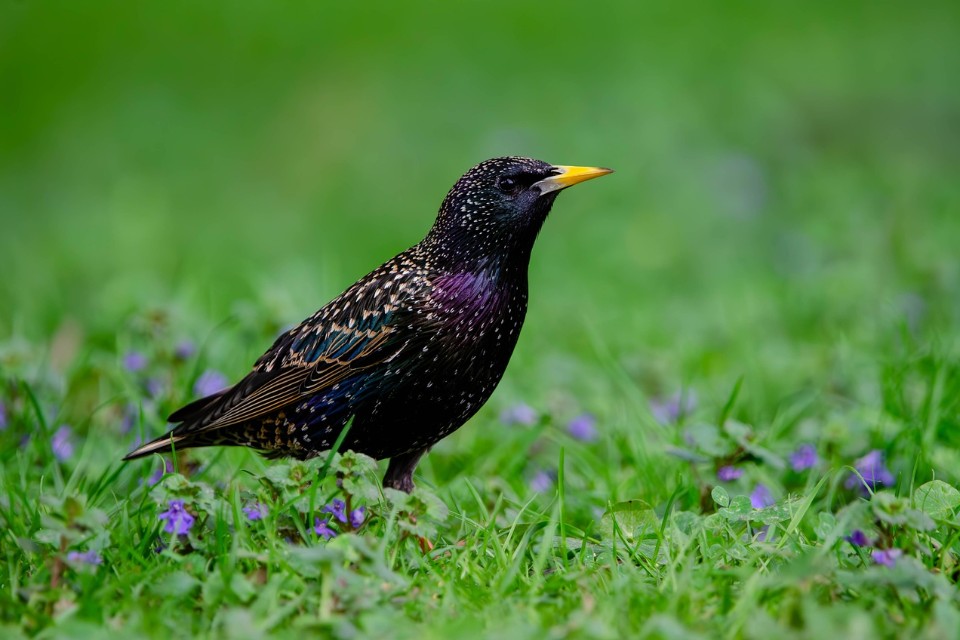
Starlings successfully displace 136 species of native songbirds, with Bluebirds, Tree Swallows, and Northern Flickers being the most vulnerable. According to Project FeederWatch dominance hierarchy research, starlings rank among the highest-scoring species for aggression. They use their bulk to physically crowd out woodpeckers and chickadees, often destabilizing established feeding dynamics in North American backyards.
Project FeederWatch dominance hierarchy research analyzed over 7,600 interspecific interactions recorded by feeder watchers across North America and established formal ability scores for 136 species.
European starlings rank among the highest-scoring species, meaning they successfully displace other birds in the majority of recorded confrontations. According to All About Birds (Cornell Lab), the data also shows that starlings appear to disrupt naturally constructed dominance hierarchies among native birds, inserting themselves as a destabilizing element in established feeding dynamics.
At suet feeders, starlings physically crowd out woodpeckers, nuthatches, and chickadees through sheer bulk and aggressive posturing. Eastern and Western Bluebirds fare particularly poorly against starlings, as does the Tree Swallow. Studies document that starlings actively eject eggs from the nests of Eastern Bluebirds, Tree Swallows, Northern Flickers, Buffleheads, and Flycatchers, making feeder-level displacement only one dimension of a broader competitive impact.
Our article on deterring invasive feeder birds covers related strategies for protecting smaller songbirds from both starlings and other aggressive species.
Why Is Starling Feeding Behavior So Messy?
Starlings are messy feeders because they use a “prying” motion to excavate preferred food, causing them to fling unwanted seeds onto the ground. This “seed flinging” creates a secondary pest problem by attracting House Sparrows, cowbirds, and rodents to the accumulated debris. In effect, the mess left by a starling invasion acts as an invitation for a second tier of invasive and pest species.
When a starling encounters a feeder stocked with a mixed seed blend, it uses its bill-opening action to excavate toward preferred items, sending unwanted seeds arcing outward and downward. A single starling at a hopper feeder can deposit a substantial pile of seed on the ground within minutes.
This secondary seed deposit creates its own ecological problem. Ground-level seed accumulation is a reliable attractant for house sparrows, brown-headed cowbirds, and Norway rats. Field research indicates that ground seed accumulation consistently attracts non-target mammals, a recruitment process that accelerates with any mixed seed blend offering small, accessible particles.
The mess signal from a starling feeder invasion is, in effect, a secondary invitation to a second tier of pest species. House sparrow behavior around ground-level seed piles is covered in our article on house sparrow nesting habits in urban areas.
How Do You Stop Starlings from Eating All Your Bird Seed?
To stop European Starlings, you must utilize mechanical deterrents like 1.5-inch wire mesh cages and upside-down suet feeders, combined with nutritional exclusion using safflower or nyjer seed. These strategies exploit the starling’s inability to crack hard shells, their poor clinging strength, and their stocky body size. By removing access to high-fat “soft” foods, you force the flock to forage elsewhere.
Does an Upside-Down Suet Feeder Actually Work?
Upside-down suet feeders are highly effective because starlings lack the specialized leg anatomy and weight distribution required to cling inverted for long periods. Unlike native woodpeckers and nuthatches, starlings find the upside-down posture metabolically expensive. Adding an overhead dome baffle further increases the deterrent effect, as starlings are strongly reluctant to feed under overhead cover.
The most widely recommended mechanical deterrent for suet feeders is the upside-down or bottom-access suet cage. Woodpeckers, nuthatches, and chickadees have evolved specifically for this inverted posture and can access food from these feeders without difficulty.
According to Project FeederWatch (Cornell Lab), suet cages accessible only from the bottom tend to be starling-resistant while still allowing woodpeckers, nuthatches, and chickadees to feed by clinging upside down. The caveat is that difficulty does not mean impossibility.
Highly motivated starlings in peak winter, when caloric pressure is highest, will sometimes learn to cling briefly in the inverted position or perch on the feeder cage rim and probe inward. The solution is to combine the upside-down feeder with a dome or baffle over the top, as starlings are strongly reluctant to feed under any overhead cover. The combination of inverted access plus overhead cover is consistently more effective than either method alone.
What Are the Best Starling-Proof Bird Seeds?
Safflower and nyjer are the best starling-proof seeds because they function as biological and mechanical filters. Safflower has a thick, bitter shell that the starling’s soft probing bill cannot easily crack, while nyjer requires specialized feeders with ports too small for starlings to access. Switching to these seeds allows you to feed cardinals and finches while discouraging invasive flocks.
Safflower has a thick, hard white shell and a bitter compound in the seed coat. For a bird with a soft, probing bill, the shell presents a genuine mechanical challenge, and the bitterness provides an additional chemical deterrent.
According to the Cornell Lab of Ornithology “All About Birds” seed guide, cardinals, grosbeaks, and some finches readily eat safflower, but species like starlings and grackles tend to avoid it. However, in areas where food is scarce, some starlings may still learn to eat safflower, so it works best when offered on its own rather than mixed with other seeds.
Nyjer seed presents a different barrier. The seeds are tiny and needle-like, and according to Project FeederWatch, nyjer requires a special feeder with very small feeding ports, with the small openings preventing spillage and physically excluding larger birds from accessing the seed. This port size functions as a reliable all-weather starling exclusion tool.
The target audience for nyjer is American Goldfinches, Pine Siskins, Dark-eyed Juncos, and House Finches, all of which benefit when starlings are excluded. For a broader discussion of finch feeding preferences and winter seed strategies, see our article on what finches eat in winter.
What Size Mesh Stops Starlings but Allows Songbirds?
A 1.5-inch wire mesh cage is the precise physical lockout dimension required to stop European Starlings while allowing smaller songbirds to enter. Because an adult starling has a stocky build that requires at least a 1.5-inch opening to pass through, these mechanical barriers successfully exclude them while granting access to chickadees, nuthatches, and finches.
A cage built from 1.5-inch wire mesh placed around a tube or suet feeder creates a physical barrier that admits birds under a certain body diameter while excluding larger birds. European starlings, which average 8 to 9 inches in length with a stocky build, cannot pass through this opening. However, chickadees, nuthatches, Downy Woodpeckers, and titmice can enter and feed normally.
The 1.5-inch threshold comes directly from nest box biology. According to NestWatch (Cornell Lab), European starlings require an entrance hole of at least 1.5 inches to access a nest cavity, confirming that this dimension functions as a reliable size lockout for feeders as well.
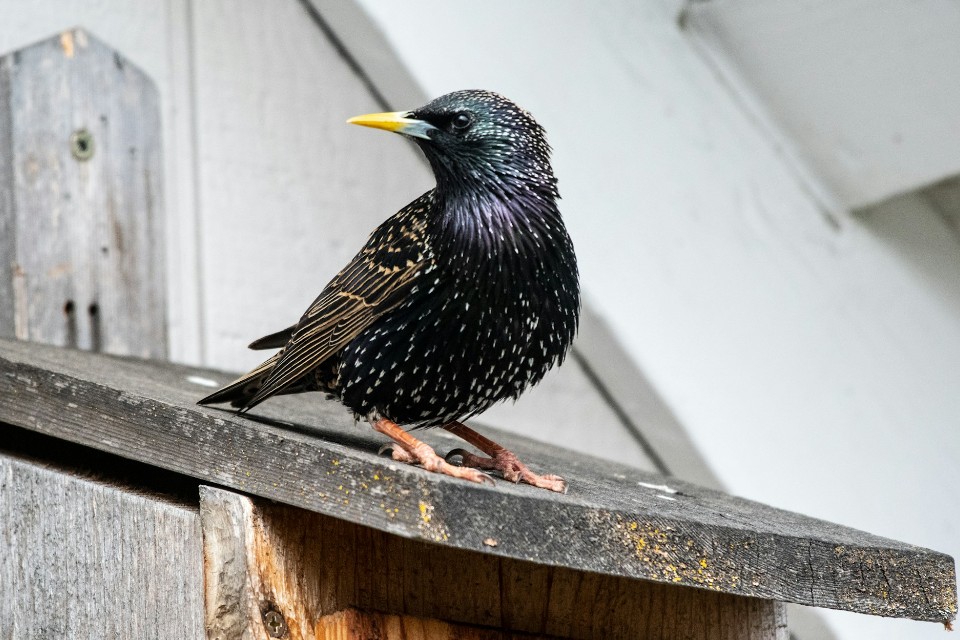
Commercial cage feeders built to this specification are widely available, and many manufacturers sell cage enclosures designed to retrofit existing tube and suet feeders. The practical limitation is that 1.5-inch mesh also excludes some larger desirable species such as Northern Cardinals and Northern Flickers, so cage feeders work best alongside a separate unprotected platform feeder for larger songbirds placed in a less accessible location.
The cage approach works best as a system rather than a single tool. Pair a caged tube feeder stocked with safflower or nyjer with an upside-down suet cage covered by a dome baffle, remove cheap millet-heavy mixes, and eliminate outdoor pet food, and you have addressed the main entry points that starlings exploit most aggressively. The result is not a starling-free yard.
It is a feeding station that the birds you want can access while making it consistently less rewarding for starlings to stay. Additional habitat and feeder design context is covered in our overview of invasive backyard birds and the strategies birders use to manage them.
Summary: The Forensic Strategy for Starling Feeder Defense
To ensure your yard remains a selective environment for native songbirds, we have distilled our deterrence research into the visual summary below. This guide provides a quick-reference look at the specific seeds, feeder designs, and biological lockouts required to successfully manage European Starling populations at your feeders.
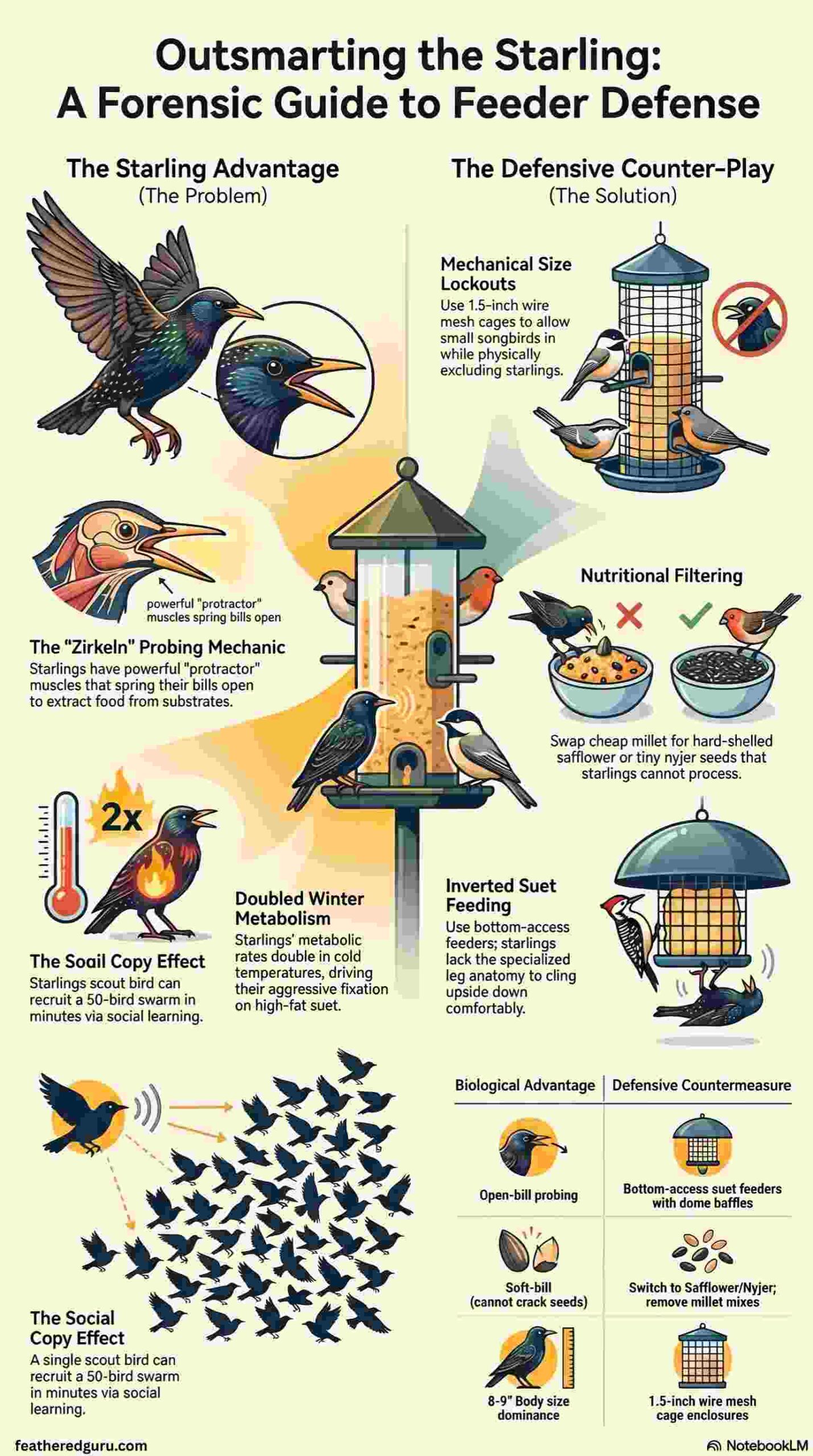
Summary: The Forensic Approach to Starling Defense
European starlings succeed at backyard feeders because of a specific set of biological advantages: protractor jaw muscles that allow open-bill probing, a soft bill that makes high-fat soft foods the ideal fuel, a winter metabolic need that drives fixation on suet and high-calorie supplements, and a social learning system that amplifies a single food discovery into a flock-level response. Each of these advantages has a corresponding defensive countermeasure.
| Starling Advantage | Biological Basis | Defensive Countermeasure |
|---|---|---|
| Open-bill probing | Enlarged protractor muscles; narrow skull | Bottom-access suet feeders with dome baffle |
| Soft-food preference | Soft, probing bill; no seed-cracking musculature | Switch suet to safflower and nyjer; remove millet mixes |
| Winter caloric drive | Elevated metabolic rate in cold; fat as premium fuel | Limit or relocate suet when flocks arrive; use inverted feeders |
| Social recruitment | Local enhancement; social copy behavior (6.67x amplification) | Remove food signal entirely; use cage feeders that deny access |
| Body size dominance | Larger than most target songbirds; aggressive displacement | 1.5-inch wire mesh cage enclosures as size lockout |
None of these strategies require harming starlings, which are federally unprotected in the United States and can be managed without permits. The goal is displacement, redirecting the birds away from the specific resources that bring them to your feeders while preserving those resources for the native songbirds you want to support. The starling is a genuinely remarkable animal, and understanding its anatomy is what makes effective deterrence possible.