
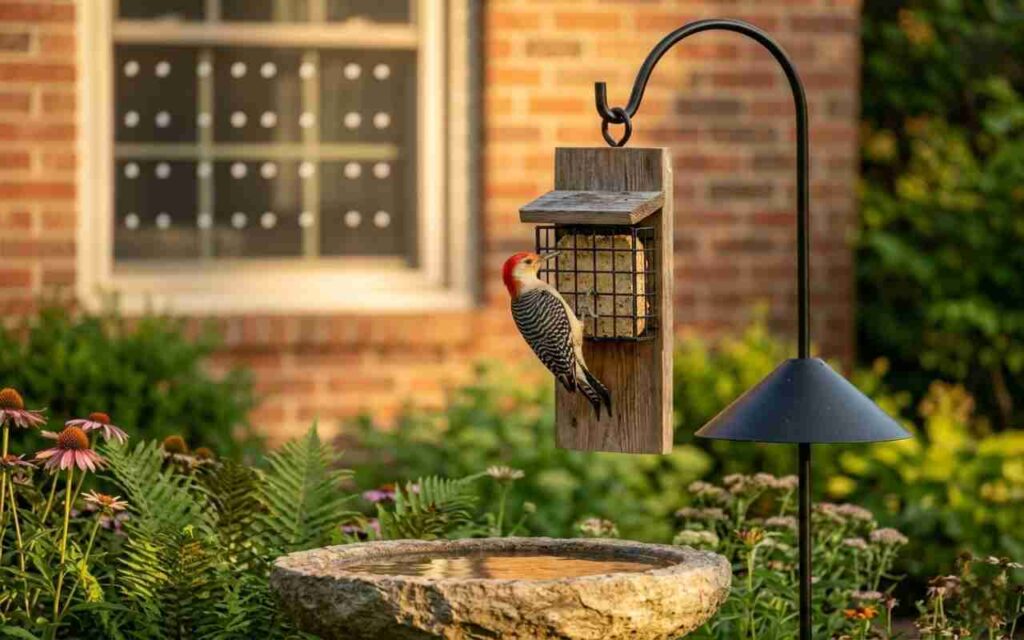
Most birders focus on suet, but learning how to attract woodpeckers safely to your backyard requires solving the “Attraction Paradox.” While standard feeders work for finches, they often fail woodpecker biomechanics, leading to neck strain and plumage damage from melting suet. More dangerously, increased presence around reflective glass elevates window strike mortality during territorial drumming season, as birds collide with perceived rivals. Creating a true sanctuary means moving beyond generic feeding toward specialized habitat provisioning.
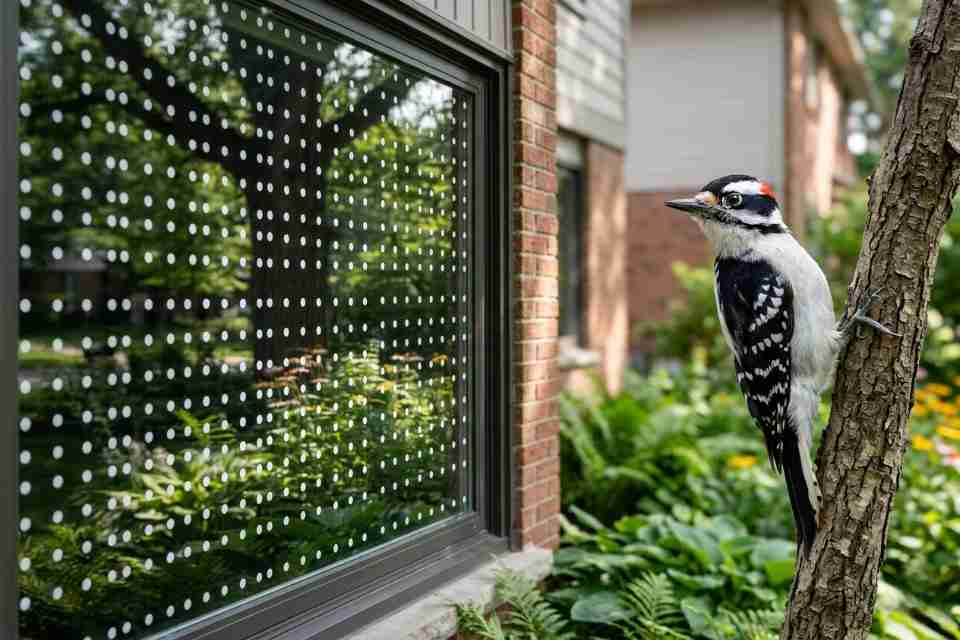
Success depends on infrastructure that matches woodpecker anatomy and foraging ecology. Using tail-prop feeders to support stiff rectrices prevents hyperextension, while pure rendered suet protects feather waterproofing. Safe attraction also requires rough-textured water basins for zygodactyl feet and a dense grid of UV-reflective dots (as seen in the image below) to break up window reflections. By balancing strategic deadwood management with these safety protocols, you create an ethical habitat that enhances, rather than endangers, your local woodpecker population 🙂.
Quick Answer: Attract woodpeckers safely by providing tail-prop suet feeders with lower support platforms, using pure rendered suet (not no-melt formulations), installing rough-surfaced water basins allowing vertical grip, maintaining wildlife snags for nesting habitat, and applying dense UV window decals preventing territorial drumming collisions during breeding season.
Woodpecker Attraction & Identification Table
| Species | Primary Attraction | Nesting Preference | Unique Safety Need |
|---|---|---|---|
| Downy Woodpecker | Suet, Sunflower Hearts | Small dead limbs | Suet restricted to <70°F |
| Hairy Woodpecker | Peanuts, Suet | Mature dead snags | Mandatory tail-prop support |
| Northern Flicker | Ground-level ants | Utility poles, snags | 2-4″ wood chip mulch |
| Red-bellied Woodpecker | Peanuts, Oranges | Dead deciduous trees | Rough-textured birdbaths |
| Pileated Woodpecker | Shelled peanuts, Suet | Large, 15-20″ DBH snags | High-elevation tail-props |
Mastering Safe Backyard Architecture: A Visual Breakdown
While understanding woodpecker anatomy is the first step, seeing the safe backyard architecture in action helps bridge the gap between theory and practice. Watch our whiteboard explainer video below for a deep dive into tail-prop mechanics, rough-surface hydration, and the exact window dot spacing needed to protect your local cavity-nesters.
Show Transcript:
0:00
We all love seeing a woodpecker in the yard—the flash of red, the drumming sound—it’s a joy. But sometimes our efforts to attract them can actually put them in danger. Is your backyard a safe haven or an accidental hazard? The things we think are helping might create hidden risks.
0:24
This is called the attraction paradox. Our desire to help can unintentionally create hazards. The first place to start is the bird feeder. Most store-bought feeders are designed for songbirds, not woodpeckers. Asking a woodpecker to use one is like asking a fish to climb a tree—it goes against their anatomy.
0:59
Finches and sparrows perch easily on small dowels, but woodpeckers are vertical clingers, designed for life on tree trunks. Their specialized feet, with two toes forward and two back, plus stiff tail feathers for balance, create a tripod that supports drumming and feeding. Standard feeders force awkward positions, causing fatigue and making them vulnerable to predators.
1:57
The solution is tail prop feeders. These platforms allow woodpeckers to use their tail, forming a stable tripod so they can eat safely and comfortably. Proper feeder design is only part of the strategy—the type of food matters too.
2:11
Temperature matters for suet. Above 70°F (21°C), suet can soften and stick to feathers, damaging the waterproofing and insulation that woodpeckers rely on. Only use pure suet when it stays solid in cooler temperatures, typically late September through April. In warmer months, provide alternatives like shelled peanuts, sunflower hearts, or nut and insect blends.
3:08
Beyond feeders, a woodpecker-friendly backyard considers water, wood, and ground cover. Smooth ceramic bird baths can be a drowning hazard because woodpeckers can’t grip slick surfaces. Add rough stones, a branch, or rope around the edge for traction.
3:57
Shelter is important. Dead trees, or snags, provide ideal nesting and feeding sites. If a snag is a hazard to property, have an arborist top it at 15–20 feet to maintain safety while preserving habitat. Northern flickers, which feed on the ground, benefit from a 2–4 inch layer of wood chip mulch as a safe, food-rich area.
4:42
Even after providing food and shelter, dangers remain, such as window collisions. Male woodpeckers are territorial during breeding season and attack reflections they mistake for rivals. This can be fatal. The solution is the 2×4 rule: place visual markers on windows no more than 2 inches apart horizontally and 4 inches vertically to break reflections and prevent collisions.
5:48
Another concern is drumming noise on structures. This is territorial behavior, not aggression. The solution isn’t scaring them away—it’s redirecting them. Installing a 6–8 foot cedar or pine post provides a better drumming surface, encouraging them to leave your structure alone.
6:25
To summarize, create a woodpecker-friendly backyard using a four-pillar approach. First, feeders: use tail prop designs and season-appropriate suet. Second, water: ensure safe, grippable bird baths. Third, windows: apply the 2×4 visual marker rule. Fourth, habitat: maintain safe snags and appropriate ground cover.
7:12
By seeing the world through a woodpecker’s perspective, you can transform your backyard from a place of hidden hazards into a thriving sanctuary. It also raises a bigger question: what other animals do we try to help whose unique needs we might be overlooking?
Safe Feeding Architecture: Tail-Props and Suet Science
The Tail-Prop Necessity for Large Woodpeckers
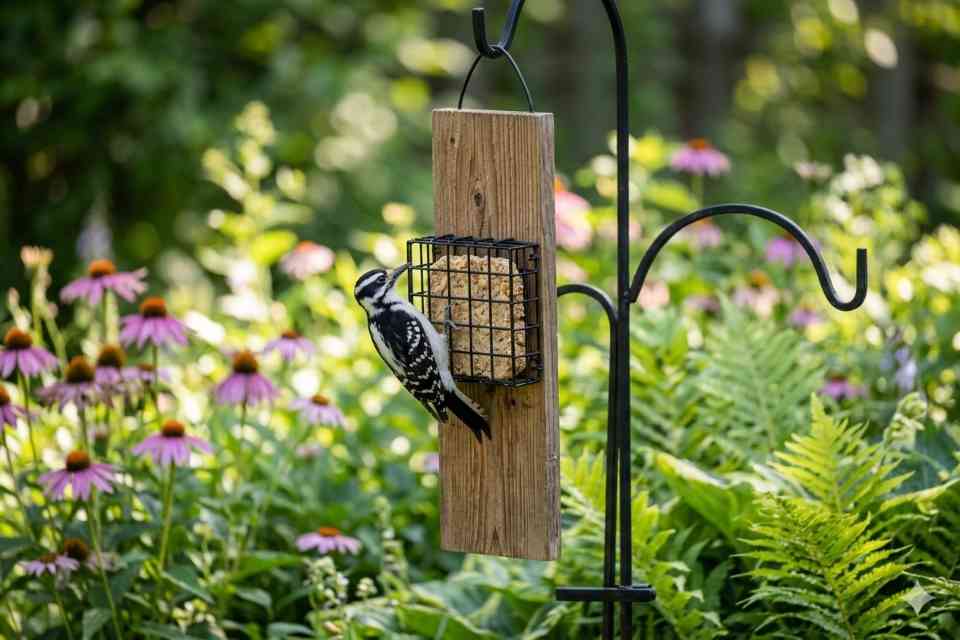
According to Wild Birds Unlimited research on woodpecker tail-prop behavior, woodpeckers have stiff tail feathers that act as sturdy props supporting their weight while clinging to trees, and this behavior can be witnessed in yards by offering tail-prop feeders. Cage-only suet feeders forcing birds to cling solely through toe grip while feeding create neck hyperextension and back strain as woodpeckers crane upward to reach food suspended above their body position.
The tail-prop feeding posture distributes weight across three contact points (two feet plus tail) creating stable tripod allowing relaxed feeding over extended periods. Pileated woodpeckers (16-19 inches length) and Hairy woodpeckers (9-13 inches) particularly benefit from tail support given their larger size and weight compared to cavity-nesting competitors. Without lower platforms or tree trunk surfaces providing tail contact, these species experience muscle fatigue and predator vulnerability from awkward feeding positions compromising their ability to monitor surroundings.
Install feeders with vertical wooden backing extending below the suet cage, providing tail-prop surface when birds feed. Alternatively, mount suet directly on tree trunks using wire mesh or specialized tree-mounted holders allowing woodpeckers to feed in natural vertical clinging posture with full tail support. The tree-mounting approach most closely mimics natural foraging biomechanics while eliminating cage-related postural stress entirely.
Pure Suet vs. No-Melt Dough: Feather Coating Danger
According to All Seasons Wild Bird Store research on suet safety, melting suet can coat feathers and interfere with their natural waterproofing and insulating functions. No-melt suet formulations marketed for warm-weather feeding often contain additives altering fat crystallization temperature, but these products still soften significantly above 80°F (27°C), creating sticky consistency that transfers to feathers during feeding.
The feather-coating process destroys the intricate microstructure maintaining waterproofing and insulation. According to Biology Insights research on feather waterproofing, tightly packed, water-repellent feathers trap a layer of air close to the bird’s body creating an insulating barrier, and this trapped air helps maintain body temperature preventing heat loss. Suet coating fills the spaces between barbules, eliminating both waterproofing capacity and insulating air pockets. The compromised plumage increases thermoregulation costs and potentially proves fatal during cold, wet weather when birds cannot maintain body temperature through wet, matted feathers.
Use pure rendered suet (beef kidney fat) during cool weather (below 70°F / 21°C) when solid consistency prevents feather transfer. Remove suet feeders entirely during warm periods or substitute with seed-based woodpecker foods including shelled peanuts, sunflower hearts, and specialized woodpecker blends containing nuts and dried insects. The seasonal suet strategy prevents feather damage while maintaining year-round food availability through temperature-appropriate options.
If you want to make your own high-energy treats, check out our guide on how to make suet cakes for birds.
The Upside-Down Feeder Hack: Starling Exclusion
Upside-down suet feeders with cage access only from below exclude starlings and grackles while accommodating woodpeckers’ vertical clinging ability. Starlings and grackles prefer perching while feeding, struggling to access food requiring sustained upside-down clinging that woodpeckers execute effortlessly using their zygodactyl feet (two toes forward, two back) and stiff tail support.
The selective exclusion reduces competition for limited suet resources while decreasing the rapid depletion occurring when aggressive flocks of starlings monopolize feeders. Woodpeckers feed more consistently when freed from competitive displacement by larger flocks, improving nutritional intake during energetically demanding breeding and winter periods.
Hydration Physics: Deep Water and Vertical Grips
The Drowning Risk: Rough-Surface Mandate
Before diving into the structural requirements of your birdbath, Learn more about keeping birds hydrated during summer to understand seasonal water needs. to understand the critical seasonal water needs of your local avian population.
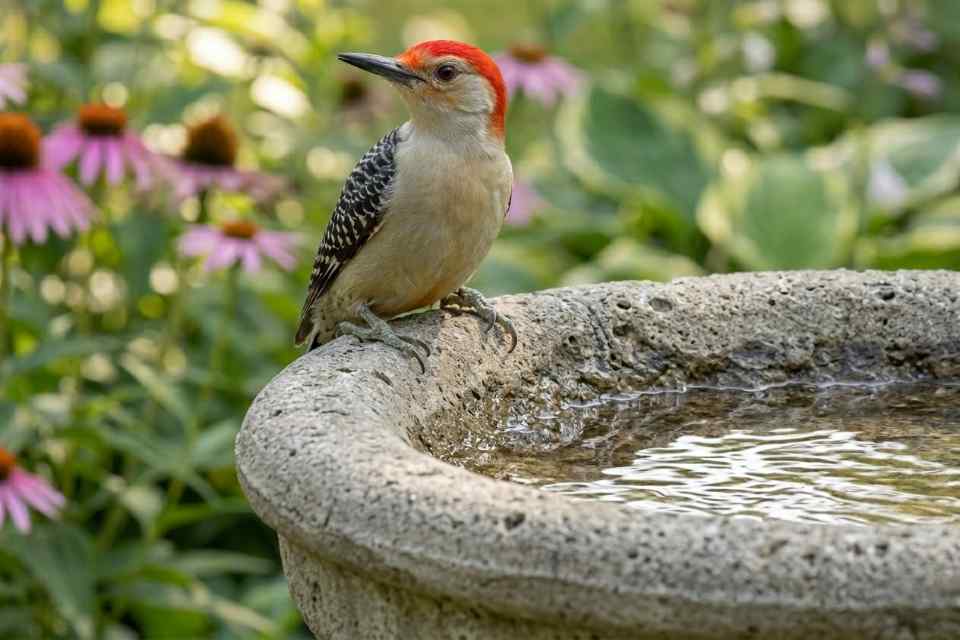
Standard ceramic or metal birdbaths with smooth surfaces pose drowning hazards for heavy-bodied woodpeckers lacking the perching ability of typical songbirds. Woodpeckers approach water in vertical clinging posture, requiring rough-textured surfaces providing grip for their sharply curved claws evolved for bark penetration rather than smooth perch grasping.
Modify existing birdbaths by adding rough-textured stones, branches, or specialized gripping surfaces creating multiple contact points for claws. Natural stone with irregular surfaces, weathered wood pieces, or rope wrapped around basin edges all provide grippable textures woodpeckers use confidently.
Habitat Engineering: The Safe Snag Strategy
Managing Deadwood Without Fall Hazards
Dead and dying trees (snags) provide essential habitat for cavity-nesting species including woodpeckers. Safe snag management balances wildlife habitat value against fall risks to structures, people, and property. Assess snag stability before designating trees for retention, with trees showing extensive decay at base requiring removal despite wildlife value.
Create controlled-height snags by topping hazardous trees at 15-20 feet rather than complete removal. The shortened trunk eliminates fall danger to nearby structures while maintaining substantial vertical habitat for cavity excavation and drumming territories.
Retaining these structural snags provides a multi-year ecological legacy; once vacated by woodpeckers, these precision-carved cavities become essential nesting sites for secondary occupants like Wood Ducks and Screech Owls for up to 36 months.
For more on encouraging birds to nest in your garden, check out our comprehensive guide.
The Wood Chip Mulch Trick for Northern Flickers
Northern Flickers feed extensively on ground level, consuming ants and beetles from soil rather than foraging on tree bark like other woodpecker species. Creating artificial foraging floors using wood chip mulch 2-4 inches deep provides substrate mimicking natural conditions where Flickers probe for ground-dwelling insects.
Nest Defense: Preventing Fatal Collisions
The 2×4 Window Rule: High-Density UV Decals
Woodpeckers strike windows during territorial drumming season when males perceive reflections as rival birds. According to window strike research, the 2×4 rule (visual markers spaced no more than 2 inches apart horizontally and 4 inches apart vertically) creates effective collision prevention by eliminating flight-path-sized gaps in visual coverage.
Aural Identification: Decoding Woodpecker Communication
Understanding the sounds of your backyard is critical for safe management. Woodpeckers use different rhythms and volumes to communicate various needs—some of which signal that your “Safe Sanctuary” architecture is working, while others may indicate a territorial conflict with your home.
1. Territorial Drumming (The “Loud & Fast” Call)
- The Sound: A rapid-fire, machine-gun-like succession of strikes on a resonant surface (hollow trees, metal chimneys, or siding).
- The Intent: This is not for feeding; it is a communication tool. Woodpeckers drum to establish territory and attract mates.
- The Safety Fix: If a bird is drumming on your house, it’s not looking for bugs—it’s looking for the loudest acoustics. Providing a large snag (as detailed in the “Safe Snag Strategy”) gives them a natural, more resonant “amplifier,” pulling them away from your structures.
2. Foraging Taps (The “Slow & Irregular” Search)
- The Sound: Slower, more deliberate, and often irregular thumping. You may hear the sound of bark being pried or wood splintering.
- The Intent: This is hunting. The bird is listening for the movement of larvae or ants behind the bark.
- The Safety Fix: Frequent foraging on your siding indicates a pest issue (like carpenter ants). Ensure your suet stations are stocked with high-energy beef kidney fat to provide an easier caloric source than manual labor on your home.
3. Vocal Calls: The “Whinny” and the “Peek”
- The Sound: High-pitched, laughing “whinnies” (Pileated) or sharp, metallic “peeks” (Downy/Hairy).
- The Intent: These are alarm calls or contact calls between pairs.
- The Safety Fix: If you hear frantic, repeated vocalizations near your windows, check your 2×4 UV dot spacing. The bird may be seeing its reflection as a rival and preparing for a territorial strike.
Troubleshooting: When Attraction Becomes Damage
Managing House Drumming: Cedar Post Redirection
Provide alternative drumming surfaces producing superior acoustic properties compared to building materials, redirecting territorial birds to designated posts away from structures. Cedar, pine, or dry hardwood posts 4-6 inches diameter and 6-8 feet tall create excellent resonators when mounted in open areas where sound carries effectively.
FAQ: Expert Protection Questions
Do Woodpeckers Eat Sunflower Seeds?
According to Lyric Bird Food woodpecker feeding research, woodpeckers enjoy many of the same foods as other species, with larger species preferring whole peanuts providing high-fat, high-protein nutrition. Sunflower seeds attract woodpeckers inconsistently, with larger species often ignoring them in favor of higher-fat options while smaller species (Downy woodpeckers) occasionally consume sunflower hearts.
What Month Should I Start Suet Feeding?
Begin suet feeding in late September or October when temperatures consistently remain below 70°F (21°C), eliminating melting risks. Continue through April when warming temperatures create melting risks and natural insect emergence provides abundant alternative food sources.
At-a-Glance: The Woodpecker Backyard Safety Checklist
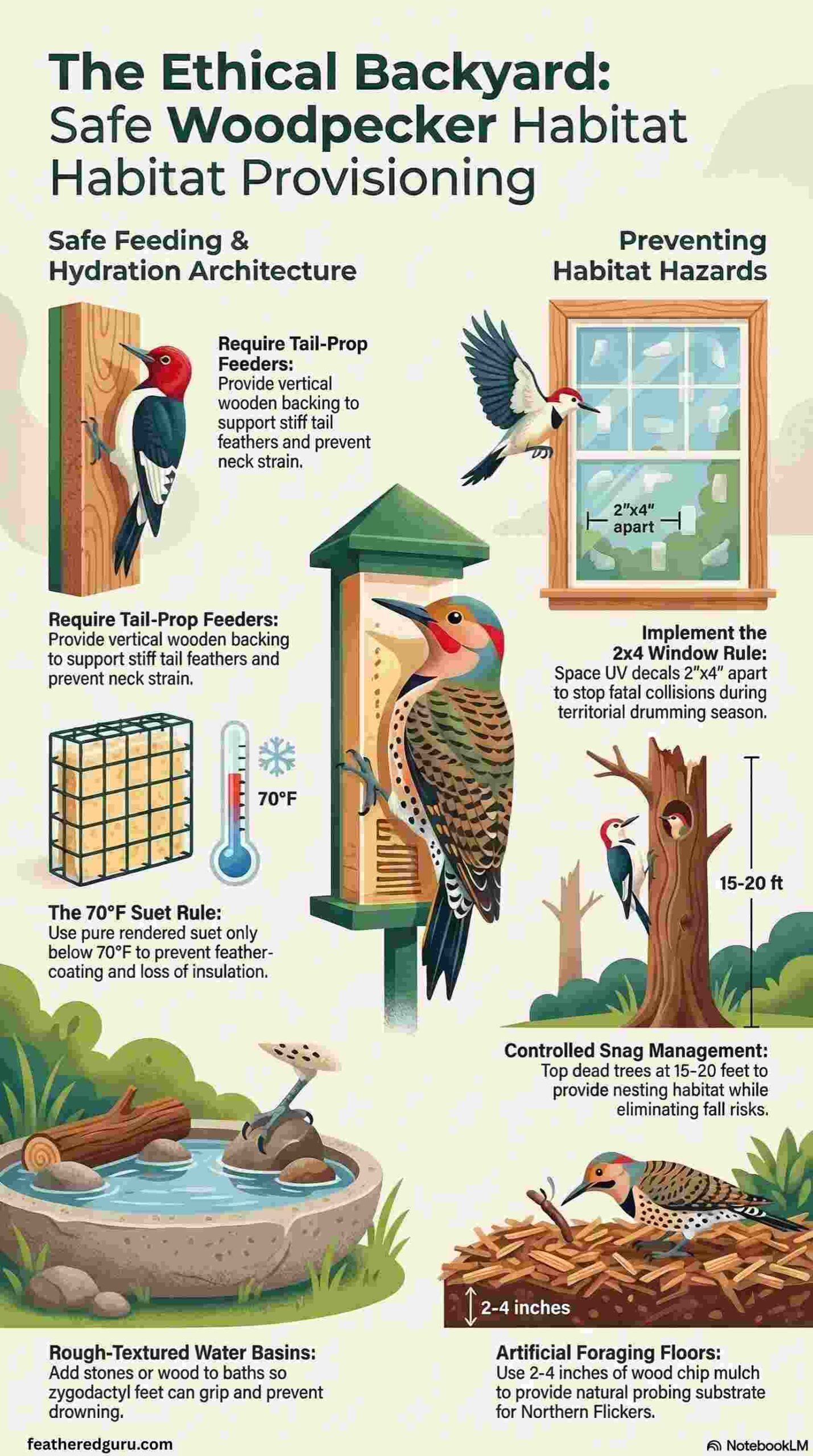
Creating a secure sanctuary is easier when you can visualize the entire habitat architecture in one place. Use our comprehensive infographic below as a quick-reference guide for 2×4 window spacing, tail-prop mechanics, and rough-surface hydration to ensure every woodpecker in your backyard remains safe and thriving.
Conclusion: The Ethical Birder’s Checklist
Attracting woodpeckers safely requires species-specific infrastructure addressing unique anatomical and behavioral requirements. The four-pillar safety audit provides framework for evaluating and improving backyard woodpecker habitat: feeder assessment (tail-prop support, pure suet below 70°F), water evaluation (rough textures, vertical mounting), window strike prevention (2×4 rule UV decals), and wood habitat management (15-20 foot controlled snags, wood chip mulch).
For additional information on supporting cavity-nesting birds, explore guides on bird-friendly garden design principles, selecting native plants for birds, and preventing window strikes.