
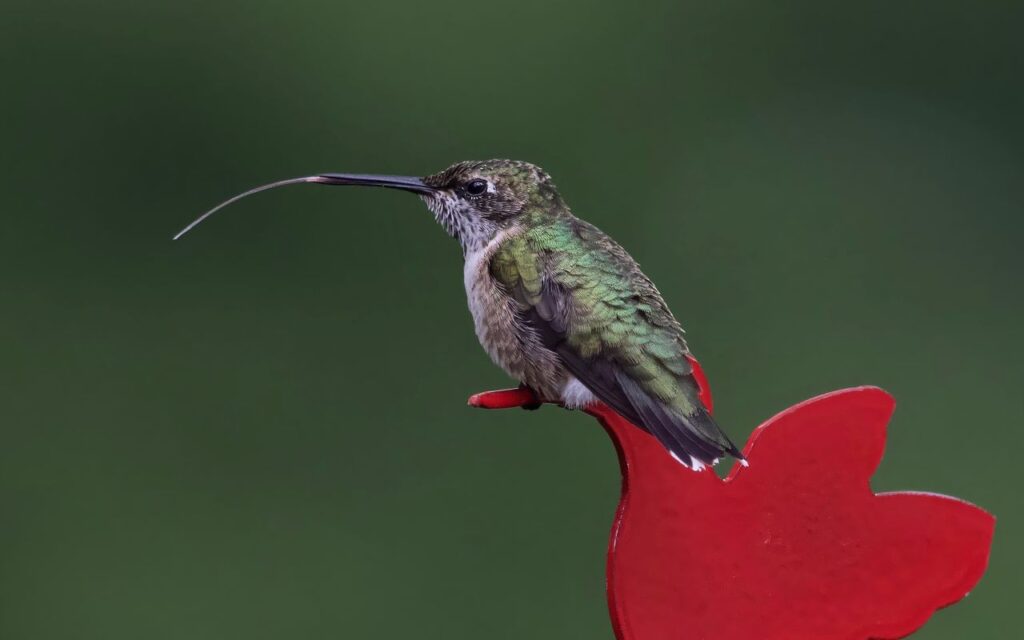
Observing the biomechanics of a hummingbird unique tongue reveals one of the most sophisticated fluid-harvesting systems in the natural world. For decades, standard field guides inaccurately claimed that these micro-avians rely on passive capillary suction to draw nectar upward against gravity. High-speed cinematography has definitively debunked that theory, proving that the organ acts as an active physical trap that changes shape instantly upon fluid contact.
When backyard birders encounter hummingbirds with protruding, locked, or visibly injured tongues, understanding this internal anatomy becomes critical for immediate field intervention. Knowing how structural elasticity interacts with nectar density, port geometry, and pathogenic microflora is key to preventing feeder-induced avian injuries.
Quick-Glance Field Summary
The hummingbird tongue operates via elastic fluid trapping rather than capillary suction, curling open upon fluid immersion and snapping closed around nectar droplets within milliseconds. Backyard feeder operators must preserve this fragile mechanism by matching feeder port depth to bill reach, regulating fluid viscosity, and neutralizing fungal pathogens.
- Feeder nectar baseline: 4:1 water-to-refined white sucrose ratio.
- Winter nectar baseline: 3:1 ratio to suppress freezing to approximately 22°F to 25°F.
- Tongue lick cycling frequency: 12 to 20 cycles per second.
- Feeder port clearance minimum: Smooth, burr-free opening preventing bill constriction.
- Sanitize protocol: 1:9 bleach-to-water soak; avoid boiling polycarbonate reservoirs to prevent plastic warping.
- Zero-tolerance additives: Never use honey, red dye, artificial sweeteners, or petroleum jelly near ports.
The Straw Myth: Why Capillary Action is Wrong
For over a century, ornithological dogma stated that surface tension pulled liquid up narrow tubes inside the tongue via pure capillary action. Modern high-speed research conducted by field researchers Alejandro Rico-Guevara and Margaret Rubega proved that capillary physics cannot account for the rapid 12 to 20 licks per second observed during high-energy feeding. Capillary action is fundamentally too slow to satisfy the bird’s extreme metabolic requirements.
Instead, the tongue behaves as an elastic micropump. When the bird compresses its tongue to squeeze out fluid inside the bill, the structure stores potential energy. As it re-enters liquid, that stored elastic energy releases, springing the grooves open to engulf nectar automatically without muscular effort.
How the Tongue Splits to Trap Nectar in Milliseconds
At resting position inside the closed bill, the tongue remains flat and partially compressed within the hyoid apparatus. Once extended into liquid, the tip bifurcates into two distinct, flexible keratinous prongs fringed with microscopic flaps called lamellae.
As the tongue dips into nectar, the surrounding fluid forces these curled lamellae to splay outward like tiny biological scoops. Upon leaving the fluid, liquid surface tension draws the lamellae inward, trapping nectar droplets securely within the central groove.
This mechanical deformation happens entirely through passive hydrodynamics rather than direct nervous stimulation. This allows the bird to consume caloric fuel rapidly while minimizing energy expenditure during hovering flight.
Feeder Port Hazards: Protecting Beaks from Sharp Plastic
In backyard birding communities, particularly on forums like r/birdwatching, enthusiasts regularly document catastrophic tongue and bill entrapments on sub-standard commercial feeders. A frequent thread observation involves hummingbirds vigorously shaking their heads or fluttering backward while pinned to tight plastic feeding flowers.
Molded plastic ports with jagged injection-molding burrs or undersized feeding apertures act like serrated traps against flexible tongue tissue and soft rhamphotheca edges. Users on localized wildlife rescue boards often recount finding birds with sheared lateral grooves or fractured bills caused by struggles against stiff metal insect screens.
To safeguard delicate oral structures, gear selection requires strict mechanical inspection:
- Port aperture edges must be inspected by hand for microscopic plastic flashing or rough metal burrs.
- Feeding ports should allow full 360-degree tongue extrusion without sideways pinch points.
- Avoid tight insect mesh covers that force the bird to hammer its bill through rigid openings.
When feeder parts degrade from ultraviolet exposure, brittle plastics develop micro-cracks that snip delicate bifurcated tips. Replacing worn feeder bases annually eliminates these mechanical hazards.
Dirty Feeder Dangers: Preventing Fatal Tongue Infections
One of the most alarming sights reported on r/backyardbirds is a hummingbird perched motionless with its tongue stuck fully extended out of its bill. This heartbreaking condition is almost universally caused by severe avian candidiasis, an oral fungal infection driven by the proliferation of Candida albicans.
When bird lovers leave sugar water unattended in summer heat, ambient spores colonize the solution and rapidly ferment. The fungal spores settle inside the micro-grooves of the tongue, causing massive swelling, necrotic tissue buildup, and agonizing tongue paralysis that prevents retraction.
Avian rehabbers frequently report that birds caught in this stage face high mortality rates from dehydration and starvation. Cleanliness must follow strict sanitizing procedures:
- Disassemble every feeder component and soak in a 1:9 bleach-to-water dilution twice weekly during hot weather.
- Avoid boiling water sterilizations on polycarbonate plastic reservoirs, which warps fittings and releases chemical additives.
- Never substitute honey, raw sugar, or molasses, which contain high iron levels and fungal loads that trigger sudden oral necrosis.
Deterring wasps and ants must also be handled without oils; petroleum jelly or glycerin applied around ports inevitably coats feathers, destroying flight capabilities and causing fatal hypothermia.
Winter Feeding: How Cold Weather Changes Sugar Nectar
The fluid dynamics of the hummingbird tongue are exceptionally sensitive to ambient temperature and liquid viscosity. Standard 4:1 water-to-sucrose nectar accurately mimics natural floral nectar concentrations, flowing effortlessly into the elastic grooves.
However, late-season and overwintering hummingbirds, such as cold-hardy Anna’s hummingbirds in northern zones, encounter serious thermodynamic hurdles. A standard 4:1 sucrose solution begins to freeze and turn into tongue-damaging slush at approximately 27°F (-2.8°C).
To prevent feeders from turning into abrasive ice blocks during deep freezes, backyard caretakers rely on verified physical chemistry adjustments:
- Switch to a concentrated 3:1 water-to-sugar ratio during sustained cold snaps to lower the freezing threshold to between 22°F and 25°F.
- Mount low-wattage incandescent feeder heaters directly beneath the basin to preserve liquid mobility without scorching the fluid.
- Maintain feeder locations within 3 feet of home windows, satisfying Audubon window collision safety standards while capturing ambient house warmth.
While a 3:1 mixture prevents ice formation, solutions thicker than 3:1 increase viscosity significantly. High fluid viscosity slows lamellae expansion, forcing the tongue to work against hydraulic drag and sharply reducing feeding efficiency.