
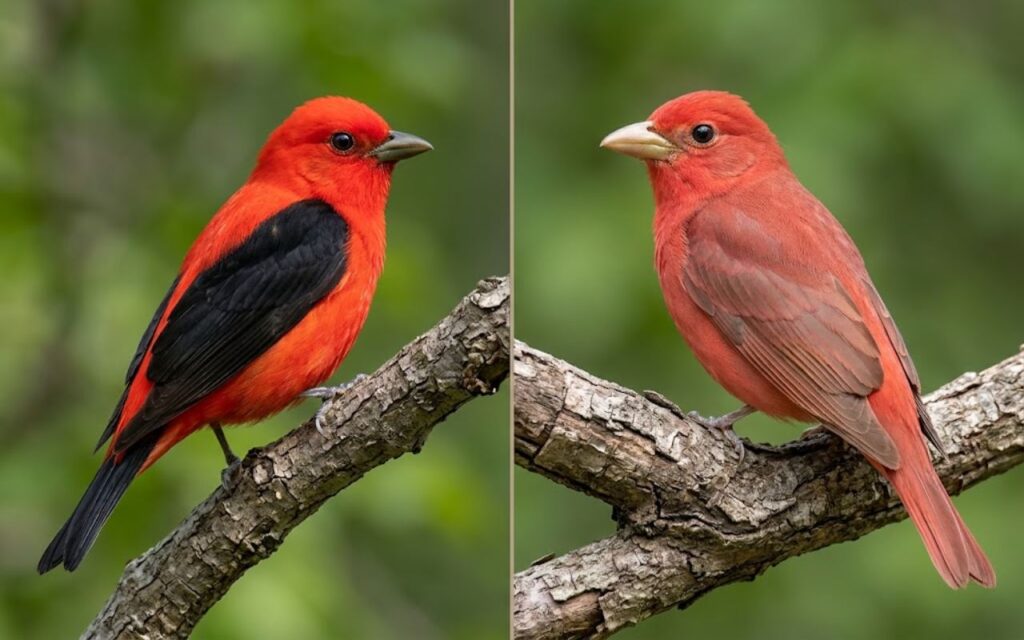
Navigating a field-ready Scarlet Tanager vs Summer Tanager ID guide requires looking beyond quick flashes of brilliant red plumage high in the forest canopy. Both species exhibit staggering sexual dimorphism and canopy-dwelling habits, leading birders to misidentify them when viewing angles or fleeting glimpses obscure diagnostic traits.
Field observers frequently struggle with backlit silhouettes, acoustic overlap, and transitional immature molts that defy textbook color plates. Isolating concrete structural measurements, specific vocal mechanics, and bill adaptations ensures reliable identification even under challenging woodland conditions.
Canopy Backlighting Pitfalls and Male Pigment Diagnostics
Adult breeding males of both species showcase vibrant red body plumage, yet their wing coloration establishes the definitive field separation. Scarlet Tanagers (Piranga olivacea) display a vivid, intense scarlet-red body contrasted against jet-black wings and a jet-black tail.
Summer Tanagers (Piranga rubra) present an overall warm rose-red wash across their entire anatomy, including brownish-red primary flight feathers that lack deep black pigmentation.
Community discussions on platforms like r/whatsthisbird frequently highlight how harsh overhead sunlight alters these visual cues. When a Summer Tanager perches against a bright white sky, deep shadows across the underwing coverts can simulate dark wings, tricking observers into logging a Scarlet Tanager.
Conversely, worn late-summer Scarlet Tanagers can appear duller as feather margins fray, causing color misinterpretations if the wings are partially hidden behind dense oak leaves.
- Adult male Scarlet Tanager: Intense scarlet body with stark, coal-black remiges and rectrices.
- Adult male Summer Tanager: Completely strawberry-red body with pale reddish-brown flight feather edges.
- Sunlight artifact hazard: Direct overhead backlighting casts deep underwing shadows that falsely mimic black wings on pale birds.
Carefully observe the bird as it shifts position relative to your light source before confirming the identification. A true Scarlet Tanager displays an abrupt, razor-sharp boundary where red mantle feathers meet black scapulars.
Bill Culmen Morphology and Structural Silhouette Discrepancies
When plumage is heavily shadowed or female birds are observed, bill dimensions provide the most dependable physical baseline. The bill of the Summer Tanager is remarkably massive, swollen, and blunt-tipped, featuring a pale horn-to-ivory culmen that can measure up to 17 to 20 millimeters in total length from the forehead feathering.
By contrast, the Scarlet Tanager carries a distinctly smaller, shorter, and more delicate bill. Ornithological data compiled by Birds of the World confirms that when measuring strict structural metrics from the nares (nostril opening) to the tip, a Scarlet Tanager’s bill measures just 10.5–12.1 mm, whereas a Summer Tanager’s bill spans a much larger 12.0–14.7 mm.
Field contributors on localized birding forums often note that a perched Summer Tanager looks top-heavy or front-loaded around the head. This distinct profile resembles a small grosbeak or oversized thrush rather than a slender, warbler-like bird.
The Scarlet Tanager retains a proportionally smaller head silhouette with a subtle tomial tooth along the upper cutting edge that is difficult to see without high-magnification optics.
- Summer Tanager Bill: Pale yellowish-buff or dull ivory; long, deep, and heavy along the base.
- Scarlet Tanager Bill: Dusky slate or dark olive-gray; compact, moderately conical, and noticeably short.
- Head Profile: Summer Tanager displays a flat forehead tapering into a thick bill; Scarlet Tanager presents a more uniformly rounded crown.
These structural differences remain constant across every plumage variation, season, and age class. Measuring bill-to-head ratios through your binoculars offers an immediate answer when plumage tones are obscured by poor lighting.
Female Olive-Yellow Variation and Immature Patchy Molt Phases
Distinguishing females and young birds demands careful attention to subtle undertones and molt stages. Female Scarlet Tanagers show dull olive-green upperparts with yellow underparts and dark brownish-olive wings that clearly contrast with the body.
Female Summer Tanagers showcase a richer, warmer mustard-yellow to ochre wash across the entire body, with wings that match the overall body tone without sharp contrast. First-spring immature male Summer Tanagers are the source of frequent confusion on wildlife forums during spring migration.
Young males undergo an incomplete preformative molt, resulting in a splotchy, tie-dye patchwork of bright red and mustard-yellow feathers scattered across the breast, back, and head. Observers unfamiliar with this transitional plumage often mistakenly report these birds as hybrids or exotic aviary escapees.
- Female Scarlet Tanager: Contrasting dark olive-brown wings against pale yellowish-olive flanks and throat.
- Female Summer Tanager: Uniform warm ochre, mustard, or buff-yellow across wings, back, and underparts.
- Molting immature males: Irregular red patches intermixed with yellow base feathers, predominantly observed in Summer Tanagers.
Look closely at the wing panel boundaries on any yellow tanager you encounter. If the wing coverts and remiges form a noticeably darker dusky pane than the back, you are viewing a Scarlet Tanager.
Acoustic Decoupling: Harsh Chip-Burr Versus Staccato Pi-Tuck Vocalizations
Vocalizations offer immediate confirmation long before a tanager emerges from dense canopy foliage. The primary contact call of the Scarlet Tanager is a hoarse, raspy two-note vocalization rendered as chip-burr or chick-burr.
The Summer Tanager uses an unmistakable, rapid-fire staccato call composed of three or four dry clicking syllables, commonly transcribed as pi-tuk or chicky-tucky-tuck. Birders relying on automated audio identification apps often discover that song interpretations can be notoriously tricky.
The territorial song of the Scarlet Tanager carries a raspy, strained quality often described by field ornithologists as a robin with a sore throat. The Summer Tanager sings a clearer, sweeter series of paired, musical whistles that closely mimics an American Robin without the raspy vocal strain.
- Scarlet Tanager call: Low, hoarse chip-burr with a guttural second syllable.
- Summer Tanager call: Sharp, explosive pi-tuk or pi-ti-tuk clicking notes.
- Scarlet Tanager song: Burry, hurried whistles with a distinctly hoarse, strained timbre.
- Summer Tanager song: Melodic, liquid phrases similar to a grosbeak or robin, lacking harsh raspiness.
Relying on the short contact calls provides far higher accuracy than evaluating songs alone. Listen for the rapid staccato clicks in open woods to quickly confirm a Summer Tanager.
Foraging Niche Stratification and Apivore Feeding Behaviors
Habitat preferences and foraging mechanics reveal distinct behavioral divergence between these two canopy dwellers. Scarlet Tanagers favor mature, unbroken tracts of eastern deciduous forest, with a particular affinity for towering oaks, beeches, and maples where they glean caterpillars from high leaves.
Summer Tanagers inhabit lower open woodlands, riparian pine-oak edges, and southern forest clearings, frequently descending into the subcanopy to hunt. Summer Tanagers are renowned apivores, specializing in capturing bees, wasps, and hornets directly in flight.
Forum reports from southern backyard birders frequently document Summer Tanagers perching near wooden eaves or commercial apiaries, catching flying hymenopterans, and beating them against branches to remove the venomous stinger before swallowing.
Scarlet Tanagers rarely engage in this targeted bee-hunting behavior, preferring to slow-glean lepidopteran larvae and beetles along horizontal canopy limbs.
- Scarlet Tanager habitat: Interior deciduous forest cores, contiguous canopies, northern and mid-latitude hardwood forests.
- Summer Tanager habitat: Open oak-pine woods, woodland borders, southern bottomlands, and suburban tree canopies.
- Diet specialization: Summer Tanagers actively target stinging wasps and bees; Scarlet Tanagers focus primarily on leaf-dwelling caterpillars.
Noting the precise forest structure and foraging maneuver provides immediate context to support your physical observations. Combining bill structure, vocal cues, and behavioral niche ensures you arrive at an accurate identification every time.