
Reader Transparency: This birding guide contains paid affiliate links. If you click a link and make a purchase, I may receive a small commission at no extra cost to you. As an Amazon Associate, I earn from qualifying purchases. Your support helps keep Feathered Guru flying!
You know that satisfying feeling when you load your backyard feeders with premium, zero-mess sunflower hearts, thinking you have given your backyard birds the ultimate luxury meal? If you have been weighing the pros and cons of shelled vs unshelled sunflower seeds for birds, realizing that shell-less kernels carry a massive environmental vulnerability during rainstorms is an essential breakthrough for your yard’s safety.
The truth is that while pre-hulled kernels offer unmatched convenience for small songbirds, removing the seed’s protective outer armor exposes the delicate interior fats to rapid spoilage. When autumn downpours or humid weather fronts roll in, these exposed hearts absorb ambient moisture like a sponge, transforming your expensive feeding stations into a clogged, mold-infested hazard zone overnight.
Do Birds Prefer Shelled or Unshelled Sunflower Seeds?
Wild birds heavily prefer shelled sunflower seeds because they can digest the high-fat kernels immediately without wasting critical calories cracking open tough outer husks.
However, unshelled sunflower seeds offer superior moisture resistance because their hard outer hulls act as a natural waterproof shield, whereas unprotected, shell-free kernels require specialized, fully covered feeders to prevent toxic mold growth during rain storms.
How Birds Pick Seeds Based on Energy
To understand why songbirds are drawn so aggressively to shelled kernels, you must look at the strict energy budget that governs cold weather survival. Foraging birds operate on a continuous, calculated balance between calorie intake and energy expenditure.
Cracking open a standard black-oil or striped sunflower hull requires significant jaw power and physical manipulation time.
According to the massive Project Wildbird Study highlighted by The National Audubon Society, sunflower chips and hearts rank as an absolute favorite for a vast majority of common backyard birds.
Finches and other small songbirds utilize highly specialized, grooved beak structures to slice open seed walls. While larger species handle this extraction with ease, smaller songbirds must spend valuable minutes working on a single seed.
Providing pre-shelled hearts completely eliminates this mechanical obstacle. This work-free fuel cache allows small species to feed at three times their normal velocity.
This rapid consumption saves critical metabolic reserves during cold freeze snaps, a core survival strategy you can read about further in my complete breakdown of common backyard birds.
The Problem with Wet Weather and No-Shell Seeds
The very feature that makes shelled sunflower seeds a premium asset during dry spells becomes their architectural downfall when wet weather arrives. Raw, intact sunflower hulls are lined with natural, water-resistant waxy polymers.
This barrier is designed by nature to insulate the inner embryo from external dampness. This protective shield allows unshelled seeds to sit inside damp feeder ports for days without absorbing moisture or rotting.
When manufacturers mechanically strip this casing away to produce sunflower hearts, the porous, oil-rich surface of the inner meat is exposed directly to the air.
As detailed in the comprehensive seed diagnostics logs by the Cornell Lab of Ornithology, sunflower hearts and chips spoil exceptionally quickly when exposed to high environmental humidity.
During extended rain events, these naked kernels draw water deep into their inner layers. The moisture softens the internal starches, causing the seeds to secrete a sticky, protein-rich glaze.
Inside tight feeding tubes, this sticky surface causes hundreds of seeds to fuse together into a dense, solid mass that blocks seed trays completely, a costly layout error I analyze in my guide on how to prevent bird seed waste.

• Built-in dome shields driving rain
• Wide bottom tray fits cardinals
• Enclosed column keeps seed dry
• Rust-proof metal handles winter storms
The Danger of Rotten Seeds and Mold
Once wet seeds clump together and get trapped inside a warm, enclosed plastic feeding column, a dangerous biochemical clock begins ticking. Stagnant moisture combined with high ambient humidity forms an ideal environment for deadly environmental fungi, particularly mold spores from the Aspergillus family.
These fungal colonies grow incredibly fast, covering damp sunflower chips in a fuzzy gray or white web within forty-eight hours.
As these molds multiply, they secrete dangerous chemical bioproducts called mycotoxins, which are toxic to avian respiratory systems. If a small finch or titmouse swallows these infected seed particles, it faces an immediate risk of developing a deadly respiratory infection that spreads rapidly across crowded yards.
Protecting your local populations from this hidden threat requires a strict dedication to regular maintenance habits, which I cover step-by-step in my tutorial on keep bird seed dry.

• Water-resistant hulls prevent wet-weather rot
• Thick outer shells lock in essential oils
• High-energy fats fuel autumn songbirds
• Universal size fits tubes and hoppers
Why Some Birds Prefer Stashing Whole Seeds
Interestingly, behavioral field studies show that the preference for shelled versus unshelled grains changes drastically depending on a bird species’ specific winter storage habits. Real-world seed tracking data reveals that certain birds select whole, unshelled sunflower seeds more often than seeds still inside their protective hulls.
This specific preference is driven entirely by transport and stashing efficiency. Because birds like jays and nuthatches are dedicated hoarders that hide thousands of individual seeds inside furrowed tree trunks, grabbing a whole seed allows the shell to act as a protective capsule.
The natural casing prevents the stored fats from oxidizing or rotting inside damp bark crevices over the winter months. By utilizing whole seeds for their long-term caches, they ensure their food reserves remain intact throughout the freezing months, a behavior pattern that dictates successful feeding birds in winter strategies.
Why Some Birds Refuse to Eat Pre-Shelled Kernels
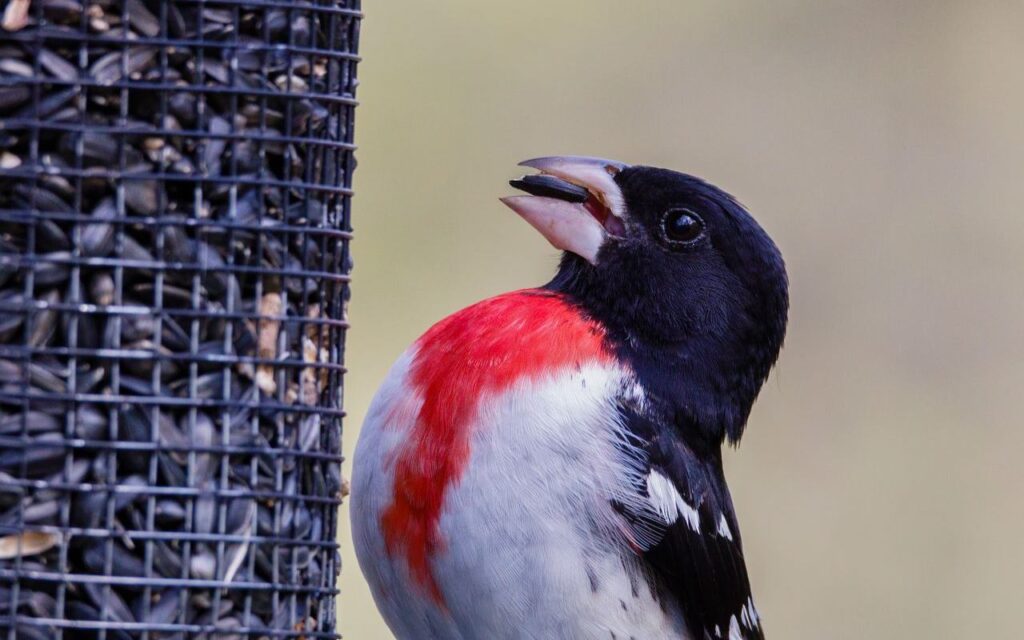
While smaller songbirds flock enthusiastically to pre-hulled seed chips, certain large-beaked backyard species will purposely pass over these soft, naked kernels. Birds like Northern Cardinals, Evening Grosbeaks, and Rose-breasted Grosbeaks possess massive, conical beaks operated by heavy, high-leverage jaw musculature.
These heavy-duty bills are evolutionarily engineered to apply massive crushing forces to crack open rigid wood-like shells.
For these specific species, picking up small, pre-shelled chips strips away the mechanical resistance their bills require for natural foraging loops. Without a hard outer casing to roll between their mandibles, their innate husking and splitting reflexes are completely under-utilized.
Processing whole shells actively helps these heavier birds keep their rapidly growing keratin beak edges naturally worn down and sharp.
Forcing large-beaked birds to live entirely on soft, hull-less pieces can lead to overgrown bills over extended periods, meaning you must provide a balanced mix of raw, unshelled options if you hope to master how to attract cardinals to your backyard.
Easy Ways to Protect Your Seed from Rain
To successfully deploy high-calorie shelled sunflower hearts without creating a toxic wet weather trap on your porch, you must alter your hardware layout to block moisture.
Never pour raw, hull-less chips into open, uncovered platform trays or simple wooden fly-through feeders during rainy seasons. Open exposure lets driving rain hit the seeds directly, turning your expensive feed into a soggy layer of sour rot in a single afternoon.
Instead, invest in heavy-duty tube feeders equipped with extra-wide, overhanging weather baffles positioned directly above the roof caps. These clear plastic domes act as umbrellas, deflecting rain safely past the feeding ports below.
Additionally, choose feeding models that feature deep, integrated drainage holes drilled directly into the bottom seed trays. Providing consistent ventilation allows trapped condensation to escape freely, ensuring your high-fat sunflower chips stay bone-dry, free-flowing, and perfectly safe for your visiting bird community.