Your backyard exists in two completely different worlds. Humans see greens, reds, yellows, and blues, but in the avian visual spectrum, those same plants glow with ultraviolet (UV) patterns invisible to our eyes. Understanding this hidden dimension and learning what colors attract birds to your yard can transform you from a casual feeder into a master birdscaper who works with avian vision.
The difference between a standard yard and a bird magnet often comes down to this color strategy. This guide reveals the science of avian tetrachromatic vision and translates it into practical seasonal color applications that turn your backyard into an irresistible destination for cardinals, hummingbirds, goldfinches, bluebirds, and orioles 🙂.
- Birds see up to 100 million colors, including ultraviolet light.
- UV patterns on flowers and berries guide birds straight to food.
- Red and pink attract hummingbirds and cardinals to nectar and fruit.
- Yellow with UV reflection draws goldfinches and seed-loving birds.
- Blue helps bluebirds spot bird baths and feeding areas.
- Orange attracts orioles and other fruit-eating species.
- Seasonal color shifts keep birds visiting year-round.
- Natural birdhouse tones protect nests; bright feeders grab attention.
- White or shiny surfaces can stress or scare birds away.
- UV-reflective plants act like glowing targets birds can see.
Video: What Colors Attract Birds? An Visual Explainer
This video summarizes the top color strategies to help you understand what colors attract birds throughout the year.
Show Transcript:
0:00
Hey everyone! Welcome back. Today, we’re diving into the hidden world of backyard birds right outside your window. We’ll learn how birds see the world and how you can use that knowledge to make your yard an irresistible haven for them.
0:18
Let’s start by seeing through a bird’s eyes. What if the green grass and red flowers you see are only half the story? Birds perceive colors and patterns invisible to us, and today, we’ll explore this secret bird vision.
0:42
Humans are trichromatic, with three color cones—red, green, and blue. Birds, however, are tetrachromatic. They have a fourth cone for ultraviolet (UV) light, giving them a superpower in vision.
1:16
This fourth cone allows birds to see an estimated 100 million colors, compared to our one million. Birds can detect UV patterns on leaves and feathers, making them experts at navigating forests and identifying each other.
2:28
Tiny oil droplets in bird eyes act like natural filters, sharpening colors and contrast. This gives them a superior visual system compared to humans, letting them see hidden colors we can’t even imagine.
3:00
Now, how do we use this knowledge to attract birds? Color is the key. Let’s decode the colors that attract birds to feeders, gardens, and birdhouses.
3:13
Red is the universal signal for high-energy food. It stands out against green backgrounds, helping hummingbirds and cardinals find nectar and berries easily.
3:53
Yellow reflects UV light strongly, acting as a glowing beacon. For goldfinches, yellow flowers like sunflowers guide them straight to seeds, especially at dawn and dusk.
4:26
Blue and orange are also critical. Blue signals water or clear skies, making bird baths more inviting. Orange indicates ripening fruit, signaling a high-sugar food source.
5:00
Timing is just as important as color. A seasonal color strategy can maximize bird visits:
- Spring: early yellow flowers welcome migrating birds.
- Summer: use high-contrast combos like red, white, and blue.
- Fall: native berries glowing in UV attract birds.
- Winter: red berries on evergreen branches stand out.
5:38
When it comes to birdhouses, use camouflage colors like gray, brown, and dull green to protect nests. Bright colors attract predators. Avoid large white surfaces and reflective metals—they can stress birds or cause collisions.
6:32
For advanced bird attraction, plant flowers with UV patterns invisible to humans but visible to birds. Examples:
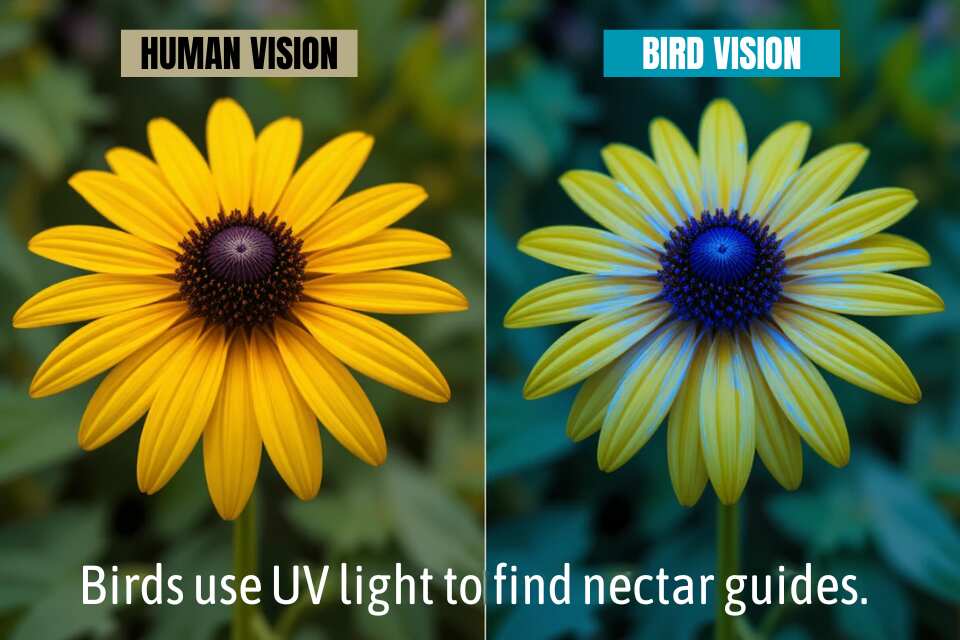
- Black-eyed Susan: dark center absorbs UV, petals reflect, creating a perfect bullseye.
- Texas Bluebonnet: UV spots fade as nectar is consumed, telling birds which flowers are still rewarding.
7:09
This hidden, vibrant world of colors is right in front of us. Now that you understand how birds see, you can design your yard to attract more backyard birds, create safe feeding spots, and enhance birdwatching experiences.
7:28
So, what will you change in your yard first?
How Much Can Birds Really See? The Science of Super-Vision
Tetrachromatic Vision vs. Human Trichromacy
Humans possess trichromatic vision, meaning we have three types of color-detecting cone cells in our eyes sensitive to red, green, and blue wavelengths. Our brains combine signals from these three cone types to create the approximately one million colors we can perceive. Birds operate on an entirely different system.
According to research on tetrachromacy, most birds have retinas with four spectral types of cone cells that mediate tetrachromatic color vision. This fourth cone type detects ultraviolet (UV) light in the 300 to 400 nanometer range, creating a visual dimension completely inaccessible to humans. The result is staggering. Birds can see and distinguish approximately 100 million colors, including an entire category of nonspectral colors that combine UV with other wavelengths.
Research published in the Proceedings of the National Academy of Sciences demonstrates that hummingbirds can discriminate nonspectral colors including UV+red, UV+green, UV+yellow, and UV+purple. These color combinations have no equivalent in human vision. When a female bunting looks at her mate’s plumage, she sees not just the red, green, and blue that you perceive, but also varying amounts of UV light reflected from each feather patch, creating patterns and contrasts invisible to human observers.
This expanded visual range provides birds with capabilities beyond color perception. According to research from Songbird Survival, birds use UV vision to navigate through dense foliage by creating contrast between leaves that appear identical to humans. Field studies show that over 90% of songbird species that appear identical in both sexes to the human eye display vastly different UV-reflectance patterns when photographed with UV-sensitive equipment. Males and females of “identical” species are actually displaying dramatically different plumage to each other.
The Oil Droplet Advantage
Bird vision surpasses human capabilities not just through the fourth UV cone, but through a sophisticated filtering system invisible to casual observation. Each cone photoreceptor in a bird’s eye contains microscopic, carotenoid-pigmented oil droplets positioned in front of the light-sensitive cells. These droplets function like high-tech camera filters, selectively absorbing certain wavelengths while allowing others to pass through.
According to research published in Current Opinion in Behavioral Sciences, pigmented oil droplets in bird photoreceptors narrow cone spectral sensitivities to enhance color discrimination at the expense of absolute sensitivity. The oil droplets contain varying concentrations of carotenoid pigments (the same compounds that make carrots orange), and these pigments filter incident light before it reaches the visual pigment in the outer segments of the photoreceptors.
The practical effect of this filtration system is dramatic. Research published in eLife found that oil droplet filtering in the blue-sensitive cone (SWS2) must shift in a coordinated manner with changes in UV sensitivity to maximize the number of colors a bird can see. This complementary tuning ensures that when a species evolves UV sensitivity, the entire visual system adjusts to take full advantage of this capability.
Think of oil droplets as creating sharper, more defined color channels. Where humans might see a gradient of yellows blending into oranges, a bird with properly filtered cone cells sees distinct bands of color with clear boundaries. This enhanced spectral resolution allows birds to detect subtle differences in fruit ripeness, identify individual flowers in dense clusters, and recognize the health status of potential mates through plumage quality.
Visual Capability Comparison
| Visual Capability | Humans (Trichromats) | Birds (Tetrachromats) |
|---|---|---|
| Cone Types | 3 (Red, Green, Blue) | 4 (Red, Green, Blue, UV/Violet) |
| Color Range | ~1 million colors | ~100 million colors |
| Wavelength Detection | 400-700 nm (visible light only) | 300-700 nm (includes UV) |
| Oil Droplet Filters | None | Carotenoid-pigmented filters in each cone |
| Nonspectral Colors | Purple only | UV+red, UV+green, UV+yellow, UV+purple, purple |
| Motion Detection | Standard | Superior (higher cone density) |
| Foliage Differentiation | Limited contrast | High contrast through UV patterns |
What Color Attracts Birds the Most?
The Red and Pink Powerhouse
Red dominates bird feeders and hummingbird gardens for excellent evolutionary reasons. Bright reds and pinks serve as universal signals for high-energy nectar in flowering plants, creating an association that birds have learned over millions of years of co-evolution with flowering plants.
According to research on hummingbird color preferences, these birds have evolved to associate the color red with abundant nectar sources. The preference stems from the fact that many nectar-producing plants display vibrant red hues as signals of reward. Red flowers stand out dramatically against green foliage backgrounds, functioning as flashing neon signs in the avian visual spectrum.
Cardinals gravitate toward red for different reasons related to their own plumage. The bright red coloring of male cardinals results from a steady diet of berries and carotenoid-rich foods. They instinctively recognize red as signaling the fruits that provide both nutrition and the pigments necessary to maintain their brilliant plumage. Pink flowers, especially those with UV-reflecting properties, attract both hummingbirds and cardinals by combining visible color with UV patterns that enhance their visibility.
Research shows that hummingbirds don’t just see red better than other colors. Rather, red provides maximum contrast against green backgrounds. Since most of a hummingbird’s foraging environment consists of green foliage, red becomes the most visually striking color, allowing birds to detect nectar sources from greater distances while expending less energy on search behavior.
Yellow for Goldfinches and Seed-Eaters
Yellow carries specific meaning in the bird world beyond simple visibility. For goldfinches, warblers, and other seed-eating species, yellow signals the presence of seeds and matches their own plumage characteristics. The connection is both visual and ecological.
According to research, yellow flowers have the greatest measure of UV reflectance among all flower colors. This combination of visible yellow plus strong UV reflection creates an especially powerful signal to birds. When a goldfinch sees a yellow composite flower like a sunflower or black-eyed Susan, it perceives not just the yellow petals humans see, but also intense UV patterns that guide it directly to seed-rich centers.
The UV-yellow combination serves multiple functions. Yellow provides high visibility during daylight hours, while UV patterns become especially important during dawn and dusk when goldfinches feed most actively. The dual-wavelength signal ensures that seed sources remain detectable across varying light conditions throughout the day.
Blue for Water and Bluebirds
Blue functions as a psychological beacon for certain bird species, particularly those associated with open habitats and water sources. Bluebirds, blue jays, and indigo buntings all show preferences for blue objects and environments, though the reasons vary by species.
For bluebirds, blue may signal suitable nesting cavities in weathered wood or open habitats with clear sky visibility. Blue bird baths attract multiple species by mimicking the appearance of natural water sources. The color creates a visual association with safe, clean water, making light blue and stone-colored baths more attractive than dark or brightly colored alternatives.
Research indicates that UV-blue combinations (where blue reflects both visible blue wavelengths and UV) create especially strong attraction for certain species. This explains why some native wildflowers that appear simply blue to humans prove especially attractive to birds when photographed under UV light, they reveal complex patterns invisible to our eyes.
Orange for Orioles and Fruit-Eaters
Orange creates a specific link between Baltimore orioles, Bullock’s orioles, and ripening citrus fruits. The association is so strong that oriole feeders are almost universally manufactured in orange colors, and orange halves are recommended as oriole attractants by birding experts.
The evolutionary connection makes sense when you consider the oriole’s natural diet. These birds feed extensively on ripening oranges, berries, and other fruits that transition from green to orange as they mature and increase in sugar content. Orange therefore signals maximum nutritional reward with minimum effort required to extract the food.
The orange preference extends beyond feeders to flowering plants. Trumpet vine, butterfly weed, and crocosmia all feature orange blooms that attract orioles along with hummingbirds. The shared attraction suggests that orange, like red, provides high contrast against green foliage while also triggering feeding responses based on fruit associations.
How to Use Seasonal Colors in Your Yard to Attract Birds
Spring: Attract Migrating Birds with Colors
Spring migration creates unique opportunities for color-based bird attraction. Returning migrants scan landscapes for visual cues indicating food availability after long flights that depleted their energy reserves. Early-blooming yellow flowers function as neon welcome mats, guiding exhausted birds to your yard.
The strategy works because yellow flowers typically bloom earlier than other colors in temperate regions. Forsythia, daffodils, primroses, and winter aconite all display yellow blooms in early spring when competing food sources remain scarce. For migrating warblers, goldfinches, and other insectivorous species, early yellow blooms signal the presence of the small insects that feed on flower nectar and pollen.
Combine yellow bloomers with early red and pink options like flowering quince and redbud trees. This color combination creates visual landmarks visible from considerable distances, helping migrating birds identify your yard as a refueling station. The mix of colors also signals habitat diversity, suggesting multiple food sources rather than a single resource.
Native spring ephemerals provide additional advantages. Plants like Virginia bluebells, wild columbine, and bloodroot bloom early, produce abundant nectar, and feature UV patterns that enhance their visibility to birds navigating through partially leafed-out spring forests.
Summer: Best Colors for Bird Attraction
By midsummer, every yard in your neighborhood likely displays flowers in full bloom. Competition for bird attention intensifies dramatically. Success requires using high-contrast color combinations and layered plantings that create visual depth distinguishable from surrounding landscapes.
The key is contrast, not just color. Pair red bee balm with white coneflowers and blue salvias. This combination creates a target pattern visible from above as birds survey neighborhoods for feeding opportunities. The varied colors also signal resource diversity, suggesting your yard offers multiple food types rather than a single nectar source.
Summer is when UV-reflective flowers provide maximum advantage. Research from the Lady Bird Johnson Wildflower Center shows that plants like plateau goldeneye, black-eyed Susan, and evening primrose feature classic UV bull’s-eye patterns that guide birds directly to nectar. These patterns remain invisible to human eyes but create striking targets in the avian visual spectrum.
Vertical layering matters during summer when dense foliage can hide ground-level plantings. Use tall flowering stalks like cardinal flower, foxglove, and delphinium to create color visible above surrounding vegetation. This three-dimensional color strategy ensures visibility from multiple approach angles.
Fall: Attract Birds with Berry Colors & UV Signals
Fall represents the season when UV vision provides birds with the greatest foraging advantage. Ripening berries undergo chemical changes that dramatically increase UV reflection, creating signals that humans cannot perceive but birds see as flashing neon advertisements.
According to research on tetrachromatic vision, some fruiting plants allow chemical changes in the outer surface of fruits that create fluorescence visible only to tetrachromats. These UV patterns indicate not just the presence of fruit, but also which fruits have reached optimal nutritional levels. Unripe berries absorb UV light and appear dark to birds, while ripe berries reflect UV and appear to glow.
Capitalize on this by planting native berry-producing shrubs like serviceberry, elderberry, viburnum, beautyberry, and dogwood. These species produce fruits that change UV-reflectance as they ripen, creating a sequential feeding opportunity that keeps birds returning to your yard throughout fall migration.
Purple and blue berries (pokeweed, Virginia creeper, porcelain berry) provide especially strong UV signals. The combination of visible purple color plus UV reflection creates maximum contrast against fall foliage, explaining why these fruits disappear rapidly once they ripen despite being toxic to humans.
Don’t deadhead summer flowers. Allow black-eyed Susans, coneflowers, and sunflowers to go to seed. The seed heads develop UV-reflective properties as they mature, guiding seed-eating birds like goldfinches, chickadees, and nuthatches directly to food sources while also providing valuable late-season protein for migrants.
Winter: Best Colors to Attract Birds in Snow
Winter strips color from most temperate landscapes, creating opportunities for strategic color placement that stands out dramatically against white snow and gray skies. The key is using evergreen structure combined with high-contrast berry colors that remain visible through snow and ice.
Red berries against evergreen foliage create the strongest visual signal in winter landscapes. Holly, winterberry, cotoneaster, and pyracantha all hold red fruits through winter, providing both visual beacons and actual food for overwintering robins, waxwings, and mockingbirds. The red-against-green contrast mimics the summer signal birds evolved to recognize, making these plantings instinctively attractive.
Evergreen conifers serve dual purposes in winter color strategy. The persistent green foliage creates shelter that birds recognize from a distance, while the contrast between green branches and white snow makes your yard visible across greater distances. Birds flying overhead can spot evergreen islands in snow-covered landscapes from hundreds of yards away.
Add winter-blooming witch hazel and winter jasmine for unexpected color. These yellow bloomers attract the few active insects available during warm winter days, and insect-eating birds like chickadees and titmice learn to check these plants regularly. The bright yellow provides psychological warmth in an otherwise colorless landscape.
Best Colors for Bird Feeders, Baths, and Houses
What Colors Attract Birds to Feeders?
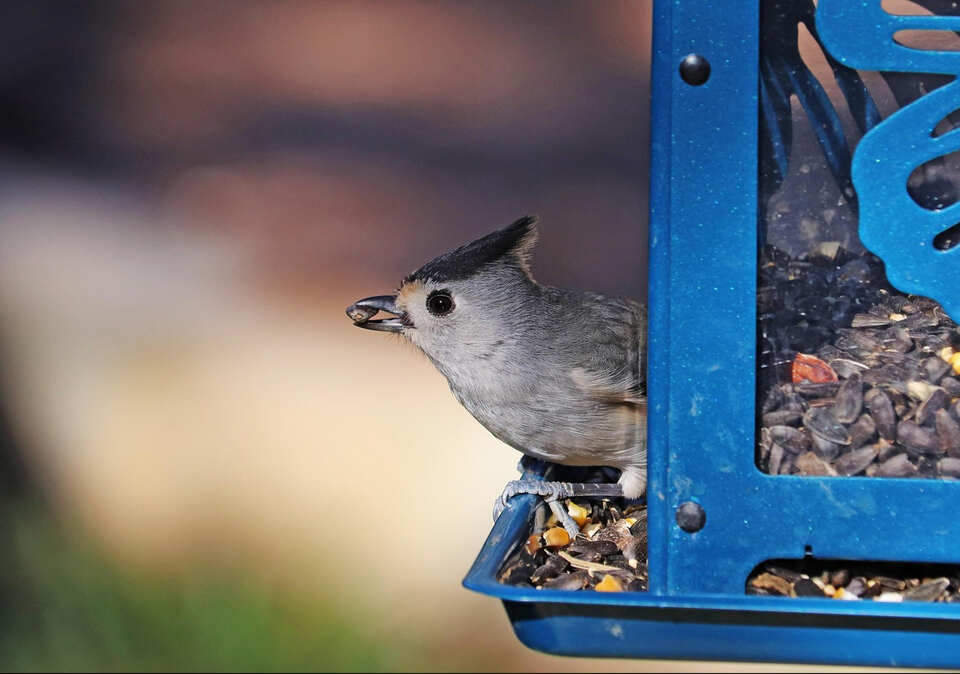
Feeder color should match the target species and the food being offered. Bright reds and yellows signal food availability to most songbirds, but the specific application matters more than simply painting everything red.
For hummingbird feeders, red remains the universal standard because it triggers the nectar-feeding response. However, research shows the red color is useful for initial attraction; once hummingbirds learn a feeder’s location, the color becomes less important than the quality and freshness of nectar inside. Consider using red accents on ports and perches rather than entirely red feeders.
Seed feeders benefit from yellow or bright green colors that signal food to goldfinches, siskins, and other small songbirds. These colors stand out against typical backyard backgrounds while also matching the colors of natural seed sources like sunflowers and thistle.
Platform feeders and suet feeders work best in earth tones (browns, tans, natural wood) that blend with bark and branch colors. Ground-feeding species like cardinals, juncos, and towhees prefer feeders that don’t draw attention from predators. Natural colors provide food access while maintaining the camouflage these birds prefer.
Avoid solid white feeders for most applications. According to research, white serves as an alarm signal in bird communication. Many species flash white wing patches or tail feathers as danger warnings. Large white surfaces may trigger stress responses that discourage feeding.
What Colors Do Birds Like for a Birdhouse?
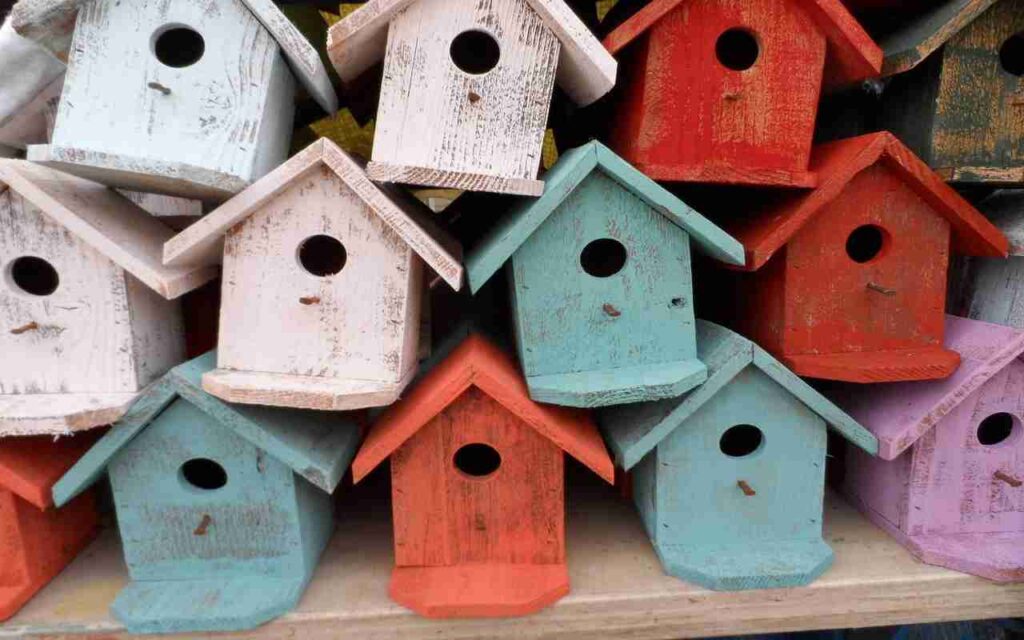
Birdhouse color strategy requires completely different thinking than feeder colors. Where feeders benefit from high visibility, nest boxes require camouflage for predator protection. The most successful birdhouse colors are those that blend with surrounding habitat rather than standing out.
Gray, brown, and dull green provide optimal camouflage in most environments. These colors help nest boxes blend with tree bark, foliage, and shadowed areas where cavity-nesting birds naturally seek nesting sites. A well-camouflaged box attracts parent birds seeking predator protection for their vulnerable eggs and nestlings.
Avoid bright colors on birdhouses entirely. Red, yellow, orange, and white all increase visibility to predators including hawks, crows, raccoons, and cats. These colors essentially advertise nest locations to the exact animals you want to avoid. The exception is purple martin houses, where purple or white colors may help with heat reflection, but even these benefit from strategic placement rather than relying on color.
Natural wood, left unpainted, often provides the best solution. It weathers to gray tones that blend with tree bark while avoiding the chemical exposure concerns of painted surfaces. If painting is necessary for weather protection, choose exterior latex paint in earth tones and avoid painting the interior, which can trap harmful fumes.
What Colors Do Birds Like for a Bird Bath?
Bird bath color affects both attraction and perceived safety. Light blue and earthy stone colors create the strongest response by mimicking natural water sources that birds instinctively recognize as safe.
Light blue triggers psychological associations with clean, fresh water. Birds evolved to seek water sources by scanning for blue reflections, and a light blue bath capitalizes on this instinct. The color suggests shallow water (which birds prefer for bathing) rather than deep water that poses drowning risks.
Natural stone colors (gray, tan, brown) work equally well by resembling rocky streams and puddles. These colors blend with natural surroundings while still remaining visible enough for birds to locate from overhead flight paths. Stone-colored baths also avoid creating the artificial appearance that may concern more cautious species.
Avoid dark colors, especially black or dark green. These colors absorb heat, making water temperatures uncomfortable or even dangerous during summer. Dark baths can heat water to levels that damage feathers or cause heat stress. Additionally, dark colors make it difficult for birds to judge water depth, potentially deterring cautious species.
Reflective or glossy surfaces should also be avoided. Shiny metal or glazed ceramic can create glare that birds find disorienting or that triggers territorial responses as birds mistake their reflections for competitors. Matte or textured surfaces provide better footing and reduce these problems.
The Danger Zone: What Colors Do Birds NOT Like?
The White Flag Warning
White occupies a unique position in bird vision as a danger signal rather than an attractant. Multiple bird species use white plumage patches as alarm signals. Northern mockingbirds flash white wing patches during territorial disputes. Dark-eyed juncos display white outer tail feathers when flushed by predators. White has become evolutionarily associated with warning and danger across many species.
Large solid white surfaces (feeders, decorations, or buildings) can trigger avoidance responses. Birds may interpret these white areas as territorial displays from other birds or as warning signals indicating predator presence. This doesn’t mean white flowers should be avoided (these occur naturally and birds recognize them as food sources), but artificial white structures often produce negative effects.
The white-danger association appears especially strong during nesting season when birds are most protective and alert to threats. A white birdhouse or feeder placed near an active nest may cause parent birds to abandon the site, interpreting the white object as a new threat that appeared during their nesting attempt.
Reflective Dangers
Metallic surfaces like silver, chrome, or mirrored finishes create multiple problems for birds. The primary issue is confusion about territorial boundaries. When birds see their reflections in shiny surfaces, they may interpret the reflection as a competing individual, triggering territorial aggression that wastes energy and creates stress.
Cardinals, robins, and bluebirds are especially prone to attacking their reflections in windows, car mirrors, and metallic yard ornaments. These attacks can continue for weeks during breeding season as hormonal males attempt to drive away the “intruder” that never leaves. The behavior causes physical exhaustion, feather damage, and in extreme cases, fatal collisions.
Reflective surfaces also create glare that may disorient birds or make it difficult to locate actual food sources, water, or perches. Where solid colors provide clear visual information, reflective surfaces create changing, ambiguous signals that birds find difficult to interpret.
Supreme Content: 5 High-UV Plants That Create Invisible Bull’s-Eyes
The following plants feature UV-reflective patterns that create invisible bull’s-eyes guiding birds directly to nectar. These species have been documented through UV photography to display the exact patterns that birds see but humans cannot perceive.
1. Plateau Goldeneye (Viguiera dentata)
This tall, bushy plant produces yellow, daisy-like flowers in October and November. According to the Lady Bird Johnson Wildflower Center, plateau goldeneye displays a classic UV bull’s-eye pattern that guides bees and butterflies to nectar. The pattern consists of UV-absorbing centers surrounded by UV-reflecting petal tips, creating a target visible only to animals with UV vision.
For birds, this pattern serves dual purposes. Hummingbirds and other nectar-feeders use the UV bull’s-eye as a precision guidance system, identifying exactly where to probe for nectar. Insect-eating birds recognize the UV pattern as indicating high insect activity, since the flowers attract abundant pollinators.
Plateau goldeneye thrives in full sun and well-drained soil. The plant reaches 3-5 feet tall, creating vertical color that remains visible above surrounding vegetation. It also serves as a larval host for several butterfly species, further increasing its value for insectivorous birds.
2. Black-Eyed Susan (Rudbeckia hirta)
This iconic prairie wildflower employs a sophisticated two-pigment system to create UV patterns. Research on UV coloration shows that Rudbeckia uses UV-absorbing pigments in the dark center disk contrasted against UV-reflecting pigments in the yellow petals. This combination creates a pattern that appears dramatically different to birds than it does to humans.
Where humans see a simple yellow flower with a dark center, birds perceive a glowing yellow ring surrounding an almost black center. The UV contrast makes the flower visible from greater distances and provides precise information about where nectar (which accumulates in florets at the disk edge) can be found.
Black-eyed Susan excels in late summer and fall when many other flowers have finished blooming. The seed heads that develop after flowering provide food for goldfinches, chickadees, and other seed-eating species. Allow the seed heads to stand through winter for maximum bird value.
3. Evening Primrose (Oenothera biennis)
Evening primrose features prominent and “stunning” UV markings according to researchers studying pollinator attraction. The flowers open in late afternoon and remain active through the night, making them particularly important for moths and night-flying insects. For birds, the UV patterns remain visible during crepuscular feeding periods at dawn and dusk.
The UV markings on evening primrose create directional guides that lead pollinators (and observant birds) from the petal edges inward to the flower center where nectar accumulates. This guidance system increases foraging efficiency, allowing birds to extract more nectar in less time compared to flowers without UV patterns.
As a biennial, evening primrose produces foliage the first year and flowers the second year. Plant in succession to ensure continuous blooms. The species tolerates poor soil and drought, making it valuable for areas where other flowering plants struggle.
4. Silverweed (Potentilla anserina)
Silverweed boasts an extremely strong UV pattern that makes it a favorite subject for researchers studying UV vision. Studies show that many flowering species use UV-reflective bull’s–eye patterns to guide pollinators to nectar and pollen, creating visual cues invisible to humans but highly visible to UV-sensitive animals.
The common name “silverweed” refers to the silvery-gray leaves rather than the flowers. The bright yellow flowers display intense UV reflection around petal edges with UV absorption in the center, creating one of the most dramatic UV bull’s-eye patterns documented in North American wildflowers.
Silverweed spreads by runners and can colonize poor soils including sandy or gravelly areas. This growth habit makes it excellent for erosion control along slopes where you want to attract birds. The dense foliage also provides cover for ground-feeding species like towhees and sparrows.
5. Texas Bluebonnet (Lupinus texensis)
Texas bluebonnet represents a masterpiece of UV signaling. The flowers feature banner spots that appear in visible light as white patches on blue petals. Under UV photography, these banner spots “pop” in bright aqua blue, creating a three-dimensional signal that guides pollinators with precision.
The UV patterns on bluebonnet banners change as flowers age and nectar depletes. Fresh flowers display intense UV reflection, while older flowers lose UV intensity. This allows bees and birds to selectively visit the most rewarding flowers, increasing foraging efficiency. For birds, this means less wasted energy probing spent flowers.
Beyond the spectacular UV patterns, bluebonnets provide additional value by fixing nitrogen in soil through symbiotic bacteria in their roots. This soil improvement benefits surrounding plants, creating more robust habitat that supports larger insect populations and therefore attracts more insect-eating birds.
Your Backyard Color Cheat Sheet: What Colors Attract Birds?
To make things even easier, I’ve put together this quick-reference cheat sheet. It summarizes what colors attract birds throughout the changing seasons so you can see exactly which shades to add to your yard right now.
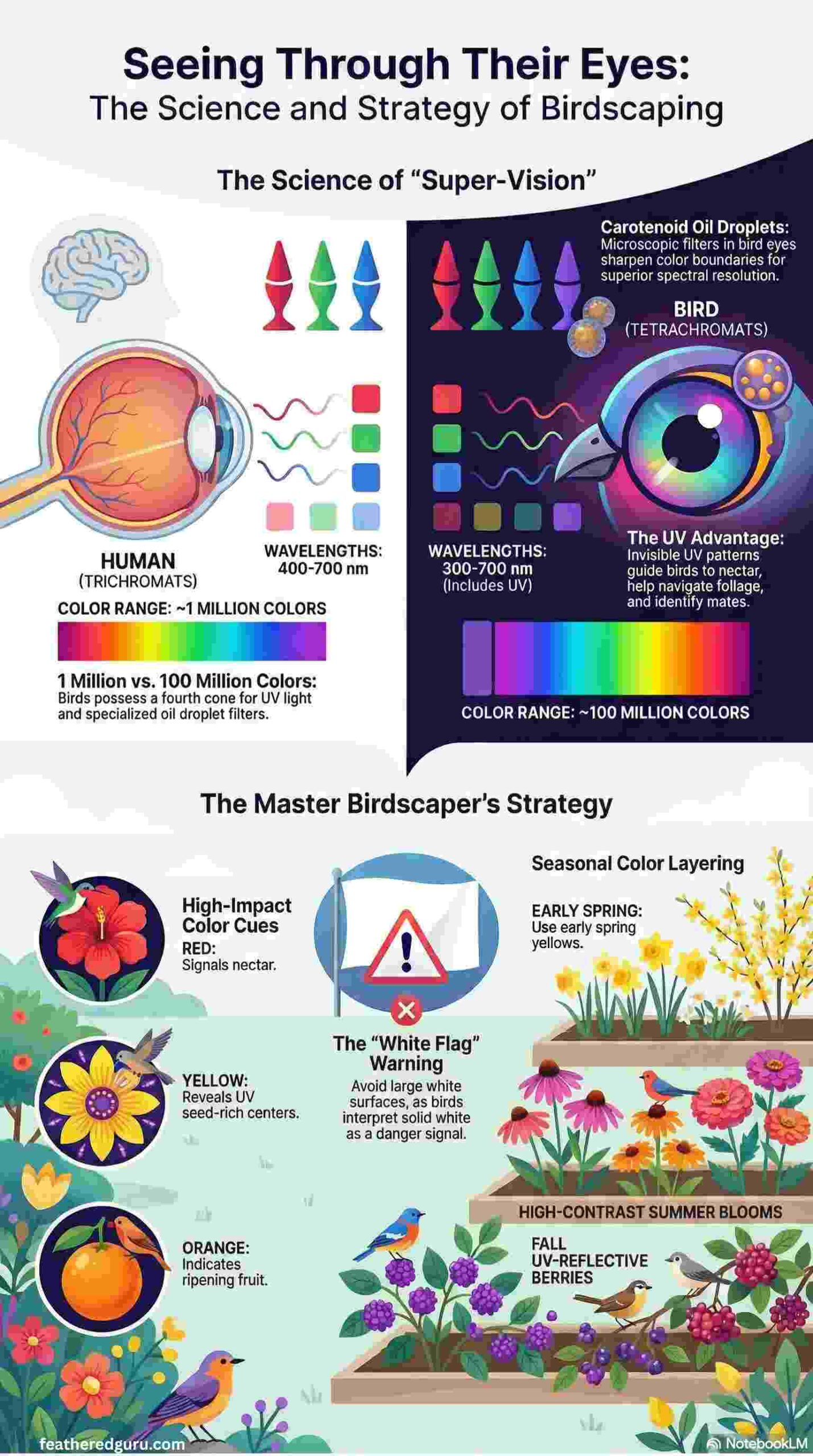
Conclusion: Seeing Your Yard Through Bird Eyes
Transforming your backyard into a bird magnet requires seeing beyond human visual limitations to understand the symphonic world of color that birds perceive. Tetrachromatic vision, oil droplet filtering, and UV sensitivity create a perceptual reality so different from our own that we must rely on research and strategic application to work effectively with it.
The practical applications are clear: use red and pink for hummingbirds and cardinals, yellow for goldfinches and seed-eaters, blue for bluebirds and water sources, and orange for orioles. Layer these colors seasonally, emphasizing early yellows in spring, high-contrast combinations in summer, UV-reflecting berries in fall, and evergreen-berry contrasts in winter.
Success requires abandoning human-centric color preferences in favor of bird-optimized strategies. Camouflage your birdhouses, make your feeders visible, create UV bull’s-eyes with the five plants detailed above, and understand that white surfaces may repel rather than attract birds. Most importantly, recognize that roughly 50% of the color information available to birds exists in a spectrum invisible to your eyes.
Understanding bird vision elevates you from casual bird feeding to master birdscaping. Armed with this knowledge, every plant choice becomes strategic, every color placement intentional, and every season an opportunity to leverage avian visual capabilities that most people never know exist. The birds were always seeing this spectacular world. Now you can design for it.
For additional strategies on attracting specific species, explore guides on attracting hummingbirds, attracting cardinals, and attracting eastern bluebirds. Understanding which flowering plants provide optimal nectar and creating a bird-friendly garden design will complete your transformation into a master birdscaper who works with avian vision to create irresistible backyard habitats.