
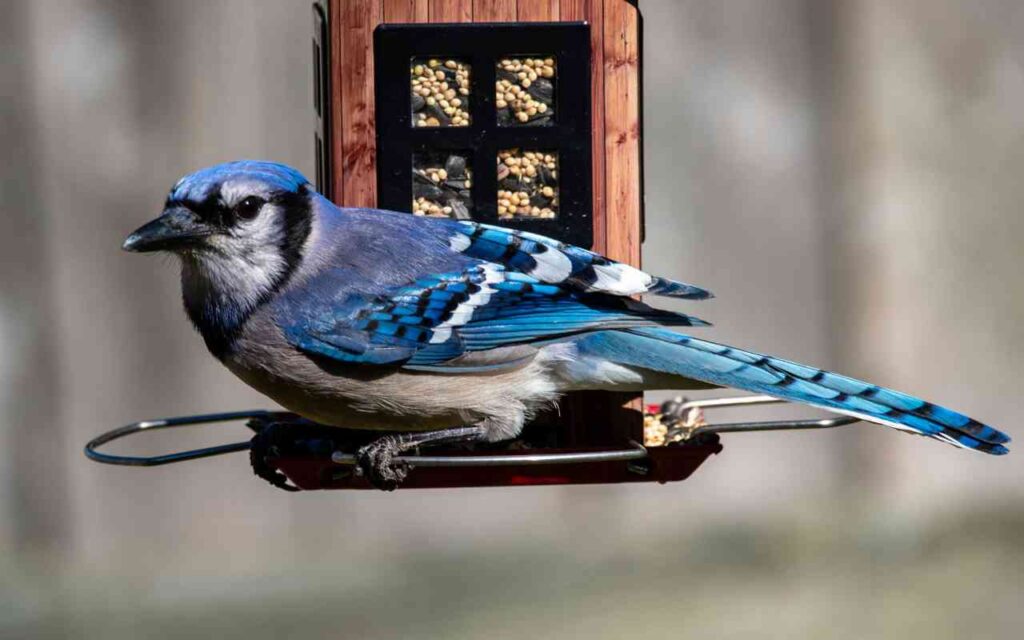
Blue jays (Cyanocitta cristata) rank among North America’s most recognizable and frequent feeder visitors, yet their dietary needs and preferences remain widely misunderstood. If you’ve ever wondered what blue jays eat at feeders, the answer goes far beyond sunflower seeds and peanuts. These intelligent corvids aren’t simply aggressive seed stealers, and they are sophisticated omnivores with seasonal dietary shifts, remarkable food-selection strategies, and an ecological role that shaped eastern North American forests.
Understanding what blue jays truly eat, backed by decades of scientific research and stomach content analyses, helps backyard birders provide optimal nutrition while appreciating these birds’ complex feeding behaviors. This comprehensive guide synthesizes findings from ornithological studies, Project FeederWatch data, and field research to explain exactly what blue jays need, prefer, and avoid. 🙂
- Blue jays are smart omnivores, not just seed thieves.
- Natural diet: 22% insects, 78% plant matter.
- Eggs and nestlings <1% of diet.
- Seasonal shifts: insects spring/summer, plants fall/winter.
- Acorns are key; caching helps forest growth.
- Top feeder foods: peanuts, sunflower seeds, corn, suet.
- Other foods: almonds, hazelnuts, pecans, mealworms.
- Avoid: salted nuts, bread, chocolate, nectar, tiny seeds.
- Jays cache many items per trip, recall ~5,000 caches.
- Feeder tips: platform or hopper, multiple spots, water nearby, safe from predators.
- Feeding blue jays supports ecology and backyard populations.
Watch: What Blue Jays Eat at Feeders
From peanuts to sunflower seeds, see what foods attract these clever birds to your backyard feeders
Show Transcript:
0:00
You know him, you love him… or maybe you’re not so sure. That brilliant flash of blue. That loud, confident call. Yep, it’s the blue jay, one of the most recognizable backyard birds in North America.
0:09
But when blue jays show up at the feeder, opinions get complicated. Are they aggressive? Do they bully smaller birds? Do they really eat everything in sight?
0:17
Today, we’re breaking down what blue jays actually eat and separating backyard birding myths from facts.
0:22
They’ve got a reputation as feeder bullies and peanut thieves, and sure, that reputation comes from somewhere. But as you’re about to see, it’s far from the full story.
0:40
Let’s start with a stat that changes everything.
0:43
About 78% of a blue jay’s diet is plant-based, including nuts, seeds, and fruit. That infamous egg-stealing behavior? It makes up less than 1% of what they eat.
0:55
In other words, blue jays are overwhelmingly vegetarian.
1:01
To really understand them, we have to look beyond backyard feeders and into how their diet changes with the seasons.
1:08
In spring and summer, when blue jays are raising young, they shift into high-protein mode. Insects become critical fuel for growing chicks.
1:17
But when fall arrives, everything changes. Their focus turns to high-energy foods like nuts and seeds to prepare for winter survival.
1:32
And when it comes to favorite foods, one stands above all others.
1:37
The acorn.
1:40
For blue jays, acorns aren’t just snacks. They are the foundation of survival.
1:46
A single blue jay can cache thousands of acorns across its territory and remember up to 5,000 individual hiding spots.
2:01
That incredible spatial memory is what gets them through winter.
2:05
But here’s the twist. Because they hide so many acorns, they inevitably forget some.
2:13
Those forgotten acorns sprout into trees.
2:16
Blue jays are one of the most effective natural tree planters in North America and play a direct role in spreading oak forests.
2:25
They aren’t just birds. They’re ecosystem engineers.
2:30
So how do you support blue jays in your own backyard? Let’s build the ideal blue jay feeder menu.
2:36
Tier One: Absolute Favorites
Peanuts (in-shell or shelled), sunflower seeds, and whole corn kernels. If you want blue jays to visit regularly, start here.
2:53
Tier Two: Strong Options
Other tree nuts, suet for high-fat energy, and even mealworms.
3:00
Tier Three: Occasional Foods
Larger seeds from standard birdseed mixes. They’ll eat them, but they’ll always choose tier-one foods first.
3:07
Pro tip: If peanuts disappear fast, it doesn’t mean the birds are greedy. It means they’re caching. Those nuts are being stored for later.
3:26
Now let’s talk about feeders, because how you feed blue jays matters just as much as what you feed them.
3:35
Blue jays are large birds. Platform feeders and large hopper feeders give them the space they need.
3:43
Want to see their intelligence in action? Try a peanut mesh feeder. Watching them problem-solve is half the fun.
3:55
You’ll also notice clever behaviors like holding nuts with their feet while hammering them open, or mimicking hawk calls to clear the feeder.
4:10
The best times to watch blue jays are early morning and late afternoon.
4:15
You can also adjust food by season.
Spring and summer: high-protein foods.
Fall: in-shell peanuts and corn for caching.
Winter: high-calorie, high-fat foods like sunflower seeds and suet.
4:34
Just as important is what not to offer. Avoid salted nuts, bread, chocolate, moldy seed, tiny seeds like niger, and hummingbird nectar.
4:53
When you feed blue jays correctly, you’re doing more than helping a bird.
4:59
You’re participating in a much bigger ecological story.
5:04
That peanut or acorn gets cached. One forgotten seed becomes a tree. Your backyard feeder supports a species that helps regenerate forests.
5:15
It’s a powerful connection between everyday bird feeding and long-term ecosystem health.
5:34
So the next time a blue jay lands at your feeder, what will you see?
5:39
A thief?
Or a highly intelligent survivor, a dedicated parent, and one of nature’s most important accidental gardeners?
Blue Jay Diet Overview: What the Research Shows
The most comprehensive dietary analysis of blue jays comes from a 1922 study by F.E.L. Beal, who examined 530 blue jay stomachs collected across 30 states and Canada throughout all seasons. His findings were published in the bulletin, The Blue Jay and Its Food, and revealed:
- 22% insects and other arthropods (varying seasonally)
- 78% plant matter including nuts, seeds, fruits, and grains
- Less than 1% eggs and nestlings (found in only 6 of 530 stomachs)
Although Blue Jays are often accused of raiding nests, eggs and nestlings make up a very small portion of their diet. According to BirdWatching Daily, a review of a 1922 stomach content study found traces of bird eggs or nestlings in only 6 out of 530 Blue Jay stomachs examined, or barely 1 percent, even though researchers specifically searched for evidence of nest predation.
Seasonal dietary shifts:
- Spring/Summer: 30-40% insects, especially when feeding nestlings
- Fall/Winter: 80-90% plant matter, heavily dominated by nuts and seeds
These proportions come from multiple stomach content analyses across different seasons and regions, demonstrating that blue jays are primarily vegetarian, particularly during winter months.
Acorns: The Cornerstone of Blue Jay Diet
Acorns dominate blue jay diet more than any other single food source. Research from multiple studies reveals the remarkable extent of this dependence:
A landmark 1981 study by Darley-Hill and Johnson documented blue jays transporting and caching 133,000 acorns from a single stand of pin oak trees in Virginia, representing 54% of the total mast crop. An additional 20% was consumed on-site. This research fundamentally changed our understanding of blue jay-oak relationships.
Key findings from acorn research:
Carrying capacity: Blue jays can carry 2-5 acorns per trip. They store acorns in their throat pouch (gular pouch), another in their mouth, and one in the bill tip, transporting up to 5 simultaneously according to Cornell research.
Caching behavior: Individual jays with radio transmitters cached 3,000-5,000 acorns in a single autumn. These caches are scattered across their territory, buried individually, and covered with debris.
Size preferences: Multiple studies demonstrate blue jays prefer small to medium-sized acorns (pin oak, willow oak, black oak) and avoid larger acorns (red oak, white oak), likely because they can’t fit large acorns in their bills, as shown in a blue jay acorn preference study.
Dispersal distances: Research shows jays cache acorns an average of 1.1 km from source trees (range: 100m–1.9 km). This long-distance dispersal is credited with spreading oak forests northward after the last glacial period, according to the Blue Jay Acorn Dispersal Study.
Memory and retrieval: Studies indicate jays can recall cache locations with approximately 90% accuracy across winter months, remembering up to 5,000 individual cache sites.
Why acorns matter for feeding blue jays: If your yard contains oak trees, blue jays will naturally harvest and cache acorns in fall. This is their most important natural food source and shouldn’t be discouraged. However, research also shows blue jays cannot maintain body weight on acorns alone, the tannins interfere with protein digestion, requiring supplemental protein from insect larvae or other sources.
Best Foods for Blue Jays at Feeders
Based on Project FeederWatch data, ornithological feeding studies, and documented preferences, here are the foods blue jays seek at feeders:
Tier 1: Highly Preferred Foods
Peanuts (Shell-on and Shelled): The single most attractive feeder food for blue jays according to multiple observational studies. Research from Birds of the World notes jays “prefer large seeds, such as peanuts” and will selectively choose the heaviest peanuts, which contain the most meat.
- In-shell peanuts: Blue jays relish the challenge of cracking shells with their powerful bills
- Shelled peanuts: Immediately accessible, often cached for later consumption
- Why they work: High fat and protein content, large size fits their foraging style, similar nutritional profile to acorns
Sunflower Seeds (Black Oil and Striped): Blue jays’ strong bills easily crack sunflower shells. Studies note they prefer larger striped sunflower seeds over smaller varieties.
- Black oil sunflower: Higher fat content (40%), easier to crack
- Striped sunflower: Larger size appeals to blue jays’ preference for substantial foods
- Hearts/chips: Convenient but remove the foraging satisfaction of cracking shells
Whole Corn: Dried whole corn kernels attract blue jays, who will carry them off for caching or immediate consumption. Field corn on the cob provides extended feeding opportunities.
Tier 2: Readily Accepted Foods
Other Tree Nuts:
- Almonds: Whole or chopped, high nutritional value
- Hazelnuts: Similar size to preferred acorns
- Pecans: Rich in fats, though large pieces are preferred over small bits
- Walnuts: Chopped pieces more manageable than whole nuts
Suet and Suet-Seed Mixes: Blue jays readily visit suet feeders, particularly in winter when insect availability declines. Research from Birds of the World documents increased effort in foraging insects during winter, suggesting suet’s animal-fat content fills an important dietary niche.
Mealworms (Dried or Live): While not typically offered at standard feeders, blue jays will consume mealworms when available, especially during breeding season when protein demands increase.
Tier 3: Accepted But Not Preferred
Mixed Seed Blends: Blue jays will pick through mixed seed but Studies note they “ignore small seeds like milo.” They’ll select larger components (sunflower, peanuts, corn) and scatter smaller seeds.
Safflower Seeds: Accepted by blue jays though not preferred over sunflower or peanuts. Often recommended as “squirrel-proof,” but blue jays crack these readily.
Nyjer/Thistle: Too small for blue jay interest. These tiny seeds don’t align with their foraging preferences.
Fruits, Berries, and Insects: Natural Diet Components
Beyond feeder foods, blue jays consume diverse natural foods throughout the year:
Insects and Invertebrates (Critical Spring/Summer): According to research, insects comprise a significant portion of spring and summer diet.
- Caterpillars: Major food for nestlings, constitute ~10% of July-August diet in Beal’s analysis
- Grasshoppers: Nearly 20% of August diet in stomach content studies
- Beetles, cicadas, crickets: Actively hunted, especially larger specimens
- Spiders, snails: Opportunistically consumed
- Dragonflies and flying insects: Captured on the wing
Fruits and Berries: Blue jays aren’t primarily frugivorous but consume various fruits seasonally:
- Wild cherries, elderberries: Summer abundance
- Sumac berries: Fall and winter persistence
- Dogwood berries: Important fall food
- Cultivated fruits: Occasionally raid gardens for cherries, grapes
- Not major fruit eaters: Research confirms nuts and seeds far outweigh fruit consumption
Other Natural Foods:
- Beechnuts: Important fall mast crop
- Pine seeds: From pine cones in coniferous areas
- Grain from agricultural areas: Opportunistically consumed
- Small vertebrates (rare): Documented eating frogs, salamanders, mice, nestling birds, carrion, all extremely uncommon based on stomach analyses
How Blue Jays Feed: Behavioral Observations
Understanding blue jay feeding behavior helps create optimal feeder setups:
Bill power and food manipulation: Blue jays possess exceptionally strong bills with specialized jaw musculature. According to research documented in Birds of the World, the “buttress complex of lower jaw” is an adaptation for forceful pounding that allows them to crack hard nuts.
Holding food with feet: Blue jays hold large food items with their feet while pecking pieces off, a behavior observed with peanuts, large caterpillars, and soft fruits. This corvid characteristic enables them to process foods other songbirds cannot.
Caching behavior at feeders: Blue jays don’t just eat at feeders, they harvest. Observations show jays making multiple rapid trips, stuffing their gular pouch with 3-5 peanuts, flying off to cache them, then immediately returning. This can empty a feeder surprisingly quickly.
Mimicking hawk calls: Research confirms blue jays sometimes mimic hawk calls when approaching feeders, particularly Red-shouldered Hawk screams. While traditionally thought to warn other birds, some evidence suggests this may temporarily scatter competitors, giving the jay brief exclusive access, though most birds return within seconds.
Feeder dominance patterns: Contrary to popular belief about blue jay aggression, Project FeederWatch data and Florida feeding studies reveal blue jays are NOT the most dominant species at feeders. According to Cornell’s research, “Red-bellied Woodpeckers, Red-headed Woodpeckers, Florida Scrub-Jays, Common Grackles, and gray squirrels strongly dominate Blue Jays at feeders, often preventing them from obtaining food.”
Blue jays can scare smaller birds temporarily, but dominance is primarily size-related, and jays themselves are often displaced by larger species.
Best Feeder Types for Blue Jays
Based on their size, behavior, and food preferences:
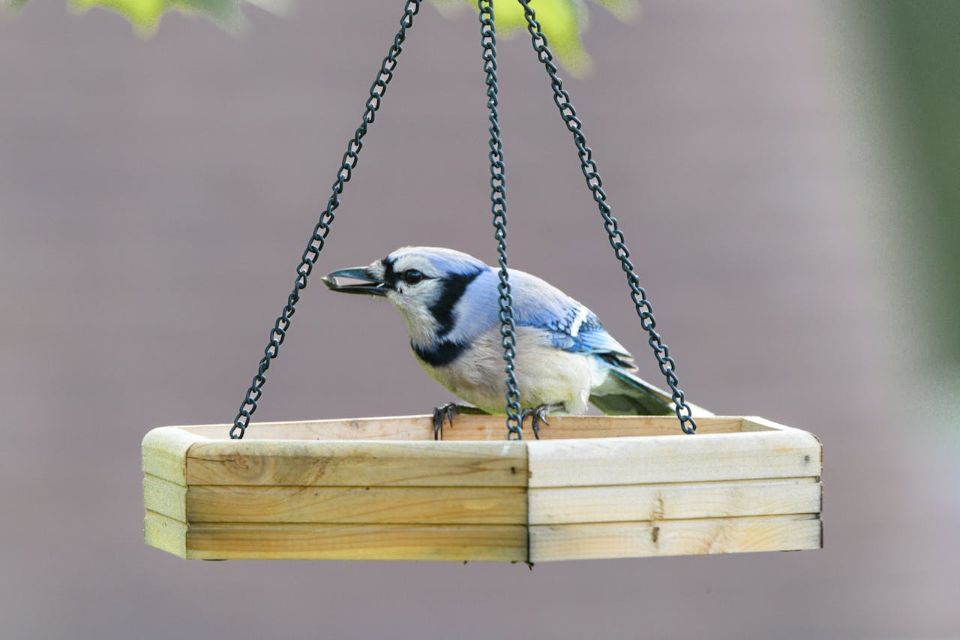
Platform Feeders (Most Effective): Blue jays’ size (9-12 inches) makes them too large and heavy for most tube feeders. Platform feeders provide stable landing surfaces and accommodate their feeding style. Open platforms allow jays to land, assess food, and selectively choose preferred items.
Hopper Feeders: Large-capacity hoppers with wide feeding trays work well. Blue jays can perch on edges and access seeds, though they may dominate these feeders and prevent smaller birds from feeding.
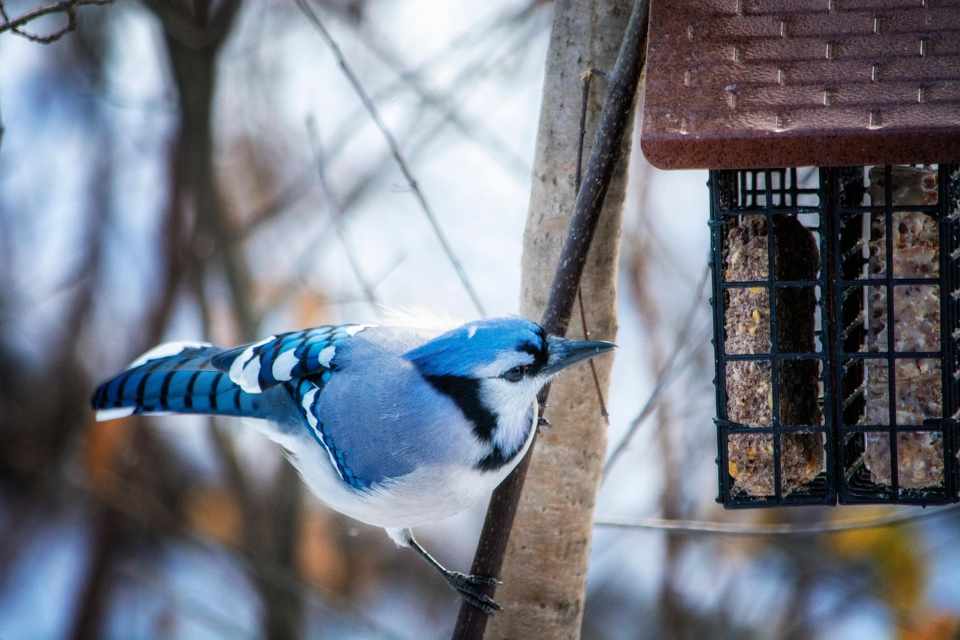
Peanut Feeders (Wire Mesh): Specialized feeders with wire mesh panels hold whole or shelled peanuts. Blue jays’ strong bills extract peanuts through the mesh, and the challenge engages their intelligence.
Suet Cages: Blue jays will cling to suet cages, though their size makes this less comfortable than for smaller woodpeckers. Larger suet feeders or those with tail props work best.
Ground Feeding: Blue jays naturally forage on the ground and will readily take food scattered on platforms, patios, or directly on the ground. This is their most natural feeding situation.
What doesn’t work:
- Small tube feeders: Blue jays cannot comfortably access standard tube feeder ports
- Tiny mesh finch feeders: Completely inappropriate for their size
- Hanging feeders that swing: Blue jays prefer stable surfaces
For comprehensive guidance on selecting appropriate feeders for blue jays and other species, see our guide on how to choose the right bird feeder.
Feeding Blue Jays Through the Seasons
Adjusting offerings by season matches blue jays’ natural dietary shifts:
Spring (March-May):
- Priorities: Energy for migration and nesting
- Offer: Peanuts, sunflower seeds, suet for fat and protein
- Natural foods: Emerging insects, tree buds, early berries
- Why it matters: Pairs establishing territories and beginning nesting need high-energy foods
Summer (June-August):
- Priorities: Protein for nestlings
- Offer: Peanuts, mealworms (if offering), suet
- Natural foods: Abundant insects (caterpillars, grasshoppers), summer berries
- Why it matters: Parent jays feeding young need convenient supplemental food between insect-hunting trips
Fall (September-November):
- Priorities: Building fat reserves, caching for winter
- Offer: Peanuts (especially in-shell for caching), sunflower seeds, corn
- Natural foods: Peak acorn harvest, beechnuts, other mast crops
- Why it matters: This is caching season, jays will aggressively harvest feeder food for winter storage
Winter (December-February):
- Priorities: High-calorie foods for surviving cold
- Offer: Peanuts, sunflower seeds, suet, corn
- Natural foods: Cached acorns retrieved, remaining berries, insect larvae in bark crevices
- Why it matters: Vegetable matter dominates winter diet (75%+); reliable feeders provide critical supplemental nutrition
Common Blue Jay Feeding Questions
Do blue jays eat from hummingbird feeders?
No. Blue jays are not nectarivores and cannot access sugar water from hummingbird feeders. If a blue jay is investigating your hummingbird feeder, it’s likely attracted by insects around the feeder, not the nectar itself.
Will blue jays eat other birds’ eggs?
The research is definitive: egg predation occurs but is rare. Of 530 stomachs examined (Beal 1922), eggs or bird remains appeared in less than 1%. A 1897 study of 297 stomachs found eggshells or bird parts in only 5. As The Nature Conservancy notes, “eggs and birds make up only 1 percent of the blue jay’s diet.”
Should I stop feeding blue jays to protect smaller birds?
No. Research shows blue jays aren’t the aggressive bullies they’re reputed to be. Project FeederWatch data indicates many species dominate blue jays at feeders. Blue jays may temporarily scatter birds but most return quickly. Multiple feeder locations accommodate all species. For strategies on managing multiple bird species at feeders, including cardinals and other backyard visitors, diverse feeder placement works best.
Why do blue jays take so many peanuts at once?
Caching behavior. Research with radio-tagged jays revealed individuals cached 3,000-5,000 acorns in a single autumn. At feeders, jays exhibit the same behavior, harvesting multiple peanuts per trip for caching rather than immediate consumption.
Do blue jays eat snakes?
No evidence supports this. Snakes actually pose predation risk to blue jay nests. Blue jays don’t hunt snakes as prey.
What do baby blue jays eat?
According to Cornell research, nestling blue jays are fed primarily insects by both parents, approximately 75-90% insect protein during the nestling period. Parents make dozens of feeding trips daily bringing caterpillars, beetles, grasshoppers, and other soft-bodied insects. For more information on blue jay breeding behavior and nestling care, see our article on interesting facts about the blue jay.
Creating a Blue Jay-Friendly Feeding Station
Based on research-backed recommendations:
Location considerations:
- Position feeders 10-15 feet from protective cover (trees/shrubs) but not so close that predators can hide
- Blue jays prefer edge habitats, where woods meet open areas
- Multiple feeder locations reduce competition and give blue jays space
Optimal feeding setup:
- Platform feeder with peanuts (in-shell and shelled) and sunflower seeds
- Hopper or tube feeder with black oil sunflower seeds
- Suet cage in winter months
- Ground feeding area with scattered corn and peanuts
Timing and schedules: Blue jays visit feeders throughout the day but research suggests peak activity occurs in early morning (6-8 AM) and late afternoon (4-6 PM). Consistent feeding schedules allow jays to incorporate your feeders into their foraging routines.
Water is essential: Blue jays need water year-round for drinking and bathing. A bird bath 15-20 feet from feeders serves blue jays and all species. In winter, a heated bird bath becomes especially valuable.
Predator protection: Keep feeding areas clear of low shrubs where cats can hide. Blue jays are large enough to generally avoid hawk predation at feeders, but cats remain a threat, especially to jays focused on ground feeding.
Foods to Avoid Offering Blue Jays
Not all foods are appropriate or safe:
Harmful foods:
- Bread, crackers, processed foods: No nutritional value, can cause malnutrition
- Salted peanuts or other salted nuts: Excessive sodium damages bird kidneys
- Chocolate, avocado, onions: Toxic to birds
- Moldy seeds or nuts: Can produce aflatoxins harmful to all birds
Ineffective foods:
- Tiny seeds (millet, nyjer): Too small for blue jay interest
- Nectar: Not part of their diet
- Fruit exclusively: Blue jays need nuts and seeds as primary foods
Quality matters: Fresh, unsalted nuts and seeds provide optimal nutrition. Discard old, rancid, or moldy foods that can harm birds. Research shows blue jays selectively choose the heaviest, freshest nuts, they can detect quality.
Blue Jay Ecological Role: Why Feeding Them Matters
Understanding blue jays’ broader ecological importance provides context for supporting them:
Oak forest regeneration: Research demonstrates blue jays’ acorn dispersal shaped eastern North American forests, according to the Blue Jay Acorn Dispersal Study. Their caching behavior, occurring over evolutionary timescales, facilitated oak species expansion after glacial periods. Jays cache acorns in environments favorable for germination, open, disturbed areas analogous to forest gaps.
Seed dispersal beyond oaks: Blue jays disperse beechnuts and other tree species, contributing to forest diversity and regeneration. Their forgotten caches become new trees.
Insect population control: During breeding season, blue jays consume thousands of caterpillars, beetles, and other insects, many considered garden and forest pests. This provides natural pest control services.
Indicator species: Blue jay populations have declined approximately 27% since 1966 according to North American Breeding Bird Survey data. Supporting blue jays through feeding contributes to their conservation.
For broader guidance on attracting and supporting blue jays year-round, see our comprehensive guide on how to attract blue jays to your yard.
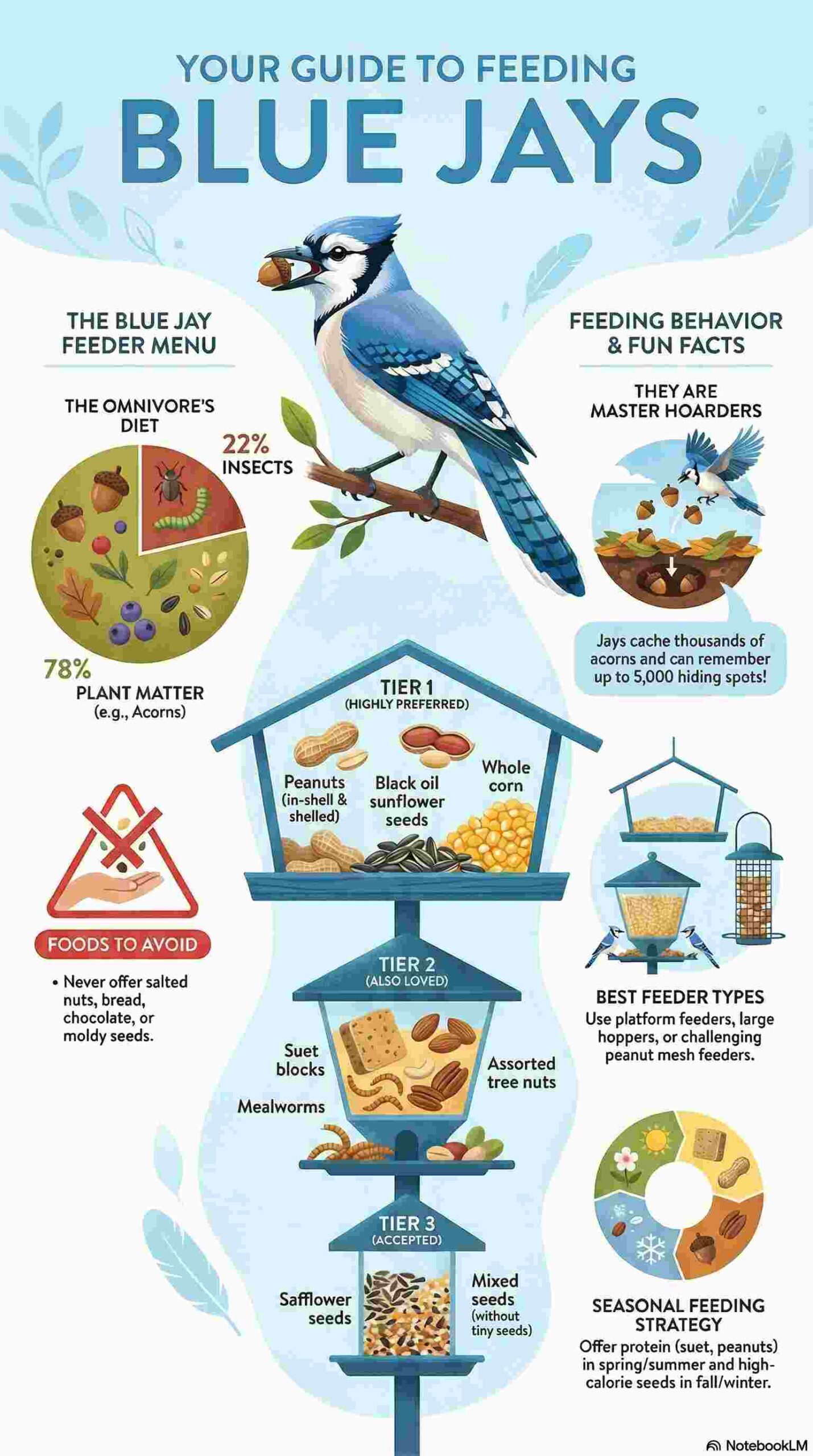
Blue Jay Feeding Guide: Infographic Overview
Summary: Research-Backed Feeding Recommendations
Based on decades of ornithological research, stomach content analyses, and observational studies:
Primary foods to offer:
- Peanuts (in-shell and shelled) – #1 preference
- Black oil and striped sunflower seeds
- Whole corn kernels
- Suet (especially winter)
Best feeders:
- Platform feeders for versatility
- Large hopper feeders with wide trays
- Peanut-specific mesh feeders
- Ground feeding for natural behavior
Seasonal priorities:
- Spring/Summer: Protein-rich foods (peanuts, suet)
- Fall: Cacheable foods (in-shell peanuts, sunflower)
- Winter: High-calorie foods (peanuts, suet, sunflower)
Key insights from research:
- Acorns dominate natural diet (up to 75% in winter)
- Insects crucial in breeding season (20-40% of diet)
- Eggs and nestlings less than 1% of diet despite reputation
- Blue jays aren’t the most dominant feeder birds
- They cache thousands of food items annually
- Strong bills adapted for cracking hard nuts
Conservation context: Blue jay populations are declining. Providing appropriate foods at feeders supplements natural food sources and supports these intelligent, ecologically important corvids.
By understanding what blue jays truly eat, based on scientific research rather than myth, backyard birders can provide optimal nutrition while appreciating these remarkable birds’ complex foraging strategies, ecological roles, and surprising dietary preferences. The flash of blue at your feeder isn’t just taking food, it’s engaging in behaviors millions of years old, shaped by co-evolution with eastern forests and continuing today in our backyards.