
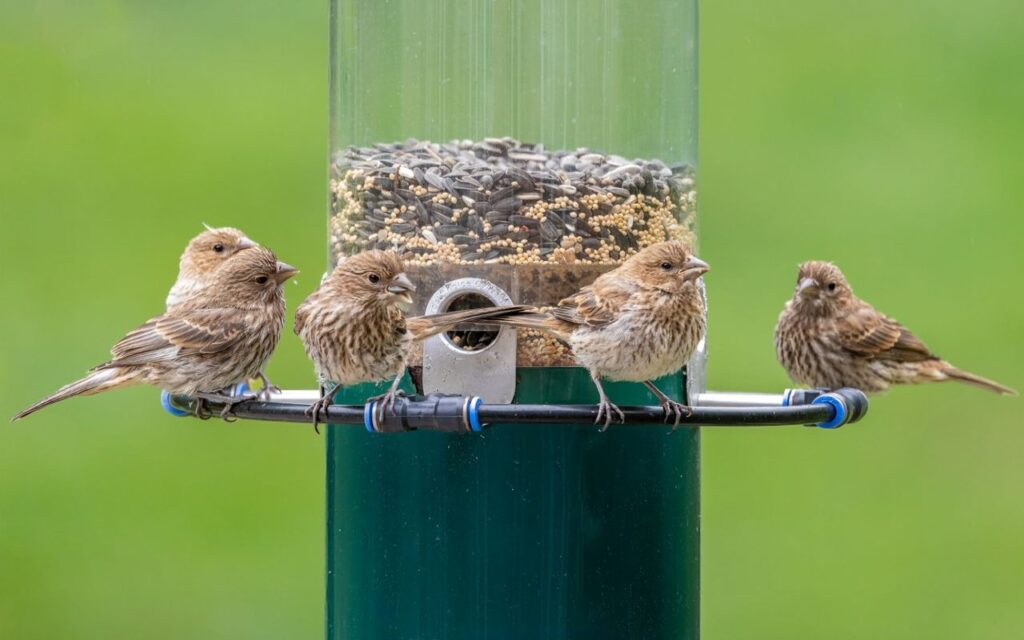
You know that frustrating feeling when you look out your window at 7:00 AM and see a chaotic, bustling flock of songbirds, but by noon your yard turns into a completely deserted ghost town? If you’ve been wondering when are birds most active at feeders, realizing that your local wildlife operates on a strict biological clock is an essential breakthrough.
The truth is that avian communities rarely forage at a flat, continuous pace throughout the daylight hours. Their daily schedules are tightly dictated by critical overnight energy depletion, specific local predator pressures, and complex social hierarchies that govern exactly when each species is allowed to eat safely.
What is the Main Reason Birds Feed Heavily in the Morning?
The primary driver is post-dawn hyperphagia, a vital metabolic requirement where small songbirds must immediately replenish up to ten percent of their total body mass lost overnight to stay warm.
Once this early survival rush finishes, birds intentionally vanish from open yards to minimize midday raptor predation risks and shift to digesting their food in dense, protective cover.
The Overnight Fast and Post-Dawn Hyperphagia Mechanics
To understand why your yard goes completely quiet after 9:00 AM, you must first look at the extreme metabolic tolls of a songbird’s nocturnal survival routine. Because small passerines like finches, chickadees, and titmice possess small body masses, they cannot store massive deposits of subcutaneous body fat without compromising their flight capabilities.
To maintain a core body temperature of roughly 105 degrees Fahrenheit during cold nights, these birds rely heavily on shivering thermogenesis. This biological mechanism rapidly consumes their lipid reserves, meaning a healthy songbird frequently wakes up at dawn having lost up to ten percent of its entire body weight overnight.
This extreme energetic depletion triggers a survival state known as post-dawn hyperphagia. Upon first light, birds face an intense evolutionary drive to locate immediate, high-calorie carbohydrates and fats to pull themselves out of starvation danger.
Your supplemental feeding station represents a highly predictable, high-density fuel cache where they can rapidly rebuild their fat reserves within a narrow 60 minute window.
This rapid calorie consumption is a foundational element of backyard habitat management, which I cover thoroughly in my guide on Feeding Birds in Winter.
The Predation-Starvation Trade-Off and Flight Physics
Once birds successfully clear their baseline morning starvation threshold, a secondary evolutionary survival mechanic dictates their midday disappearance. When a songbird’s crop is completely empty at sunrise, it willingly accepts the danger of feeding in open, exposed yard spaces because failing to find food means certain death.
However, as the bird consumes seeds and its body mass quickly increases, its takeoff velocity and flight maneuverability drop significantly due to basic aerodynamic physics.
As demonstrated by large scale tracking data published by The Royal Society, an individual bird’s daily activity budget is tightly governed by a continuous, calculated trade-off between the risk of winter starvation and mass-dependent predation risk.
A heavy, fully fed bird is a much easier target for a diving Cooper’s Hawk or Sharp-shinned Hawk during the middle of the day. Therefore, as ambient temperatures rise and raptor activity peaks closer to noon, small birds choose to leave open feeders entirely.
They shift their positions back into the safety of dense evergreen canopies, dense shrub lines, and protective thickets. Inside this thick vegetative cover, they can quietly digest their morning intake while remaining entirely hidden from sharp aerial eyes.
NETVUE Birdfy Smart Bird Feeder with Camera
This advanced 1080P color-vision smart camera feeder automatically tracks and records your backyard visitors with zero subscription fees. Featuring lifetime free artificial intelligence capable of identifying bird species with ninety-nine percent accuracy, it sends instant motion alerts straight to your phone.
The solar-powered station utilizes a high-gain wireless antenna for steady outdoor connectivity, automatically saving three months of free cloud video clips to easily study your yard’s unique morning feeding habits.

This solar-powered 1080P smart camera feeder automatically records backyard visitors with zero subscription fees. Featuring lifetime free AI bird identification with ninety-nine percent accuracy, it sends instant motion alerts to your phone and saves three months of free cloud video clips to track your local feeding schedules.
Avian Hierarchy and the Dominance Queue Strategy
Another core element of information gain driving morning-only activity is the invisible social queue that governs backyard wildlife behavior. Avian communities do not forage together randomly; instead, they operate on strict, species-interlocking dominance hierarchies that dictate exactly when a bird is allowed to approach a choice food resource safely.
Larger, more aggressive species like Blue Jays, European Starlings, and Woodpeckers heavily dominate choice feeding perches during prime morning slots. These high-ranking birds take full control of the main seed trays first, aggressively driving away smaller, subordinate species to clean out the choice nuts.
Because of this constant pressure, smaller birds like goldfinches and nuthatches are forced to adapt by operating on a time-shifted queue system. They often arrive at the very first glimpse of twilight, which is frequently before the sun fully clears the horizon, to feed rapidly before the heavier species wake up and claim the platform.
Once the larger birds arrive and occupy the main ports, the smaller birds slip back into the margins. If your feeder lacks diverse perches or is prone to overcrowding, this territorial gatekeeping can cause a complete drop-off in visible yard traffic by mid-morning, a structural obstacle I detail step-by-step in my guide on How to Prevent Bird Seed Waste.
Foraging Efficiency and Natural Resource Replenishment
Beyond your supplemental seed trays, wild birds also continuously calculate their daily schedules based on the natural availability of wild insects, berries, and native seed pods.
Early morning dew and low ambient temperatures keep insects sluggish and slow-moving on tree trunks, making them incredibly easy for woodpeckers and nuthatches to harvest with minimal energy expenditure.
As the sun rises and warms the landscape, wild insects become highly active and distribute themselves across wide forest canopies, which naturally alters a bird’s standard yard foraging loops.
Real-world behavioral tracking published via Biology Letters confirms that small birds prioritize finding new food patches early in the day and shift toward exploiting known patches as hours progress.
These shifting environmental variables dictate daily search efficiency, meaning your supplemental feeding station represents a highly stable, easily accessible food grid during peak morning hours when natural woodland foraging requires higher energy expenditures.
The Evening Foraging Surge: A Secondary Survival Window
While morning loops dominate backyard activity plots, a secondary, highly aggressive foraging spike occurs during the final hours of the afternoon. This behavior is triggered by antic-dawn forecasting, an evolutionary strategy where birds gauge the looming severity of the coming night frost.
As twilight approaches, small passerines return to premium seed hubs to pack their crops with as many lipid-dense grains as possible before dark. This evening replenishment serves as the direct fuel supply for their nocturnal shivering routines.
Without this late-afternoon calorie deposit, a bird cannot safely sustain its core body temperature across a freezing twelve-hour winter night cycle. Recognizing this dual spike pattern allows you to time your replenishment schedules perfectly so seed basins remain full during both critical fuel rushes.
Seasonal Variations in Daily Avian Feed Cycles
It is essential to recognize that this high-intensity morning rush shifts dynamically as seasonal parameters alter your local ecosystem footprint. During spring and early summer nesting periods, the post-dawn feeding surge shifts away from dry seed trays toward wild insect hatches to satisfy high-protein parental duties.
As autumn frost conditions arrive, natural insect availability plummets, causing local populations to pivot back onto your supplemental high-calorie grain networks at first light.
Furthermore, shorter daylight windows in late autumn contract their midday rest intervals significantly. This seasonal contraction forces birds to spend more consecutive afternoon hours traveling across localized property lines to meet their daily baseline metabolic targets.
Adjusting Yard Layouts for Even Afternoon Dwell Times
If you want to break up this harsh morning-only pattern and encourage a steady, beautiful flow of bird species to your windows throughout the afternoon, you must alter your yard’s physical layout. Relying on a single, isolated feeder pole out in the open center of your lawn forces birds to abandon your space the second morning light shifts into high-glare midday sun.
To naturally extend their visit windows, you need to establish a layered habitat footprint across your property lines. Install distinct feeding stations at multiple heights, such as low ground platforms for doves, specialized tube lines for finches, and elevated suet cages for woodpeckers.
Crucially, position your secondary afternoon stations within five to ten feet of a structural living windbreak or dense vegetative canopy. This protective placement lowers ambient wind friction and drops the localized thermal stress on visiting flocks during cold winter afternoons.
Providing a continuous, safe microclimate alongside fresh, liquid water prevents your local birds from vanishing into deep woods. It allows lower-ranking species to forage peacefully during the quiet afternoon slots without facing aggressive morning territory wars.