
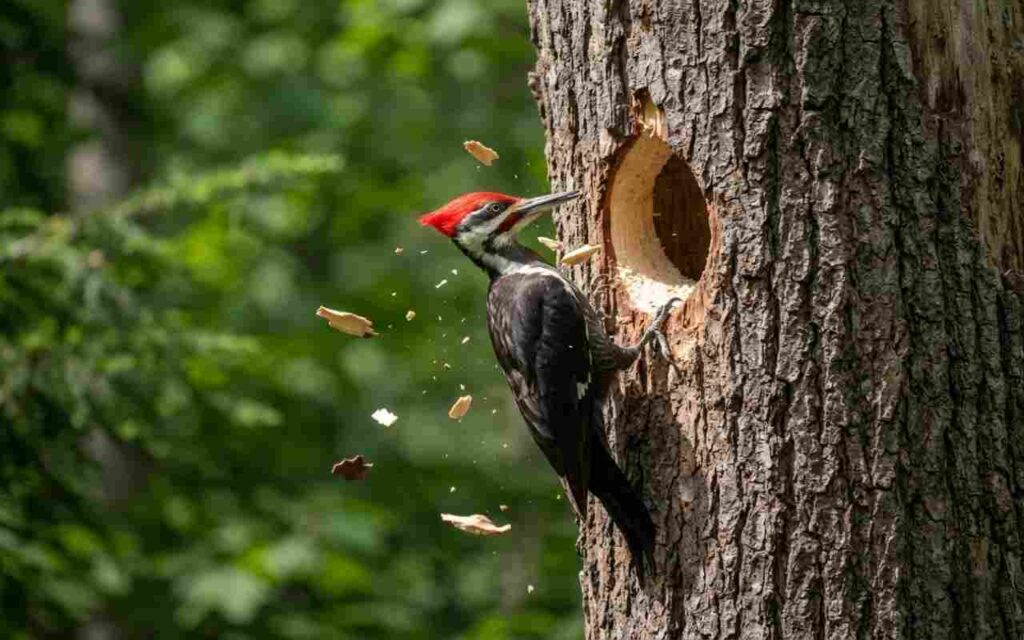
Pileated woodpeckers are the master architects of the forest, creating massive cavities that serve as the foundation for woodland biodiversity. To understand where pileated woodpeckers nest, one must look for large-diameter snags (dead or dying trees) capable of supporting their characteristically deep excavations. These pileated woodpecker nesting sites are selected exclusively in mature forests where trees have a substantial diameter at breast height (DBH) to maintain structural integrity during the construction of chambers roughly 8 inches wide and 22 inches deep.
This selection process is highly strategic, targeting trees infected with heart rot fungus, which softens the interior wood while preserving a protective hard sapwood shell against predators and weather. As a critical keystone species, the Pileated’s single-season nesting cycle creates a vital “real estate” market. After 3–6 weeks of intense labor, these abandoned cavities become essential homes for over 20 secondary cavity-nesters, including Wood Ducks, Barred Owls, and bats.
Quick Answer: Where do pileated woodpeckers nest?
Pileated woodpeckers nest exclusively in large dead or dying trees (snags) with a minimum diameter of 21 inches (DBH). They excavate unique, oblong cavities positioned 20–85 feet high, featuring entrances roughly 3.5 inches wide by 5 inches high and an internal depth of approximately 22 inches. These sites are strategically selected in trees infected with heart rot fungus to facilitate deep excavation while maintaining a protective sapwood shell.
Pileated Woodpecker Nesting Requirements: At-a-Glance
| Feature | Technical Requirement | Habitat Significance |
|---|---|---|
| Tree Type | Large-diameter Snags (Dead/Dying) | Provides soft interior for deep excavation |
| Min. Diameter | 21″ DBH (Diameter at Breast Height) | Ensures structural integrity for 22″ cavities |
| Nest Height | 20 – 85 Feet Above Ground | Primary defense against terrestrial predators |
| Cavity Shape | Distinctly Oblong or Teardrop | Signature identifier of Pileated architecture |
| Fungal Asset | Heart Rot (Phellinus pini) | Softens heartwood while preserving sapwood |
| Reuse Cycle | Single Season (Annual Excavation) | Creates a “Keystone” legacy for 20+ species |
Visualizing the Nest: A Structural Breakdown of Pileated Woodpecker Cavities
To help you visualize the intricate internal engineering of a Pileated Woodpecker’s home, we’ve included a detailed video analysis below. This breakdown illustrates the specific tree-selection criteria and cavity dimensions required for a successful forest nesting site.
Show Transcript:
0:00
Today we’re heading into the forest to look at one of nature’s most impressive ecosystem engineers: the pileated woodpecker. This bird isn’t just pecking trees for food. It’s actually building homes that support an entire wildlife community.
0:16
To understand why the pileated woodpecker matters so much, start with a small forest mystery. What could possibly connect a duck, a large owl, and a tiny bat?
0:30
The answer has nothing to do with diet or hunting behavior. It’s about where they live. All of them depend on tree cavities for shelter, and the real estate developer behind many of those homes is the pileated woodpecker.
0:40
Many forests face a serious wildlife housing shortage. Dozens of animals need hollow tree cavities to raise their young, including owls, ducks, squirrels, and bats.
0:53
The problem is that most of these species cannot make their own cavities. They are known as secondary cavity nesters, meaning they must find an existing hole created by another animal.
1:06
This creates a high-demand, low-supply housing market in the forest. The species that solves this problem is the pileated woodpecker, a powerful excavator that creates new nesting cavities each year.
1:18
But this woodpecker is extremely selective about where it builds. It follows a very strict blueprint when choosing the perfect construction site.
1:27
Almost always, the bird selects a large dead or dying tree known as a snag. These standing dead trees provide the right structure for excavation.
1:36
The first requirement is size. The woodpecker usually chooses a tree that is at least 21 inches in diameter. That thickness allows the bird to carve a large chamber without weakening the trunk.
1:46
Foresters measure this using a standard method called diameter at breast height, or DBH. This measurement helps determine whether a tree is large enough to support wildlife cavities.
1:55
For a tree to reach that size, it often needs to be between 80 and 120 years old. This immediately shows why mature forests are so important for pileated woodpeckers.
2:06
There is another surprising ingredient in this process. The woodpecker actually prefers trees infected with heart rot fungus.
2:16
Heart rot softens the wood inside the trunk while leaving the outer layer strong. This creates the perfect natural shell that allows the woodpecker to excavate a deep cavity safely.
2:30
Put all these factors together and the checklist becomes very specific: a large, mature snag with heart rot fungus and a high location for safety.
2:40
Finding a tree that meets every one of these requirements can be difficult. That is why protecting mature forests and standing dead trees is so important for wildlife.
2:50
Once the woodpecker finds the right tree, the engineering of the cavity itself is remarkable.
3:02
The entrance hole is not round. Instead, it has an oblong or teardrop shape that opens into a chamber roughly eight inches wide.
3:10
From there the cavity drops nearly two feet deep inside the tree. That depth serves as a defense system.
3:18
Predators like raccoons can reach into the hole, but their arms cannot reach far enough to grab eggs or chicks at the bottom.
3:24
Inside the nest, the woodpeckers leave a soft layer of fresh wood chips created during excavation. It’s a simple but effective nesting surface.
3:31
Building the cavity takes serious effort. The male pileated woodpecker performs about 90 percent of the digging work.
3:38
Excavation can take three to six weeks of steady carving into the wood.
3:43
After the cavity is finished, both parents share incubation duties, although the male usually takes the overnight shift.
3:47
The chicks spend roughly a month inside the nest before making their first flight from the high entrance hole.
3:54
When walking through the woods, it’s important to know that not every hole made by a pileated woodpecker is a nest.
4:04
These birds excavate cavities for several different reasons.
4:08
A nesting cavity typically has a single clean oblong entrance. Roost cavities, used for sleeping, often have multiple entrances that allow quick escape routes.
4:20
Feeding holes look very different. They are rough rectangular gashes where the bird has ripped into the wood searching for carpenter ants, a favorite food.
4:35
After the breeding season ends, the woodpecker abandons the cavity it spent weeks creating.
4:42
This single act of abandonment solves the forest housing shortage.
4:48
The empty cavity quickly becomes valuable real estate for other animals.
4:56
Wood ducks may use it for nesting. Barred owls may move in. Flying squirrels, small mammals, and even entire colonies of bats can occupy the space.
5:06
In ecology, this role has a special name. The pileated woodpecker is known as a primary cavity excavator.
5:19
Organizations like the Audubon Society describe this process as a cascade of benefits because the woodpecker’s work supports many other species.
5:29
This is the definition of a keystone species, an animal that plays an outsized role in maintaining a healthy ecosystem.
5:36
If the pileated woodpecker disappeared, the entire forest community would change.
5:42
So what does this mean for conservation?
5:48
The solution is straightforward. Protect mature forests and keep large standing dead trees whenever possible.
5:56
Those snags are not useless debris. They are future wildlife housing.
6:05
By preserving large, old trees and fungus-infected snags, we support the pileated woodpecker and the entire network of animals that rely on its work.
6:16
The next time you walk through the woods and see a massive dead tree standing tall, don’t see decay.
6:25
Instead, see potential: a future nesting cavity, a wildlife nursery, and the foundation of a thriving forest community waiting for its master architect to arrive.
The Ideal Nest Tree: Structural Requirements
The DBH Standard: Diameter at Breast Height
Nest trees average around 82 cm (approximately 32 inches) DBH (diameter at breast height, measured at 4.5 feet above ground), with a range of 40-100 cm across study sites — substantially larger than trees used by other cavity-nesting species.
This figure comes from Sierra Forest Legacy research on Pileated Woodpecker nesting habitat across North America, which compiled nest tree measurements from multiple regional studies.
For practical habitat management, Northwest Natural Resource Group forest management guidelines recommend a minimum threshold of 21 inches (53 cm) DBH when assessing nest tree suitability in managed forest stands. The diameter requirement reflects the internal space needed for proper cavity construction.
The same Northwest Natural Resource Group data shows Pileated woodpeckers create chambers approximately 8 inches wide and 22 inches deep, which requires trees with adequate wood thickness to contain the cavity while maintaining a structural shell that prevents collapse.
Trees below minimum diameter thresholds lack sufficient wood volume for properly dimensioned cavities, forcing birds to excavate shallower, narrower chambers that compromise nestling safety and development.
Diameter correlates directly with tree age, with minimum-diameter threshold trees typically 80-120 years old depending on species and growing conditions.
This age requirement explains Pileated woodpecker dependence on mature forest stands and their vulnerability to logging practices that remove large-diameter trees before natural senescence and cavity suitability can develop.
The Heart Rot Strategy: Fungal Infection as an Asset
Pileated woodpeckers strongly favor trees infected with a fungus that causes the heartwood to become very soft, known as red heart disease. Cornell Lab of Ornithology’s Pileated Woodpecker species account documents this preference in detail, noting the species’ reliance on fungus-softened wood for efficient excavation.
Phellinus pini and related heart rot fungi selectively decompose interior heartwood while leaving the outer sapwood shell relatively intact, creating ideal excavation conditions where the soft interior allows rapid cavity creation while the hard exterior provides structural protection.
The fungal infection process requires decades, with visible conks (fruiting bodies) appearing on tree trunks indicating advanced internal decay. Woodpeckers locate infected trees through acoustic assessment, drumming on trunks and interpreting the resonance patterns that reveal internal decay extent.
The preferential selection of fungus-infected trees over sound wood demonstrates sophisticated tree quality assessment that enables efficient cavity site selection while reducing the physical effort required for excavation.

Height Data: Predator Avoidance Through Elevation
Nest cavities are typically positioned 20-85 feet (6-26 meters) above ground, with many occurring in the 40-60 foot range that balances predator avoidance, excavation effort, and structural stability concerns. Northwest Natural Resource Group nesting habitat data documents this height distribution across managed forest sites.
The elevation eliminates access by terrestrial predators including raccoons, rat snakes, and black bears, while keeping cavities below crown zones where branching interferes with placement and wind movement creates structural instability.
Western populations in particular depend on mature and old-growth forest conditions where adequate snag heights and diameters are available. USDA Forest Service research on Pileated Woodpecker habitat in the northern Rockies documents how the species requires old-growth structural characteristics, specifically large-diameter snags with sufficient height, that are absent from young managed stands.
The substantial elevation requirement limits suitable nest sites to mature forest stands where canopy heights support properly positioned cavities, further constraining Pileated woodpecker habitat to old-growth and mature second-growth forests.

Cavity Anatomy: Engineering Data
Entrance Shape and Dimensions
The entrance opening is characteristically oblong or teardrop-shaped, never perfectly circular. Cornell Lab of Ornithology’s life history research documents this as a consistent identifying feature across geographic populations.
The vertical elongation reflects excavation mechanics where birds work from top downward, creating a taller-than-wide opening that matches their body proportions during entry and exit and serves as one of the most reliable field identification features distinguishing Pileated cavities from those of other species.
The specific dimensions serve a defensive function, sized to accommodate Pileated woodpecker passage while restricting access by larger predators. Raccoons (primary nest predators in many regions) possess forelimb reach allowing egg and nestling predation through openings they cannot physically enter.
However, the 22-inch cavity depth places nest contents beyond reach when combined with the entrance dimensions that limit arm insertion angle.
Internal Chamber Specifications
The excavated chamber extends approximately 8 inches wide and 22 inches deep below the entrance, creating a gourd-shaped cavity that is wider than the entrance tunnel. Northwest Natural Resource Group cavity measurements document these dimensions across multiple nest sites.
The expansion below the entrance creates a nestling chamber where young develop protected from direct exposure through the entrance opening, with some depth variation reflecting individual site characteristics and the extent of internal decay available for excavation.
Cornell Lab nesting research notes that unlike many cavity-nesting birds that remove excavation debris, Pileated woodpeckers intentionally retain wood chips as nest substrate, with no mud, grass, or feather lining added.
The floor accumulates several inches of fresh wood chips from excavation, providing cushioning for eggs and insulation for nestlings. This wood chip substrate also absorbs waste and provides thermal buffering during temperature extremes.
Nesting vs. Roosting vs. Feeding Holes: How to Tell Them Apart
One of the most common questions from birders and forest managers involves distinguishing Pileated nesting cavities from the other excavations this species creates year-round. The three types differ in shape, depth, number of entrances, and location, and recognizing each type helps confirm active nesting versus general territory presence.
For a broader comparison of how different woodpecker species approach excavation, see this guide to downy vs. hairy woodpecker differences, which covers the range of cavity sizes produced by North American woodpeckers.
Nesting Cavities: Single Entrance, Single Season
Nesting cavities feature a single entrance, smooth interior finish from dedicated excavation effort, and use for only one breeding attempt before abandonment.
Research from the USDA Forest Service confirms that Pileated woodpeckers excavate a new nest cavity each breeding season rather than reusing previous years’ sites, creating a continuous production of secondary cavity-nesting habitat as abandoned cavities become available to other species.
The single-use pattern likely relates to parasite accumulation, with mites, lice, and other ectoparasites building populations in used cavities that create unacceptable infestation risk for subsequent breeding attempts.
Roosting Cavities: Multiple Entrances, Extensive Decay
Roosting cavities used for overnight shelter typically feature 2-10 or more entrance holes, creating multiple escape routes if predators discover the roost location during vulnerable sleeping periods. The multiple-entrance pattern is the most reliable field distinction between roosting and nesting cavities.
These roosting excavations occur in more extensively decayed trees with larger hollow volumes than structurally sound nest trees, since roosting requires only space rather than the structural integrity needed for active nesting and nestling development.
Feeding Excavations: Rectangular and Rough-Edged
Feeding excavations appear as rectangular or square deep furrows with rough, jagged edges and no deep internal chamber. These foraging sites target carpenter ant colonies and wood-boring beetle larvae in dead and dying wood, with excavation depth following prey galleries rather than creating deliberate cavity structure.
The distinctive rectangular shape results from the Pileated woodpecker’s foraging technique of removing large wood slabs to expose insect colonies, rather than drilling the round holes produced by smaller woodpecker species.
Fresh feeding excavations show bright wood color contrasting with weathered bark, with large wood chips scattered at the tree base indicating recent Pileated activity.

The Breeding and Construction Lifecycle
Labor Division and Excavation Timeline
Males perform approximately 90% of excavation labor, working primarily during morning hours over a 3-6 week construction period. Cornell Lab breeding behavior research documents this male-biased labor pattern as consistent across the species’ range.
The extended timeline reflects the substantial wood removal volume required to create a cavity measuring 8 inches wide and 22 inches deep within heartwood-rotted but structurally sound wood, while simultaneously maintaining territory defense and foraging requirements.
Female participation increases during the final excavation stages when the cavity nears completion, with both sexes working to finalize interior dimensions and entrance shaping.
The male-biased labor investment during construction may serve a mate quality signaling function, demonstrating excavation competence and physical condition to the female during pair bonding.
Incubation Patterns: Who Sits When
Males exclusively incubate eggs overnight, entering cavities at dusk and remaining until dawn. Females share daytime incubation duties, with both sexes alternating through multiple shifts during daylight hours. Cornell Lab incubation data confirms this sex-specific nighttime pattern appears consistent across Pileated woodpecker populations.
The incubation period lasts 15-18 days, with both parents maintaining near-constant egg coverage except during brief feeding breaks. The cavity’s insulating properties and wood chip substrate help maintain stable temperatures during incubation shift changes.
Nestling Development and Fledging
Young remain in the nest cavity 24-31 days post-hatching before fledging, substantially longer than most woodpecker species, reflecting the Pileated woodpecker’s large body size and extended development requirements.
Cornell Lab nestling development data notes that this extended period allows full feather development and flight muscle strengthening necessary for initial flight from cavity entrances positioned 40-60 feet above ground.
Fledging occurs through direct flight from the cavity entrance rather than a gradual climbing and hopping progression typical of ground-nesting species. The young must achieve flight competence entirely within the protected cavity environment, since their first exit represents a committed aerial departure.
If you plan to observe nesting activity in your local forest, the guidance in this article on how to avoid disturbing nesting birds in spring applies directly to Pileated woodpecker sites, where even quiet approach can cause nest abandonment during early incubation.
Predator Defense Strategies
How Cavity Dimensions Exclude Predators
The oblong entrance opening combines with the deep cavity chamber to create a layered predator barrier. Raccoons, the primary cavity predator across much of the Pileated woodpecker’s range, cannot reach the cavity floor even with full forelimb extension through the entrance, since the 22-inch depth exceeds raccoon arm reach when the entrance dimensions limit insertion angle.
Great Horned Owls cannot enter openings dimensioned for Pileated body size, limiting owl predation attempts to young birds venturing near the entrance during the late nestling period.
The dimensional precision across geographic populations, despite regional variation in tree species and predator communities, suggests that entrance size is under strong selective pressure.
Birds that excavate properly dimensioned entrances achieve greater reproductive success than those producing oversized openings, maintaining tight dimensional consistency as an evolved defense rather than an incidental outcome of excavation mechanics.
The Abandonment Response to Nest Compromise
If eggs are damaged by predator intrusion or fall from the cavity, breeding pairs typically abandon the site immediately rather than continuing the nesting attempt. Field research documents this abandonment response as consistent across multiple study populations.
The response reflects an assessment that a compromised cavity represents an unsuitable site requiring relocation rather than continued investment in a nest with demonstrated security failure.
This behavioral pattern creates strong selection pressure favoring cavity structural integrity and proper entrance dimensions, since pairs with secure cavities achieve reproductive success while those experiencing intrusion invest energy in new cavity excavation and delayed breeding.
Post-Nesting: The Cavity Legacy for Forest Wildlife
Snag Retention and Secondary Users
Northwest Natural Resource Group cavity management guidelines recommend retaining abandoned nest snags for a minimum of 3 years post-abandonment to ensure cavity availability for secondary users across multiple breeding seasons. Many secondary species require several seasons evaluating a cavity before occupation, making extended snag retention critical for dependent species population maintenance.
The retention period also accounts for cavity weathering and enlargement through natural decay processes, which creates interior dimensions preferred by species requiring more space than fresh Pileated excavations provide.
Among the most dependent secondary users are cavity-nesting waterfowl. Wood Ducks, Buffleheads, Common Goldeneyes, and Hooded Mergansers all utilize Pileated cavities for nesting, since their dimensional requirements closely match Pileated excavations.
These waterfowl species lack excavation capability entirely, depending on appropriately sized natural cavities or woodpecker excavations for successful reproduction in forested wetland habitats.
Barred Owls, Eastern Screech-Owls, and Northern Saw-whet Owls similarly occupy abandoned Pileated cavities, with entrance dimensions that exclude larger owl predators while accommodating medium-sized cavity-dependent species.
Forest-roosting bat species also benefit substantially from Pileated woodpecker activity. Various bat species use abandoned Pileated cavities for maternal colonies during the summer breeding season, taking advantage of the substantial interior volume and the insulating properties of enclosed wood cavities.
Chickadees offer a useful contrast here, while they excavate their own smaller cavities in soft wood, they also readily adopt abandoned Pileated excavations once weathering has enlarged the entrance slightly, demonstrating how a single Pileated nest tree can support multiple cavity-nesting species across successive seasons.

The Pileated as a Keystone Excavator
The ecological role of Pileated woodpeckers extends well beyond their own reproductive success. Audubon Society species documentation characterizes the Pileated woodpecker as a primary cavity excavator whose nest holes become critical habitat for a cascade of forest species that lack excavation ability.
This keystone function means that Pileated woodpecker population health directly influences the reproductive capacity of dozens of other species sharing the same mature forest habitats, from small owls and cavity-nesting ducks to flying squirrels and tree-roosting bats.
Research on secondary cavity nester communities in eastern and western forests consistently finds that the abundance and quality of available cavities, most of them originally excavated by Pileated woodpeckers, represents a significant limiting factor for multiple species.
Forest management practices that maintain Pileated woodpecker populations therefore provide disproportionate conservation benefit across entire forest bird and mammal communities.
How to Find an Active Nest: Field Identification Cues
Wood Chips at the Base
The most reliable early indicator of Pileated excavation activity is the presence of large wood chips at the tree base. Look for 3-4 inch wood slabs rather than fine sawdust, since the large chip size distinguishes Pileated work from smaller woodpecker species that produce sawdust-like debris.
Fresh chips show bright interior wood color contrasting with the gray weathered bark surface, while aged chips turn gray themselves, giving a rough indication of how recently excavation occurred.
Active nests accumulate chips throughout the 3-6 week excavation period, creating a concentrated debris pile directly below the cavity entrance. Wind and rain distribute chips over time, with a more scattered pattern developing as excavation recedes into the past.
The chip pile can allow nest detection weeks or months after excavation is complete, making it useful for locating cavities that may now be in active use by secondary nesters.
Guano Streaks on the Trunk
Examine tree trunks for white guano streaks on bark below cavity entrances, which become particularly visible during weeks 4-6 of the nestling period when young produce substantial waste volume that exceeds the parents’ removal capacity.
The fecal accumulation signals active nesting rather than a completed or abandoned site, though some persistence after fledging means guano alone does not confirm current occupancy.
The white wash becomes increasingly prominent as nestlings mature and waste production peaks immediately before fledging. Combined with adult activity including frequent feeding flights to the cavity entrance and the characteristic calls of begging nestlings audible from nearby, guano presence provides reliable confirmation of active nesting.
For anyone interested in documenting nesting activity responsibly, reviewing nesting disturbance best practices before approaching any active cavity site is strongly recommended.
At-a-Glance: The Anatomy of a Pileated Woodpecker Nesting Site
To summarize the complex environmental and structural requirements of these forest architects, we’ve created a high-level infographic. This visual checklist provides a quick-reference guide to the specific tree dimensions, cavity geometry, and habitat markers discussed in this guide.

Conservation and Habitat Management
Pileated woodpecker conservation depends primarily on maintaining mature forest stands containing large-diameter dead and dying trees suitable for cavity excavation.The specific habitat requirements, including large DBH minimums, heart rot infection, and appropriate snag height, limit suitable nest sites to forests where management allows natural tree senescence and snag retention.
USDA Forest Service habitat research from the northern Rockies documents how these requirements exclude the species from young managed stands regardless of total forest area, since structural complexity rather than simply tree cover determines habitat suitability.
Forestry practices that remove large dead trees for safety or aesthetic reasons eliminate critical nesting habitat. Timber harvest rotations that prevent trees from reaching old-growth dimensions and natural mortality stages preclude Pileated occupancy even in otherwise forested landscapes.
Northwest Natural Resource Group forest stewardship guidelines outline how effective conservation requires active retention of large snags, protection of heart-rot infected living trees from harvest, and management rotations that allow a meaningful percentage of forest to achieve late successional stages with the structural characteristics that support cavity excavation.
For landowners and backyard birders looking to support woodpeckers more broadly, this guide on how to attract woodpeckers to your yard covers habitat features that benefit multiple woodpecker species, including snag retention and native plantings that support the insect prey base Pileated woodpeckers depend on year-round.
Understanding the nesting biology of cavity excavators also provides useful context for anyone interested in attracting nesting birds more broadly, since the same principles of structural complexity and undisturbed mature vegetation apply across cavity-nesting species.
The Northern Flicker, another cavity-excavating woodpecker species sharing much of the Pileated’s range, provides a useful comparison case: flickers excavate smaller cavities in softer wood and tolerate more open and suburban habitats, while Pileated woodpeckers remain strictly dependent on the large-diameter snags and old-growth structural conditions that only mature and late-successional forests provide.
Protecting that mature forest resource is, ultimately, the single most effective conservation action available for this species and the dozens of cavity-dependent wildlife species that rely on its excavation work.