
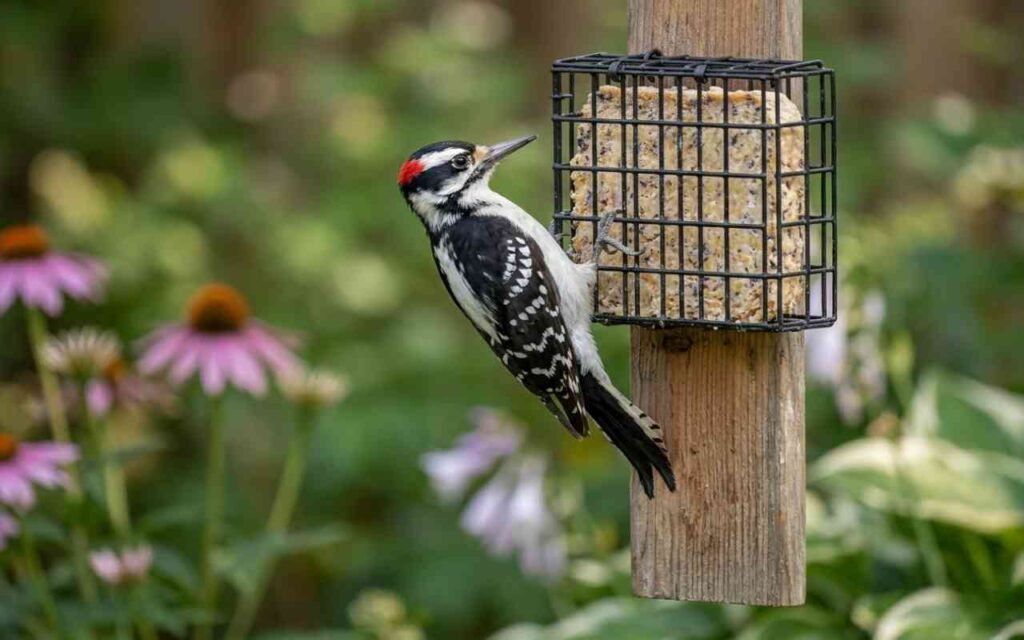
Woodpeckers are strategic foragers, not accidental visitors. To understand what woodpeckers eat in suburban yards, one must look at how these birds follow precise energy calculations shaped by intense caloric demands. Whether a Pileated Woodpecker works a dead snag or a Northern Flicker probes your turf, their behavior reflects a nutritional logic designed to support them throughout the year.
Suburban landscapes offer a unique “cafeteria” of concentrated calories, from carpenter ant galleries in weathered posts to high-fat suet cakes. Woodpeckers have adapted their forest instincts to exploit these human-modified habitats. This guide breaks down exactly what they eat, why specific macronutrients matter seasonally, and how to engineer a safe feeding station that meets their unique physical needs.
Quick Answer: What do woodpeckers eat in suburban yards?
In suburban yards, woodpeckers are protein-driven foragers targeting carpenter ants, lawn grubs, and beetle larvae. To support their caloric demands safely, homeowners should provide rendered suet stable below 70°F, shelled peanuts, and specialized “tail-prop” feeders. By integrating “Safe Snag” architecture using standing deadwood placed 30 feet from structures, you can successfully divert foraging away from home siding while maintaining a healthy backyard sanctuary.
Visualizing the Foraging Mechanics: A Video Breakdown
To help you visualize how different species from the ground-probing Northern Flicker to the vertical-clinging Pileated navigate your backyard, we’ve included a detailed video analysis below. This breakdown illustrates the specific caloric trade-offs and structural requirements of a high-performance suburban feeding station.
Show Transcript:
0:00
Have you ever watched a woodpecker hammering on a tree and wondered what’s going on inside that tiny head? It’s not random pecking—it’s an incredible story of energy, physics, and survival. Every action a woodpecker takes is about efficiency and getting more calories than it burns.
0:17
Why do woodpeckers drill? It’s not to sharpen beaks or annoy humans. The true reason is energy optimization. Clinging to a tree, drilling into bark, and hunting insects all require huge amounts of energy. Woodpeckers operate on a precise energy budget to survive and thrive in their habitat.
0:59
Woodpeckers face physical demands unlike any other backyard bird. Unlike perching birds like sparrows that expend minimal energy, woodpeckers must cling vertically and drill for high-calorie meals. Their zygodactyl feet—two toes forward, two back—provide a powerful grip, while stiff tail feathers act like a tripod for balance and energy efficiency.
1:53
The payoff? Woodpeckers are nature’s pest control. Holes they make reveal pre-existing infestations like carpenter ants or wood-boring beetles. Their drumming isn’t destructive—it’s a diagnostic tool, uncovering larvae hidden inside wood. These birds keep trees, decks, and even your yard healthy.
2:33
Woodpecker hunting is methodical. They tap and listen for hollow insect galleries, then drill only where prey is located. Northern flickers, for example, get over 99% of their diet from ants, using a specialized 4 cm tongue to extract them from underground. Their drilling is highly targeted, not random noise.
3:18
Feeding woodpeckers effectively requires understanding their energy needs. Regular bird seed doesn’t cut it. High-fat, high-protein foods like suet or shelled peanuts mimic the insects and grubs they naturally hunt. Above 70°F (21°C), no-melt suet dough prevents smearing and keeps woodpeckers safe.
3:53
Upside-down feeders are perfect for woodpeckers. Their acrobatic abilities allow them to cling and feed upside down, while larger competitors like starlings struggle. Red-bellied woodpeckers also enjoy half an orange, adding variety and nutrients to their diet.
4:21
Woodpecker drumming communicates territory and status. Deep, messy holes indicate foraging, while shallow, fast drumming on resonant surfaces like gutters is a signal to other birds: this is my territory. Understanding the difference helps backyard bird enthusiasts interpret woodpecker behavior.
5:03
You can also create woodpecker-friendly habitats. Leave dead trees or snags that are safe to stand for at least 36 months. Once a woodpecker leaves its nest, these cavities provide homes for species like mountain bluebirds, tree swallows, small owls, and even bats.
5:54
Woodpeckers are a keystone species. By supporting them, you support your entire local ecosystem. They are athletes, hunters, and ecosystem engineers all in one. Every time they visit your yard, they contribute to pest control, habitat creation, and biodiversity.
6:16
Next time you see a woodpecker, recognize it as more than a bird. It’s a high-energy creature managing calories, controlling pests, and building homes for wildlife. Your yard becomes a living habitat, and your role is to nurture it. What will you build with it?
The Suburban “Cafeteria”: Why Woodpeckers Choose Modified Landscapes
Caloric Necessity and the Physics of Vertical Foraging
Woodpecker foraging is energetically expensive in ways that distinguish these birds from typical perching species. Maintaining a vertical position on a tree trunk or feeder requires constant muscular engagement from the zygodactyl feet (two toes forward, two back) and the stiffened tail feathers used as a structural prop.
The excavation work itself, driving a bill repeatedly into wood at high force, burns substantial calories relative to food recovered. For a woodpecker, every foraging strategy is an energy trade-off: the caloric value of the prey must justify the mechanical effort required to extract it.
This is why high-fat, high-protein prey like wood-boring beetle larvae and carpenter ants dominate the diet, and why suet, which replicates that fat-and-protein profile, outperforms seed mixes at feeders for virtually every woodpecker species.
Seeds deliver carbohydrates efficiently to ground-feeding and perching species, but woodpeckers are built for fat and protein extraction. A suet cake replicates the energy density of insect larvae woodpeckers excavate from wood, which is why it functions as an effective substitute in human-modified landscapes where natural foraging sites may be limited.
The Transition from Forest to Suburb
Suburban environments succeed as woodpecker habitat when they replicate key structural features of mature forest: aging trees with bark furrows harboring insects, dead or declining wood providing excavation opportunities, and fruit-bearing plants offering seasonal sugar sources.
The transition from forest foraging to human-modified landscapes is seamless for generalist species like Downy and Red-bellied Woodpeckers, which have broad dietary flexibility. It is more constrained for habitat specialists like the Pileated Woodpecker.
Northwest Natural Resource Group guidelines for managing Pileated Woodpecker habitat document that this species selects nest trees larger than 21 inches in diameter, requiring a cavity 8 inches wide and 22 inches deep placed between 20 and 85 feet aboveground, and that each pair excavates an entirely new nest cavity almost every year. These are structural requirements that most suburban properties simply cannot meet.
What suburban yards lack in old-growth structural complexity, they can partially compensate for through intentional habitat design: retained deadwood, native berry plantings, and properly designed feeding stations.
Primary Protein: The Suburban Pest Control Service
Carpenter Ants and Termites: Reading Excavation Hunting Signs
The most calorically significant prey woodpeckers hunt in suburban environments is carpenter ants. Unlike termites, which consume wood cellulose, carpenter ants excavate galleries in soft or decaying wood to create nesting sites, making them detectable through the acoustic tapping techniques woodpeckers use to locate wood-boring beetles.
When a woodpecker works a section of fence post, deck timber, or tree trunk with deep, irregular excavation holes, it has detected a carpenter ant colony and is drilling directly to the gallery.
This excavation hunting behavior is distinct from the shallow, exploratory probing of healthy wood. Deep, irregular holes with rough edges and large wood chips at the base indicate active insect infestation hunting.
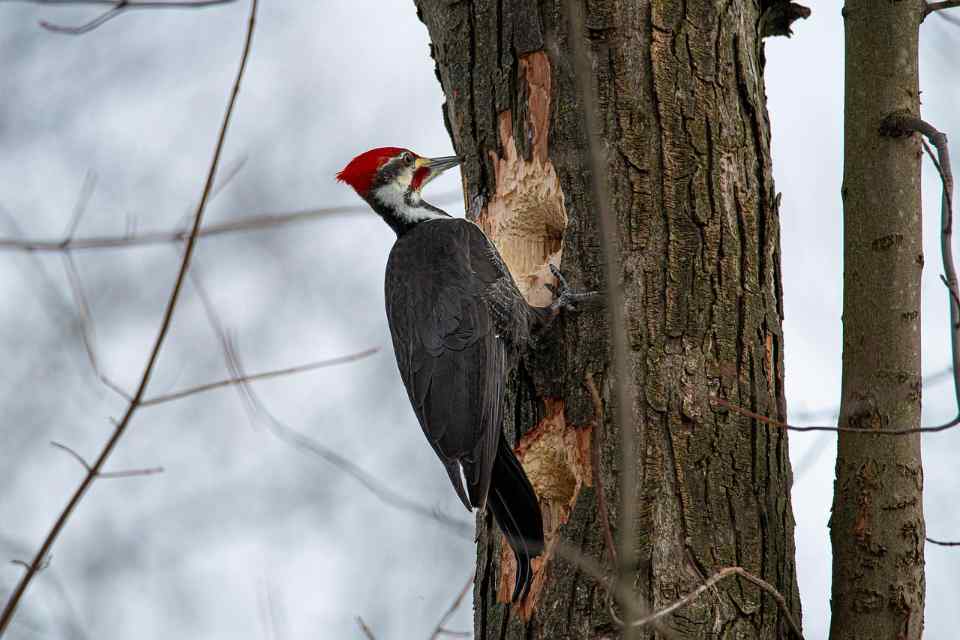
If this pattern appears on structural wood such as siding, eaves, or deck posts, the woodpecker is serving as a diagnostic indicator: the wood likely has an established carpenter ant or wood-boring beetle population. The bird is not causing the damage; it is revealing a pre-existing infestation.
Lawn Probing: The Northern Flicker’s Suburban Specialization
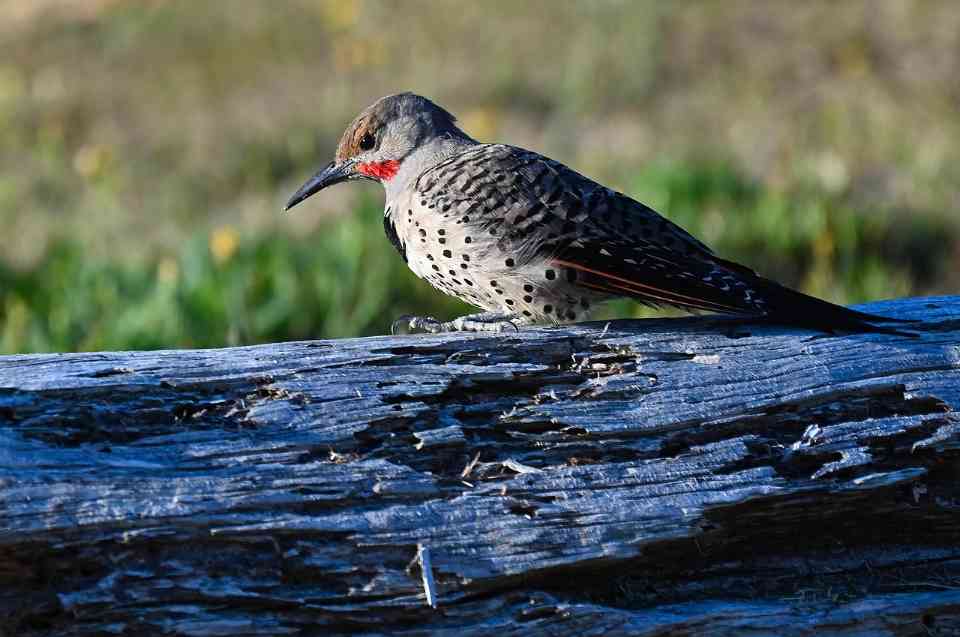
The Northern Flicker is the most grassland-adapted woodpecker in North America and the species most likely to be seen foraging directly on suburban lawns. Research published in the Journal of Field Ornithology analyzed fecal samples from 73 breeding flickers in British Columbia and found that ants made up over 99% of identified prey items, confirming that this species is one of the most highly specialized ant predators among all North American woodpeckers.
In suburban lawns, this translates to visible probing behavior: the bird walking across turf and drilling short, angled holes to access ant colonies in the soil horizon, using a tongue that can extend more than 4 centimeters beyond the bill tip to extract larvae from underground chambers.
A related field study published in Ecoscience used radio telemetry to track foraging flickers and found that these birds shift between open and shaded foraging habitats based on ant surface activity linked to ambient temperature, demonstrating the precision of the prey-tracking behavior flickers bring to suburban environments.
Flickers also target beetle grubs, including Japanese beetle larvae, making them useful pest management allies in yards where these species are problematic. For more on this species’ unique adaptations, the guide to Northern Flicker natural history covers the full behavioral profile.
Ornamental Trees as Larvae Reservoirs
Suburban fruit trees, shade trees, and large ornamental shrubs function as insect incubators that concentrate the larval prey woodpeckers depend on. Apple, cherry, and pear trees commonly host borers including the Roundheaded Apple Tree Borer, while oak, maple, and ash trees support dozens of wood-boring beetle species.
The bark furrows of older ornamental trees also harbor scale insects, wood-boring weevils, and overwintering moth pupae, all accessible to woodpeckers that probe bark surfaces rather than excavating deeply.
Older, slightly rough-barked trees are consistently more valuable to woodpeckers than smooth-barked young specimens because bark complexity creates more insect microhabitat, even when those older trees look less aesthetically pristine.
High-Energy Fats: Engineering the Perfect Suet Station
Pure Rendered Suet vs. No-Melt Dough: The Temperature Safety Rule
Suet is the single most effective supplemental food for attracting and retaining woodpeckers at a feeding station. Raw beef kidney fat rendered into pure suet cakes provides the highest caloric density available in commercial bird foods, closely approximating the fat content of the insect larvae woodpeckers excavate in natural foraging.
However, raw suet softens above roughly 70 degrees Fahrenheit (21 degrees Celsius) and can smear onto feathers, impairing the waterproofing birds maintain through preening. No-melt suet dough, rendered suet mixed with cornmeal and other binding agents that raise the melting point, solves this problem and is the recommended format for year-round use across most of North America.
Birds and Blooms, citing Cornell Lab Project FeederWatch data, notes that suet is the primary driver of consistent woodpecker visits at supplemental feeders, with Downy Woodpeckers typically the first species to adopt a new station.
For a complete guide to formulating suet products at home, including rendered fat ratios and binding agent options, this resource on how to make suet cakes for birds covers the full preparation process.
Nutrient-Dense Nuts: Why Shelled Peanuts Outperform Standard Seed
Shelled peanuts (peanut hearts) and shelled walnuts provide a high-fat, high-protein food source that woodpeckers can consume without the shell-cracking effort required for whole nuts. The caloric density of peanuts significantly exceeds that of sunflower seeds, which already outperform millet and other standard bird seed mixes for woodpeckers.
Shelled peanuts offered in a mesh tube feeder or tray feeder are readily taken by Downy, Hairy, and Red-bellied Woodpeckers and represent a cost-effective supplement to suet during seasons when insect availability is reduced.
Red-bellied Woodpeckers are particularly drawn to high-calorie nut offerings and have been documented caching shelled peanuts and nut pieces in bark crevices for later retrieval, a food-storing behavior that distinguishes them from the more immediate-consumption foraging patterns of smaller woodpecker species.
The Peanut Butter Option for Winter Survival
Plain peanut butter (no added salt, no xylitol, no artificial sweeteners) applied to a pine cone or packed into the holes of a log feeder provides an extremely high-calorie food source that becomes particularly valuable during winter cold snaps when natural insect food is unavailable.
The protein and fat content of peanut butter closely approximates suet and is readily accepted by most woodpecker species that visit suburban feeders. The key safety requirement is avoiding any product containing xylitol, which is toxic to birds, or added salt.
Standard commercial peanut butter with only peanuts and oil as ingredients is safe. Applying it to textured surfaces rather than smooth ones ensures birds can access it without beak-fouling risk.
Seasonal Fruit and Sugars: The Fruit Specialist Strategy
Native Berry Plants as Natural Food Sources
Several suburban woodpecker species consume substantial quantities of fruit and berries as seasonal carbohydrate and sugar sources. Holly (Ilex species), Elderberry (Sambucus species), and Flowering Dogwood (Cornus florida) are among the most productive native berry plants for woodpeckers, providing fruit that persists into late fall and winter when insect availability drops.
These plants serve a dual function: the insects they host during the growing season provide protein foraging opportunities, while the berries themselves provide quick-energy carbohydrates during cold weather.
Serviceberry (Amelanchier species), native viburnums, and wild grape are also documented woodpecker food plants across the eastern United States. Native species consistently outperform hybrid ornamentals for wildlife value because their fruit retention timing has co-evolved with the periods of maximum wildlife food demand.
The Orange Strategy for Red-Bellied Woodpeckers
Red-bellied Woodpeckers are the most fruit-focused of the common suburban woodpecker species. Cornell Lab of Ornithology’s Red-bellied Woodpecker life history account documents a diet that includes substantial fruit and nut components alongside insects, with the species known to store food in bark crevices and post holes for retrieval during leaner periods.
Halved oranges or grapefruit impaled on a feeder spike or placed on a flat tray will consistently draw Red-bellied Woodpeckers where the species is present, particularly during fall and winter when berry supplies are reduced.
Grapes, water-soaked raisins, and dried cherries also attract Red-bellied Woodpeckers and occasionally Downy Woodpeckers, providing rapid-access sugar energy alongside the slower-release calories from fat and protein sources.
Spring Sap Sources: Ornamental Maples and Birch
In early spring, before insects become reliably available, several woodpecker species exploit tree sap as an energy bridge between winter fat reserves and the insect season. Yellow-bellied Sapsuckers drill orderly rows of small holes in ornamental maples, birches, and apple trees to harvest sugar-rich sap during late winter thaw cycles.
Other woodpecker species, including Downy and Hairy Woodpeckers, opportunistically visit Sapsucker wells to consume both the sap and the insects attracted to it.
Sapsucker wells appear as neat horizontal rows of small square holes, distinctly different from the irregular excavation holes of insect-hunting woodpeckers, and confirm that sap foraging is occurring on a given tree.
Foraging vs. Drumming Damage: Reading the Signs Correctly
One of the most practically useful distinctions for suburban homeowners is separating woodpecker behavior that indicates active insect infestation from behavior that is purely communicative. Misidentifying drumming as feeding leads to ineffective responses, while ignoring true excavation hunting signs can allow structural damage to compound.
The complete guide to preventing woodpecker damage to structures covers the full range of intervention strategies, but field identification of hole types is the essential first step.
Hunting Signs: Excavation That Follows Insects
Active insect hunting produces deep, irregular holes with rough edges, variable diameter, and wood chips at the base. These excavations follow the galleries of the prey species being targeted, so the hole pattern is irregular and depth is substantial, often 1-3 inches or more in soft wood.
Multiple holes clustered in the same area indicate a woodpecker has located a concentrated insect colony. When this pattern appears on structural wood such as siding, eaves, or deck posts, it almost always indicates a pre-existing infestation that attracted the bird, not random or territorial behavior.
Communication Signs: Drumming on Resonant Surfaces
Territorial drumming produces rapid, even percussion on the most resonant available surface, in suburban environments often metal gutters, chimney caps, metal siding, or satellite dishes. Drumming holes, when they exist, are shallow, round, and concentrated in a small area on a surface chosen for acoustic properties rather than insect content.
The behavior concentrates in early morning during breeding season rather than distributing through the day. Response strategies for drumming and feeding excavation differ entirely: drumming can be redirected by removing the resonant surface or providing an alternative substrate, while feeding excavation requires addressing the underlying infestation.
The Safe Snag Strategy: Drawing Birds Away from Structures
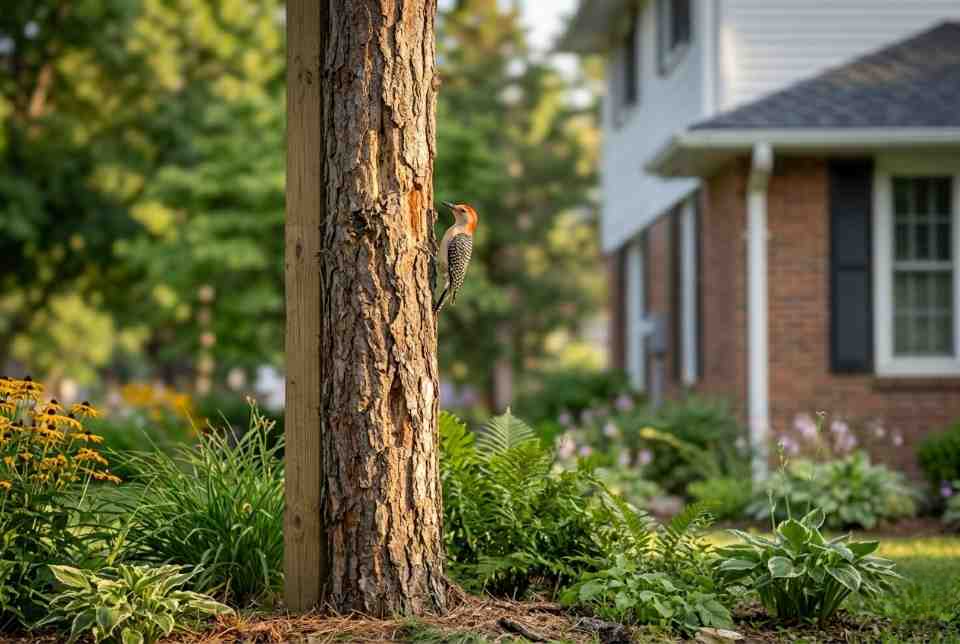
Positioning a designated dead or dying tree (snag) or a purchased log feeder mounted on a post at 15-20 feet from the house provides woodpeckers with an alternative foraging and drumming target that is structurally superior to house siding.
A safe snag allowed to naturally host insect colonies provides genuine foraging reward that house siding cannot replicate. Woodpeckers reliably prefer it over structures that yield no food return, because the behavior is rooted in finding calories, not in targeting a specific material.
Infrastructure: The Physics of a Successful Feeding Station
The Tail-Prop Requirement for Larger Species
The structural requirement that most commonly causes woodpecker feeder failure is inadequate tail support. Woodpeckers use their stiffened tail feathers as a third structural support point when clinging vertically, a posture that standard cage or tube feeders do not accommodate.
Hairy Woodpeckers and larger species will typically reject feeders lacking an extension below the suet cage where the tail can press for stability. Tail-prop feeders consist of a suet cage mounted on a backing board extending 6-8 inches below the cage, providing a flat surface for tail bracing.
A simple modification to any standard suet cage is attaching a piece of rough-cut wood below the cage opening. For comparing which feeder designs work best for specific woodpecker species, the guide to downy vs. hairy woodpecker identification and behavior provides useful species-level context.
The Upside-Down Suet Feeder: Excluding Starlings While Serving Woodpeckers
European Starlings are the most persistent competitor at suburban suet feeders and can deplete a suet cake within hours. The most effective exclusion strategy is an upside-down suet feeder, where the cage is mounted so that birds must cling below the suet and reach upward to feed.
Woodpeckers, with their strong zygodactyl grip and tail-prop stability, feed comfortably in this inverted position. Starlings, which are not adapted for clinging postures and lack the tail-prop behavior, cannot sustain the inverted position long enough to feed effectively.
This design exclusion is highly selective: it removes the primary competitor while preserving full access for the target species.
Water: Rough-Textured Basins for Safe Access
Woodpeckers drink regularly and benefit from reliable water sources, particularly during summer heat and winter freezes. Standard smooth-bottomed birdbaths present a footing problem: the zygodactyl foot structure and stiff tail, optimized for gripping bark, perform poorly on slick ceramic or glass surfaces.
Rough-textured stone basins, concrete birdbaths with natural surface texture, or baths fitted with river gravel at the drinking edge provide the grip surface woodpeckers need. Shallow water depth of 1-2 inches maximum and a gradual slope from edge to center are the other key requirements, since woodpeckers tip the bill in and raise the head to swallow rather than wading.
Suburban Conservation: Managing Your Yard as Keystone Habitat
The 36-Month Deadwood Rule
The single highest-value habitat modification available to suburban property owners supporting woodpeckers is retaining dead and declining wood. Northwest Natural Resource Group forest stewardship guidelines for Pileated Woodpecker habitat document that consistent recruitment of dead, dying, and decadent trees is necessary to support woodpecker populations, and recommend retaining snags in clumped arrangements close to each other to maximize their habitat value.
Abandoned woodpecker cavities continue providing value long after the excavating bird has moved on. More than 20 species of secondary cavity dwellers have been documented using old Pileated Woodpecker cavities, including tree-dwelling ducks, owls, and small mammals.
A safe snag positioned away from structures provides multi-year foraging habitat as wood-boring insects colonize the decaying wood, a drumming and territory announcement site, and potential nesting or roosting cavity sites for smaller woodpecker species.
Woodpeckers as Ecosystem Engineers: The Cascading Yard Benefit
The value of supporting woodpeckers in suburban yards extends well beyond the birds themselves. Research published in PLOS ONE examined woodpeckers as ecosystem engineers across two distinct habitat types and found that secondary cavity nesters including mountain bluebirds and tree swallows showed higher probabilities of nesting success in abandoned woodpecker cavities than in naturally occurring decay cavities.
The study found that Northern Flickers, Hairy Woodpeckers, and Red-naped Sapsuckers together supplied the majority of nest cavities used by secondary nesters in the study areas, with flickers providing the highest volume of available cavities.
This research demonstrates that supporting a resident woodpecker pair in a suburban yard creates a cascading benefit for owls, swallows, bluebirds, and bats that occupy the woodpecker’s abandoned excavations in subsequent seasons.
The Clean Feeder Protocol: Disease Prevention in Dense Populations
Suburban feeding stations concentrate bird populations at densities far exceeding natural encounter rates, creating elevated disease transmission risk. Salmonellosis, which spreads through fecal contamination of food and feeder surfaces, and Aspergillosis, a fungal respiratory disease that develops in wet or moldy product, are the two most common disease risks at poorly maintained feeders.
The recommended cleaning protocol for suet feeders is removal and scrubbing with a 9:1 water-to-bleach solution every two weeks, with more frequent cleaning during periods of high feeder use or hot weather. Suet cages should be emptied and replaced rather than topped up over old product, since degraded suet at the bottom creates a contamination substrate even when fresh suet is added on top.
For the full range of strategies to attract and support woodpecker species in suburban settings, this comprehensive resource on how to attract woodpeckers to your yard covers habitat, feeder placement, and supplemental food selection across all common North American species.
At-a-Glance: The Suburban Woodpecker Feeding Checklist
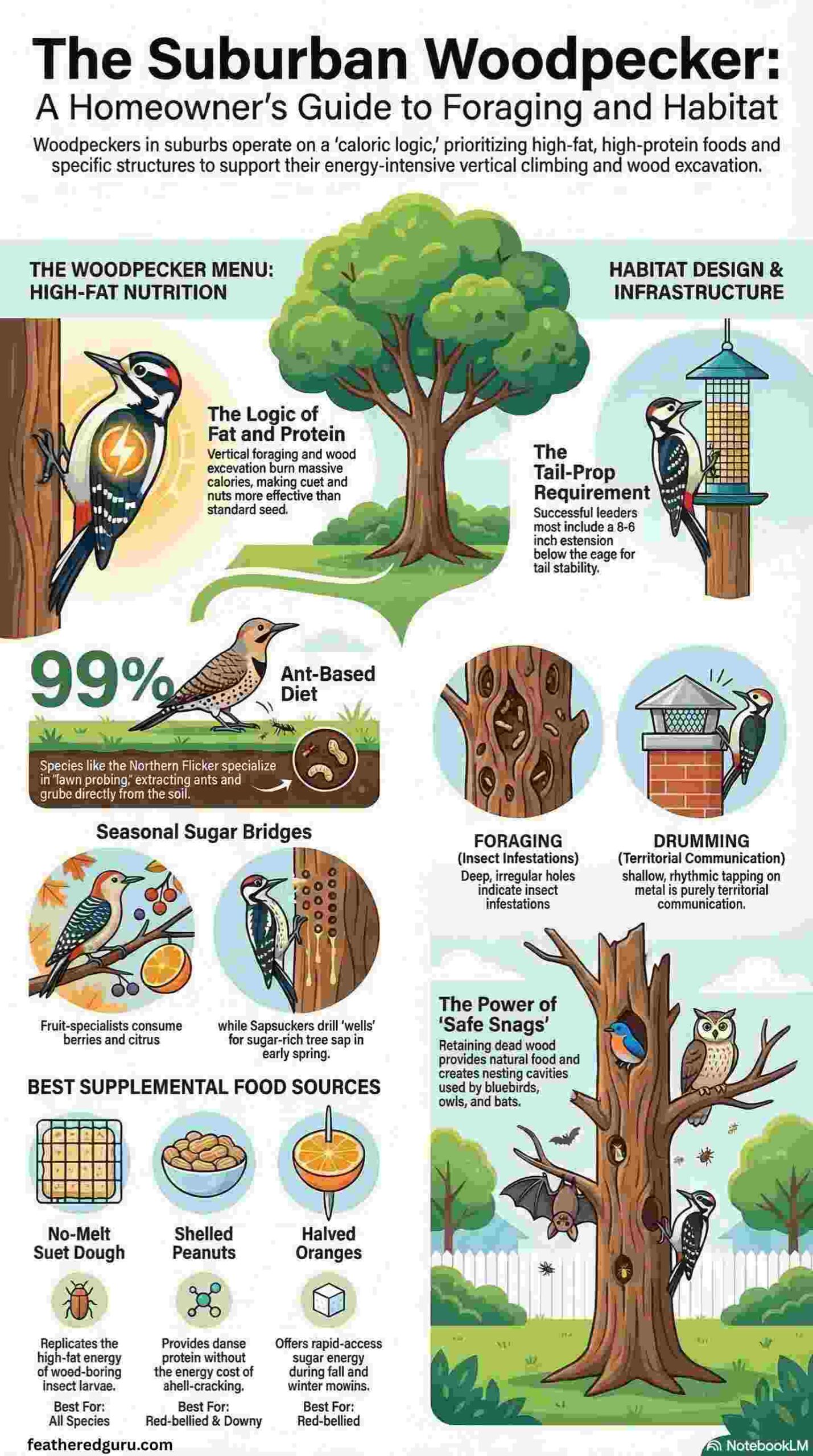
To summarize the caloric requirements and infrastructure needs of your backyard visitors, we’ve created a high-level feeding checklist. This visual guide provides a quick-reference look at the specific insect proteins, high-energy fats, and feeder designs required to sustain a healthy suburban woodpecker population throughout the year.
Conclusion: Building a Yard Woodpeckers Will Use Year After Year
Woodpeckers visit suburban yards for one reason above all others: calories. When they probe turf for ants, excavate larvae from bark, or cling to a suet feeder, they are responding to the same energy demands that shape their behavior in natural forests. Yards that attract woodpeckers consistently recreate the foods those birds evolved to find, including insect colonies in aging wood, high fat foods that resemble insect larvae, and seasonal fruit or sap that provides quick energy when insects are scarce.
The most reliable suburban habitat combines three elements working together. Insect producing trees or retained deadwood provide natural foraging sites. A feeding station designed for vertical clinging birds supplies concentrated fat and protein through suet and nuts. A dependable water source allows birds to drink and cool off during hot weather. When these features exist together, woodpeckers begin to treat a yard as part of their regular feeding territory instead of an occasional stop.
Supporting woodpeckers benefits far more than the birds themselves. The cavities they excavate later become nesting sites for bluebirds, swallows, chickadees, and other cavity nesting wildlife. In that way, attracting woodpeckers does more than bring striking birds into view. It helps transform a typical suburban yard into functioning habitat for an entire community of species.