
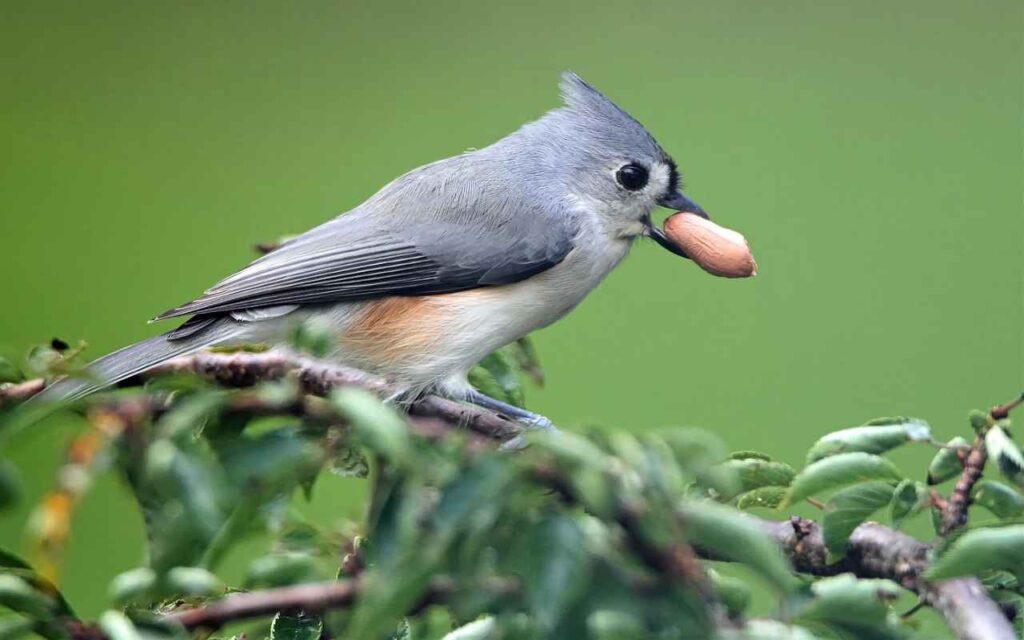
The Tufted Titmouse is a master of suburban survival. But what do tufted titmice eat in feeders and gardens? Understanding their diet requires looking past their quick visits to your feeder. While they appear to be casual companions, these birds are actually executing a sophisticated caching protocol designed to sustain a non-migratory winter.
Every seed selected and every 130-foot caching radius established is part of a calculated energy budget. From their largest-seed rule at the feeder to their shift toward 66% insect protein in summer gardens, their foraging is a precise biological strategy. This guide breaks down the nutritional logic required to transform a passive feeding station into a year-round Titmouse sanctuary.
Quick Answer: What do tufted titmice eat in feeders and gardens?
In suburban gardens, tufted titmice eat primarily insects and caterpillars during summer before shifting to seeds, nuts, and berries in winter. At feeders, they prioritize the largest seeds available, specifically preferring black oil sunflower and shelled peanuts. They rarely consume food at the feeder itself, instead caching seeds within a 130-foot radius and requiring stable perch surfaces to accommodate their active foraging behavior.
Visualizing the Titmouse Pantry: A Foraging Biomechanics Breakdown
To help you visualize how these acrobatic foragers manage their high-speed caching runs and unique seed-shattering techniques, we’ve included a detailed video analysis below. This breakdown illustrates the specific energy calculations and structural requirements of a high-performance Titmouse feeding station in a suburban garden.
Show Transcript:
0:00
You know that little gray bird with the pointy crest at your feeder? That’s the tufted titmouse. It seems like a simple, constant visitor to your backyard, but every quick dash it makes is more than just a snack grab—it’s a carefully executed survival strategy.
0:16
Titmice aren’t shy. Those rapid seed grabs are part of a bigger plan. Each lightning-fast trip to your feeder is a deliberate move in a methodical routine. They’re prepping for winter, storing seeds for months when food becomes scarce.
0:59
The behavior is called cashing. Titmice take seeds from feeders not to eat immediately, but to hide them in secret spots around your yard. These hidden caches ensure they have a reliable winter food supply, protecting them from starvation in harsh conditions.
1:25
Research shows these stashes are usually within 130 feet of the feeder. They tuck seeds into cracks in tree bark, fence posts, or under loose bark. Mature trees with rough bark and a few dead branches are incredibly valuable for this behavior.
1:58
Winter is a calorie war for non-migratory birds like titmice. Each hidden seed is a tiny victory. Unlike migratory birds that fly south, titmice stay put, increasing their metabolism by over 16% in the cold just to maintain body temperature.
2:52
While we see them eating seeds at our feeders, two-thirds of a titmouse’s diet is actually insects—caterpillars, spiders, wasps—especially in summer. Seed feeding is a winter adaptation, with feeders acting as crucial survival stations.
3:44
The best yard feature for supporting titmice? An oak tree. It provides caterpillars in summer and perfect cashing spots in winter, creating an ideal habitat year-round.
4:06
To maximize each trip to your feeder, provide high-calorie seeds like peanuts or sunflower seeds. Titmice prefer energy-dense food, making every foraging trip efficient. They even use a “hammering” technique on large seeds, tapping them on branches until they crack.
5:03
Safety is critical. Those back-and-forth trips put titmice at risk of window strikes. Over a billion birds die annually in the U.S. from collisions. Make glass visible with patterns or UV reflective tape.
5:42
Feeder placement matters. Position feeders within 3 feet of a window or farther than 30 feet. The in-between range is dangerous because birds can build lethal flight speed toward glass.
5:55
A complete tipmouse-friendly habitat includes hygiene and water. Clean feeders every two weeks to prevent disease. Offer a shallow birdbath with a rough surface and consider adding a dripper—the sound of moving water attracts birds.
6:12
Next time you see a titmouse darting from your feeder, appreciate its skill. It’s not just a small, skittish bird—it’s a master strategist, storing food, navigating your yard, and surviving winter through brilliant preparation.
6:29
Think about it: how many other secret survival dramas are playing out in your backyard every day? Every small bird has a story, and your feeders are the stage for winter survival strategies in action.
The Suburban Omnivore, Understanding the Titmouse “Pantry”
Why Tufted Titmice Are the “First Responders” to Your Garden Feeders
Titmice are resident year-round on established territories. Unlike migrants that arrive seasonally, an individual bird that discovers your feeder in October will likely visit it every month for the rest of its adult life.
This territory fidelity, combined with the species’ well-documented curiosity, makes titmice among the first birds to investigate a new feeder installation in any yard with established tree cover. They are often present within 24 to 48 hours of a feeder going up.
Audubon Society’s Tufted Titmouse field guide documents their characteristic visit pattern: scout the feeder from cover, fly in, grab one seed, retreat immediately to shelter. It looks shy but it is actually a caching run, not a feeding visit.
This means a titmouse that appears to visit your feeder briefly three times may actually be making 15 to 20 caching runs per hour during peak autumn food-loading behavior. The bird is far more active than it appears.
The Caloric Cost of a Non-Migratory Winter
Migrants solve winter food scarcity by leaving. Titmice stay, which means they must cache aggressively in autumn and adapt physiologically to maintain body temperature through hard freezes.
Research published in Physiological and Biochemical Zoology on seasonal metabolic acclimatization in titmice and chickadees found that winter summit metabolism exceeded summer summit metabolism by 16.2% in titmice. That is a documented physiological shift requiring real additional fuel every single day to sustain.
The study also found that winter birds tolerated colder test temperatures than summer birds, confirming that cold acclimatization is a genuine survival mechanism in this family, not simply a behavioral response to reduced food availability.
The practical implication is that the window between mid-September and the first hard frost is when a well-stocked feeder matters most. Every seed a titmouse caches during this period is a calorie it can withdraw later without braving cold temperatures or predator exposure during a food search.
The Garden Menu, Seasonal Shifts and Natural Foraging
Summer Protein (Two-Thirds of Annual Diet): Hunting Caterpillars, Wasps, and Spiders
Most feeder operators think of titmice as seed birds. In terms of annual diet, they are not. Birds and Blooms, citing Cornell Lab of Ornithology Project FeederWatch data, confirms that roughly two-thirds of the annual titmouse diet consists of animal matter: caterpillars, wasps, bees, beetles, spiders, and insect eggs.
Caterpillars are the single most important prey category in summer. Additional prey documented across research literature includes sawfly larvae, true bugs, scale insects, pupae, snails, and overwintering insect eggs found in bark crevices.
During breeding season, titmice forage almost entirely in the outer canopy branches of deciduous trees, where caterpillar and insect density is highest. The feeder goes largely ignored from May through August while nestling feeding demands peak.
This matters enormously for yard management decisions. A yard with established oaks, maples, cherries, and serviceberries provides the summer protein base that no feeder can replicate. Insecticide applications on garden trees during this period directly reduce the food supply titmice are hunting at the moment protein demand is highest.
Winter Fats (Shift to Seeds and Nuts): The Critical Transition to Acorns, Beechnuts, and Berries
As insects disappear in autumn, the Tufted Titmouse shifts to a diet dominated by seeds, nuts, and persistent berries. This is not simply a response to insect scarcity. It is a physiologically timed transition accompanied by aggressive food caching that begins weeks before insects actually become scarce.
Acorns and beechnuts are the primary high-fat wild foods driving this transition, supplemented by seeds from native trees and shrubs, dried berry fruits that persist through winter, and the supplemental foods available at feeders.
Oak trees are the single most valuable winter food plant for titmice in eastern North American yards, both for the acorns they produce and for the insect overwintering habitat their bark provides. A mature oak in a suburban yard functions simultaneously as a summer insect hunting ground and a winter food and caching resource.
Native berry plants including Winterberry Holly (Ilex verticillata), American Beautyberry (Callicarpa americana), and native viburnums extend the fruit food supply into January when other sources run out. For native plant selections that support winter songbirds most effectively, the resource on attracting nesting birds with native habitat plants covers species across the eastern United States.
The “Lawn Probing” Myth: Distinguishing Titmice from Ground-Feeding Flickers
A common backyard misidentification involves titmice seen foraging on the ground, assumed to be doing the same thing as Northern Flickers. They are not.
Research literature documents that wintering titmice spend roughly a quarter of foraging time on the ground, around 17% in shrubs, and the majority in trees. But ground foraging for titmice means gleaning fallen seeds, probing leaf litter for invertebrates, and retrieving cached food items.
A Flicker on the ground is actively excavating ant colonies using a tongue that extends 4 centimeters past the bill tip, probing deep into soil for larvae. The visual distinction is reliable and consistent: titmice hop and glean, Flickers probe and drill. For more on Flicker foraging ecology, see the guide to Northern Flicker natural history.
The Feeder “Gold Standard”, High-Energy Seeds and Nuts
The “Largest Seed” Rule: Why They Always Bypass Millet for Black Oil Sunflower
Cornell Lab of Ornithology’s Tufted Titmouse Life History account confirms that titmice consistently select the largest available seed at any feeder. This is a documented energy maximization strategy: choose the food item that delivers the most calories per handling event.
At a mixed-seed feeder, titmice bypass millet, milo, and canary seed entirely. They go straight for black oil sunflower or striped sunflower, which deliver significantly more fat and protein per seed than any of the smaller options in the mix.
When both sunflower types are available, titmice typically select striped sunflower (larger seed, thicker shell) over black oil sunflower (smaller seed, thinner shell). The larger seed wins even when the shell requires more work to open.
The most efficient feeder setup is a dedicated tube or hopper stocked with black oil sunflower seed or shelled sunflower hearts. Mixed seed mixes generate significant waste as titmice discard smaller seeds they have no interest in, and that waste attracts ground-feeding species that compete for feeder space.
Peanut Power: The Preference for Shelled Peanuts and Peanut Crunch Suet Dough
Shelled peanuts represent the highest caloric density food available at a titmouse feeder. The fat and protein content of shelled peanuts exceeds that of sunflower seeds, which is why titmice will often bypass a sunflower feeder in favor of a peanut feeder when both are available simultaneously.
Shelled peanuts also reduce processing work for the bird. Titmice shell seeds before caching them, so offering pre-shelled peanuts eliminates a handling step and speeds up each caching run, allowing the bird to move more calories per hour of foraging.
Suet dough formulated with peanut butter or whole peanut pieces (marketed as peanut crunch suet dough) combines the caloric density of peanuts with a no-melt binder that keeps the product solid above 70 degrees Fahrenheit. This makes it safe at feeding stations year-round rather than just in cool weather.
Plain peanut butter with no added salt and no xylitol, applied to the bark of a pine cone or packed into a log feeder, provides the same nutrient profile at minimal cost. For a complete guide to formulating suet products at home, the resource on making suet cakes for birds covers rendered fat ratios and binding agent options in full.
The “Hammering” Technique: How They Use Their Feet and Stout Bills to Chisel Open Shells
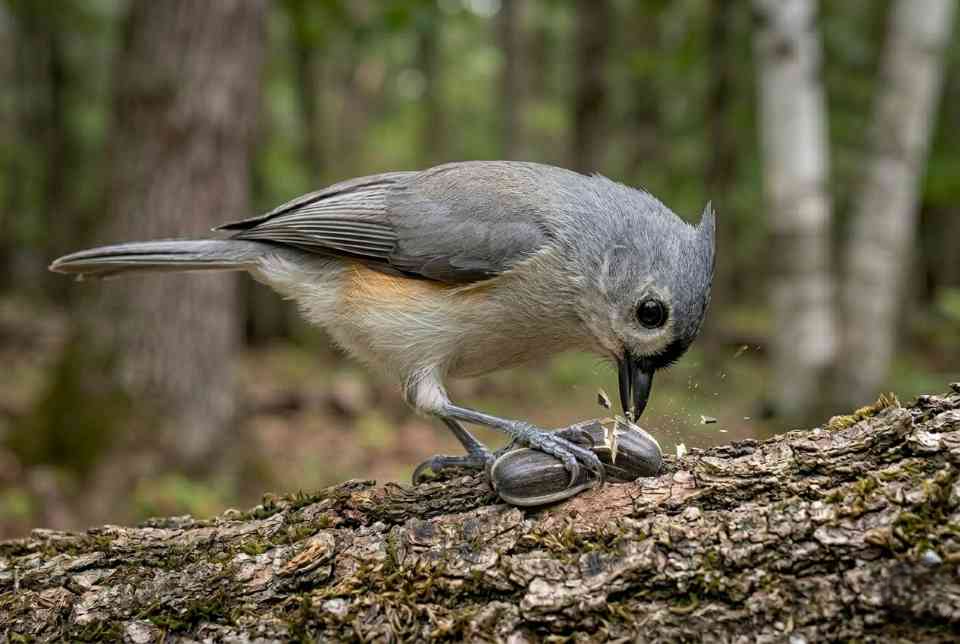
When a titmouse grabs a large seed from the feeder, it carries it to a nearby branch, positions it against the bark or into a branch fork, braces it with one or both feet, and hammers downward with the bill in repeated sharp strikes. The tapping is audible from several feet away.
Unlike larger woodpeckers that can use raw power, the Tufted Titmouse relies on physics. By pinning a seed against a rough surface with its feet, as seen in the image above, it creates a stable platform for a series of rapid, vertical “chiseling” strikes. This mechanical leverage allows a bird weighing only 20 grams to access the high-energy fats locked inside durable sunflower and peanut shells.
Pennington Wild Bird documentation on Tufted Titmice confirms this foot-and-bill technique and notes that titmice remove shells before caching seeds, storing the processed kernel rather than the whole seed. This conserves both energy and cache space.
This technique allows titmice to exploit seeds that are far too large for smaller finches to crack open. It is one reason they dominate at peanut and large sunflower feeders over House Finches and most sparrow species, which cannot manage seeds of the same size.
Caching and the “130-Foot Radius”
The Hoarding Instinct: Why They Rarely Eat at the Feeder and Instead Wedge Food into Bark
The rapid grab-and-go behavior you see at the feeder is not shyness. Cornell Lab research confirms that titmice hoard food in fall and winter, taking only one seed per feeder trip, with cache sites usually within 130 feet of the feeder and seeds typically shelled before being hidden.
Vassar College biology research on Tufted Titmouse general biology documents that cache sites include bark crevices, bark furrows, broken branches, ground locations, and gaps in structural features like fence posts. The bird returns to retrieve these caches across days and weeks.
This distributed caching strategy provides a critical survival advantage that a feeder-only diet cannot replicate. A bird that has cached seeds across dozens of locations retains access to stored calories even during feeder outages, bad weather, or periods of high competitor activity at the feeding station.
The caching instinct fires regardless of feeder reliability. Titmice cache aggressively even from a feeder that has never once been empty, because the evolutionary programming does not assess supply consistency. It defaults to one rule: store everything you can.
Strategic Storage: Identifying Cache Sites in Your Yard
The 130-foot caching radius is one of the most specifically documented behavioral parameters for any common backyard bird. Cornell Lab’s species overview states that titmouse cache sites are consistently within this range, with the bird executing repeated single-seed trips across daylight hours during autumn and early winter.
Watch a titmouse’s departure path after each feeder visit and you will quickly identify the small set of locations it returns to repeatedly: a particular bark furrow, a gap between fence boards, a spot under loose bark on a dead branch. These are the active cache sites for that individual bird’s territory.
Rough-barked trees, dead wood with surface furrows, and split fence posts are the most valuable caching habitat a suburban yard can offer. A yard that combines a quality feeder with good nearby caching habitat holds resident titmice more reliably than a feeder-only setup, because the birds assess both food availability and cache site quality when evaluating a territory.
Safe Sanctuary, Protecting Your Foraging Titmice
Why the Caching Flight Path Creates a Window Collision Risk
A titmouse making 15 to 20 caching runs per hour is crossing the feeder-to-tree corridor at full flight speed every few minutes. If a window sits anywhere in that corridor, the collision risk accumulates with every single run.
Research published in The Wilson Journal of Ornithology estimates that between 1.28 billion and 3.46 billion birds die annually from glass collisions in the United States. That figure represents a 350% upward revision from the 2014 estimate, driven by data from 10 wildlife rehabilitation facilities showing 70% of birds admitted after window strikes ultimately die from their injuries.
Birds cannot perceive glass as a physical barrier. Both clear glass that mirrors sky and trees and genuinely reflective glass are invisible to birds as obstacles. A titmouse flying toward a tree reflected in a window sees the reflection as the real tree and does not slow down before impact.
Using UV Grid Patterns to Break Up Window Reflections

The established solution is patterned visual marking applied to the exterior glass surface at sufficient density. The American Bird Conservancy recommends a 2-inch by 4-inch spacing rule: gaps no larger than 2 inches vertically and 4 inches horizontally across the entire glass face.
UV-reflective films, adhesive dot-pattern tapes, and scored window films all achieve this if applied at the required density. The key word is exterior: the marking must be on the outside surface of the glass, not the inside.
Interior treatments including blinds, inside-surface decals, and window art are largely ineffective because they do not interrupt the exterior reflection a bird sees while approaching from flight distance.
The “3-Foot or 30-Foot” Feeder Placement Rule
Cornell Lab of Ornithology feeder management guidelines state the placement rule directly: feeders should be positioned either within 3 feet of a window or more than 30 feet away. Everything between those two distances is the danger zone.
Within 3 feet of glass, a departing bird cannot accelerate to a speed sufficient to cause fatal injury before reaching the window. Beyond 30 feet, the house reads as a background landscape feature rather than a flight corridor exit, and birds are less likely to orient directly toward windows at full speed.
Window-mounted suction-cup feeders solve both problems simultaneously and offer an additional benefit: the titmouse’s rapid grab-and-cache pattern becomes visible from inches away, making them among the most rewarding feeder positions available for observing caching behavior in real time.
Infrastructure and Hygiene
Tube, Hopper, and Upside-Down Feeder Designs
Tufted Titmice feed comfortably from tube feeders, hopper feeders, platform feeders, and suet cages. Their foot-bracing hammer technique requires a stable perch with enough room to position a seed against a surface for processing.
Narrow tube feeder ports that prevent perching do not suit titmice well. Wider-port tubes, hoppers with accessible ledges, and platform feeders all accommodate their technique better and generate less seed waste from birds struggling to hold position.
Titmice also manage upside-down suet feeders comfortably. This design simultaneously excludes European Starlings, which cannot sustain an inverted clinging posture long enough to feed effectively. For feeder design comparisons across resident yard species, the guide to downy vs. hairy woodpecker identification and feeder use covers relevant species-level context.
The Shallow Bath Mandate: Stones and Drippers for Safe Hydration
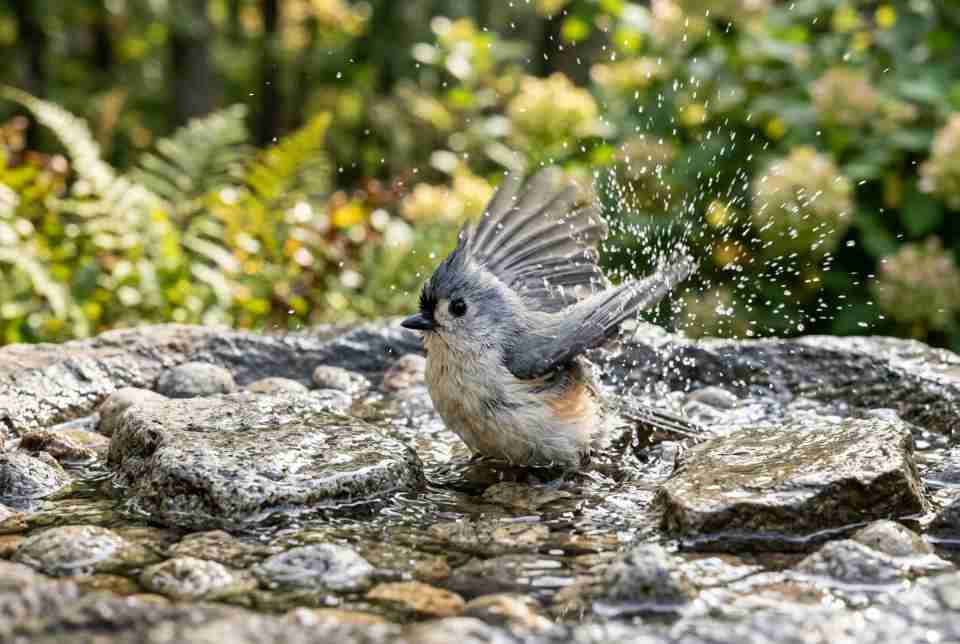
At 18 to 26 grams, Tufted Titmice are too small for standard deep birdbaths. As seen in the image above, providing a flat stone “island” allows these small-bodied birds to hydrate and bathe without losing their footing in deeper water. They need a maximum water depth of 1 inch, a rough or textured bottom that provides grip, and a gradual slope from the edge to the center so they can wade in incrementally.
Standard smooth-bottomed birdbaths are a footing hazard for birds this small. Rough-textured stone basins, concrete baths with natural surface texture, or any bath fitted with river gravel at the drinking edge provide the grip titmice need to drink and bathe safely.
A dripper or mister is the most effective single upgrade to any birdbath. The sound of moving water carries through tree cover and draws birds to a source they cannot see from flight altitude. Pebbles placed in any standard bath reduce depth and add grip at the same time, serving both purposes with minimal cost. For year-round water and habitat management across multiple resident species, the guide to creating year-round backyard bird habitat covers the full setup.
The 9:1 Cleanliness Protocol: Preventing Disease in Dense Feeder Populations
Suburban feeding stations concentrate bird populations at densities that far exceed natural encounter rates, creating disease transmission conditions a dispersed wild population never faces. For titmice, the two primary feeder-associated disease risks are Salmonellosis from fecal contamination of seed surfaces and Aspergillosis, a fungal respiratory disease that develops in wet or moldy product.
The recommended protocol is a 9:1 water-to-bleach solution applied to all feeder surfaces every two weeks, with more frequent cleaning during hot weather, high feeder traffic, or any period of wet conditions that accelerate seed spoilage.
Emptying feeders completely before refilling is essential. Wet or compacted seed at the base of a tube feeder creates an anaerobic environment that grows mold and bacteria even when fresh seed is added above it. Topping up rather than replacing is one of the most common and damaging feeder hygiene mistakes.
Consistent feeder hygiene is the single highest-impact management action available for maintaining a healthy resident titmouse population across multiple seasons. For the breeding season management decisions that affect the titmouse pairs nesting in your yard each spring, the guide to avoiding disturbance to nesting birds in spring covers what to watch for from April onward.
At-a-Glance: The Tufted Titmouse Suburban Feeding Checklist
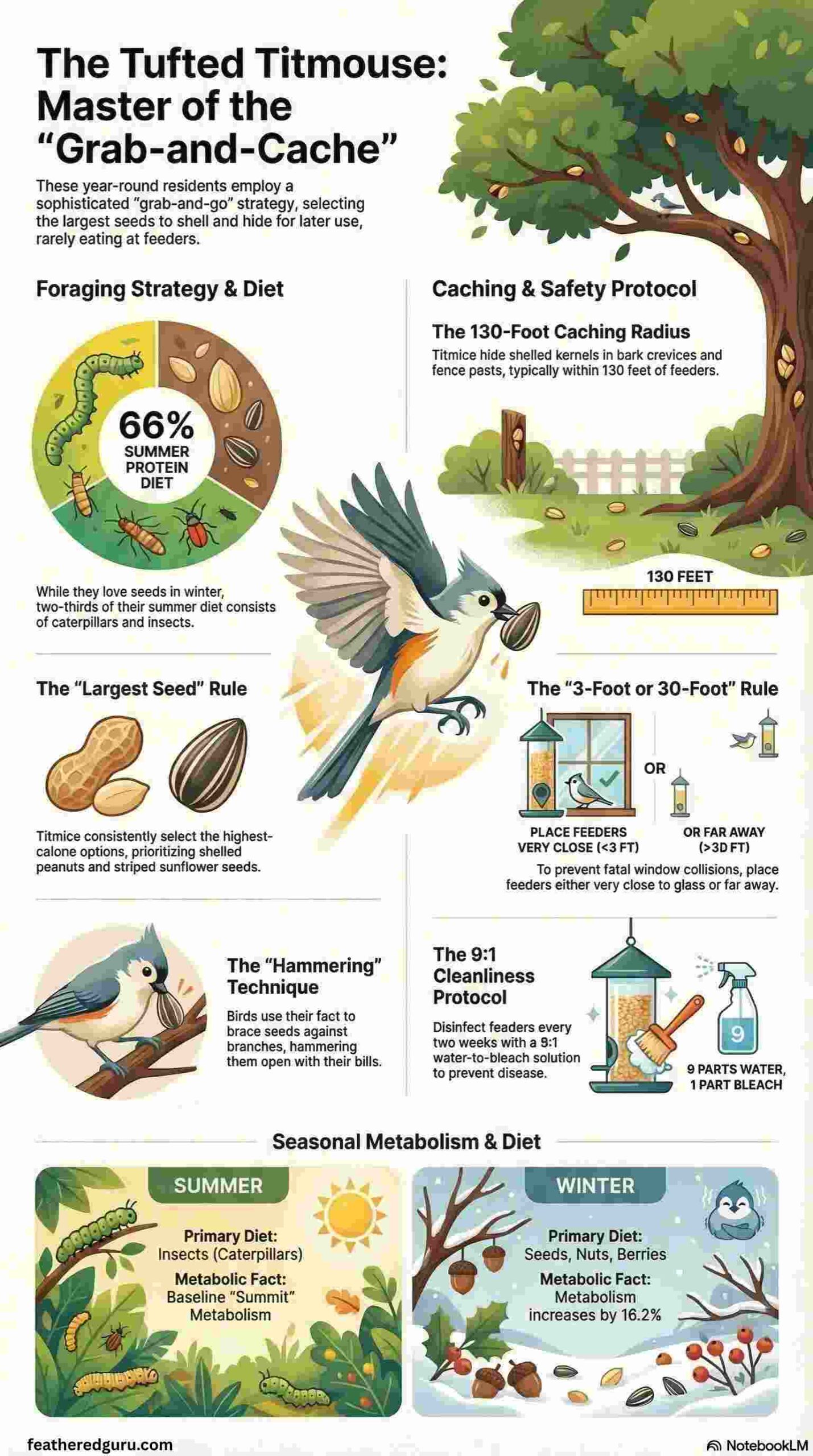
To help you optimize your garden for these acrobatic foragers, we have synthesized the seasonal dietary shifts and feeder requirements into a high-level visual checklist. This guide summarizes the critical protein-to-fat ratios and the 130-foot caching radius required to sustain a healthy Tufted Titmouse population throughout the year.
Conclusion
Caring for Tufted Titmice goes beyond filling a feeder. Supporting them means understanding their seasonal needs: summer protein from insects and caterpillars, winter energy from seeds, nuts, and berries, and providing safe caching spots within your yard.
Maintaining clean feeders, offering suitable water sources, and protecting flight paths around windows ensures they can thrive year-round.
Observing their clever caching and foraging behaviors brings both enjoyment and a deeper connection to your backyard wildlife. By creating this thoughtful habitat, you’re giving these acrobatic birds the best chance to flourish in your garden through every season.