
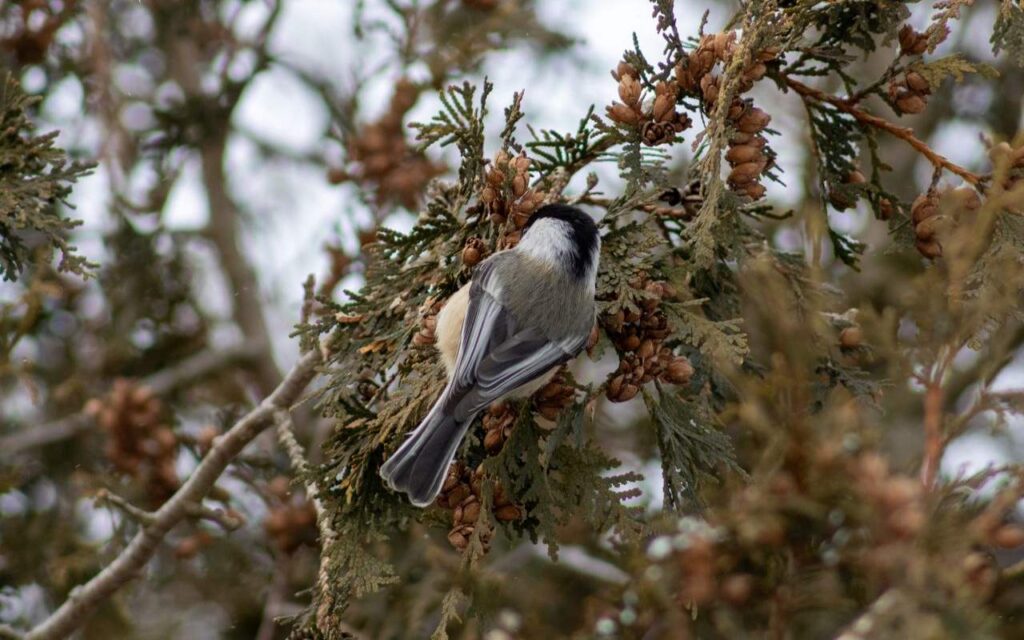
Establishing native conifers for birds to use as winter roosting sites transforms a bleak backyard into a critical thermal sanctuary when freezing temperatures threaten small songbird survival. During periods of extreme overnight cold, species like black-capped chickadees, golden-crowned kinglets, and dark-eyed juncos face rapid metabolic heat loss. Dense evergreen needles interrupt lethal wind chills and block radiative heat loss to the open night sky.
Backyard birders frequently discover that wooden roosting boxes remain empty while birds pack themselves deep into the interior boughs of local evergreens. Selecting the proper regional species ensures dense branch architecture, natural lipid-rich winter cones, and dependable shelter throughout severe winter storms.
Thermal Microclimates and Windbreak Geometry for Winter Roost Sites
Small passerines maintain a remarkably high daytime internal body temperature between 106 and 109 degrees Fahrenheit. To survive sub-freezing nights without completely exhausting their fat reserves, species like chickadees actively drop into a state of regulated nocturnal hypothermia, lowering their core body temperature by 15 to 20 degrees to slow their metabolic expenditure.
Conifer foliage modifies the surrounding microclimate by functioning as a physical windbreak and a radiant heat trap. Dense needles create an insulated boundary layer that slows air movement, allowing birds to roost in relatively motionless pockets of air and minimizing the massive caloric energy required to shiver.
To maximize thermal efficiency, planting layouts must counter prevailing local winter winds, which predominantly arrive from the northwest across much of North America. Staggering trees in an alternating two-row barrier disrupts wind currents far more effectively than a single straight line.
This design creates sheltered lee pockets on the south and east sides of the grove where birds can roost without expending critical energy fighting wind draft.
- Multi-row staggered shelterbelts reduce ground-level wind speeds by up to seventy percent in downwind resting zones.
- Dense inner bough clusters elevate localized pocket temperatures by two to five degrees Fahrenheit above surrounding open areas.
- Exterior canopy layers deflect driving sleet, keeping the structural heartwood and central trunk dry.
Backyard observers actively tracking bird movements note that kinglets and chickadees consistently abandon tree perches exposed to direct air currents. Instead, birds gravitate toward interior spaces located within the dense inner third of the conifer canopy. This core zone minimizes exposure to aerial predators above while avoiding ground-level thermal radiative cold sinks.
Eastern Redcedar and Dense Juniper Foliage as Predator Havens
Eastern redcedar (Juniperus virginiana) is widely recognized in wildlife rehabilitation and birding communities as a premier roosting native across the eastern and central regions. Its tightly woven, scale-like needles form an impenetrable barrier that keeps fierce winter winds away from roosting birds. In addition, the spiky foliage acts as a natural defensive barricade against fast-moving raptors such as sharp-shinned and Cooper’s hawks.
A core advantage of the redcedar is its dual function as an emergency winter larder and a thermal fortress. Female trees produce heavy crops of blue, fleshy, modified seed cones packed with high-energy carbohydrates and lipids. Species like cedar waxwings, eastern bluebirds, and yellow-rumped warblers spend the day foraging on these high-calorie yields before slipping straight into the interior boughs at dusk.
- Female seed cones provide a high-calorie survival food during prolonged snow cover when ground foraging fails.
- Tightly interlaced branchlets block heavy wet snow from accumulating on inner roosting perches.
- Broad regional adaptability allows healthy growth in poor, rocky, or alkaline soils where other conifers struggle.
Field observers frequently document community roosting behavior inside mature redcedars during severe blizzards. Small birds often gather along the main trunk, pressing their bodies close together to share metabolic body heat.
The dense outer foliage traps this convective heat, creating a shared microclimate that significantly boosts overnight survival.eat. The dense outer foliage traps this convective heat, creating a shared microclimate that significantly boosts overnight survival.
White Spruce and Douglas-Fir Interior Branch Architecture
For northern and western regions, white spruce (Picea glauca) and Douglas-fir (Pseudotsuga menziesii) provide the expansive structural geometry required by larger birds and mixed flocks. These species produce a classic conical silhouette with layered horizontal boughs that deflect heavy precipitation outward. Beneath these living shingles lies an open, sheltered zone close to the trunk that remains dry and insulated.
Unlike smaller ornamental evergreens that shed their lower needles prematurely, healthy native spruces retain lower branches for decades when grown in adequate sunlight. This downward-sweeping growth habit seals off the base of the tree from wind turbulence, protecting ground-foraging birds like juncos and towhees. As snow accumulates on the outer needle tips, it creates an additional insulating wall that further buffers the interior space.
- Horizontally oriented lateral branches provide stable, non-slip perching platforms for larger birds like mourning doves and northern flickers.
- Stiff, four-sided spruce needles create a physical matrix that deters intrusion by predatory climbing mammals.
- Deep canopy recesses keep roosting plumage dry, preventing wet feathers that lead to lethal avian hypothermia.
Ornithological field studies confirm that birds systematically choose branches located within twelve inches of the central trunk for overnight roosts. This interior placement minimizes needle movement during winter gales, reducing physical disturbance while birds sleep. Douglas-fir canopies offer similar benefits in the Pacific Northwest, maintaining dry interior zones even during relentless winter rains.
Heavy Snowpack Canopy Failure and Winter Branch Trapping
Selecting native conifers requires an understanding of how distinct species handle heavy, wet snowloads. Certain species, such as eastern white pine (Pinus strobus), feature brittle horizontal limbs that crack and split under dense, freezing precipitation. Limb failure poses an immediate physical hazard to roosting birds and permanently compromises the structural canopy required for winter protection.
Field hobbyists and arborists consistently report that species with flexible, downward-sloping branch systems handle wet snow with minimal structural damage. Spruces and hemlocks naturally flex under heavy loads, sliding snow off their tips rather than snapping at the collar. Furthermore, broken pine boughs frequently weep sticky resin, which poses a severe hazard if it contacts avian primary flight feathers or downy insulative plumage.
- Eastern hemlock (Tsuga canadensis) features exceptionally supple branches that droop under snow without fracturing.
- Balsam fir (Abies balsamea) provides rigid, upright branch tips that shed wet snow while maintaining open, dry interior voids.
- Brittle pine species require selective early pruning to prevent high-risk split forks that fail under extreme ice accumulation.
When severe ice storms strike, birds trapped in weak-canopied trees can become encased or forced into exposed positions. Choosing species native to high-snowfall regions ensures the tree has evolved branch mechanics to handle heavy winter precipitation. This structural integrity guarantees that the inner roosting pockets remain intact throughout the coldest months of the year.
Ground Placement Distances and Feeder Corridor Spacing
The strategic placement of conifers within a yard layout dictates whether they function as safe havens or predatory traps. Placing conifers too far from feeding stations forces small birds to cross exposed ground, leaving them vulnerable to hunting accipiters and roaming domestic cats. Conversely, planting dense cover too close to supplemental feeders gives stealth ambush predators concealed staging perches.
To strike an optimal balance, align conifer plantings within ten to fifteen feet of your primary feeding stations. This distance allows birds to make a rapid, direct sprint into dense boughs if a predator appears overhead. It simultaneously prevents stalking ground predators from using the evergreen skirt as an unseen launching pad directly beneath a feeding tray.
- Position dense conifers between ten and fifteen feet from feeders to serve as an instant, accessible escape refuge.
- Follow established window strike safety parameters by keeping feeding zones within three feet of glass or well beyond thirty feet.
- Install native shrubs like viburnum or dogwood alongside conifers to create multi-tiered vegetation corridors for safe ground transit.
Avoid planting single, isolated conifers in the center of broad lawns, as birds rarely risk flying over extensive open spaces in winter. Creating continuous vegetation corridors by grouping conifers with native deciduous thickets mimics natural forest-edge dynamics. This holistic approach supplies songbirds with uninterrupted shelter, low-stress movement corridors, and dependable thermal protection all winter long.