
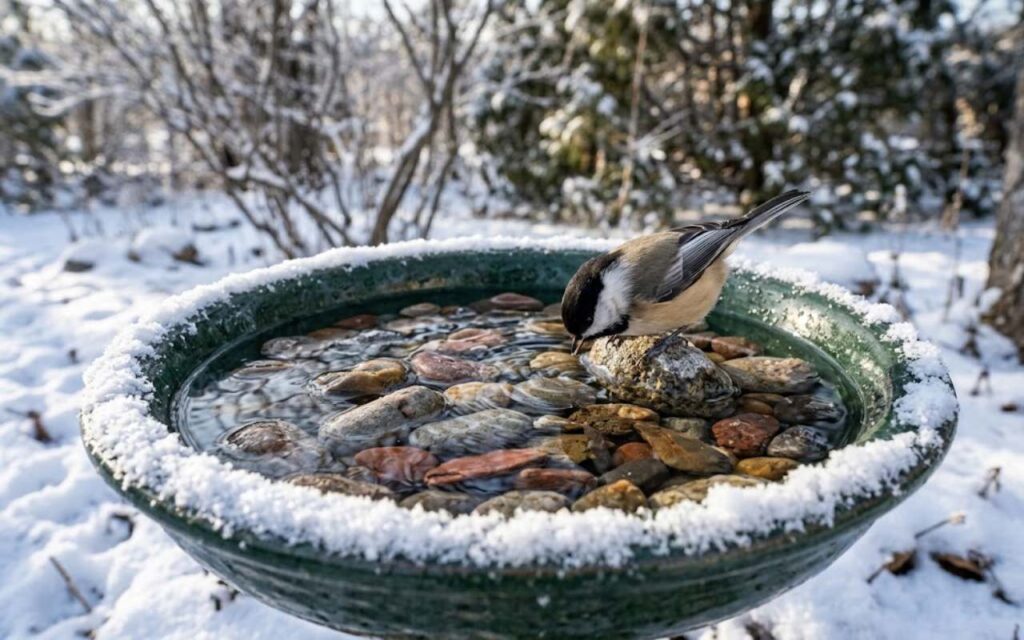
Learning the proper technique for adding stones to bird bath installations is one of the most effective mechanical modifications you can make to protect vulnerable backyard songbirds during sub-freezing weather. While open liquid water is a critical survival resource when natural ponds and puddles freeze solid, deep basins create a lethal hazard for small passerines.
Backyard birders frequently observe small birds hesitating on the slick, icy rims of artificial bowls or fluttering uncontrollably when submerged too deeply. Installing textured perches converts an otherwise treacherous pool into a secure, accessible winter drinking station.
Feather Saturation Risks and Avian Winter Hypothermia
Small passerines such as goldfinches, chickadees, and kinglets maintain an active core body temperature near 105 degrees Fahrenheit. Their primary defense against frigid winter air is the loft of their plumage, which traps a insulating pocket of warm air directly against the skin.
When cold water penetrates down into the under-fluff, this vital thermal barrier collapses immediately, spiking conductive heat loss to fatal levels. In sub-freezing conditions, even a partially soaked bird can succumb to hypothermia within minutes.
Wild birds actively preen using oily secretions from their uropygial gland, but this natural waterproofing is designed to shed falling precipitation rather than resist full bodily submersion in freezing water.
If forced to lean precariously over deep basin rims to drink, small birds often slip on frost-glazed materials and saturate their breast feathers. A dry, secure rock platform elevates the bird safely above the water level, allowing it to dip its bill without immersing its plumage.
Forum discussions frequently caution against adding chemical additives like glycerin or salts to lower water freezing points; these substances destroy feather barbule alignment, mat plumage, and accelerate hypothermia. Textured stones solve the problem purely through physical elevation without altering water chemistry.
Basin Geometry and Water Depth Thresholds for Passerines
Most commercial concrete and resin bird baths feature uniform bowl depressions between two and three inches deep. While larger species like blue jays and American robins navigate these depths comfortably, small songbirds avoid water that exceeds the tops of their tarsometatarsal joints.
For the smallest backyard visitors, proper hydration requires water levels carefully graded between one-half inch and one inch.
- Ruby-crowned kinglets and American goldfinches: Safe wading depth between 0.25 and 0.5 inches.
- Black-capped chickadees and tufted titmice: Maximum functional drinking depth between 0.5 and 0.75 inches.
- Dark-eyed juncos and native sparrows: Stable wading and perching threshold up to 1.0 inch.
- Blue jays, European starlings, and northern cardinals: Capable of using 1.5 to 2.5 inch water depths.
A single flat rock resting on the bottom of a bowl creates an artificial shoreline that bridges this structural design flaw. By sloping stones from the water center toward the dry rim, you establish a varied depth gradient. This mechanical transition lets species of all sizes find a safe foothold matched precisely to their individual leg length and center of gravity.
Mineral Selection: Dense River Rocks Versus Porous Fieldstones
Not all landscape stones are safe or functional inside a winter bird bath. Smooth, polished decorative stones from craft stores lack physical texture, making them nearly impossible for cold-stiffened claws to grip securely.
Porous minerals, on the other hand, absorb water into internal fissures, causing the stones to crack apart when trapped moisture expands during hard freezes.
- Textured field slate: Provides broad, flat surfaces with exceptional micro-grip for songbird feet.
- Dense basalt or river cobble: Heavy enough to resist displacement and non-porous enough to endure repeated freezing.
- Rough quarried granite: Heavy, non-reactive, and textured without sharp crystalline edges that could tear foot pads.
- Porous limestone or sandstone: Soft rocks that absorb water, crumble in frost, and shelter fungal microbes within their pores.
Darker minerals like basalt and dark gray slate offer an additional physical benefit in winter conditions. Dark surfaces absorb ambient solar radiation on clear days, transferring gentle residual heat directly into the immediate water film surrounding the stone.
Avoid smooth glass marbles entirely, as wet algal films quickly turn glass into an unnavigable hazard for perching wildlife.
Winter Bird Bath Stone & Depth Reference Guide
| Stone Type | Winter Safety Rating | Primary Benefit / Risk |
|---|---|---|
| Basalt & Dark Slate | EXCELLENT | Non-porous, excellent micro-grip, and absorbs solar heat to warm water films. |
| Quarried Granite | EXCELLENT | Heavy, non-reactive, and naturally textured without sharp, harmful edges. |
| Limestone & Sandstone | DANGEROUS | Porous structure absorbs water, cracks in frost, and harbors fungal microbes. |
| Glass Marbles / Craft Stones | DANGEROUS | Lacks surface texture; slick algal films make perching impossible for frozen claws. |
| Target Avian Species | Safe Wading Depth | Critical Hazard Limit |
|---|---|---|
| Kinglets & Goldfinches | 0.25″ – 0.5″ | > 0.5″ (Risk of drowning/soaking) |
| Chickadees & Titmice | 0.5″ – 0.75″ | > 0.75″ (Tarsometatarsal limit) |
| Juncos & Native Sparrows | Up to 1.0″ | > 1.0″ (Feather saturation risk) |
| Blue Jays, Robins, Cardinals | 1.5″ – 2.5″ | > 3.0″ (Deep basin threshold) |
Preventing Ice Rafting and Submerged Heater Displacement
Integrating perching stones alongside bird bath de-icers requires careful hardware arrangement. Submersible heating elements depend on natural convective circulation to distribute warmed water outward across the bowl.
Placing heavy rocks directly on top of a heating element can trap heat against the casing, damaging the internal thermostat or tripping electrical circuit breakers.
- Maintain a minimum clearance of one inch between perching stones and the heating element housing.
- Cluster flat stones around the shallow perimeter, keeping the central thermal rising column completely unobstructed.
- Use stones weighing at least two pounds to keep them from being shifted by ice sheets expanding during rapid temperature drops.
- Adjust the final water level so that the upper surface of the stone remains 0.5 inches dry above the waterline.
Backyard bird enthusiasts frequently document heating element failures caused by shifting ice masses sliding loose stones into the heater wiring. Securing the perimeter configuration prevents mechanical binding and protects the heating unit.
Additionally, ensure the bath conforms to Audubon window strike guidelines by placing it either within three feet of glass or more than thirty feet away to protect birds flushing from the stone perches.
Biofilm Management and Stone Sanitization Protocols
Submerged rock piles present a maintenance challenge by creating dead zones where organic detritus settles out of sight. Even in winter, fallen leaves, bird droppings, and microscopic pathogens like Salmonella enterica accumulate beneath submerged stones.
Cold water slows biological activity, but sheltered voids between irregular rocks can harbor bacteria that foul the entire bath volume.
- Remove perching stones weekly to scrub away organic accumulation using a stiff bristle brush.
- Soak the stones for ten minutes in a standard sanitizing solution of one part household bleach to nine parts water.
- Rinse the stones thoroughly with clean running water until all residual chlorine scent disappears.
- Let the stones air-dry fully in the sun before repositioning them around the submerged heater.
Never pour boiling water directly over frozen rocks or plastic basin liners to clear ice accumulations. The instantaneous thermal shock will shatter dense metamorphic stones and crack rigid plastic or resin reservoirs.
Systematic physical cleaning combined with well-placed, textured perching stones creates a dependable, safe oasis for overwintering birds facing harsh sub-zero conditions.