
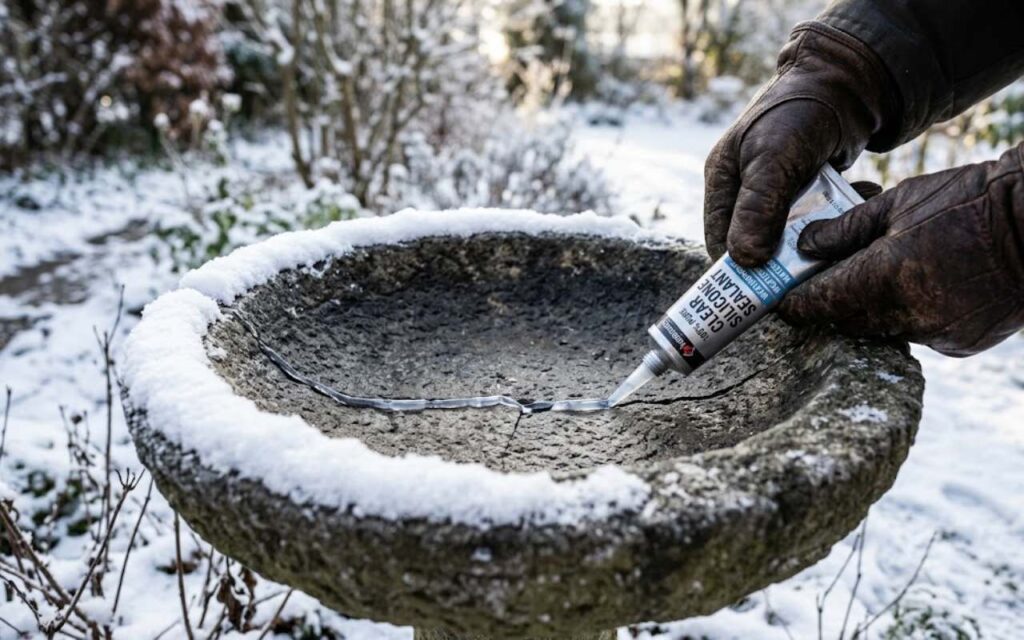
Learning how to fix a leaky bird bath during winter requires navigating the delicate intersection of structural material science and avian toxicology. Sub-freezing temperatures cause micro-fissures to expand into draining cracks, leaving backyard birds without vital hydration when natural open water sources are completely locked in ice.
Solving this problem demands durable, cold-hardy repair materials that will not leach lethal volatile organic compounds or chemical biocides into the drinking basin.
Many standard commercial sealants contain potent fungicides that are fatal to birds if ingested or absorbed through skin contact. Taking the basin out of commission for a rapid, targeted repair using verified non-toxic methods preserves your equipment and protects local wildlife through the harshest winter months.
Freeze-Thaw Thermal Stress and Sub-Surface Basin Fractures
Concrete, terra cotta, and glazed ceramic basins are naturally porous materials that readily absorb ambient water during late autumn rains. When temperatures drop below 32 degrees Fahrenheit, trapped water inside these microscopic voids expands by roughly nine percent, creating immense internal pressure that shears mineral bonds.
Live forum discussions across wild bird communities repeatedly highlight that submerged de-icers can actually worsen this structural stress by generating intense, localized thermal gradients directly against freezing stone. These localized hotspots cause uneven expansion rates across the base of the basin, resulting in spiderweb fractures or sudden bifurcated splits.
Polyresin and stamped plastic baths resist internal water absorption, yet they become brittle in sub-zero conditions and crack under the mechanical weight of shifting ice sheets. Diagnosing the exact origin of the leak requires completely drying the basin and inspecting the underside for dark, waterlogged fracture lines.
Common failure points reported by winter birding enthusiasts include:
- Structural hairline cracks radiating outward from the central heating element contact zone.
- Total rim separation along cast concrete stress lines due to standing perimeter ice expansion.
- Delamination of cheap factory glaze coatings that expose porous inner ceramic clay to water intrusion.
- Micro-punctures in molded resin seams caused by aggressive ice chipping with metal scrapers.
Understanding the precise structural failure of your basin dictates which repair compound can withstand continuous freeze-thaw cycles without rupturing again.
Toxic Chemical Additives to Avoid in Cold-Cure Formulations
Hardware stores stock hundreds of exterior sealants, but the vast majority of commercial caulks are lethal to avian physiology. Standard bathroom and kitchen silicones contain anti-mildew fungicides, such as bio-accumulative organotins or arsenic derivatives, engineered to kill mold spores.
If these biocides leach into bath water, birds ingest them during preening or suffer direct neurotoxic reactions from drinking. Petroleum-based asphalt mastics and standard automotive gasket adhesives also pose severe contamination risks through prolonged off-gassing and hydrocarbon leaching.
Furthermore, well-meaning hobbyists often experiment with cold-weather water additives like glycerin, automotive antifreeze, or table salt to prevent freezing. Glycerin coats avian feathers, destroying the interlocking barbule structure responsible for waterproofing, which causes rapid, fatal hypothermia in sub-freezing air.
Harmful chemical components that must never contact an avian water supply include:
- Added mildewcides and anti-microbial compounds commonly labeled as ten-year mold protection.
- Polyurethane construction adhesives that leach unreacted diisocyanates and aromatic solvents during continuous submersion.
- Ethylene glycol, propylene glycol, or alcohol compounds mistakenly introduced as basin de-icers.
- High-VOC solvent-cure rubber sealants that release xylene, toluene, or petroleum distillates into standing water.
Only pure, chemical-free compounds rated for potable water storage or sensitive aquatic organisms should ever be applied to a wildlife watering station.
Wildlife-Safe Cold-Weather Sealants Ranked by Thermal Tolerance
When evaluating repairs that survive deep winter while protecting birds, pure aquatic-grade formulations represent the absolute gold standard. These materials do not contain chemical fungicides, and once fully cured, they remain chemically inert across severe thermal ranges.
| Sealant Type | Best Substrate Compatibility | Optimal Curing Temp | Full Cure Window | Post-Cure Environmental Tolerance |
|---|---|---|---|---|
| 100% Pure Aquarium Silicone | Glass, Glazed Ceramic, Polyresin | 65°F to 80°F | 2 to 7 Days | -70°F to 450°F |
| Hydraulic Water-Stop Cement | Unglazed Concrete, Natural Stone | 45°F to 90°F | 24 Hours | Complete Sub-Zero Immunity |
| Food-Safe Two-Part Epoxy Paste | Sheared Ceramic, Cast Composites | 70°F to 75°F | 24 to 48 Hours | -40°F to 200°F |
| Pure Butyl Rubber Glazing Tape | Exterior Underside (All Substrates) | 50°F to 100°F | Instant (Mechanical) | -30°F to 180°F |
Aquarium-grade silicone is the most reliable choice for glass, glazed ceramic, and smooth polyresin basins. Manufacturers dictate that while it can physically be applied to surfaces as cold as 0°F (-18°C) without freezing in the cartridge, it requires indoor ambient warmth and humidity to kickstart its molecular cross-linking.
Once it successfully achieves its elastomer state, it retains elastic operational flexibility down to minus 70 degrees Fahrenheit, accommodating the dynamic expansion and contraction of the basin walls without tearing.
For thick, unglazed concrete or natural stone baths, hydraulic water-stop cement provides a mineral-compatible repair that expands microscopically as it cures, anchoring directly into the stone matrix.
Top wildlife-safe sealing compounds evaluated for winter stability include:
- Pure Butyl Rubber Glazing Tape: An excellent mess-free structural reinforcement used exclusively on the dry, exterior underside of hairline basin cracks.chanics, which directly dictates how you must manage temperature and ambient humidity during installation.
- 100% Pure RTV Silicone: Labeled explicitly safe for aquariums; free of bio-accumulative organotins, trialkoxysilanes, or generic mold inhibitors.
- Rapid-Setting Hydraulic Cement: Formulated purely from Portland cement and specialized mineral aggregates for locking deep concrete fissures.
- Food-Contact Certified Two-Part Epoxy Paste: Ideal for structural rebuilding of sheared ceramic or composite rim fragments.
Indoor Curing Windows and Forum-Tested Field Application Hacks
The most common reason cold-weather bird bath repairs fail is attempting to cure sealants outside in freezing ambient temperatures. While pure RTV silicone can technically be extruded in sub-zero environments, the chemical curing mechanism itself completely stalls without atmospheric moisture and an optimal ambient temperature.
Freezing conditions leave the adhesive as a soft, unbonded paste that will rapidly leach unreacted oligomers and disintegrate the moment it is filled with water. To guarantee success, you must bring the damaged bird bath indoors to a ventilated garage, workshop, or basement heated to at least 50°F to 70°F.
Clean the crack thoroughly using pure isopropyl alcohol to strip away algae, bacterial biofilm, and loose mineral scale, avoiding common household dish soaps that leave surfactant residues behind.
Experienced hobbyists across wild birding forums recommend placing a warm incandescent work light or running a small personal space heater roughly 18 inches away from the patch to maintain local warmth and prevent cold ambient drafts from extending the curing cycle.
Essential steps for executing a resilient indoor repair include:
- Allowing a full 48 to 72 hours (and up to 7 days for deep silicone beads) of uninterrupted warm indoor curing time before exposing the bath to moisture.
- Scrubbing the fracture perimeter with a stiff wire brush and flushing completely with pure isopropyl alcohol.
- Scoring smooth plastic or resin surfaces with 80-grit sandpaper to give a rough mechanical bite to the adhesive layer.
- Forcing the repair compound deep into the void with a flat putty knife rather than smoothing it only on top.
Post-Cure Rinsing Protocols and Winter Basin Refill Management
Once the sealant achieves full chemical cure and ceases all off-gassing, you must conduct a thorough washdown before returning the basin to local wildlife. Even aquarium-safe acetoxy-cure silicones release volatile acetic acid during their curing phase, giving off a sharp vinegar odor that can irritate sensitive avian mucous membranes.
Soak the basin with a standard maintenance solution of 1 part white vinegar to 9 parts clean water, rinse it thoroughly with fresh water, and wipe it dry with clean cotton towels. Performing a dry-table leak test indoors for six hours prevents the frustration of hauling a heavy, leaking water bath back outdoors in freezing weather.
When positioning the bath back outside, avoid filling it immediately with steaming hot tap water, as extreme thermal shock can crack newly cured ceramic or stone. Use cool tap water, and ensure your bird bath heater is rated with an internal thermostat so it only runs when temperatures approach freezing.
Crucial operational steps for winter bird bath longevity include:
- Maintaining a clean 1:9 white vinegar to water periodic wipe-down schedule to curb bacterial biofilm without degrading the sealant bond.
- Inspecting the cured repair area for complete chemical odor dissipation prior to outdoor installation.
- Elevating submerged de-icing coils off the sealed patch using a clean, flat river rock to prevent direct heat scorching.
- Emptying and refilling the basin using room-temperature water during the warmest midday hours.