
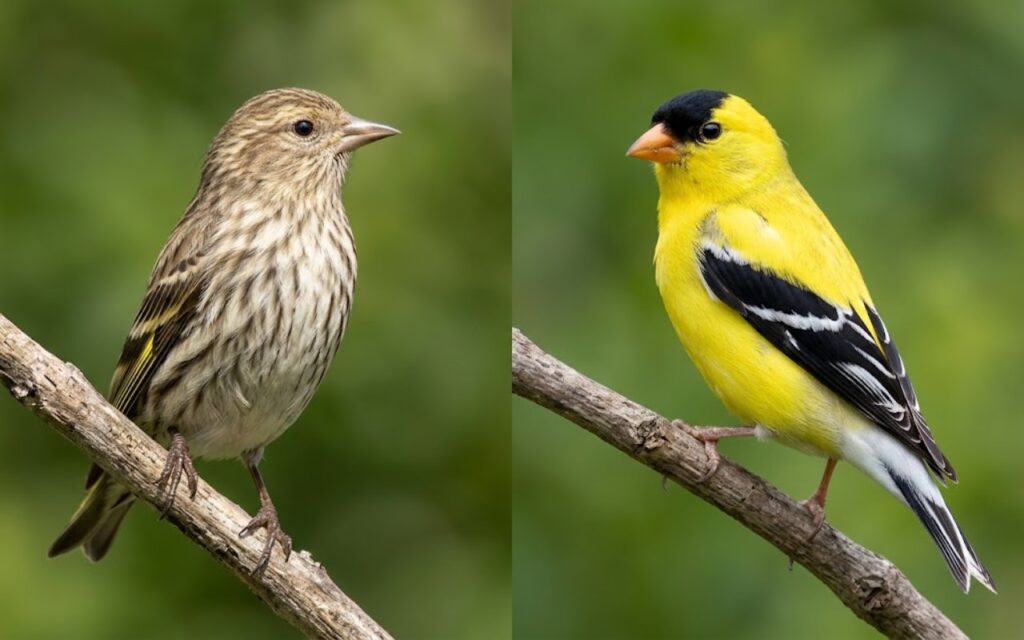
Mastering a Pine Siskin vs American Goldfinch: Quick ID check is essential when mixed winter flocks swarm backyard thistle feeders. Drab winter plumage often causes casual observers to confuse these two small cardueline finches at first glance.
Both species frequently forage side by side across North America during the non-breeding months. Distinguishing them requires looking past basic olive-brown tones to assess structural anatomy, feather patterns, and distinct social behaviors.
Bill Morphology and Silhouette Geometry at the Feeder
The most reliable way to separate these two species in poor light or silhouette is the structure of the bill. Pine Siskins possess an acutely pointed, slender, needle-like bill designed to probe between tightly closed conifer scales. In contrast, the American Goldfinch carries a classic conical seed-cracking bill with a thicker base and a distinctly arched culmen.
On community forums like r/backyardbirds, seasoned backyard birders frequently remind newcomers that bill shape does not change with the seasons. While plumage shifts dramatically between summer and winter, skeletal morphology remains completely constant. A bird showing an ultra-sharp, delicate dagger profile is invariably a siskin.
The head profile also creates a discernible difference in overall posture. The American Goldfinch shows a rounder crown and a slightly plumper, barrel-shaped chest when perched. The Pine Siskin appears leaner, flatter on the crown, and noticeably more angular during active feeding bouts.
- Pine Siskin bills measure significantly narrower at the nostrils, tapering sharply to an acute needle point.
- American Goldfinch bills maintain a stout, triangular wedge that provides crushing leverage for hard seed hulls.
- Feeder silhouettes reveal that goldfinches rest with a rounded throat angle, whereas siskins hold an alert, streamlined posture.
This physical disparity directly influences how each species handles different seed types on feeding trays.
Plumage Streaking and Wing Bar Variations
Winter American Goldfinches shed their bright lemon-yellow breeding feathers in favor of an unstreaked, warm buffy-tan body. While female and immature goldfinches can look drab gray-brown, their bellies, flanks, and breasts remain completely clean of dark markings. Pine Siskins are heavily, crisply streaked with dark brown across their entire underside, flanks, and back.
A frequent troubleshooting issue raised by hobbyists on wild bird forums involves the elusive yellow flash on Pine Siskins. Many beginners expect siskins to show vivid yellow patches, only to find birds that appear almost entirely brown. The sulfur-yellow edging on siskin flight feathers and tail bases is variable and often stays tucked beneath covert feathers while at rest.
American Goldfinches display clean, prominent white or pale buff wing bars set against dark blackish-brown wings. Even in dull non-breeding plumage, goldfinches retain unstreaked flanks that instantly separate them from heavily textured siskins.
- Pine Siskin underparts display dense, pencil-thin vertical streaks extending down to the undertail coverts.
- American Goldfinch underparts remain smooth buff or creamy white without vertical breast lines.
- Goldfinch wings showcase two distinct, broad wing bars across the median and greater coverts.
- Siskin wings exhibit narrow wing bars combined with subtle yellow flashes along the primary flight feather bases.
Examining the flank feathers will resolve identification questions when poor viewing angles conceal the wings.
Agonistic Feeder Dominance and Behavioral Clues
Feeder watchers quickly notice that Pine Siskins and American Goldfinches exhibit vastly different temperaments. Pine Siskins are notoriously pugnacious and aggressive toward flock mates and larger birds alike. They frequently drop their wings, flare their tails, and lunge with open beaks to monopolize feeding ports.
In discussions on backyard wildlife boards, members often detail how a tiny group of siskins can completely drive away docile goldfinches from mesh finch socks. American Goldfinches typically wait their turn or scatter when challenged by scrappier flock members. Goldfinches rarely engage in extended bill-snapping displays unless severely crowded.
Flight patterns provide further behavioral verification during quick yard flybys. Both species exhibit an undulating flight path, rising on rapid wing flaps and dipping as wings fold against the body. However, siskins call constantly in transit with a rising, buzzy churr that sounds distinctly like a zipper being pulled.
- Siskins actively defend individual feeder perches through open-bill posturing and aggressive horizontal lunges.
- Goldfinches display a gentler social hierarchy, tolerating close perching on shared perches or feeding trays.
- Goldfinch contact calls sound like a sweet, descending musical lilt often transcribed as “per-chick-o-ree.”
- Siskin flight vocalizations center on an unmistakable, ascending raspy trill with a dry metallic timbre.
Noting these social interactions offers immediate field confirmation long before a visual scan reveals wing bars.
Winter Irruption Dynamics and Seed Preference Mechanics
The abundance of Pine Siskins in suburban yards fluctuates dramatically from one winter to the next. Siskins are facultative irruptive migrants whose movements depend on the seed crop failure of northern boreal conifers. When spruce, fir, and hemlock cone crops fail in Canada, massive waves of siskins sweep southward into backyards across the lower latitudes.
American Goldfinches follow more predictable, regular seasonal movements within their established range. While both birds relish small oil seeds, their feeding mechanics differ based on beak mechanics. Siskins favor Nyjer (Guizotia abyssinica) and fine sunflower chips, easily extracting tiny kernels with their fine-tipped mandibles.
Community members on specialty birding forums often note that heavy siskin irruptions rapidly deplete food supplies within hours. Their aggressive feeding technique often shreds soft fabric mesh feeders, prompting birders to switch to rigid metal mesh cylinders.
- Nyjer seed provides high lipid and protein concentrations that sustain both species during freezing weather.
- Fine sunflower chips offer rapid caloric intake without requiring energy-intensive hull cracking.
- Rigid 0.25-inch stainless steel wire mesh resists damage from sharp siskin bills far better than nylon socks.
- Conifer plantings such as native spruce and hemlock supply natural foraging canopy that keeps flocks dispersed.
Anticipating irruption years allows yard managers to deploy appropriate hardware before feeding stations become overrun.
Biosecurity Sanitation and Lethargic Flock Management
Concentrated flocks of Pine Siskins present serious disease vectors that require strict yard vigilance. Siskins are extraordinarily susceptible to salmonellosis, an intestinal infection caused by the bacterium Salmonella enterica. The bacteria spread rapidly through saliva and fecal matter deposited on damp tray feeders and crowded perches.
Wildlife rehabilitation workers frequently urge forum users to watch for sick siskins sitting puffed up and lethargic under feeders. A sick bird will remain motionless on the ground, allowing humans to approach closely without attempting to fly. When these symptoms appear, continuing to feed the flock accelerates transmission to vulnerable American Goldfinches.
Halting the spread requires aggressive sanitation and temporary feeder removal to break the chain of infection. Backyard feeding stations must be thoroughly cleaned using safe, standardized protocols.
- Remove all feeders immediately for a minimum of fourteen days whenever a puffed, lethargic finch is observed.
- Scrape and discard all accumulated seed hulls and waste beneath feeding zones using a garden shovel.
- Soak hard-surface feeders in a 1:9 bleach-to-water dilution for at least ten minutes before scrubbing.
- Rinse cleaned hardware thoroughly with clear running water and air-dry completely prior to restocking fresh seed.
Responsible maintenance protects visiting finches and preserves healthy bird populations throughout the harshest winter weeks.