
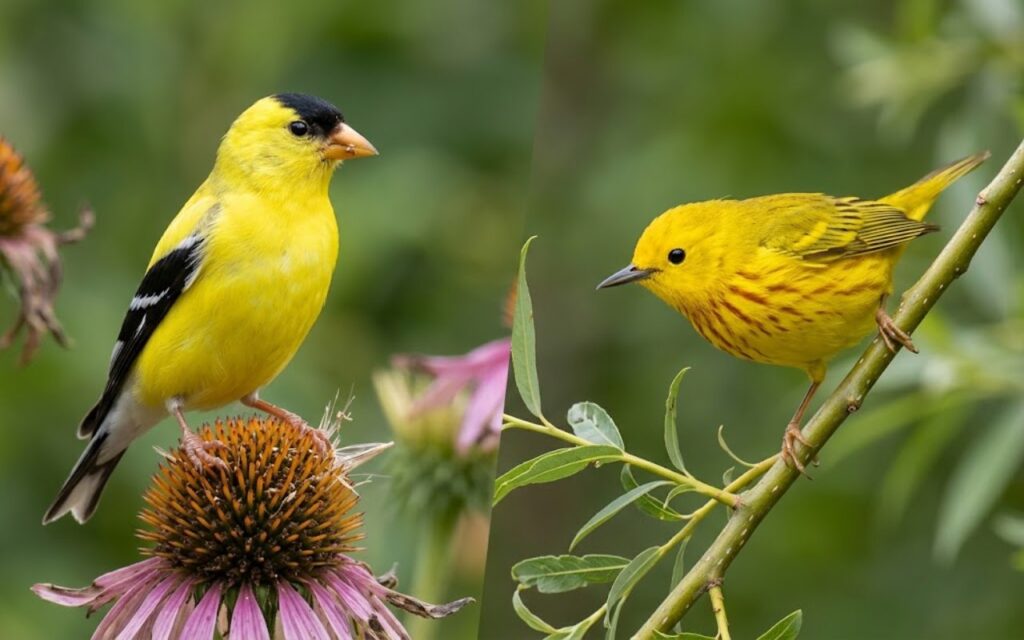
Distinguishing a goldfinch vs yellow warbler is one of the most frequent challenges discussed across backyard birding communities. While both species boast vivid, luminous yellow plumage during North American summers, their evolutionary adaptations, anatomical structures, and feeding behaviors diverge completely.
Novice birders often glance through a sunlit kitchen window, notice a streak of intense yellow moving through the foliage, and immediately record a warbler. In field conditions, simple lighting artifacts and rapid movements obscure key field marks, leading to common misidentifications across citizen science databases.
Bill Morphology and Foraging Silhouette Mechanics
The most reliable physical diagnostic between these two species lies directly in the structure of the bill. An American Goldfinch possesses a thick, conical, seed-cracking beak adapted specifically for husking tough composite seeds.
A Yellow Warbler carries a fine, needle-like, sharply pointed bill engineered exclusively for gleaning soft-bodied arthropods from the undersides of leaves. On community forums like r/whatsthisbird, experienced observers consistently advise users to look past color and evaluate silhouette geometry first.
Reddit contributors frequently highlight that backlighting renders bright yellow plumage dull gray or black, making bill shape the only reliable visual metric. A conical finch beak creates a distinct equilateral triangle profile that joins the forehead at an abrupt angle.
- Finch bill profile: Short, stout, conical, buffy yellow-orange in breeding season, gray-brown in winter.
- Warbler bill profile: Slender, straight, sharply pointed, dark charcoal to black year-round.
- Feeding mechanics: Finches rotate and manipulate hard seeds using strong jaw musculature.
- Insect gleaning mechanics: Warblers deliver precise, rapid snapping strikes against foliage.
These anatomical differences dictate how each bird handles food items in the field. When observing an ambiguous yellow visitor in shrubbery, watch how the bird interacts with the flora. A bird systematically mashing flower heads or husking achenes is invariably a finch, whereas a bird inspecting leaf surfaces and leaf petioles for caterpillars is a warbler.
Plumage Patterns, Wing Bars, and Chest Streaking Nuances
Color distribution across the wings and underparts provides immediate visual separation when lighting allows clear inspection. Breeding male American Goldfinches exhibit stark, jet-black wings marked with clean white wing bars, a brilliant black cap, and a white rump patch that contrasts sharply with their lemon-yellow mantle.
Yellow Warblers completely lack true black feathers, displaying greenish-yellow wing coverts, yellow-edged flight feathers, and a uniformly olive-yellow mantle. A widespread point of confusion documented on localized birding boards occurs when observers spot the breast markings of male Yellow Warblers.
Mature male Yellow Warblers showcase fine, vertical, chestnut-red breast streaks that appear painted onto the yellow wash. American Goldfinches never present ventral streaking in any plumage cycle, maintaining completely unmarked, solid yellow breasts and abdomens.
- American Goldfinch wings: Deep jet-black flight feathers punctuated by bold white wing bars and white feather margins.
- Yellow Warbler wings: Olive-green to warm yellowish-charcoal, lacking stark monochrome bars.
- Goldfinch head pattern: Prominent black forehead cap on breeding males, shifting to olive-brown in winter.
- Warbler head pattern: Completely yellow face with an open, blank expression and an uninterrupted dark eye.
Female and juvenile plumages present additional nuances that trip up backyard naturalists. Female goldfinches lack the black cap and appear in dull olive-yellow with muted wing bars, yet they retain that unmistakable conical bill.
Female Yellow Warblers are plainer, lacking the chestnut breast streaks of the males, yet they retain an overall warm, buttery-yellow wash across the entire vent and undertail coverts.
Flight Dynamics, Canopy Locomotion, and Acoustic Cues
The biomechanics of movement and aerial transit reveal immediate species identities before a bird even settles into view. Goldfinches fly with an exaggerated, undulating, roller-coaster trajectory, tucking their wings tightly against their bodies between bursts of flaps.
At the crest of each flap-bound arc, goldfinches regularly utter their diagnostic contact call, often transcribed as a bouncing “per-chick-o-ree” or “potato-chip” vocalization.
Yellow Warblers maintain direct, rapid, horizontal flight patterns without the deep aerial dips characteristic of cardueline finches. Within the canopy, a Yellow Warbler moves with frantic, nervous energy, hopping rapidly along twigs, hovering momentarily under leaves, and darting after escaping insects.
In contrast, a goldfinch moves deliberately, frequently perching upright on seed heads and hanging acrobatically upside down to reach thistle seed.
- Goldfinch flight pattern: Deeply undulating, roller-coaster dips paired with rhythmic vocalizations.
- Warbler flight pattern: Direct, level, darting flights across short canopy gaps.
- Vocal signature of the goldfinch: Bright, bouncing flight calls and sweet, rambling canary-like twitters.
- Vocal signature of the warbler: A piercing, accelerated musical song famously parsed as “sweet, sweet, sweet, I’m so sweet.”
Field discussions on the American Birding Association forums emphasize that acoustic identification prevents the vast majority of visual errors. Goldfinches call incessantly on the wing, broadcasting their presence across open fields and suburban yards.
Yellow Warblers deliver high-tempo territorial songs from dense willow thickets and wet deciduous edges throughout spring and early summer.
Seasonal Breeding Timelines and Nesting Substrate Clues
Nesting phenology creates a striking temporal separation between these two birds across temperate North America. Yellow Warblers arrive early from their Neotropical wintering grounds, initiating courtship and nest construction during April and May when emerging insect populations peak.
By late July, their breeding duties have largely concluded, and many begin their southward migration while the summer still feels young. American Goldfinches are famous among field ornithologists for being among the latest nesting songbirds on the continent.
They delay breeding until late June, July, or even early August, deliberately synchronizing their parental duties with the seeding cycle of composite plants like thistles, sunflowers, and asters.
They wait for mature thistle down to emerge, which female goldfinches harvest in copious quantities to line their tightly woven, waterproof cup nests.
- Yellow Warbler breeding onset: Mid-spring (late April through May), driven by caterpillar emergence.
- American Goldfinch breeding onset: Mid to late summer (July through August), driven by ripe seed crops.
- Warbler nest materials: Fine grasses, shredded bark fibers, plant down, and animal hair placed in upright shrub forks.
- Goldfinch nest materials: Dense woven plant fibers lined heavily with down from thistle, milkweed, or cattail.
Forum contributors regularly note the sudden disappearance of Yellow Warblers by late August, leaving suburban yards populated almost exclusively by flocks of late-brood goldfinches.
If you encounter an active nest in August lined with thick thistle fluff, the parent birds are definitively goldfinches. Understanding these ecological schedules removes much of the guesswork from mid-summer identification.
Backyard Feeder Station Diagnostics and Habitat Preferences
Attracting and diagnosing these species in a residential yard relies heavily on the specific stations and plantings you provide. Goldfinches are specialized granivores that readily swarm commercial feeding stations, particularly mesh feeders loaded with nyjer seed and tube feeders filled with black oil sunflower seeds.
They congregate in raucous, social flocks, perching side by side while feeding. Yellow Warblers almost never consume commercial birdseed, because their digestive systems cannot process dry grain shells.
On backyard birding forums, experienced hobbyists repeatedly debunk claims of warblers eating nyjer, clarifying that visitors on seed feeders are invariably goldfinches or pine siskins.
Yellow Warblers visit yards primarily for water features, especially misting attachments, shallow ceramic drippers, or dense native plantings that host abundant caterpillars.
- Goldfinch yard attractants: Tube feeders with sunflower hearts, fine nyjer sock feeders, and standing native coneflowers.
- Warbler yard attractants: Running water drippers, canopy misting devices, native willows, and insect-rich fruit trees.
- Preferred warbler habitat: Wet brushy thickets, willow swamps, stream corridors, and suburban hedgerows.
- Preferred goldfinch habitat: Weedy fields, agricultural verges, open orchards, and manicured suburban gardens.
To resolve the identification dilemma quickly, look at the hardware and habitat context. If a yellow bird is perching on a feeder perch cracking a seed coat, it is an American Goldfinch. If a yellow bird is gleaning foliage near a water mister or patrolling a willow branch along a damp property line, you have located a Yellow Warbler.