
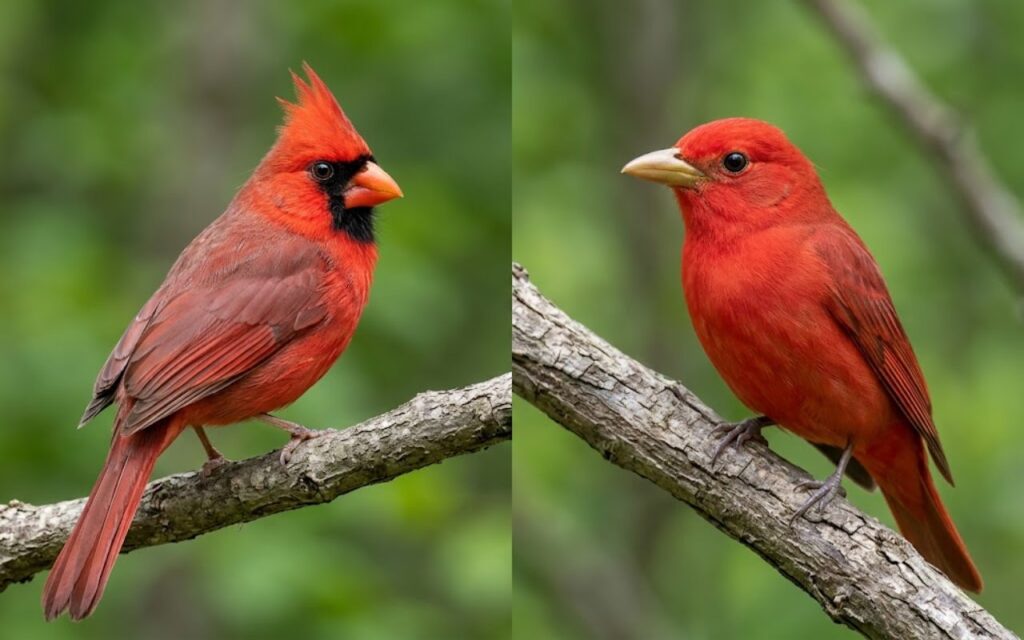
Mastering a Northern Cardinal vs Summer Tanager: Quick ID can save backyard birders from endless confusion during the heat of late spring and summer migrations. While a sudden flash of vibrant red plumage in dense foliage often leads observers to assume they are watching a familiar resident cardinal, the migratory tanager presents fundamentally distinct anatomical and behavioral traits.
A careful look past surface color reveals sharp contrasts in bill structure, silhouette, canopy preferences, and foraging habits. Understanding these specific field marks ensures you never misidentify these two distinct species when they share overlapping habitats.
Silhouette Anomalies and Bill Morphology Differences
The fastest way to separate these two species in the field is to evaluate structural anatomy rather than relying strictly on scarlet body feathers. Northern Cardinals (Cardinalis cardinalis) possess a dramatic, erectile crest that rises or flattens based on agitation, paired with a heavy, seed-cracking conical beak.
In contrast, the Summer Tanager (Piranga rubra) displays a completely crestless head with a flatter crown profile, accompanied by a markedly elongated, swollen, blunt-tipped bill.
Community discussions on bird identification forums regularly showcase blurry backyard photos where observers ask why a cardinal appears bald or deformed.
On Reddit’s r/whatsthisbird, experienced field identifiers frequently point out that the Summer Tanager carries a pale horn-colored to yellowish bill, whereas an adult cardinal sports a bright orange, deeply curved seed crusher.
- Northern Cardinal features include a prominent feather crest, jet-black facial mask encompassing the chin and lores, and a deep, seed-splitting orange bill.
- Summer Tanager features include an uninterrupted strawberry-red or rose-red head without a crest, zero black facial markings, and an oversized, pale yellow-tan bill built for handling tough insects.
This distinct facial architecture directly reflects the evolutionary divergence between the two families. Cardinals belong to the family Cardinalidae, while tanagers of the genus Piranga are actually specialized members of Cardinalidae that evolved divergent bill dimensions specifically adapted for seizing large flying insects rather than husking thick shells.
Canopy Hawker Versus Feeder Ground Gleaner Foraging Traits
Observing where and how the bird moves through your yard offers immediate identification clues before you even lift your binoculars. Northern Cardinals are classic understory dwellers and ground foragers that spend their days low in brush piles, dense hedgerows, and the lower skirts of feeder stations.
Summer Tanagers are high-canopy specialists that rarely touch the ground, spending the majority of their active hours hidden high in mature oak, hickory, or pine crowns. A recurring scenario reported in regional birding groups involves homeowners wondering why an apparent red cardinal is aggressively hovering near porch eaves.
These birds are invariably Summer Tanagers, which are specialized wasp and bee predators that pluck stinging insects directly out of active nests.
- Northern Cardinals forage primarily on or near the ground, hopping cautiously to pick up dropped sunflower seeds, small wild grains, or native berries.
- Cardinals frequent low-hanging platform feeders, hopper stations, and dense thickets within six feet of the soil line.
- Summer Tanagers feed through sallying, which involves launching from high branches to capture wasps, bees, beetles, and cicadas mid-air.
- Tanagers frequently perch beside structural eaves or roof soffits to target paper wasp combs, removing the venomous sting by rubbing the insect vigorously against bark before swallowing.
Cardinals lack the aerodynamic maneuverability required to harvest aerial insects with this level of agility. If the bird in question is performing acrobatic flycatching sallies high in the canopy or raiding an elevated hornet nest, you are undeniably watching a Summer Tanager.
Acoustic Separation: Whistle Patterns Versus Pit-Tuck Call Notes
Acoustic signatures provide the most reliable identification metric when thick deciduous foliage obscures visual sightings. The Northern Cardinal produces a series of loud, sweet, slurred whistles that typically rise or fall in pitch, often described by field guides as sounding like cheer-cheer-cheer or birdie-birdie-birdie.
Summer Tanagers possess an entirely different vocal palette that sounds more like an American Robin with a sore throat, singing a rich, robin-like series of slurred musical phrases.
The sharpest audio distinction lies in their quick alarm notes and contact calls. When alarmed or contacting mates, Summer Tanagers emit a dry, clicking chatter that sounds like pit-ti-tuck or a sharp, percussive pi-tuck. Cardinal alarm notes consist of a hard, metallic, mechanical chip that cuts sharply through garden brush.
- Northern Cardinal songs feature loud, pure whistles delivered from an exposed, mid-level perch, repeating clear phrases with distinct pitch variations.
- Cardinal alarm calls consist of a sharp, crisp, metallic chip note that sounds like two small coins striking together.
- Summer Tanager songs consist of burry, variable phrases delivered almost exclusively from the highest canopy leaves.
- Summer Tanager call notes are a dry, woody, multi-syllable chatter transcribed universally as pit-ti-tuck.
Birders struggling with canopy identification can easily use these call notes to confirm a diagnosis. If an unseen red bird chips mechanically in a low boxwood hedge, it is a cardinal; if a sharp clicking sound drops from the crown of a seventy-foot red oak, look up for a tanager.
Female Plumage Nuances and Molting Color Splotches
Separating the females and immature males of these two species demands precise attention to undertones and field markings. Female Northern Cardinals are warm grayish-tan overall, displaying soft red washes on the crest, wings, and tail feathers, alongside a muted version of the dark facial mask.
Female Summer Tanagers are entirely devoid of gray or mask patterns, exhibiting a rich, warm mustard-yellow or olive-yellow wash across the entire body. Novice birders frequently report spotting diseased, injured, or mutated birds in localized forums during late summer.
In one notable thread on r/birdwatching, a user documented a bird that looked like it had been splattered with red and chartreuse house paint.
- First-year male Summer Tanagers undergo an irregular preformative molt, resulting in a dramatic patchwork of bright yellow and blotchy red feathers across their body.
- Female Summer Tanagers occasionally exhibit an atypical orange or pale reddish flush, but they always lack the cardinal’s crest and black face.
- Female Northern Cardinals consistently show subtle crimson borders on their flight feathers while maintaining a cool, grayish-brown body contour.
- Cardinals possess a dark charcoal-gray to black mask around an orange bill regardless of age once juvenile feathers are shed, preventing yellow or blotchy misidentifications.
These molting blotches in young tanagers can look alarming to the uninitiated, yet they represent a completely normal transitional plumage phase. Once you identify the absence of a crest and the presence of that stout, pale beak, the patchwork bird is effortlessly sorted as an adolescent Summer Tanager.
Backyard Gear Adjustments and Sightline Optimization
Attracting these two birds requires completely divergent backyard feeding and landscaping strategies due to their contrasting diets. Northern Cardinals readily accept standard feeder hardware, showing heavy preference for high-lipid seeds offered on stable platforms.
Summer Tanagers almost never consume hard, whole birdseed because their beak morphology cannot efficiently crack heavy hulls. Backyard hobbyists often express frustration that their expensive seed blends never attract migratory tanagers.
To bring Summer Tanagers into viewing range, you must adjust your offerings toward specialized insect arrays, sweet fruit, and open elevated water features.
- Offer black oil sunflower seeds, striped sunflower, and white safflower on heavy-duty, stationary tray feeders positioned within ten feet of dense escape cover for cardinals.
- Deploy elevated mealworm feeders containing live or rehydrated larvae placed high near tree canopy lines to entice insect-hunting Summer Tanagers.
- Mount half-oranges, fresh suet, or shallow bowls of berry-infused suet pellets on hanging branch poles to draw tanagers out of dense canopy foliage.
- Maintain a clean bird bath equipped with a dynamic water dripper, using standard 1:9 bleach-to-water dilution soaking for periodic sanitation to eliminate avian pathogens like Candida albicans.
Cardinals will happily drink from shallow basins on the ground, while tanagers prioritize the movement and sound of dripping water higher up in open sightlines. Implementing these targeted gear adjustments ensures you create distinct foraging zones, allowing you to observe and identify both magnificent species from your window all summer long.