
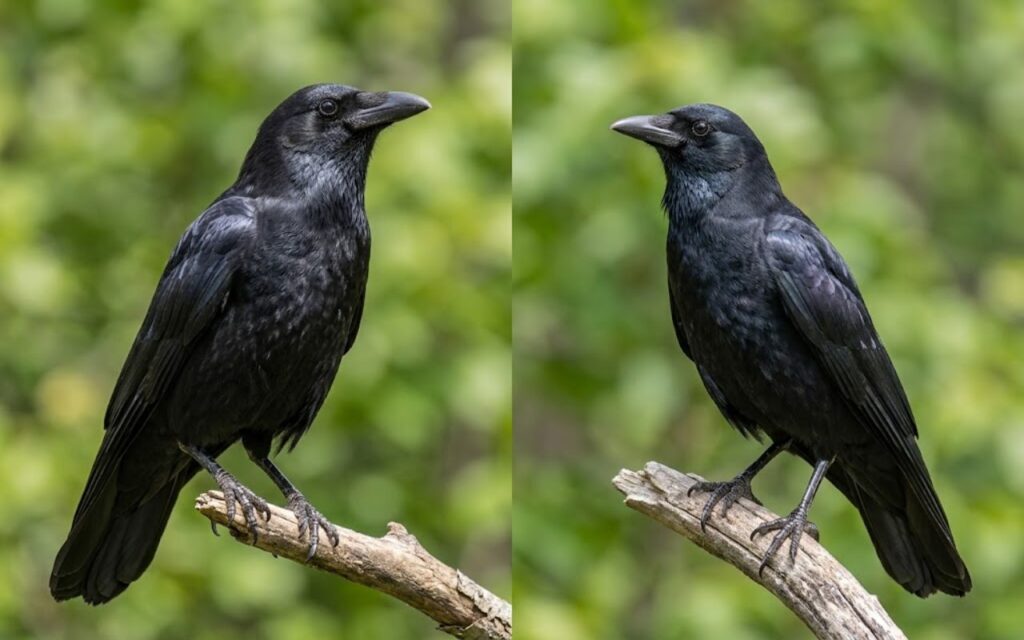
Mastering an American Crow vs Fish Crow: ID guide in the field requires looking beyond plumage and tuning your ears to distinct acoustic signatures. While both species share overlapping glossy black feathers and opportunistic foraging habits, subtle morphological and behavioral differences separate them.
Relying on size alone often leads to misidentifications because individual variation and field viewing angles distort perceived scale. By integrating specialized audio diagnostics, posture cues, and habitat trends, you can separate Corvus brachyrhynchos from Corvus ossifragus with confidence.
Acoustic Diagnostic Rules and the Nasal Double-Note Call
Vocalizations remain the single most reliable criterion for separating these two corvids in the field. The American Crow delivers a resonant, full-bodied, and throaty call that reverberates across open territory with a crisp cadence. In contrast, the Fish Crow produces an unmistakable, highly nasal vocalization that sounds distinctly compressed and reedy.
On community forums like r/whatsthisbird, experienced observers repeatedly warn beginners about juvenile American Crows during late spring and early summer. Fledgling American Crows beg with raspy, higher-pitched whines that frequently mimic the nasal quality of a Fish Crow.
Paying attention to syllable count and inflected cadence will prevent these false positive identifications:
- A two-syllabled, nasal “uh-uh” with dropping inflection on the second note points exclusively to a Fish Crow.
- A single, rising, interrogative “anh?” or “caar” delivered through the nares indicates a calling Fish Crow.
- A harsh, staccato, rhythmic series of clear, uninflected calls signifies an adult American Crow.
- Sustained juvenile begging calls with open bill fluttering should be disregarded until adult birds respond nearby.
Audio verification is best achieved by waiting for an unsolicited, relaxed adult vocalization. Recording these notes on a smartphone audio application like Merlin Bird ID by the Cornell Lab of Ornithology often reveals a distinct acoustic frequency peak between 1.5 and 2.5 kilohertz.
However, the true diagnostic marker is the baseline pitch, which sits structurally higher and flatter than the deep, resonant caw of an American Crow.
You can listen to this compressed, dual-note “uh-uh” timbre firsthand via the official Cornell Lab Macaulay Library Fish Crow Audio Portal, which highlights how the sound waves clip tightly without the deep diaphragm projection of its larger relative.
Morphological Subtleties Across Wing Proportions and Bill Depth
Visual identification without sound is notoriously difficult, yet structural proportions provide valuable clues when birds are observed at close range. The American Crow features a heavier, more formidable bill with a deep culmen that appears robust relative to its head dimensions.
The Fish Crow exhibits a slightly more delicate, tapered bill that gives the bird a sleek, flatter facial profile. Wing and tail ratios on perched subjects provide an additional diagnostic baseline for careful observers.
A perched Fish Crow displays relatively long primary projection, meaning the tips of the folded wings extend nearly to the end of the square-cut tail. An American Crow shows shorter primary extension relative to its longer rectrices, leaving a noticeable portion of the tail exposed past the wing tips:
- American Crow bill depth measures visibly thicker at the midpoint between the nostril and the bill tip.
- Fish Crow tarsi and feet appear noticeably more slender, lacking the bulky scale plating of larger corvids.
- Perched Fish Crow wing tips terminate within an inch of the trailing tail feathers.
- Perched American Crow primary tips stop significantly short of the distal tail border.
Feather sheen also displays minor structural differences when direct sunlight reflects off fresh autumn plumage. American Crows show a deep violet or purplish iridescence restricted primarily across their mantle, scapulars, and crown, while their belly and lower underparts remain a flat, relatively dull black.
In contrast, the Fish Crow features a uniform, silky bluish-violet or greenish gloss that extends consistently all the way down onto its belly. This all-over, polished iridescence gives the Fish Crow a distinctly sleek, uniform appearance in optimal lighting conditions that contrasts with the multi-textured look of its larger relative.
Postural Mechanics and Throat Feather Erection During Calls
Body language during active calling events offers a definitive visual separation that bypasses plumage ambiguity. When an American Crow calls, it typically leans its entire body forward in a rhythmic, full-frame pumping motion. The bird dips its head, points its bill downward, and spreads its tail slightly with every single vocal burst.
The Fish Crow adopts an entirely different posture while vocalizing from a branch or utility wire. It hunches its shoulders, pulls its head tight into the body, and puffs out its throat feathers into a scruffy, ragged beard. Forum contributors on birding boards often describe this throat fluffing as the most reliable visual indicator of an actively calling Fish Crow:
- Fish Crow throat feathers erect vertically to create a distinct, bearded bulge during vocalization.
- Fish Crow wings frequently twitch or shudder downward against the flanks when emitting short nasal calls.
- American Crow heads bow forward with the bill angling toward the perch during loud territorial calls.
- American Crow throats remain relatively smooth and unruffled without localized feather flaring.
These postural displays are tied directly to vocal tract anatomy and airflow production. The Fish Crow contracts its thoracic muscles while compressing its neck, creating the characteristic pinched acoustic timbre. Observing this hunchback posture alongside the throat bulge confirms the species even when highway noise obscures clear hearing.
Geographic Corridor Shifts and Inland Waterway Infiltration
Historically, the Fish Crow remained tied to Atlantic and Gulf coastal salt marshes, tidal estuaries, and large southern river deltas. Over recent decades, birders in regional forums have documented a sustained inland range expansion along urban river corridors.
Fish Crows now thrive deep inside inland valleys across Pennsylvania, Ohio, and Tennessee, following commercial waste systems and major river basins. The American Crow remains an omnipresent generalist across forests, agricultural plains, suburban neighborhoods, and high-altitude valleys.
In contrast, inland Fish Crows show a strong preference for localized infrastructure adjacent to major water networks. These expanding populations exploit human food waste alongside ring-billed gulls near shopping centers, interstate plazas, and municipal reservoirs:
- River corridors like the Hudson, Susquehanna, and Ohio serve as the primary inland travel highways for expanding Fish Crow colonies.
- Big-box commercial center dumpsters provide reliable lipid and protein resources that support inland overwintering flocks.
- Tidal shorelines, barrier beaches, and brackish marshes feature heavy concentrations of Fish Crows scavenging marine invertebrates.
- High-elevation interior woodlands and extensive agricultural farm belts remain dominated almost entirely by American Crows.
Understanding these habitat preferences prevents hasty assumptions based on geography alone. Finding a small corvid in an inland parking lot three hundred miles from the ocean no longer rules out a Fish Crow. Field observers must evaluate local water proximity and foraging substrates before eliminating the coastal species.
Field Gear Adjustments and Acoustic Recording Troubleshooting
Documenting ambiguous corvids requires thoughtful gear deployment in the field. Standard zoom binoculars between 8×42 and 10×42 magnification provide the best balance of field of view and light gathering for structural bill assessments.
Spotting scopes set above 30x magnification often suffer from heat shimmer across parking lots and open beaches, making primary feather tips difficult to count.
Backyard birders on regional ornithological forums frequently run into digital audio compression issues when using automated bird sound identification applications. Wind noise blowing across an unprotected phone microphone often clips the initial attack of a call, turning a full American Crow vocalization into a thin sound file:
- Equip your mobile recording setup with a small, clip-on directional lavalier microphone fitted with a foam wind screen.
- Orient your body to block wind gusts between the subject and the microphone sensor to prevent signal clipping.
- Capture at least ten sequential call bursts to ensure the bird is not giving an anomalous stress call.
- Document clear photographs of the perched bird from a broadside angle to measure primary projection against tail length.
Pairing clean audio recordings with sharp profile imagery creates ironclad documentation for regional platforms like eBird. When unexpected corvids appear outside their historical ranges, this dual-media approach satisfies local review committees. Careful attention to vocal nuance, perched anatomy, and throat feather movement turns a difficult field challenge into an accurate identification.