
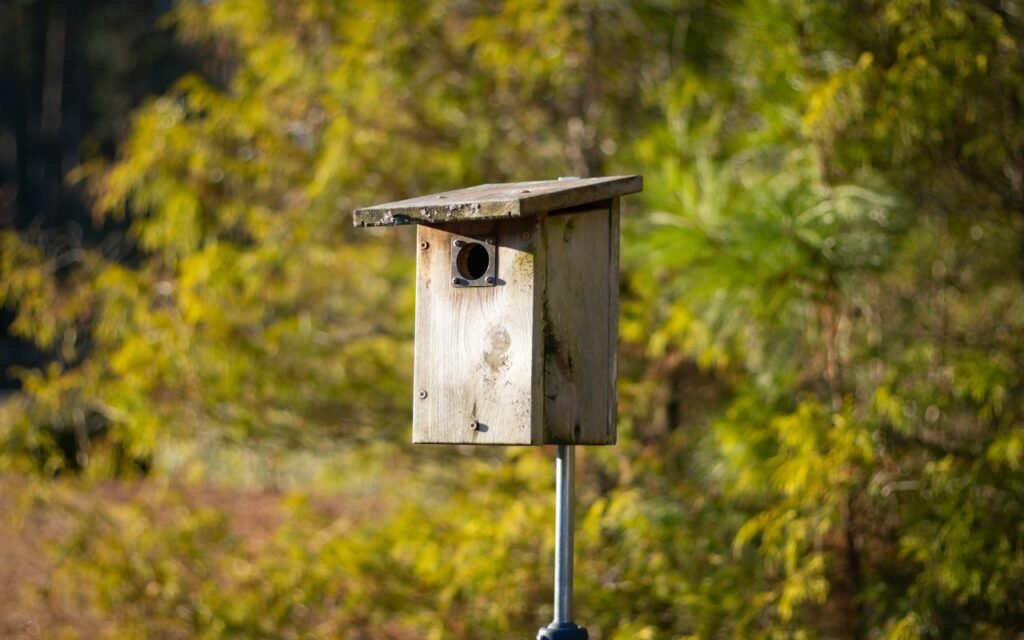
You spot what looks like a perfect tree, only to watch local birds completely ignore it. If you are hunting for the best birdhouse placement strategies, you know the frustration of staring at an empty box. Cavity nesters evaluate yards based on wind patterns, predator sightlines, and territorial stress. Finding the ideal spot requires building a safe refuge rather than hanging a decoration.
By angling entry holes away from local storm paths, isolating nesting spaces from high-traffic bird feeders, and using smooth freestanding pipe mounts, you can maximize your seasonal occupancy rates. Here is how to map your lawn’s layout to match the exact privacy and safety expectations of wild birds.
Where Is the Best Place to Put a Birdhouse?
The best location is a quiet, low-traffic zone mounted on a freestanding metal pole facing east-to-southeast, positioned at least 30 to 40 feet away from active backyard bird feeders and bird baths.
This specific layout shields the entrance portal from prevailing storm winds, prevents territorial fighting near high-volume food traffic, and blocks climbing ground predators completely when paired with an under-box stovepipe baffle.
1. The Compass Rule: Shielding From Prevailing Storms
The microclimate inside an enclosed nesting cavity dictates whether fragile hatchlings live or die during sudden spring cold snaps. As a universal installation baseline, your entry portal must face east, southeast, or due south.
Across most of North American ecosystems, highly destructive spring rainstorms and localized gust patterns blast directly out of the west and northwest. Facing your box in an easterly direction acts as a mechanical windbreak, preventing driving downpours from entering the entrance portal, soaking the delicate moss inner bedding, and chilling featherless nestlings.
Furthermore, an east-facing door matches natural solar cycles perfectly. It allows the first rays of morning dawn to hit the face of the wood box, warming up the cold interior air fast after a freezing night. Conversely, by the time the intense, baking heat of the late afternoon sun rolls around, the roof angle shields the core layout, stopping the box from turning into an oven.
2. The Feeder Buffer Zone Strategy
One of the most devastating mistakes a beginner can make is hanging a new nesting box directly adjacent to a high-volume sunflower or suet bird feeder. While humans view this as creating a convenient, all-in-one avian dining area, birds interpret this setup as a chaotic safety hazard.
Backyard bird feeders function as highly active public hubs. They draw in massive, noisy flocks of competing species, non-target mammalian pests like squirrels, and highly focused neighborhood predators like stalking domestic cats or Cooper’s Hawks. A brooding female cavity nester requires absolute sensory isolation to feel secure during her incubation window.
If her immediate canopy is constantly swarmed by foraging flocks, she will experience severe stress and completely abandon her clutch. To mitigate this threat, enforce a strict 30 to 40-foot structural buffer zone between your public feeding platforms and your private nesting boxes. This distance lets your parent birds forage effectively for nearby food resources while maintaining an isolated, stress-free airspace right outside their front door.
For a comprehensive look at balancing your entire backyard environment from scratch, refer back to our foundational birdhouse guide for beginners.
3. Open Fields vs. Shrubby Edge Habitats
Avian species select their nesting territory using strict landscape profiles. You must audit your lawn’s vegetation density before finalizing a mounting point, as trying to force an edge-dwelling bird into an open prairie layout will result in a permanent vacancy.
Open Meadow Nesters
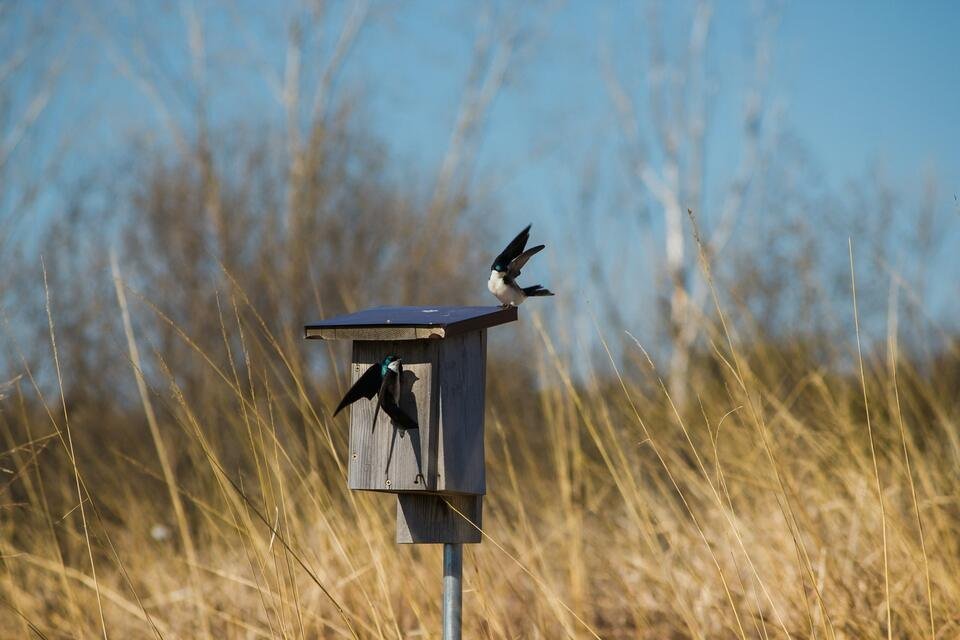
Vibrant species such as the Eastern Bluebird and Tree Swallow evolved to hunt across open pastures, farm fields, and broad meadows. They require wide expanses of open lawn with a clear radius to spot ground insects from above. Their nesting boxes should be placed completely out in the open, away from mature tree canopies that give crows, hawks, or blue jays an elevated vantage point to sit and watch the box entry door.
Brushy Edge Nesters
In direct contrast, small songbirds like House Wrens, Black-capped Chickadees, and Tufted Titmice avoid wide, exposed spaces where they are highly vulnerable to aerial attack. They seek out boxes placed along brushy forest margins, thick garden hedges, berry thickets, or dense ornamental shrubbery layers.
They utilize these low-hanging branches as safe staging points, temporary perches where they can hide, scan the lawn for immediate threats, and then fly quickly and directly into their entry portal.
4. Flight Path Physics and Canopy Clearance
Understanding flight mechanics is critical to predicting box occupancy. When wild birds leave a nesting box, they do not immediately accelerate into a steep vertical climb. Instead, they rely on a downward drop-off to gain airspeed before leveling out into horizontal flight. This means the exit trajectory from the entrance portal must be completely unobstructed.
Ensure that the direct linear airspace for at least 10 to 15 feet in front of the box doorway is entirely clear of low tree limbs, hanging clotheslines, climbing vines, or tall ornamental landscape grasses. If an adult bird is forced to maneuver through a dense web of branches just to clear the entrance, the metabolic cost of feeding their young skyrockets.
Furthermore, restricted exit paths create a perfect ambush zone for outdoor domestic cats to wait in low brush and catch parent birds as they attempt to slow down for a landing.
5. Isolating the Mount to Stop Climbing Pests
Tree trunks, wooden privacy fences, and porch deck railings are excellent design options for hanging human decorations, but they represent a fatal design choice for wild birds. The bark of a mature oak or the rough timber grain of a fence panel offers outstanding claw traction for climbing predators like raccoons, red squirrels, rat snakes, and neighborhood cats. Mounting your box here transforms a sanctuary into an easy hunting platform.
According to long-term field data tracked by the Cornell Lab of Ornithology NestWatch Program, the single safest way to put up small nest boxes is on smooth, free-standing metal poles or PVC pipes driven securely straight into the soil rather than utilizing existing wooden structures.
The slick, non-porous surface of a galvanized steel conduit pipe prevents land predators from gaining vertical leverage. To completely lock down this defensive perimeter, you must slide a metal stovepipe or cone-shaped predator baffle onto the pole directly below the base of your birdhouse, creating an absolute physical barrier against climbing raiders.
⚠️ CRITICAL PLACEMENT WARNING: Avoid Lawn Chemical Scent Trails
Never spray concentrated chemical insecticides, commercial lawn fertilizers, or synthetic weed killers within a 15-foot radius of your mounting pole. Growing cavity nesters rely on immediate ground vegetation to hunt for protein-dense caterpillars to feed their young. Toxic chemical residues easily transfer onto adult feathers during arrivals, and heavy ground fumes can quickly collect inside an enclosed nesting cavity, causing respiratory failure.
6. Managing Species Territory and Box Spacing
During the spring breeding season, wild birds fiercely enforce invisible territorial borders around their nests to protect localized food security. Trying to mount multiple birdhouses on the same tree trunk or post will trigger aggressive territorial fighting rather than high-density tenancy.
Intra-species Spacing Boundaries
Most solitary songbird pairs require a minimum of 100 to 300 feet of separation from another box housing the exact same species. If you want to deploy multiple bluebird or wren structures across a standard suburban property line, position the mounting pipes on opposite sides of your house or break up their lines of sight using outbuildings, garages, or thick evergreen privacy hedges.
The “Bluebird-Swallow Pairing” Exception
Field researchers have documented one remarkable structural exception to this territorial rule. Eastern Bluebirds and Tree Swallows compete aggressively for identical tree cavities, but they do not compete for food resources since swallows catch insects mid-air while bluebirds forage on the ground.
If you install two identical birdhouses exactly 15 to 20 feet apart, a pair of bluebirds will claim one box and a pair of swallows will claim the neighbor box. Once both pairs settle in, they form a highly effective defense pact. The highly agile swallows will dive-bomb crows, hawks, and outdoor cats, actively helping the bluebirds guard the immediate airspace for both families.
7. Human Foot Traffic and Domestic Animal Zones
The visual architecture of your human property impacts bird psychology far more than most people realize. Even if your box perfectly aligns with the compass and vegetation rules, positioning it over a pathway that experiences regular human or domestic pet movement will cause nesting failure.
Avoid placing boxes near high-traffic paths like concrete walkways, patio doors, children’s play structures, or along property edges where neighborhood dogs routinely run back and forth along a fence line. Every time a human or dog passes within a bird’s visual threshold, the brooding female is forced to make a survival calculation.
If she is startled off her eggs multiple times an hour, the internal incubation temperatures drop, threatening the viability of the clutch. Pick a low-traffic backyard quadrant, such as a quiet garden corner or a back meadow edge—where human observation can happen from a distant window rather than right next to the mounting post.
8. Evaluating Proximity to Open Water Sources
Water access is a dual-edged sword when mapping out your birdhouse grid. Cavity-nesting birds must drink and bathe daily to maintain their insulating feather alignments, but standing water is also a massive magnet for nest predators and invasive competitors.
Position your nesting box between 30 and 50 feet away from any natural backyard ponds, drainage ditches, or artificial bird baths. Placing a box closer than 30 feet to an open water source exposes vulnerable nestlings to high concentrations of emerging mosquitoes and biting blackflies, which can lead to nest fatality due to parasite infestation.
Furthermore, larger birds like Common Grackles and invasive European Starlings frequently swarm backyard water features. Keeping your nesting site at a distance prevents these aggressive birds from noticing the entrance portal while they utilize your lawn’s water stations.