
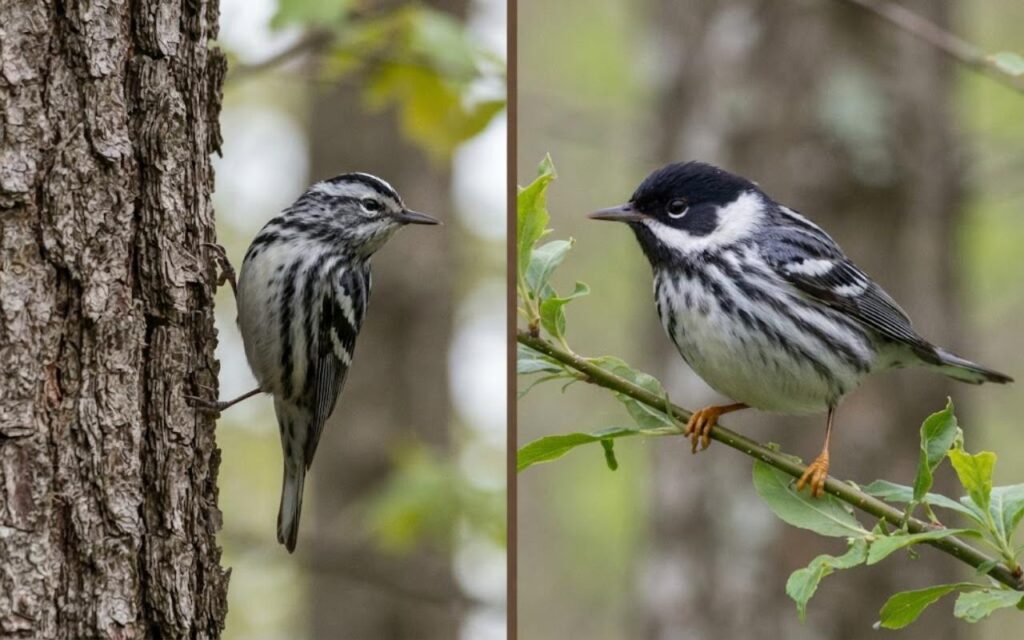
Tackling a Black-and-white Warbler vs Blackpoll Warbler identification in the field requires separating subtle plumage contrasts from rapid arboreal feeding behaviors. While spring breeding males share a monochrome palette of stark black, white, and heavy streaking, their anatomical structure and environmental niches diverge completely.
Birders frequently misjudge these two parulids when catching fragmented views through dense spring foliage or high canopies. Understanding their unique plumage geography, posture, seasonal molt cycles, and vocal profiles ensures clean identification even during challenging fall migration windows.
Quick-Glance Field Summary
Field identification between these two species hinges on examining crown patterns and observing vertical trunk climbing versus horizontal canopy hopping. Spring Blackpolls feature a solid black skullcap with clean white cheeks, whereas Black-and-white Warblers display a prominent white central crown stripe and creep along tree bark like a nuthatch.
- Crown pattern: Black-and-white shows a white median stripe; breeding male Blackpoll has a solid black cap.
- Auricular patch: Black-and-white features dark or dusky cheeks; breeding male Blackpoll shows stark white cheeks.
- Foraging niche: Black-and-white gleans along trunks and large limbs; Blackpoll gleans in the high outer canopy.
- Fall plumage: Black-and-white retains black and white stripes; Blackpoll shifts to dull olive-yellow with blurry streaks.
- Leg and foot color: Black-and-white has dark grey or black legs; Blackpoll exhibits pale yellowish or light horn-colored legs with pale soles.
Crown and Auricular Geography: Parsing the Solid Black Cap from Median Stripes
In community identification forums such as r/whatsthisbird, spring sightings often spark debates when birders grab fleeting photos of streaked underparts. A user recently posted an obscured canopy shot mistaking a breeding male Blackpoll Warbler for a Black-and-white Warbler simply because the bird presented bold, high-contrast monochrome flank streaks.
Forum veterans quickly resolved the inquiry by highlighting the head pattern, which serves as the most reliable visual baseline. The breeding male Blackpoll Warbler (Setophaga striata) exhibits a completely solid, uninterrupted black cap extending from the forehead straight back to the nape.
This crisp black skullcap sits directly above a clean, unstreaked white auricular cheek patch, creating an appearance reminiscent of a miniature chickadee. A narrow black line borders the lower jaw, framing the white throat and underparts without any pale interrupting lines across the crown.
In direct contrast, the Black-and-white Warbler (Mniotilta varia) never shows a solid black crown cap in any plumage. Both sexes feature a conspicuous, wide white median crown stripe bordered by heavy black lateral stripes. Their cheeks are dusky to solid black in adult males, bordered by a long white supercilium that curves over the eye and down the neck.
- Male Blackpoll cap: Solid glossy black down to the eye line with pure white cheeks.
- Black-and-white cap: Wide white median stripe centered between dual black lateral crown stripes.
- Eye framing: Blackpoll displays no white eye-stripe; Black-and-white shows a distinct white supercilium and lower crescent.
These sharp facial patterns allow for instantaneous separation even when birds forage in low light conditions.
| Field Trait | Black-and-White Warbler (Mniotilta varia) | Blackpoll Warbler (Setophaga striata) | Field Identification Clue |
|---|---|---|---|
| Crown Pattern | Bold white median stripe running straight through the center of a black head. | Solid, uniform ink-black cap with no center stripe (breeding male). | Look at the crown; a white stripe down the center confirms Black-and-White. |
| Leg & Foot Color | Uniform dark charcoal-gray or solid blackish legs and pads. | Bright, distinct orange or pale yellowish legs and clean yellow foot pads. | Check the feet; pale orange or yellow legs instantly confirm a Blackpoll. |
| Foraging Style | Creeps deliberately up and down major tree trunks and heavy limbs like a nuthatch. | Hops actively along slender twigs and leafy outer canopies to glean insects. | Behavior is absolute; trunk-crawling birds are virtually always Black-and-White. |
Locomotion Diagnostics: Trunk-Creeping Bark Gleaners vs Canopy Foliage Hops
Behavioral observations provide definitive proof of identity when lighting obscures feather color. On localized wildlife community boards, field observers emphasize that bird movement reveals species identity long before plumage details register through binoculars. The morphological build of each bird dictates an entirely separate style of motion through forest strata.
The Black-and-white Warbler is a dedicated bark gleaner whose physical anatomy reflects specialized tree-climbing adaptation. It possesses an unusually elongated hind claw, a short tail, and stout legs that permit it to hop vertically and upside-down along tree trunks and large horizontal boughs.
It systematically works its way up, down, and around primary tree limbs in a manner identical to a nuthatch or brown creeper, probing bark crevices for hidden insect larvae.
The Blackpoll Warbler exhibits standard foliage-gleaning warbler mechanics. It travels horizontally along outer branch tips, hopping deliberately between leaf clusters high in the forest canopy. A Blackpoll does not traverse bare tree trunks or hang upside-down along main boughs; instead, it pauses to peer under leaves and occasionally flutters out to snatch flying insects from the air.
- Black-and-white movement: Climbs vertically, spirals down bark trunks, and probes furrowed bark crevices.
- Blackpoll movement: Hops between horizontal branches, scans foliage leaves, and perches upright in the canopy.
- Primary foraging zone: Black-and-white occupies lower to mid-level bark; Blackpoll occupies mid to upper outer canopy foliage.
Observing an individual bird for just ten seconds will instantly resolve identification based entirely on whether it treats tree bark as a roadway or remains confined to foliage.
Fall Molt Drift: Sorting Drab Olive Immatures from Permanent Striping
Autumn migration introduces severe identification confusion for birders tracking the infamous confusing fall warblers. A common complaint across online ornithological communities involves identifying drab, greenish warblers that lack the bold breeding plumage seen in May.
The Blackpoll Warbler undergoes an extensive prebasic molt that completely transforms its appearance, while the Black-and-white Warbler remains remarkably consistent year-round.
In the fall, adult and immature Blackpoll Warblers lose all traces of their black skullcaps and white cheeks. They emerge in a dull olive-green wash across the head and back, accented by faint, blurry dusky streaking on the breast and flanks. Their underparts become a soft yellowish-buff that transitions to clean white undertail coverts, accompanied by two distinct white wing bars across dark flight feathers.
The Black-and-white Warbler undergoes a far less disruptive molt cycle. While fall immatures and females show slightly buffy flanks and duller black markings, they never develop an olive-green body wash. They retain their bold white median crown stripe, prominent supercilium, and contrasting zebra-like dorsal striping through every month of the year.
- Fall Black-and-white plumage: Retains black and white longitudinal stripes with clean or pale buff-washed flanks.
- Fall Blackpoll plumage: Olive-green upperparts, dull greenish-yellow throat and breast, and faint breast streaks.
- Fall Blackpoll wing structure: Prominent dual white wing bars contrasting against dark dusky primary feathers.
If an autumn migrant shows an olive-green cast across the crown or back, it cannot be a Black-and-white Warbler.
Tarsal and Foot Coloration: Yellow Soles versus Dark Sclerotic Scales
When examining high-canopy fall warblers through telephoto lenses, experienced field ornithologists rely heavily on bare part diagnostics. Discussion threads on community bird forums frequently highlight leg color as the absolute gold standard when separating fall Blackpolls from similar species like the Bay-breasted Warbler or Black-and-white Warbler. Leg pigmentation remains stable even when feather colors fade or vary by age.
Blackpoll Warblers feature distinctive pale leg coloration that stands out against shaded branches. Their tarsi are typically pale straw-yellow, flesh-toned, or light brownish-horn, accompanied by noticeably bright yellow soles on the undersides of their feet. Even in atypical individuals where the front of the tarsus appears dusky, turning angles reveal pale yellowish pigment along the rear edge and bottom of each toe.
The Black-and-white Warbler features uniformly dark leg structures tailored for heavy bark abrasion. Its tarsi and toes are clad in dark slate-grey or charcoal-black sclerotic scales that never display pale yellow tones. The soles of its large clinging feet match the dark grey tone of the surrounding tarsal skin.
- Blackpoll tarsus: Pale horn, light yellowish-brown, or dull flesh-colored.
- Blackpoll foot pads: Conspicuous bright yellow soles visible when perched or perching overhead.
- Black-and-white leg and foot: Dark slate-grey to bluish-black across the entire tarsus and toe structure.
Checking the foot and tarsus color provides an unambiguous hardware check when fall feather patterns appear intermediate or worn.
Acoustic Signatures: High-Frequency Wheelbarrows versus Accelerating Ticking
Vocalizations offer immediate identification when birds forage out of sight in dense deciduous canopy covers. Both species produce exceptionally high-pitched songs that challenge human high-frequency hearing thresholds, yet their rhythmic cadences differ completely. Acoustic software analyses and forum sound-ID threads point to rhythm as the primary separation factor.
The Black-and-white Warbler sings a repetitive, rolling two-syllable phrase commonly transcribed as weese-see, weese-see, weese-see. The song typically repeats between six and ten times in an even, unhurried cadence that sounds like an unoiled squeaky wheelbarrow rolling along a path.
The pitch alternates regularly between the high introductory note and the slightly lower second note, maintaining an even volume and tempo from start to finish.
The Blackpoll Warbler produces one of the highest-frequency songs of any North American passerine, often exceeding eight kilohertz. Its song consists of a rapid, mechanical series of short, ticking notes uttered on a single unvarying pitch: tsit-tsit-tsit-tsit-tsit-tsit. The series features a distinctive dynamic envelope, starting softly, swelling to a loud crescendo in the center, and fading out gently at the end.
- Black-and-white song cadence: Alternating two-note phrases with a rolling, rhythmic rise and fall.
- Black-and-white tone: Squeaky, thin, and delivered at a steady pace of several rhythmic units.
- Blackpoll song cadence: Rapid, single-pitch staccato ticks delivered at high speed.
- Blackpoll dynamic envelope: Distinct crescendo in the middle of the phrase that fades toward the conclusion.
Learning to separate the steady squeak of the bark creeper from the pulsing staccato tick of the canopy traveler completes a foolproof field identification strategy.