
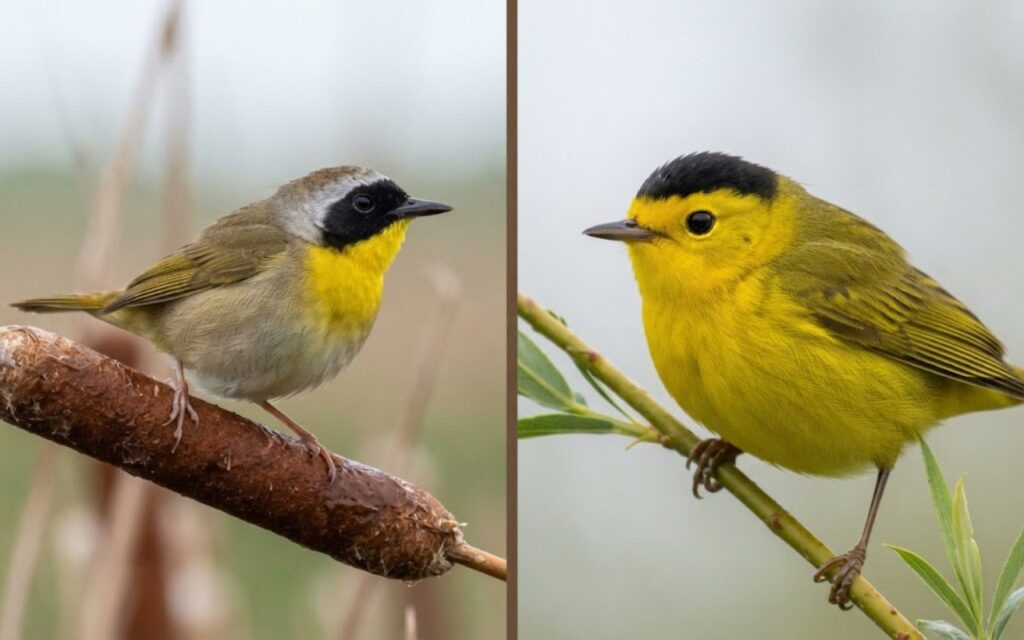
Distinguishing between a Common Yellowthroat vs Wilson’s Warbler presents one of the most classic identification puzzles for field birders across North American migration corridors and breeding territories. While adult breeding males display starkly contrasting head markings, female and immature fall plumages frequently leave observers struggling to make a definitive call in thick vegetation.
Field observers often miss critical field marks when birds are obscured by foliage or silhouetted against a bright sky. By moving past standard field guide portraits and learning how these two parulid species differ in facial structure, plumage demarcation, and micro-habitat mechanics, you can confidently separate them in seconds.
Quick-Glance Field Summary
Accurate separation relies on checking whether yellow extends continuously from the throat through the undertail coverts, combined with evaluating facial adornments and tail movement patterns. Wilson’s Warblers show uninterrupted yellow across the entire underside paired with nervous wing-flicking, whereas Common Yellowthroats display a distinct pale belly break and cock their tails upward in dense undergrowth.
- Wilson’s Warbler (Cardellina pusilla): Continuous bright yellow underparts from chin to vent, rounded black crown patch (subtle or veiled in some females), dark slender legs, and frequent aerial insect-hawking.
- Common Yellowthroat (Geothlypis trichas): Yellow restricted to throat and breast with contrasting whitish-buff belly, broad black bandit mask (males) or plain olive face (females), stouter pinkish legs, and low skulking behavior.
- Core Optic Target: Inspect the lower breast and belly junction; any wash of pale gray, white, or buff immediately rules out a Wilson’s Warbler.
- Behavioral Cue: Look for Wilson’s Warbler tail-pumping in circular or lateral sweeps, compared to the sharp, wren-like vertical tail-cocking typical of Common Yellowthroats.
Cranial Markings and Facial Structure Contrasts
The most definitive field mark on adult males is the orientation of their black head ornamentation. A male Common Yellowthroat features a bold, jet-black facial mask extending from the lores across the cheeks and forehead, bordered along the top by a frosty white or light gray line.
Conversely, a male Wilson’s Warbler sports a solid, glossy black cap perched squarely on top of the crown like a small beret, leaving the lores, forehead, and cheeks entirely saturated with vivid yellow.
Female and hatch-year birds present a much subtle challenge that frequently surfaces in bird identification forums. On platforms like Reddit’s r/whatsthisbird, novice observers regularly confuse female Wilson’s Warblers with female Common Yellowthroats because immature female Wilson’s can lack the black cap entirely.
In those non-capped individuals, check the facial plainness; female Common Yellowthroats exhibit a diffuse, pale eyering and buffy supraloral line on an otherwise drab olive-brown face, while female Wilson’s Warblers retain an open, bright yellow face framed by olive-yellow upperparts.
Bill morphology also provides a subtle structural separation for close-range binocular views. The bill of the Common Yellowthroat is relatively stout, heavy-based, and slightly decurved along the culmen, adapted for gleaning heavy-bodied larvae from fibrous marsh stems. The bill of the Wilson’s Warbler is noticeably smaller, finer, and needle-like, featuring prominent rictal bristles at the base to aid in snatching flying gnats mid-air.
| Field Trait | Common Yellowthroat (G. trichas) | Wilson’s Warbler (C. pusilla) | Field Identification Clue |
|---|---|---|---|
| Head Ornamentation | Oversized, heavy ink-black facial mask wrapping across the eyes and cheeks. | Small, neat, perfectly round glossy-black crown cap on top of a yellow head. | Look at the placement; a black mask means Yellowthroat, a black cap confirms Wilson’s. |
| Ventral Uniformity | Yellow is restricted to the throat and breast; belly and flanks fade to dull whitish-buff. | Uniformly bright, intense lemon-yellow running continuously from throat to under-tail. | Check the belly; pure yellow underparts indicate a Wilson’s Warbler. |
| Tail Dynamics | Holds tail relatively still or jerks it upward inside low brush cover. | Constantly flits, twitches, and rotates its tail in a circular motion while foraging. | Behavior is key; an active, frantic tail-twitching loop points straight to Wilson’s. |
Underpart Saturation and Vent Color Breaks
Plumage color across the ventral surface is the most reliable baseline diagnostic when birds are partially hidden behind dense leaves. A Wilson’s Warbler maintains unbroken, rich lemon-yellow pigment from the chin straight through the breast, belly, flanks, and undertail coverts. There is never a break in color tone along the ventral midline; the bird appears saturated throughout its entire lower profile.
In contrast, the Common Yellowthroat exhibits a pronounced color division across its underparts. The bright canary yellow of the throat and upper chest terminates abruptly, giving way to a dull whitish, buff, or pale gray belly and washed-out brownish flanks. Even on dull immature female yellowthroats, this contrasting belly patch remains visible under clean light.
- Wilson’s Warbler Underparts: 100 percent uniform yellow across throat, breast, belly, and crissum.
- Common Yellowthroat Underparts: Bright yellow throat and upper breast, transitioning to a pale dirty-white or buff belly, with yellow returning only at the undertail coverts.
- Flank Coloration: Wilson’s displays olive-yellow flanks; Common Yellowthroat shows dingy olive-brown or tan flanks.
Foraging Strata and Micro-Habitat Preferences
Habitat choices and vertical foraging zones offer clear environmental indicators during the breeding season. Common Yellowthroats are strict habitat specialists, breeding primarily in emergent wetlands, cattail marshes (Typha), sedge meadows, and dense damp brush along swamp borders. They rarely feed higher than six feet off the ground, spending most of their energy hopping through saturated reed beds and tangled briars.
Wilson’s Warblers prefer montane willow carrs, high-latitude alder thickets, riparian forest edges, and coastal scrub. While they readily forage in low willow ribbons, they actively utilize the mid-canopy and sub-canopy layers up to twenty feet or higher, particularly during peak insect blooms.
In Western river corridors where their breeding ranges overlap, the yellowthroat clings to the flooded emergent vegetation, while the Wilson’s Warbler occupies the upper foliage of the surrounding willow and cottonwood canopy.
Forum contributors on specialty wild bird networks frequently highlight that lighting within these micro-habitats creates optical illusions. For example, a birder in a Pacific Northwest willow thicket documented how dappled canopy shade cast shadows across a female Yellowthroat’s head, perfectly simulating a faint cap.
In these low-light situations, habitat placement alone can mislead you, which is why structural and plumage marks must confirm the identification.
Locomotion, Tail Mechanics, and Aerial Foraging
Watching how a bird moves through foliage frequently solves the puzzle before you even discern facial markings. Wilson’s Warblers are restless, hyperactive dynamos that constantly shuffle their perches and flick their wings. They frequently execute rapid, twisting aerial sallying maneuvers, launching from a branch to snap up insects in flight before looping back down to a new perch.
Common Yellowthroats move with a deliberate, secretive cadence. Rather than sallying out into open air, they skulk methodically through the dense understory, gleaning prey directly from thick reed stalks and tangled leaf litter. Their flight between perches is low, pumping, and hurried, dropping straight back down into cover as soon as possible.
- Wilson’s Warbler Tail Action: Frequent lateral twitching, nervous rotary tail-dipping, and shallow shivering of lowered wings.
- Common Yellowthroat Tail Action: Sharp vertical tail-cocking reminiscent of a marsh wren, often held elevated while perching on vertical stalks.
- Foraging Style: Wilson’s uses aerial flycatching and hover-gleaning; Yellowthroat relies on low-level surface gleaning inside dense tangles.
Chip Notes and Vocal Architecture
When thick brush prevents visual confirmation, vocalizations provide unambiguous species separation. The primary song of the Common Yellowthroat is the well-known, rollicking three-part cadence commonly transcribed as “witchity-witchity-witchity,” delivered with robust projection from deep inside a marsh. The song of the Wilson’s Warbler is a rapid, descending, chattering trill that accelerates toward the end, possessing a dry, mechanical quality.
Call notes are even more critical for year-round identification, especially during fall migration when songs cease. The Common Yellowthroat produces a husky, raspy, low-pitched “tchat” or “chack” that sounds surprisingly heavy for a wood-warbler. It serves as an aggressive scold note whenever an intruder approaches its nesting territory.
According to audio archives preserved in the Cornell Lab of Ornithology Macaulay Library, the call of the Wilson’s Warbler is a distinct, sharp, single “chip” note. Rather than a flat, nasal “jimp,” its acoustic profile is characterized by field researchers as a loud, explosive smacking sound that strongly mimics a puckering kiss.
Learning to isolate this sharp, kissing contact call allows you to instantly track traveling Wilson’s Warblers through high brush long before they reveal themselves to your optics.