
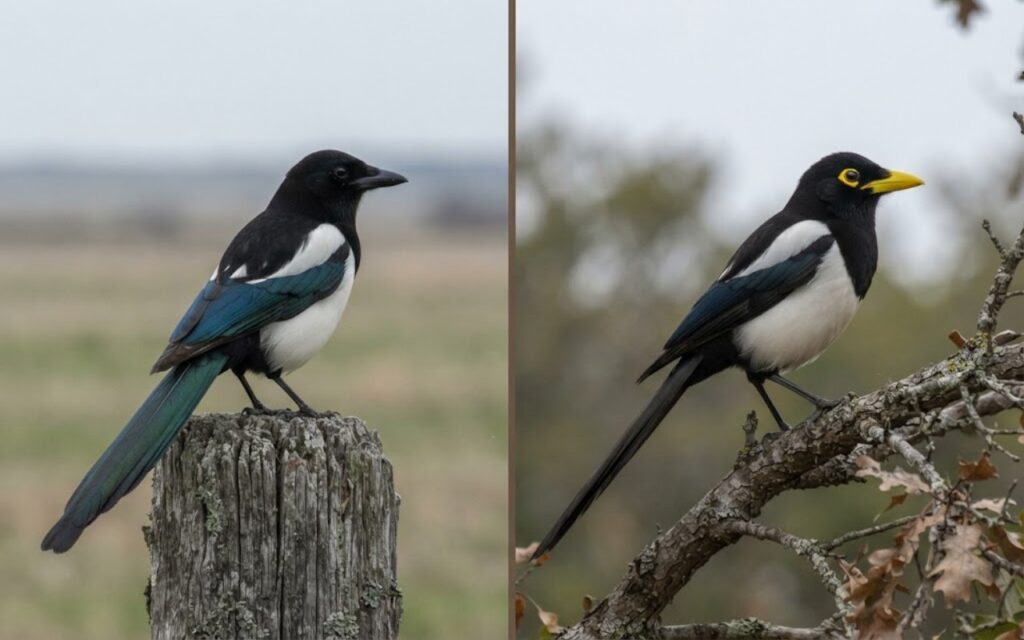
Distinguishing between a Black-billed Magpie vs Yellow-billed Magpie in the field is one of the classic identification challenges for western birders. While bill coloration seems like an obvious field mark on paper, real-world field conditions often present lighting glare, juvenile plumage variations, and fleeting views that complicate identification.
Understanding the subtle morphological traits, habitat boundaries, and acoustic signatures of these two sister species removes guesswork. This guide provides field-tested identification protocols and crowdsourced community insights to help you separate them accurately in every season.
Quick-Glance Field Summary
Separating these two corvids relies on evaluating geographic boundaries alongside head plumage and facial skin traits rather than bill color alone. Observers must cross-reference geographic location against bare orbital skin patches and distinct vocal registers to eliminate lighting illusions.
- Geographic range: Yellow-billed is strictly endemic to California west of the Sierra Nevada; Black-billed occupies the Intermountain West, Great Plains, and coastal Alaska.
- Bill coloration: Yellow-billed features a bright yellow-orange bill; Black-billed displays an entirely black bill across all ages.
- Orbital eye skin: Yellow-billed shows a naked crescent of bright yellow skin below and behind the eye; Black-billed displays fully feathered black lores and ocular regions.
- Vocal pitch: Yellow-billed calls are higher pitched and more nasal at roughly 1.5 to 2.2 kHz; Black-billed calls sit lower at roughly 1.0 to 1.6 kHz.
- Temperature tolerance: Yellow-billed thrives in hot Mediterranean oak savannas; Black-billed manages harsh montane and subarctic winter cold down to -40°F.
Geographic Isolation and the Sierra Nevada Distribution Barrier
The single most reliable indicator separating these two species is geographic range. The Yellow-billed Magpie (Pica nuttalli) is entirely endemic to California, restricted to the Central Valley, surrounding oak-covered foothills, and south-central coastal valleys. In contrast, the Black-billed Magpie (Pica hudsonia) occupies a sprawling western range spanning the Rocky Mountains, the Great Basin, Canada, and up into Alaska.
Community discussions on r/whatsthisbird frequently emphasize that true geographic overlap between these species is virtually non-existent under natural conditions. The high-altitude spine of the Sierra Nevada forms a natural biogeographical wall that keeps the populations strictly segregated. A birder encountering a wild magpie east of the Sierra crest in Nevada or north of the Oregon border is universally looking at a Black-billed Magpie.
The only potential confusion zones occur near the northeastern margins of California, such as Modoc and Lassen counties, where Black-billed Magpies breed east of the Cascade and Sierra crests. In community listserv threads covering northern California, observers occasionally report vagrants or escapees in atypical microclimates. However, healthy wild populations maintain distinct geographic boundaries without established, overlapping breeding territories.
| Identification Mark | Black-billed Magpie (Pica hudsonia) | Yellow-billed Magpie (Pica nuttalli) | Field Identification Clue |
|---|---|---|---|
| Bill Coloration | Solid, deep ink-black bill from base to tip. | Vibrant, bright lemon-yellow bill. | Look directly at the beak; a yellow bill instantly confirms a California endemic. |
| Facial Skin | Completely black, fully feathered face surrounding the eye. | A distinct patch of bare, bright yellow skin directly behind and below the eye. | Yellow-billed species show a prominent bare yellow “eyebrow” patch. |
| Geographic Range | Widespread across the Western interior, Rocky Mountains, and plains. | Strictly endemic to California’s Central Valley and coastal oak foothills. | Location is definitive; Yellow-billed magpies do not live outside California. |
Bill Pigmentation, Facial Bare Skin, and Harsh Sun Optical Glare
While the primary field mark is bill coloration, lighting conditions in open open-country habitats frequently create visual distortions. On community birding forums, photographers frequently share images where intense midday sunlight reflects off a Black-billed Magpie’s wet or polished bill, creating a pale sheen that mimics yellow horn tissue. In contrast, heavy shadowing in dense riparian trees can obscure the bright lemon tone of a Yellow-billed Magpie’s bill.
To avoid false identifications caused by optical glare, experienced field observers inspect the bare skin surrounding the eye rather than relying solely on the bill tip. Yellow-billed Magpies possess a diagnostic, unfeathered patch of bright yellow orbital skin extending under and behind the eye. This naked skin patch remains visible even when backlit or partially obscured by foliage.
Black-billed Magpies possess fully feathered eye perimeters with black feathers meeting the eye edge uniformly. In poor lighting, checking this ocular perimeter provides instant clarity.
- Bill color: Pure yellow-orange in adult Yellow-billed; solid carbon-black in adult and subadult Black-billed.
- Post-ocular bare skin: Present and yellow in Yellow-billed; absent and fully feathered black in Black-billed.
- Plumage iridescence: Both species show glossy blue-green structural color on the wings and tail feathers.
- Underwing contrast: Both species reveal extensive white primary patches in direct flight.
Vocalization Frequencies and Rapid Chattering Acoustics
When visual confirmation is obscured by thick oak canopies, acoustic analysis provides definitive proof of identity. The primary vocalization of both corvids consists of an agitated, multi-syllable alarm rattle described as a harsh chatter. However, the fundamental frequency and tonal resonance between the two species diverge noticeably to an attentive ear.
Field observers posting on regional audio archive boards note that the Yellow-billed Magpie exhibits a higher, distinctly nasal pitch. Its chatter sounds thinner and more querulous, often compared to the whine of a small ratchet tool. Black-billed Magpies deliver a deeper, throaty rasp with lower fundamental resonance and more percussive cadence.
If you are tracking an agitated flock in dense brush, record a quick voice memo on your smartphone to evaluate the frequency profile. The vocal signatures match distinct acoustic bands that help verify your sighting.
- Yellow-billed rattle frequency: Peaks higher, ranging from 1.5 kHz to 2.2 kHz with clear harmonic overtones.
- Black-billed rattle frequency: Resonates lower, concentrated between 1.0 kHz and 1.6 kHz with gravelly rasping.
- Delivery cadence: Yellow-billed notes cycle rapidly at 5 to 7 syllables per second in high agitation.
- Black-billed delivery: Tends toward slightly slower, chunkier groupings of 3 to 5 notes per burst.
Juvenile Gape Transition Pitfalls and Molt Misidentifications
A frequent point of community confusion surfaces each summer when juvenile corvids fledge and display non-standard bill tones. User threads on specialized bird identification forums consistently reveal birders mistaking juvenile Black-billed Magpies for Yellow-billed variants due to soft, pale gape flanges. A freshly fledged Black-billed Magpie often shows fleshy yellow or pink edges at the base of the bill.
Conversely, juvenile Yellow-billed Magpies do not leave the nest with fully saturated golden bills. Their bills often appear dull, dingy horn-gray or pale yellow-brown, only brightening as carotenoid pigments accumulate through summer molts. These transitional stages cause birders to doubt their checklists when observing family groups in late spring and early summer.
To properly age and identify fledglings, field ornithologists recommend observing bill shape and gape texture alongside social context. Juvenile birds exhibit shorter bill profiles, softer facial feather borders, and food-begging behavior directed at adults.
- Fledgling Black-billed bill: Dark central culmen with fleshy yellow-pink mouth corners that darken within weeks.
- Fledgling Yellow-billed bill: Muted yellowish-gray horn that lacks the intense chrome-yellow saturation of mature adults.
- Juvenile eye ring: Yellow-billed fledglings develop the yellow post-ocular patch quickly, distinguishing them from Black-billed juveniles.
- Behavioral verification: Juveniles remain near nesting colonies, following fully plumaged adult birds for nourishment.
Habitat Microclimates and West Nile Virus Conservation Impacts
Habitat selection highlights the physiological adaptations that separate these sister species. Yellow-billed Magpies are ecological specialists tied directly to California oak savanna, riparian woodlands, and agricultural edges bordering valley oaks (Quercus lobata). They require tall canopy trees for colonial nesting structures alongside open ground for foraging on acorns, insects, and seeds.
Black-billed Magpies are ecological generalists adapted to cold, dry climates across sagebrush plains, agricultural fields, and montane pine forests up to 9,000 feet elevation. They regularly forage in urban alleyways and cattle feedlots throughout severe sub-zero winters. Yellow-billed Magpies avoid high-elevation snow zones, remaining anchored within mild Mediterranean valleys.
Conservation status represents another stark divergence between these birds. The Yellow-billed Magpie suffered catastrophic losses starting in 2004 due to extreme susceptibility to West Nile Virus, which destroyed an estimated 50 percent of its total population. Monitoring protocols developed by local Audubon chapters stress the importance of documenting Yellow-billed colonies, as this localized species remains vulnerable to habitat fragmentation and seasonal disease outbreaks.
- Yellow-billed habitat: Lowland Mediterranean climate, valley oak savannas, walnut orchards, and suburban park edges below 2,000 feet.
- Black-billed habitat: Sagebrush scrub, river bottoms, aspen groves, high-elevation montane valleys, and suburban corridors.
- Nesting architecture: Both build massive domed stick nests with distinct lateral escape holes.
- Conservation category: Yellow-billed is an Audubon species of special concern; Black-billed maintains stable, widespread populations.