
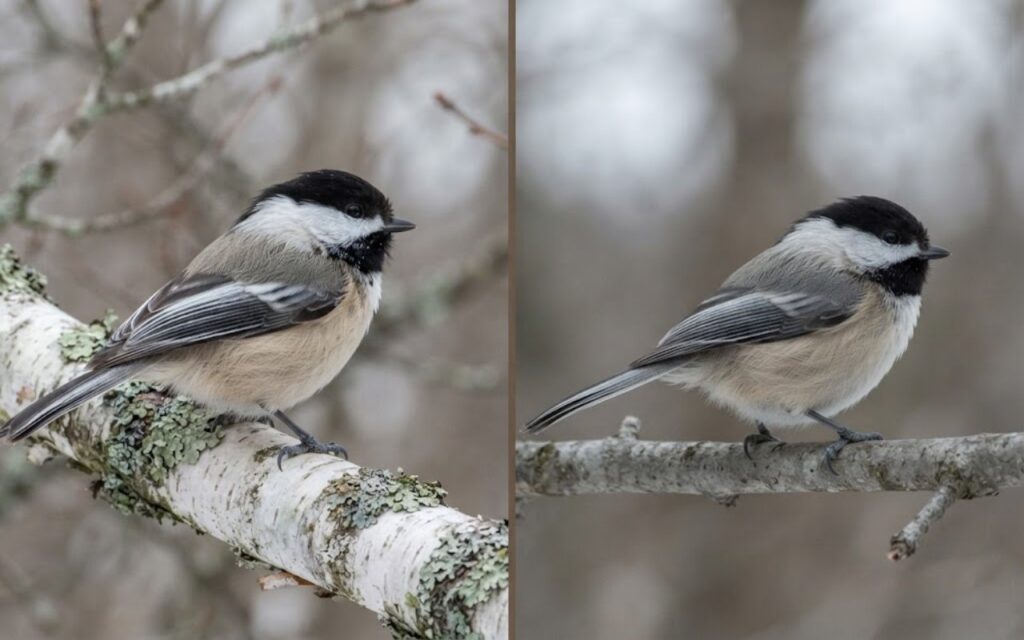
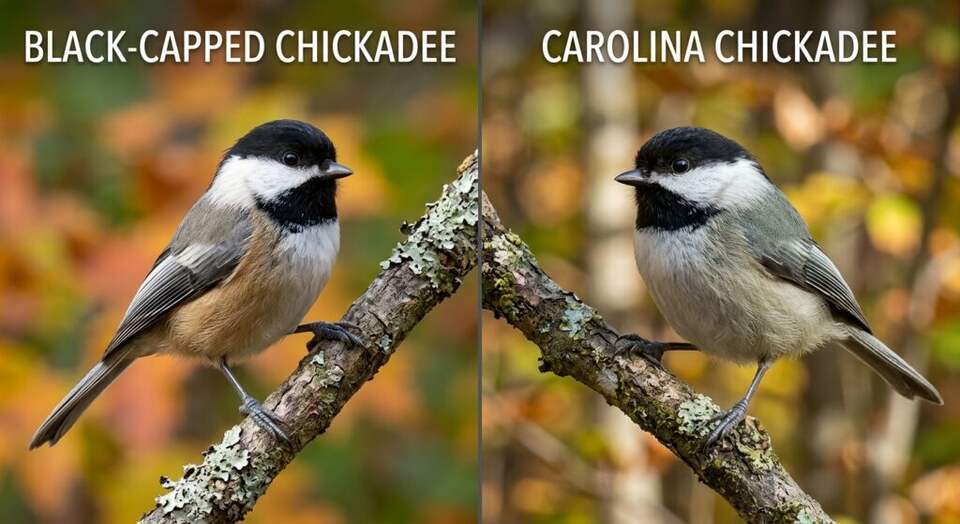
Comparing the black-capped chickadee vs carolina chickadee introduces birders to a difficult identification challenge along a narrow mid-Atlantic hybrid line. These tiny lookalikes share nearly identical black caps and dark throat bibs across overlapping territorial borderlines. Misidentifying them typically occurs in backyard gardens directly inside this contact zone where the species frequently interbreed.
The secret to telling them apart instantly relies on checking your county map and analyzing folded wing margins. Black-capped Chickadees feature broad, stark white feather edges that create a bold wing frosting, whereas Carolina Chickadees display uniform gray wings lacking white piping. This comprehensive manual breaks down these subtle plumage markers and song tempo shifts to help you confidently identify your local visiting flocks.
Quick-Glance Field Summary
Separating these two chickadee species relies on evaluating a cluster of subtle traits including vocal pitch sequence, secondary wing feather edging, and geographic coordinate alignment rather than any single visual marker.
In the active suture zone, visual identification of silent birds is often impossible without high-resolution photographic wing chord analysis or genetic testing.
- Geographic dividing line: A dynamic band roughly tracking the 39th to 40th parallel north, shifting northward at approximately one kilometer per year.
- Black-capped Chickadee song: Pure, two-note whistle “fee-bee” spaced around 3.5 to 3.2 kHz with a lower second note.
- Carolina Chickadee song: Higher-pitched, four-note whistle “fee-bee fee-bay” ranging from 4.0 to 6.0 kHz.
- Black-capped tail-to-wing ratio: Tail length averages over 85 percent of wing chord length.
- Carolina tail-to-wing ratio: Tail length averages under 80 percent of wing chord length, creating a compact silhouette.
- Wing covert edging: Black-capped shows broad, bright white “hockey puck” edges on secondaries; Carolina shows dull gray or narrow off-white margins.
- Bib appearance: Black-capped features a ragged, diffuse bottom bib edge; Carolina features a clean, neatly truncated bib margin.
Geographic Overlap and the Shifting Hybrid Suture Zone
The geographical range boundary between these two species forms an active, narrow suture zone stretching from New Jersey through southern Pennsylvania, central Ohio, Indiana, and Illinois, then southwest into Missouri and Kansas.
On community forums like r/birdwatching, birders based in central Pennsylvania frequently express frustration when trying to log winter feeder visitors, noting that visual traits alone constantly contradict automated audio identifiers.
Climate warming has driven the Carolina Chickadee steadily northward into historic Black-capped territory over recent decades, moving the contact line north at roughly one kilometer annually.
Within this 20 to 35 kilometer wide transition corridor, interbreeding occurs regularly, resulting in fertile hybrids that display intermediate plumage and mixed vocalizations.
Research from localized banding stations shows that birds found north of Interstate 80 are predominantly Black-capped, while those well south of the Mason-Dixon line are Carolina Chickadees.
If you are observing a silent bird directly inside this overlapping latitude belt, responsible field ornithology mandates recording the entry simply as a chickadee species complex unless high-definition audio or in-hand measurements are secured.
Elevation also plays a crucial role in the Appalachian region. Carolina Chickadees occupy the low river valleys, while Black-capped Chickadees persist in higher elevation spruce and mixed-hardwood pockets above 2,500 feet.
Understanding local topography helps eliminate confusion before you even lift your binoculars.
Plumage Field Marks: Bib Margins and Wing Covert Edging
When good lighting allows for close-range visual inspection, the primary field mark lies along the trailing edges of the folded wing. The Black-capped Chickadee features extensive, clean white edges along the secondary flight feathers and greater wing coverts, often nicknamed the “white hockey puck” or “snowy wing patch” among forum birders.
In contrast, the Carolina Chickadee exhibits uniform slate-gray secondaries with very narrow, dull grayish-white margins that rarely contrast sharply with the rest of the wing.
Feather wear complicates this diagnostic mark during the late spring and summer months. A thread contributor on the WhatIsThisBird community highlighted how abrasive nesting cavity entrances wear down feather tips, stripping away white fringes and causing worn Black-capped Chickadees to mimic the plain, drab wings of Carolina Chickadees.
- Black-capped secondary edging: Broad, prominent snowy-white margins forming an obvious panel on the closed wing.
- Carolina secondary edging: Thin, muted grayish-white margins with little to no obvious wing panel contrast.
- Black-capped nape and bib: Large, ragged black bib with feathery, irregular edges bleeding softly into a white chest.
- Carolina nape and bib: Compact, neat black bib ending sharply along a crisp, straight horizontal margin.
- Black-capped cheek patch: Gleaming, pure white cheeks extending back past the ear coverts onto the sides of the neck.
- Carolina cheek patch: Duller grayish-white cheeks, often showing a faint dusky tint toward the lower nape.
The overall color cast of the body flanks provides an additional clue. Black-capped Chickadees possess a warm, rich buffy-tan wash across their flanks, especially fresh after the post-breeding molt in autumn. Carolina Chickadees show paler, cooler, pale-gray flanks with minimal tan coloration.
Vocalization Mechanics: Deciphering the Fee-Bee and Fee-Bay Song Sequences
Acoustic analysis is the most dependable field tool for separating pure populations outside the hybrid corridor. The typical spring song of the Black-capped Chickadee is a simple, two-note whistle transcribed as “fee-bee.”
The first note sounds at approximately 3.5 kHz, followed by a slight pitch drop of about 150 to 200 Hz for the second note, which often features a rapid amplitude modulation stutter.
Carolina Chickadees deliver a higher-pitched, faster, four-note song usually written as “fee-bee fee-bay.” This song alternates between high and low frequencies, typically oscillating from 5.0 kHz down to 4.0 kHz, then back up to 5.5 kHz before dropping again. The vocal cadence is brisk and airy, lacking the clear, resonant volume of the Black-capped whistle.
The ubiquitous scold call, often transcribed as “chick-a-dee-dee-dee,” also carries measurable diagnostic differences. Carolina Chickadees call at a significantly faster tempo with higher pitch, packing more introductory “chick” notes and terminal “dee” notes per second into each burst. Black-capped calls are slower, deeper, and sound noticeably huskier to the trained human ear.
Hybrid individuals throw a major wrench into audio identification apps by learning bilingual songs or scrambling the syllables.
Banding studies confirm that hybrid chickadees frequently sing reversed four-note songs or combine a Black-capped introductory note with Carolina terminal phrasing. When an audio recording reveals aberrant syntax in the contact zone, morphological measurements become necessary.
Morphometric Proportions: Tail-to-Wing Chord Ratios in the Hand
In hand at banding stations, licensed ornithologists rely on strict morphometric ratios rather than subjective feather coloration. The most definitive physical parameter is the tail-to-wing chord ratio, which separates the two species with high statistical reliability. Black-capped Chickadees are longer-tailed birds with a distinct, proportionally elongated appearance.
Carolina Chickadees feature a shorter tail relative to their overall wing length, giving them a more compact, bull-necked posture in the field. Measuring unflattened wing chords and rectrix lengths produces decisive ratios that bypass plumage ambiguities caused by dirt or feather abrasion.
- Black-capped wing chord: Measures between 60.5 and 67.5 millimeters in typical adult specimens.
- Black-capped tail length: Measures between 56.5 and 63.0 millimeters, yielding a tail-to-wing ratio of 0.886 to 1.032 (typically above 0.90).
- Carolina wing chord: Measures between 56 and 64 millimeters in adult specimens.
- Carolina tail length: Measures between 48 and 55 millimeters, yielding a tail-to-wing ratio of 0.819 to 0.922 (typically below 0.90).
- Outermost rectrix differentiation: Outer tail feathers of Black-capped show pale white margins; Carolina shows uniform gray margins.
Field observers without banding permits can still evaluate these proportions through high-resolution photography. Look for the tip of the tail relative to the folded primary feather tips while the bird perches horizontally on a branch. A Black-capped Chickadee displays an elongated tail extending far beyond the wing tips, whereas a Carolina Chickadee appears visibly shortened from rear flank to tail tip.
Feeder Habitat Strategy, Nest Box Cavities, and Winter Flocking Behavior
Both species readily frequent backyard feeders, but their microhabitat selections and foraging movements show distinct evolutionary adjustments. Black-capped Chickadees thrive in northern deciduous, mixed conifer, and boreal edges where winter temperatures routinely plunge below zero.
They exhibit extraordinary memory capacity, caching thousands of black oil sunflower seeds across acres of woodland and enlarging their hippocampus seasonally to retrieve them.
Carolina Chickadees are better adapted to humid southeastern pine barrens, oak-hickory forests, and suburban green spaces. While they also cache seeds, they depend less heavily on long-term storage mechanisms due to shorter, milder winters.
Both species enthusiastically choose high-lipid winter feeds, but backyard enthusiasts should cater to their small bills and agile clinging habits.
- Feeder offerings: Clean black oil sunflower seeds, shelled sunflower chips, and high-tallow suet blocks packed with animal fat.
- Hopper placement: Hang feeders within three feet or beyond thirty feet of exterior home windows to eliminate fatal flight collisions.
- Nest box entrance diameter: Bore precisely 1.125-inch (1 1/8-inch) entrance holes to exclude larger House Sparrows while admitting both chickadee species.
- Nest box dimensions: Construct an interior floor measuring 4 by 4 inches with an 8-inch depth, adding wood shavings inside the base.
- Predator deterrence: Mount boxes on metal poles equipped with 8-inch stovepipe baffles rather than attaching them directly to tree trunks.
During winter, both species act as nuclear leaders of mixed-species foraging flocks, guiding nuthatches, kinglets, titmice, and downy woodpeckers through woodland feeding circuits.
Their alarm calls broadcast specific predator threats to the entire avian community, with additional “dee” notes tacked onto the call to indicate higher threat levels. Observing flock dynamics along the boundary line offers an intimate window into how these two closely matched songbirds divide and share the landscape.