
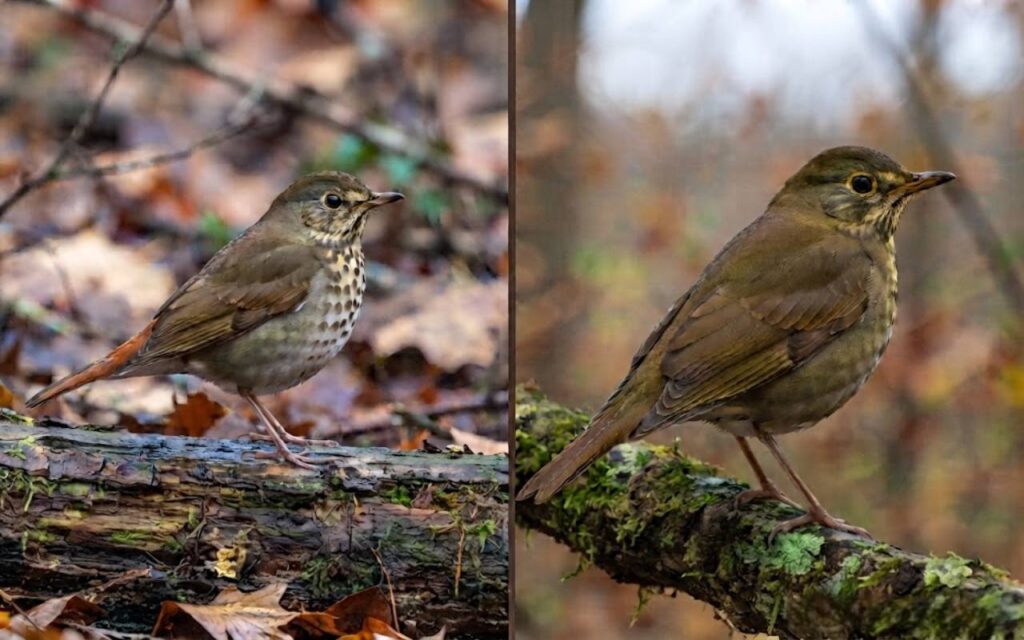
Distinguishing between a Hermit Thrush vs Swainson’s Thrush in the field is one of the most classic identification puzzles encountered by birders across North America. Both species share spotted cream underparts, drab brown upperparts, and a tendency to lurk in dense, shadowed forest understories.
Recent identification threads on r/whatsthisbird frequently highlight how deceptive lighting in deep foliage can trick observers into misjudging warmth in plumage tones. Backyard observers also frequently confuse nocturnal flight calls during migration seasons, mistaking the spring-peeper-like night call of one species for backyard frogs or common migrant sparrows.
Quick-Glance Field Summary
Telling these two Catharus thrushes apart requires isolating three immediate field marks: the contrast between the tail and the back, the presence of buffy spectacles on the face, and diagnostic tail movements.
Looking for a rapid tail cock followed by a slow drop confirms a Hermit Thrush, while an upward-spiraling song and bold buff-colored eye-rings connected across the bill base confirm a Swainson’s Thrush.
- Tail coloration: Hermit Thrush shows a distinct reddish-rufous tail contrasting with a duller olive-brown back; Swainson’s Thrush shows a uniform olive-brown tail matching its back.
- Facial pattern: Hermit Thrush exhibits a distinct white eye-ring with dark lores; Swainson’s Thrush features a bold buffy eye-ring connected by buffy lores to form distinct spectacles.
- Body motion: Hermit Thrush routinely cocks its tail upright and lowers it slowly; Swainson’s Thrush keeps its tail still or gives quick, nervous wing flicks.
- Song structure: Hermit Thrush begins with a single, clear, sustained flutelike whistle before warbling; Swainson’s Thrush sings a rolling series of phrases that spiral consistently upward in pitch.
- Call notes: Hermit Thrush gives a low, dry “chup” or “cluck”; Swainson’s Thrush produces a high, liquid, rising “whit” or night-migrant “peep”.
- Seasonal timing: Hermit Thrush winters across North America and lingers in cold weather; Swainson’s Thrush is a strict Neotropical migrant absent in temperate regions during winter.
Plumage Contrast and the Rufous Tail Diagnostic
The primary visual indicator separating these two birds is the color contrast between the rump, tail, and mantle. A Hermit Thrush displays a two-toned dorsal appearance, featuring an olive or grayish-brown back paired with a distinctly warm, reddish-rufous tail and rump.
Swainson’s Thrush displays a completely uniform dorsal tone, with its tail, wings, and back sharing the exact same shade of russet-olive or grayish-olive depending on whether it belongs to the Pacific or olive subspecies group.
Lighting conditions inside damp thickets cause substantial confusion for field observers. Reddit community members frequently report that sunlight filtering through autumn canopies can cast warm golden reflections across a Swainson’s Thrush, making its tail appear deceptively red.
To avoid misidentification, you must view the bird in neutral light or look for a definitive boundary line where the lower back meets the upper tail coverts.
If the bird hops into view and shows a distinct reddish contrast only on the tail feathers, it is a Hermit Thrush. If the bird remains completely monochromatic across its entire upper surface from nape to rectrices, you are looking at a Swainson’s Thrush.
| Thrush Mark | Hermit Thrush (C. guttatus) | Swainson’s Thrush (C. ustulatus) | Field Identification Clue |
|---|---|---|---|
| Tail Color Contrast | Distinctly warm, rufous-reddish tail that contrasts strongly with a colder grayish-brown back. | Uniformly olive-brown from the crown of the head straight down to the tip of the tail. | Look at the tail; a sudden flash of warm brick-red indicates a Hermit Thrush. |
| Facial Eye-Ring | Narrow, crisp, and clean white eye-ring with a relatively plain, dark gray face. | Broad, bold, warm buffy-yellow eye-ring that extends forward to form distinct spectacles. | Swainson’s displays prominent, cream-colored glasses; Hermit faces look plain. |
| Physical Habit | Vigorously and frequently pumps its tail downward, then raises it slowly. | Holds its body rigid and still; rarely or never pumps its tail when perched. | Perched motion is a dead giveaway; constant tail-flicking confirms a Hermit. |
Facial Markings and the Buffy Spectacle Diagnostic
When a thrush is facing you directly or perched behind thick brush, the facial pattern provides the most reliable visual field mark. Swainson’s Thrush features prominent buffy lores that connect directly into a bold, buff-tinted eye-ring. This continuous wash of warm color across the bridge of the bill creates the appearance of eyeglasses, commonly referred to by ornithologists as spectacles.
The Hermit Thrush lacks this connected spectacle feature entirely. Instead, it possesses a clean, whitish eye-ring set against cold, dark, or grayish lores. The absence of warm buff on the lores makes the white eye-ring stand out sharply, giving the bird a wide-eyed, startled facial expression.
- Hermit Thrush: Stark white or pale off-white orbital ring; dark grayish or muted lores; lacks a pale bridge across the bill.
- Swainson’s Thrush: Distinct warm buff or yellowish-tan orbital ring; broad buffy lores; clearly defined spectacles wrapping the eyes and upper bill.
In worn late-summer plumage, the buff wash on a Swainson’s Thrush can fade slightly toward cream. Even when faded, the pale coloration across the lores remains visible, preventing the isolated circular eye-ring look characteristic of the Hermit Thrush.
Motion Signals and Tail-Pumping Biomechanics
Behavioral biomechanics provide immediate identification value when foliage conceals the head or tail coloration. The Hermit Thrush exhibits a diagnostic nervous habit known to field researchers as tail-cocking. When landing on a branch or stopping on the forest floor, it abruptly jerks its tail upward by twenty to forty degrees and slowly lowers it back to the resting position.
This movement is almost universally accompanied by a slight, rhythmic flicking of the primary wingtips. Swainson’s Thrush does not perform this deliberate cock-and-drop tail routine. While a Swainson’s Thrush may give quick, agitated wing-flicks when startled, its tail remains aligned with the body axis rather than snapping upward.
Community discussions on regional birding boards note that this behavioral cue works across all North American subspecies. Even in poor light where plumage tones fail, watching a perching thrush for five seconds will usually reveal this mechanical behavior.
If the bird drops onto a log, snaps its tail up rapidly, and lets it sink slowly, you can identify it as a Hermit Thrush without checking its plumage.
Acoustic Signatures from Flute Openers to Upward Spirals
Vocalizations offer an unambiguous distinction between these species during spring migration and the breeding season. The Hermit Thrush is famous for its serene, ethereally paused song structure. Each phrase begins with a single, long, clear introductory flute note, followed by complex, musical descending and ascending arpeggios on completely different pitch registers.
In contrast, the song of the Swainson’s Thrush follows a distinctive rolling cadence that spirals steadily upward in frequency. The notes cascade through harmonic overtones, ending at a pitch higher than the starting phrase without pausing on an isolated introductory whistle.
Field observers often describe the song of the Swainson’s Thrush as a swirling, liquid vortex of flute notes climbing a musical staircase.
- Hermit Thrush song: Single long introductory whistle; subsequent phrases vary widely in pitch; phrases separated by pauses.
- Swainson’s Thrush song: Rolling, continuously ascending spiral; no isolated flat intro note; phrases end on high harmonic frequencies.
- Hermit Thrush contact call: A low-pitched, deep, dry “chup” or guttural “tuck” delivered from low branches.
- Swainson’s Thrush contact call: A sharp, upward-slurred, liquid “whit” or “quip”, similar to the sound of a water drop.
At night, migrating Swainson’s Thrushes emit a distinctive flight call that sounds remarkably like a Spring Peeper frog. Thousands of these calls can be heard overhead on calm autumn nights across suburban neighborhoods.
Phenology Timing and Seasonal Habitat Overlap
Calendar dates and geographic distribution rule out many identification errors before field gear is even unpacked. Swainson’s Thrush is a complete long-distance Neotropical migrant that winters exclusively in Central and South America.
Any spotted Catharus thrush observed in the United States or southern Canada between December and March is almost certainly a Hermit Thrush. Hermit Thrushes are physiologically adapted to cold climates, relying on winter berries and ground invertebrates to survive freezing temperatures.
They inhabit temperate woodlands, riparian thickets, and suburban yards throughout the southern and coastal United States all winter long. Swainson’s Thrushes do not arrive in North America until late April or early May, and they vacate northern breeding territories by early October.
During the narrow spring and autumn migratory windows when both species occupy the same woodlot, elevation and microhabitat often diverge. Swainson’s Thrushes favor dense, mid-canopy deciduous foliage and boreal coniferous zones during breeding.
Hermit Thrushes are more terrestrial, spending extensive time foraging through leaf litter on the ground or perching silently on low, shadowed branches.