
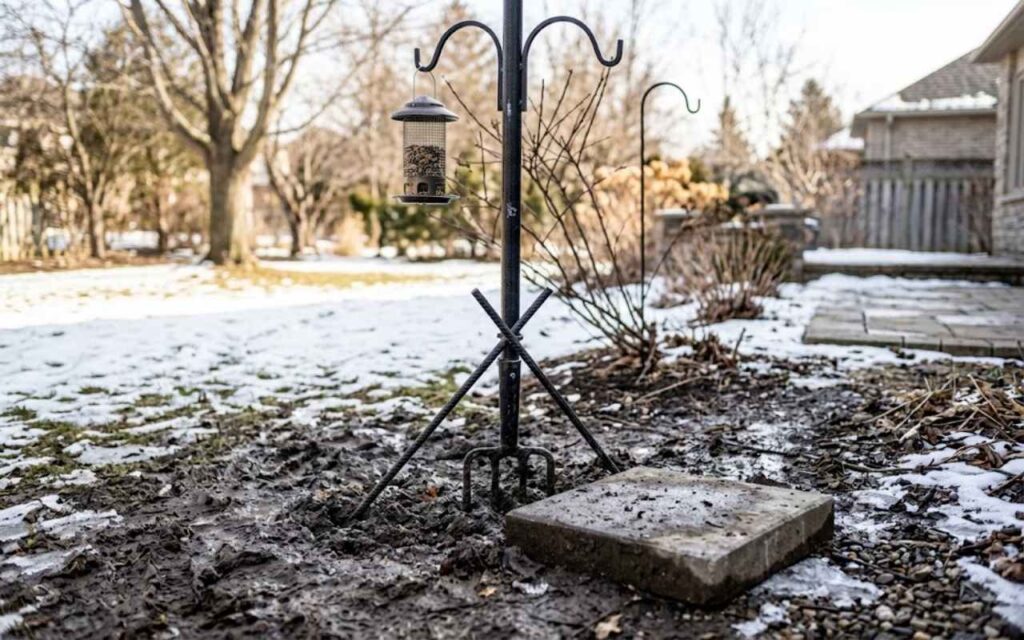
Learning how to anchor a bird feeder pole in soft winter mud or deep snow is essential for maintaining a stable feeding station during severe winter thaws and blizzards. When saturated topsoil loses its shear strength or heavy snowpack buries standard ground stakes, heavy seed payloads and high winter winds cause feeder setups to tilt, collapse, or dump food into the slush.
Backyard birders frequently struggle with shifting poles that suddenly allow squirrels and raccoons access past tilted baffles. Implementing proper soil anchoring mechanics and hardware stabilization ensures your feeders remain upright, safe, and easily serviceable all season long.
Ground Sleeve Dynamics and Frost Heave Mechanics in Saturated Winter Soils
Repeated freeze and thaw cycles subject winter soil to frost heave, an upward swelling of soil caused by the migration of subsurface water toward freezing zones. When surface mud saturates, standard thin metal ground prongs lose lateral resistance, turning vertical poles into levers that lean under minimal wind resistance. Installing a permanent or semi-permanent heavy-wall PVC or galvanized steel ground sleeve allows the primary pole to stay plumb regardless of surface mud consistency.
To prevent frost jacking, the anchor sleeve must penetrate well below the active surface mud layer into unyielding, dense subsoil. Standard screw-in ground sockets fail if their flighting threads measure under 1.5 inches in width, as soft winter mud easily shears between narrow threads. Using a wider steel ground auger or driving a sacrificial steel pipe deep into the subgrade creates a stable, sleeve-based socket that isolates the feeder pole from topsoil liquefaction.
- Drive a 24-inch to 36-inch length of 1.25-inch galvanized steel plumbing pipe into the ground until only two inches remain exposed.
- Insert your 1-inch outer-diameter feeder pole directly into this sleeve, using rubber shims or steel collar bolts to eliminate internal play.
- Clear accumulated meltwater from the base of the sleeve periodically to prevent freeze-expansion from pinching or cracking the inner pole.
This sleeve arrangement also allows you to extract the main feeder pole for seasonal maintenance without disturbing the ground anchor point. If winter thaws create standing water around the sleeve base, surrounding the perimeter with crushed limestone chips will disperse hydraulic pressure and improve local drainage.
Deep Snow Foundation Stabilizing Strategies Using Rebar and Earth Augers
Deep snow crusts create a false ground level that fools many backyard hobbyists into seating feeder stakes too shallowly. Snowpack compresses under weight and thermal radiation, causing tripods or standard step-in spade stakes to tilt unpredictably into hollow snow pockets. Anchoring directly through the snow into true mineral soil requires extended hardware profiles that compensate for seasonal snow depths.
Attaching high-tensile steel rebar directly to your primary feeder mast provides an immediate, low-cost stabilizing system that punches straight through hard snow crusts. Threaded earth augers with broad 3-inch or 4-inch helical discs offer far superior pullout resistance compared to straight stakes, gripping the frozen subsoil beneath the loose drift.
- Drive two 4-foot lengths of 0.5-inch steel rebar directly into the frozen turf beneath the snow layer, keeping them parallel to the main pole.
- Secure the rebar tightly against opposite sides of the feeder mast using heavy-duty, UV-resistant stainless steel hose clamps.
- Turn a 30-inch helical earth auger into the subsoil using a crossbar handle before securing the auger eyelet to the pole with heavy-duty U-bolts.
This dual-anchor method forms a rigid, multi-point ground triangle that completely resists the lateral torque produced by wind against platform feeders and seed tubes. When the snow melts, the subsoil anchors remain firmly engaged, preventing the common mid-spring collapse that occurs when sudden mud layers open up.
| Anchoring Method | Best Used For | Soil / Snow Condition | Max Wind Resistance |
|---|---|---|---|
| Galvanized Sleeve | Heavy single-mast poles | Deep, saturated winter mud | Medium (Up to 30 mph) |
| Helical Earth Auger | Large multi-feeder stations | Frozen subsoil beneath snow crust | High (Up to 45 mph) |
| 3-Point Guy-Wire | Top-heavy hopper feeders | Soupy, fully liquefied topsoil | Extreme (45+ mph squalls) |
Guy-Wire Geometry and Mechanical Guying Against Winter Gale Loads
Heavy hopper feeders filled with dense black oil sunflower seed possess significant top-heavy leverage during 40 mile-per-hour winter squalls. When the ground is either soupy mud or powdery snow, ground-level friction alone cannot counteract extreme aerodynamic rotational forces. Installing a three-point mechanical guy-wire system distributes the tipping load directly down into deep ground anchors.
Effective guying geometry requires anchoring lines outward at an angle of roughly 45 to 60 degrees relative to the vertical pole. Steep guy lines run too close to the mast, providing virtually zero lateral support, while lines anchored too flat create trip hazards for people and pathways for predators. Stainless steel aircraft cable measuring 0.0625 to 0.125 inches in thickness prevents biting rodents from cutting the stabilizing lines.
- Space three steel ground stakes symmetrically at 120-degree intervals, set out from the feeder pole at a distance equal to half the pole height.
- Attach 7×7 stranded stainless steel wire rope to a collar mounted above your lower predator baffle, using turnbuckles on each leg to fine-tune tension.
- Mark each guy line with high-visibility reflective bands or split plastic conduit to protect humans and deer from running into taut wires in blinding snowstorms.
Balanced cable tension eliminates mechanical wobble entirely, preventing expensive pole masts from bending under asymmetrical ice accumulation. By taking the torque off the pole base, the guy wires allow basic ground sleeves to remain secure even in fully saturated, soupy soil.
Maintaining Baffle Clearances and Window Strike Safety Over Shifting Drifts
Snowpack drastically alters the clearance geometry of squirrel and raccoon baffles. Standard predator baffles must sit at least 4 to 5 feet above the ground to stop climbing pests, with 8 to 10 feet of horizontal clearance from launch points. As snow piles up, a baffle that once sat 5 feet high may end up only 2 feet above the crust, giving squirrels and raccoons direct leaping access to your feed reserves.
Deep snow also affects feeder elevation relative to nearby glass surfaces. Following the standard window placement collision guidelines outlined by Audubon, feeders should sit either within 3 feet of a window or farther than 30 feet away. A distance within 3 feet prevents birds from gaining lethal flight velocity if startled into the glass, while a distance beyond 30 feet gives them adequate room to identify reflections and bank away safely.
- Adjust pole-mounted cylindrical stovepipe baffles upward along the mast as the snowpack deepens, preserving at least 4 feet of clearance from the crust.
- Shovel a 6-foot radius clear of snow directly beneath the feeder zone to maintain original vertical drop distances.
- Check horizontal clear zones to ensure heavy snow drifts on shrubs or woodpiles do not create new elevated jumping ramps for rodents.
Keeping the ground clear beneath the feeder pole also limits the risk of mammalian predators ambushing ground-foraging native sparrows and juncos. Maintaining proper spatial clearances prevents both equipment damage and unnecessary avian mortality throughout dynamic winter conditions.
Moisture Mitigation, Seed Spoilage, and Safe Winter Sanitation Protocols
Soft winter mud and deep snow introduce extreme humidity into backyard feeding stations. Saturated bottom debris under feeders fosters lethal fungal pathogens, most notably Aspergillus flavus, which produces toxic aflatoxins that destroy avian liver function. Wet snow blowing against seed ports creates hard crusts that block feeding openings and accelerate internal reservoir mold.
Winter seed selection plays a vital role in preventing clumping and waste. High-lipid black oil sunflower seed features thick hulls that shield the nutritious meat from moisture, whereas low-viscosity nyjer seeds spoil rapidly if slush penetrates fine feeder mesh. Safflower seeds provide another robust winter lipid source, offering moisture resistance while naturally deterring non-target species like common grackles and squirrels.
- Install an 18-inch polycarbonate weather dome over exposed hopper and tube feeders to deflect blowing snow, sleet, and driving rain.
- Disinfect feeder reservoirs biweekly using a standard 1:9 household bleach-to-water dilution soak, allowing the parts to dry thoroughly before refilling.
- Avoid using boiling water on delicate polycarbonate plastics, as extreme thermal shock warps seams and cracks feeder hulls.
- Never use additives like glycerin or chemical anti-freeze on feeding stations or perches, as oily substances mat avian feathers and lead to fatal hypothermia.
Regular sanitation combined with secure structural hardware protects wild bird populations from both mechanical failures and deadly winter pathogens. A well-anchored, clean, and properly protected pole setup keeps your backyard flock fully nourished and safe until spring green-up begins.