
Reader Transparency: This birding guide contains paid affiliate links. If you click a link and make a purchase, I may receive a small commission at no extra cost to you. As an Amazon Associate, I earn from qualifying purchases. Your support helps keep Feathered Guru flying!
Learning how to keep ants out of hummingbird feeders is a top priority for backyard birding enthusiasts during the peak summer months. In the intense seasonal heat, sugar water inside reservoirs ferments rapidly and releases a strong sweet scent that attracts columns of scouting insects straight down your mounting poles.
Once these pests take over, they can quickly ruin your nectar supply and scare away your local birds. Fortunately, you can protect your backyard sanctuary using simple, safe mechanical tactics that stop crawling insects right in their tracks.
Quick Answer: How do you keep ants out of hummingbird feeders?
You keep ants out of hummingbird feeders by installing a water-filled ant moat directly above the feeder hook to create an impassable physical barrier. Hanging your feeder with slick monofilament fishing line prevents ants from gaining traction, while moving the feeder away from tree canopies stops them from dropping directly onto the feeding ports. These non-hazardous mechanical solutions protect your nectar supply without introducing toxic chemicals into your backyard habitat.
What Happens When Ants Get Inside a Hummingbird Feeder?
When ants get inside a hummingbird feeder, they crawl into the port valves, drown in the nectar, and release bacteria that causes the liquid to sour, which completely scares away hummingbirds and forces them to permanently abandon the station.
Once these crawling pests find a clear path down your hanger hooks, they crawl inside the port valves, drown in the nectar, and contaminate the entire fluid supply. This biological contamination turns the liquid sour and completely frightens away desirable yard species like Ruby-throated Hummingbirds, forcing them to abandon your property.
Learning how to manage these pests requires shifting completely away from dangerous chemical sprays or store-bought pesticide treatments that can easily harm wild birds. To protect your yard and save your backyard sanctuary, you must use targeted physical water barriers and tactical open-air spacing adjustments.
Keeping your feeding stations completely pest-free ensures that wild hummingbirds return consistently to your property season after species. This mechanical protection stops them from abandoning contaminated nectar sources for cleaner foraging locations elsewhere in the neighborhood.
The complete Feathered Guru resource library detailing how to attract hummingbirds documents the full range of habitat and station setup strategies. Reviewing these guidelines supports a healthy, returning hummingbird population across your entire property throughout the active feeding season.
Summer Hummingbird Feeder Protection Metrics
- Primary Targeted Threat: Sugar-source scouting ants
- Core Vulnerability Target: Inability to cross open water barriers and low-friction vertical lines
- Optimal Ant Moat Water Depth: Restricted strictly between 0.5 inches and 1.0 inch maximum
- Sanitization Frequency: Tri-weekly hot-water flush with absolute zero chemical soap residues
- Feeder Canopy Clearance: Minimum of 24 inches of open air gap from surrounding tree foliage
Why Are Ants Attracted to Hummingbird Sugar Water?
Ants are attracted to hummingbird sugar water because they prefer high concentrations of sucrose, which they can detect from far away using sensitive antennae, leading to rapid colony recruitment.
Understanding why crawling pests target your sugar stations requires a close look at insect foraging dynamics. Ants possess highly sensitive chemoreceptor arrays on their antennae that can detect dissolved sucrose plumes from distances exceeding 50 feet under optimal wind conditions.
When a single worker scout discovers a small leak or a wet syrup droplet along a plastic feeding port, it leaves a long chemical trail back to its colony using specialized pheromone trail markers. Within hours, thousands of recruited workers will follow this invisible trail straight up your yard hooks and down into your nectar ports in a continuous bidirectional stream.
Formal data from a study published in the Journal of Animal Ecology shows that sucrose concentration thresholds are the primary drivers of ant foraging preference hierarchies. Standard hummingbird nectar mixed at a 25 percent sucrose concentration consistently triggers mass ant recruitment while plain water sources nearby are completely ignored.
High summer temperatures dramatically accelerate nectar fermentation rates inside the reservoir. This heat increases the volatility of the evaporating sucrose compounds, producing stronger, more widely dispersed airborne chemical signals that extend the detection range of foraging scouts.
How Do You Use an Ant Moat to Protect a Hummingbird Feeder?
You protect a hummingbird feeder by installing a water-filled ant moat directly above the feeder cup to create an impassable physical barrier that exploits the surface tension limitations of small crawling insects.
The most effective way to intercept foraging insects before they reach your sugar water is to install a heavy-duty water-filled ant moat attachment directly above your station. An ant moat is a small cup-shaped reservoir positioned directly above the feeder on the hanging hook.
When you fill this cup with plain fresh water, it creates a simple, impassable physical barrier that exploits the surface tension limitation of small crawling insects. Because worker ants cannot swim and cannot traverse an open water surface wider than approximately 0.25 inches, a standard moat cup creates a flawless physical gap in the crawling path.
If your current setup doesn’t have a barrier, upgrading to a specialized system is the easiest way to solve the problem permanently. You can browse high-quality options like the Kingsyard Built-In Ant Moat Hummingbird Feeder on Amazon to swap out your old setup, or pick up a standalone hook attachment like the TERULF Red Umbrella Ant Guard Moat 2-Pack on Amazon to add a heavy-duty water shield to your existing equipment.
A water moat positioned in direct summer sun loses a significant amount of fluid through evaporation in high temperatures. Checking and refilling your moat water every 48 hours during peak summer heat waves is critical to maintaining the barrier’s physical integrity.
Dead insect debris, leaf fragments, and airborne dust can accumulate in the moat cup within a few days. You must regularly rinse the cup completely with fresh water to prevent this debris layer from creating a dry bridge that allows ants to walk right over the water surface.
Where Should You Hang a Hummingbird Feeder to Avoid Ants?
You should hang a hummingbird feeder in an open yard space with at least 24 inches of clear air gap from surrounding tree foliage to prevent climbing insects from dropping directly onto the feeding ports.
If you hang your sugar stations directly inside dense tree branches or low garden bushes, you are making it incredibly easy for pests to find them. Ants are expert climbers that navigate high forest canopies daily, meaning overhanging tree branches positioned within close reach of the feeder body create an immediate bridging opportunity.
Scouts traveling across the branch canopy can drop directly onto the feeder top, completely bypassing every pole-based and cord-based barrier you have installed below. Trimming any branch or structural overhang to maintain a minimum 24-inch clearance in every direction eliminates this bridging vulnerability.
Moving your feeding stations out into open yard spaces forces the insects to make a long, exposed trek from the ground up a smooth metal column, making them highly vulnerable to natural lawn predators. East-facing or north-facing positions that receive morning light but avoid direct afternoon sun consistently produce the lowest nectar fermentation rates, reducing ant recruitment intensity safely.
How Does Fishing Line Keep Ants Off Hummingbird Feeders?
Slick monofilament fishing line keeps ants off feeders by removing the wide, textured surface they need for climbing traction, forcing crawling insects to slip and drop off before reaching the nectar ports.
When insects manage to climb your main yard poles despite your water barriers, you can deploy advanced mechanical exclusion barriers to stop them from sliding down the final line. This exclusion technique hangs your feeder hardware from thin monofilament fishing line.
Replacing your textured nylon ropes with a clear, thin suspension line loop removes the wide, textured contact surface that ants require to descend with chemical trail-marking accuracy. Flying birds are completely unaffected by the clear line, as they simply fly directly to the feeding flowers from the open air.
Crawling insects have specialized grip pads on their feet that require textured surfaces to climb vertically. When they step onto a slick, smooth monofilament fishing line, they cannot find any physical leverage to hold their body weight, causing them to slip and drop off the line long before they ever reach your nectar ports.
Can You Use Pesticides or Petroleum Jelly on Hummingbird Feeders?
No, you should never use chemical pesticides or petroleum jelly on feeders because they melt in high summer heat, contaminate the sugar water with toxic hydrocarbons, and ruin the insulating microstructure of bird feathers.
Chemical ant repellents applied to feeder poles, cords, or mounting hardware represent the least effective and most dangerous ant management strategy in backyard birding. Most chemical formulations break down within a few days under direct sun and rain exposure, requiring constant applications that introduce contaminant residues into the surrounding soil.
According to the Audubon Society’s hummingbird feeding FAQs, maintaining a safe station requires cleaning it with hot water or weak vinegar the moment insect encroachment occurs. They explicitly warn against using standard dish soaps because they leave behind residues that can be harmful to visiting birds.
Petroleum jelly should never be smeared onto hooks because it melts into a liquid in high summer temperatures, dripping down into the reservoir and contaminating the sugar water with harmful hydrocarbons. Beyond contamination risk, petroleum-based grease that transfers onto a hummingbird’s feathers disrupts the microstructure of their flight insulation layer.
This transfer reduces thermoregulatory efficiency and impairs the feather interlocking required for high-speed aerial maneuvers. Sticking to mechanical water barriers and smooth fishing lines keeps your birds perfectly safe.
How Do You Identify and Clean Ant-Contaminated Nectar?
You identify ant-contaminated nectar by a cloudy discoloration, floating insect debris, and a sour fermentation odor, which must be cleaned by completely discarding the fluid and performing a 10 percent vinegar wash.
Nectar contamination by ant activity is visible as a cloudy discoloration of the sugar water combined with floating insect debris, dead scouts, and a fermentation odor. The Cornell Lab of Ornithology’s hummingbird care resources explain that ants can be incredibly pesky visitors at your feeders. They recommend installing a dedicated water-filled ant trap to physically stop them from contaminating your supply.
Any nectar showing these contamination signs must be discarded completely to protect your visitor return rates. Clean the empty reservoir with a mild vinegar rinse diluted to 10 percent concentration, then rinse it thoroughly with fresh water before refilling it with a fresh sugar solution.
Additionally, look for feeders that use plain red port flowers with no yellow accents. Yellow feeding port flowers are highly visible to foraging insects because many ant and bee species possess ultraviolet and yellow-spectrum photoreceptors specifically tuned to detect yellow floral color signals.
Switching to plain red ports removes this visual attractant signal and focuses insect color tracking responses completely away from the nectar access points, reducing initial scouting recruitment before mechanical barriers are even installed.
How Do You Set Up a Complete Ant-Proof Hummingbird Station?
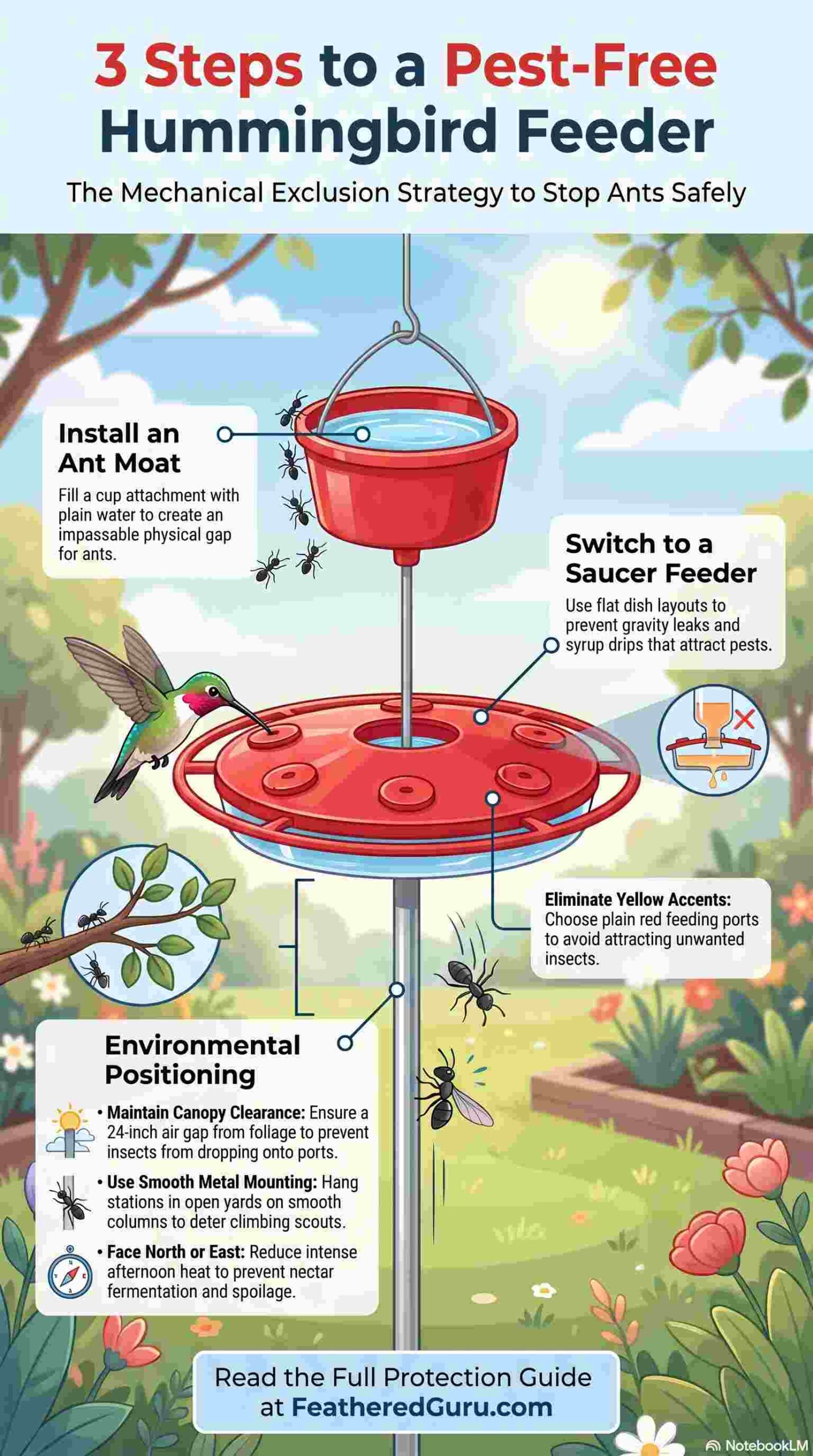
You set up a complete ant-proof hummingbird station by combining three mechanical barriers in sequence: an upper water-filled moat, a leak-free saucer-style feeder, and an open-air hanging placement with zero foliage contact.
Visualizing how these individual steps work together can help you map out your backyard setup. Review the quick-reference checklist blueprint below to see exactly how to position your hardware and eliminate pest access points across your entire property.
If flying pests are swarming your lawn alongside crawling scouts, combine these layout shields with the biomechanical lift tricks detailed in our ultimate field guide on how to keep bees and wasps away from hummingbird feeders.
Connecting Your Summer Property Strategies
Managing a busy summer ant invasion is just the first step in maintaining a healthy, high-performance backyard wildlife habitat.
Protect Your Summer Bird Baths
Once you secure your sugar feeding stations from crawling pests, you should check your backyard water features to ensure big, aggressive flocks of summer birds aren’t ruining your clean pools. To keep your backyard water stations safe and quiet for small songbirds, read our complete guide on how to keep starlings away from bird baths.
Keep Your Local Songbirds Hydrated
In the peak heat of July, access to clean, safe drinking water is absolutely critical for your local birds’ survival. To explore more advanced ways to support your local wildlife through the hot summer weather, check out our seasonal guide on how to keep birds hydrated during summer to keep your sanctuary thriving all season long.
Frequently Asked Questions on Managing Summer Feeders
Can I use essential oils like peppermint to deter ants from my feeders?
No. You must never apply essential oils, strong perfumes, or chemical scent blockers to any part of a hummingbird feeder. These strong oils can easily get into the nectar supply, which can poison the birds or ruin their delicate scent receptors.
Do ants prefer red glass hummingbird feeders over clear plastic ones?
Ants are completely colorblind to red tones and locate your feeding stations purely by following the airborne scent of fermenting sugar water. Changing the color of your glass or plastic basin will not stop an invasion once a leak starts coating your lines.
Will a built-in ant moat work as well as a hanging cup?
Yes. Many modern hummingbird feeders feature a small, built-in plastic cup molded right into the center of the top lid. As long as you keep this built-in cup filled with clean water every single day during the summer heat, it will stop climbing insects just as effectively as a separate hanging unit.