
Reader Transparency: This birding guide contains paid affiliate links. If you click a link and make a purchase, I may receive a small commission at no extra cost to you. As an Amazon Associate, I earn from qualifying purchases. Your support helps keep Feathered Guru flying!
Learning how to keep bees and wasps away from hummingbird feeders is a top priority for backyard birding enthusiasts dealing with stinging pests during the late summer months. In this season, natural floral nectar sources decline sharply, creating a localized deficit that drives honeybees, paper wasps, and aggressive yellowjackets straight to your backyard sugar stations.
Once these stinging colonies discover a clear food source, they swarm the feeding ports, block access, and intimidate your local birds. Fortunately, you can reclaim your yard and outsmart these insects completely using precise biomechanical changes, structural modifications, and strategic layout shifts that address core insect foraging behaviors.
Quick Answer: How do you keep bees and wasps away from hummingbird feeders?
You keep bees and wasps away from hummingbird feeders by switching to a flat saucer-style dish feeder with a built-in nectar lift, which places the liquid completely out of reach of short insect mouthparts while remaining accessible to long hummingbird tongues. Additionally, removing all yellow visual accents, installing flexible silicone nectar guard tips over the port holes, and setting up a separate decoy diversion feeder at the edge of your property will break the pest scouting loop without introducing hazardous chemical sprays into your backyard habitat.
What Happens When Hymenoptera Swarm Your Sugar Stations?
When hymenoptera swarm your sugar stations, they crowd out feeding birds, aggressively defend the territory, and can create a hazardous environment for backyard property owners.
Hymenoptera—the scientific family name for bees, wasps, and ants—possess highly advanced social communication systems. When a single yellowjacket or honeybee scout finds an exposed drop of syrup on a plastic portal thread, it returns to its hive and executes a recruitment process. Within a few hours, a minor nuisance transforms into a full-scale insect takeover.
The insect recruitment pipeline follows a rapid progression:
- The Scout Phase: An insect scout discovers a sticky sugar leak on the feeder.
- The Recruitment Phase: The scout leaves an evaporated scent trail back to its colony.
- The Dominance Phase: Mass swarms take over the ports and aggressively defend the area.
- The Displacement Phase: Wild hummingbirds permanently abandon your yard due to safety risks.
Hummingbirds are highly energetic aerial acrobats, but they generally avoid feeding directly around stinging insects to protect their eyes and soft tissue from defensive stings. If wasps monopolize your yard hooks, the birds will quickly abandon your property to seek cleaner, safer foraging zones elsewhere in the neighborhood.
Managing these pests safely means avoiding toxic aerosol sprays that pollute the yard and contaminate the avian food supply. To learn more about standard baseline protection setups on your property, check out the complete backyard birding guide.
Summer Insect vs. Avian Biological Metrics
The core reason insects take over your hardware comes down to a direct evolutionary mismatch between insect anatomy and avian physiology. Understanding these exact numbers allows you to modify your hardware to exploit their physical weaknesses.
| Biological Characteristic | Hummingbirds | Honeybees (Apis mellifera) | Yellowjackets / Wasps |
|---|---|---|---|
| Average Reach / Mouthparts | 0.50 to 0.75 inches | 0.22 to 0.28 inches | 0.10 to 0.15 inches |
| Color Spectrum Attraction | Deep Red, Pink, Orange | Ultraviolet, Bright Yellow, Blue | Bright Yellow, White, Meat Scent |
| Primary Foraging Mechanism | Visual Color Tracking | Scent Tracking & Air Plumes | Hydrocarbon & Scent Tracking |
| Nectar Thickness Preference | Standard 4:1 (20% Sugar) | Variable Sugar Plumes | High-Value Concentrated Sugars |
Why Are Wasps and Bees Drawn to Your Feeders?
Wasps and bees are drawn to your feeders because rising summer temperatures cause inverted gravity bottles to leak, creating a highly visible, evaporated scent trail that insects easily track.
Understanding the physics of your setup reveals why traditional bottle-style hardware acts as an accidental insect magnet. Inverted bottle-style feeders rely on a strict internal vacuum seal to hold the liquid inside the glass or plastic reservoir.
Under direct summer sunlight, this physical vacuum assembly fails systematically:
- Thermal Expansion: Intense solar heat warms the trapped air cavity inside the upper bottle.
- Vacuum Failure: The expanding air forces the liquid down, breaking the internal vacuum pressure seal.
- Scent Leaks: Fluid drips directly out of the bottom portals, coating the exterior housing and creating a strong, airborne scent plume.
Furthermore, many commercial brands include bright yellow plastic flower shapes around the feeding holes. According to ultraviolet vision and receptor noise-limited modeling research published in the Journal of Comparative Physiology A, a bee’s photoreceptors are highly sensitive to ultraviolet and yellow light, which they naturally associate with pollen-bearing blooms.
While hummingbirds locate your stations by tracking deep reds, bees and wasps are visually drawn to these yellow accents. Removing these yellow visual targets from your setup cleanly shuts down the primary tracking channel insects use to locate your yard, letting you focus entirely on your physical exclusion strategies.
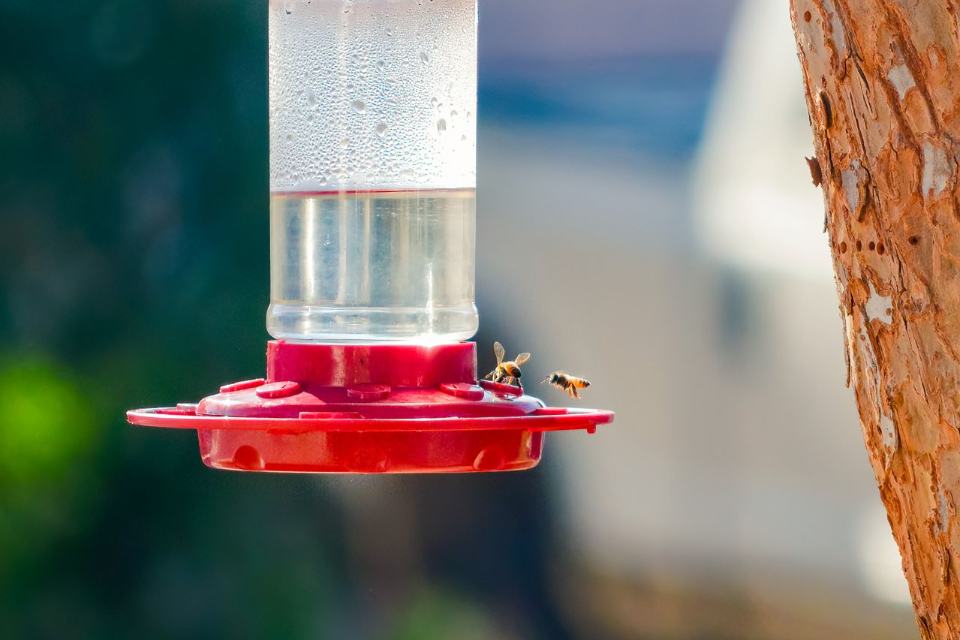
However, color modification is only half the battle. As displayed in the image below, even if you utilize an all-red feeder base with zero yellow parts, an inverted gravity bottle will still attract relentless swarms of honeybee scouts the exact moment a heat-fueled vacuum leak occurs along the bottom seam.
If you are already dealing with trailing crawling insects alongside flying pests on your property, combine this color removal step with the physical water barriers detailed in our companion guide on how to keep ants out of hummingbird feeders.
How Do You Use a Nectar Lift to Block Stinging Pests?
You use a Nectar Lift to block stinging pests by switching to a flat saucer-style dish feeder that maintains an empty air gap between the surface of the nectar and the top of the feeding port.
The single most effective engineering fix to defeat stinging pests is to exploit the limitation of their tongue length. Honeybees and wasps have short lapping mouthparts compared to a hummingbird’s long bill and extendable, tube-like tongue.
By switching to a flat, saucer-shaped dish feeder, the fluid sits quietly in a shallow pan below the top lid rather than being constantly pushed forward by gravity.
- The 0.35-Inch Exclusion Rule: Fill your saucer dish basin carefully. Ensure the liquid level remains at least 0.35 inches below the top plastic mesh layer.
- The Avian Advantage: Long hummingbird bills easily cross this air gap. They extend their tongues deep into the basin to drink safely.
- The Insect Barrier: Short wasp mouthparts cannot reach the deep fluid boundary. Stinging pests find it physically impossible to drink from the dry lid surface.
- The Permanent Hardware Fix: Swap out your leaky gravity system entirely. You can browse specialized layouts like the iBorn Glass Hummingbird Feeder on Amazon to fix this configuration for your property.
Can You Stop Pests Using Specialized Nectar Guards?
Yes, you can stop pests using flexible silicone Nectar Guard tips that create a mechanical one-way valve over the port holes, blocking insects while allowing bird bills to slide through.
If you prefer to keep using your existing vertical bottle-style feeders, you can utilize physical clip-on screens or port adaptations to separate insects from the reservoir. According to the Cornell Lab of Ornithology’s feeder guidelines, you must be careful with colored add-ons; when port bee guards are bright yellow, they can actually attract yellowjacket wasps instead of discouraging them.
Furthermore, if sugar solution drips onto an exterior guard, it creates an immediate foraging target. This is why transitioning to a deep basin style setup works best, as it naturally holds the nectar out of an insect’s physical reach while leaving it perfectly accessible to a hummingbird’s tongue.
Nectar Guard tips are small, flexible sleeves made of medical-grade silicone that slide over the inside stems of your feeding portals. These sleeves utilize a reliable, self-sealing mechanical boundary:
- The Access Slit: The tips feature a microscopic, self-sealing center slit.
- The Avian Entry: When a hummingbird approaches, its needle-like bill easily pushes through the flexible silicone to lap up the sugar water.
- The Pest Block: The moment the bill retracts, the silicone snaps shut. Because wasps and bees have blunt head structures and rigid mouthparts, they cannot force the slit open, sealing off the sugar supply completely. Reviewing these small additions is a vital component of responsible bird feeding practices across your entire property.
How Do You Set Up a Decoy Diversion Feeder?
You set up a decoy diversion feeder by placing a highly concentrated, ultra-sweet sugar water station at the far edge of your yard to permanently lure foraging insects away from your birding areas.
Insects are highly efficient foragers that will target the easiest and most energy-dense food source available. You can exploit this behavior by setting up a dedicated insect feeding zone completely separate from your main birding environment.
Execute the Relocation Strategy: Begin by hanging the decoy station directly next to your active hummingbird feeder for 24 hours until the swarm completely migrates to the easier, sweeter dish. Once the insects are locked onto the decoy, move that dish 5 feet away every afternoon. Within a week, you can successfully relocate the entire insect column 50 to 60 feet away to the back corner of your property, leaving your main hummingbird sanctuary completely clear.
Mix an Ultra-Sweet Concentration: Mix a highly concentrated solution using five parts water to one part white sugar (5:1 ratio). This sweet sugar solution targets the specific preference of late-season social insects. To ensure you make standard mixtures correctly for your normal stations, check our comprehensive manual on how to make hummingbird nectar at home.
Deploy an Open-Access Basin: Pour this ultra-rich mixture into an open-port container placed in direct sunlight. Add a few small river rocks to the basin to provide a safe landing platform for honeybees.
Why Commercial Chemical Sprays Fail and Harm Birds
Commercial chemical sprays fail because they break down rapidly in outdoor elements and contain neurotoxins that can easily stick to bird feathers and prove fatal to wildlife.
Using standard store-bought wasp killers, bug sprays, or household chemical repellents anywhere near an avian feeding environment is highly dangerous. Hummingbirds have incredibly high metabolic rates and breathe rapidly, making them highly sensitive to airborne chemical particles and synthetic fumes.
Furthermore, spraying oils, petroleum jelly, or sticky gels onto the exterior housing or hanging hooks can coat a hummingbird’s plumage. If a bird rubs against these greasy residues, the hydrocarbons destroy the microscopic barbules that lock feathers together. This causes the feathers to mat, ruining their natural weather insulation and impairing their high-speed flight mechanics.
Master Troubleshooting Protocol for Stinging Insects
If wasps and bees suddenly swarm your yard, follow this systematic field protocol to isolate the cause and restore your station’s integrity.
Disrupt the Flight Coordinates: If bees or wasps refuse to abandon the feeder, you can break their immediate foraging loop by physically moving the hardware just a few feet away.
According to ecological field research published in PNAS (Proceedings of the National Academy of Sciences), social insects rely on structured long-term vector memories to navigate back to precise coordinate nodes.
Shifting your sugar station even a tiny distance completely breaks their active memory loop, forcing the colony’s scouts to spend hours recalibrating their search grids while your local hummingbirds relocate the red ports instantly by sight.
Remove Yellow Visual Targets: Inspect your feeder ports immediately. If they feature snap-in yellow flower inserts, pull them out using a pair of needle-nosed pliers and discard them.
Audit the Housing Assembly: Check the main seam threads where the basin connects to the hanging cap. If you find any cracks or worn gaskets allowing fluid to seep out, replace the unit immediately to stop the volatile scent trail.
Perform an Exterior Scrub: If a leak has occurred, take the hardware down and scrub the outside shell using hot water and white vinegar to erase all surface sugar residues. According to the Audubon Society’s hummingbird feeding FAQs, you must clean your hardware right away whenever you notice any sign of insect encroachment, and you should always avoid dish soaps because they leave behind residues that can be harmful to visiting birds.
How Do You Set Up a Complete Wasp-Proof Hummingbird Station?
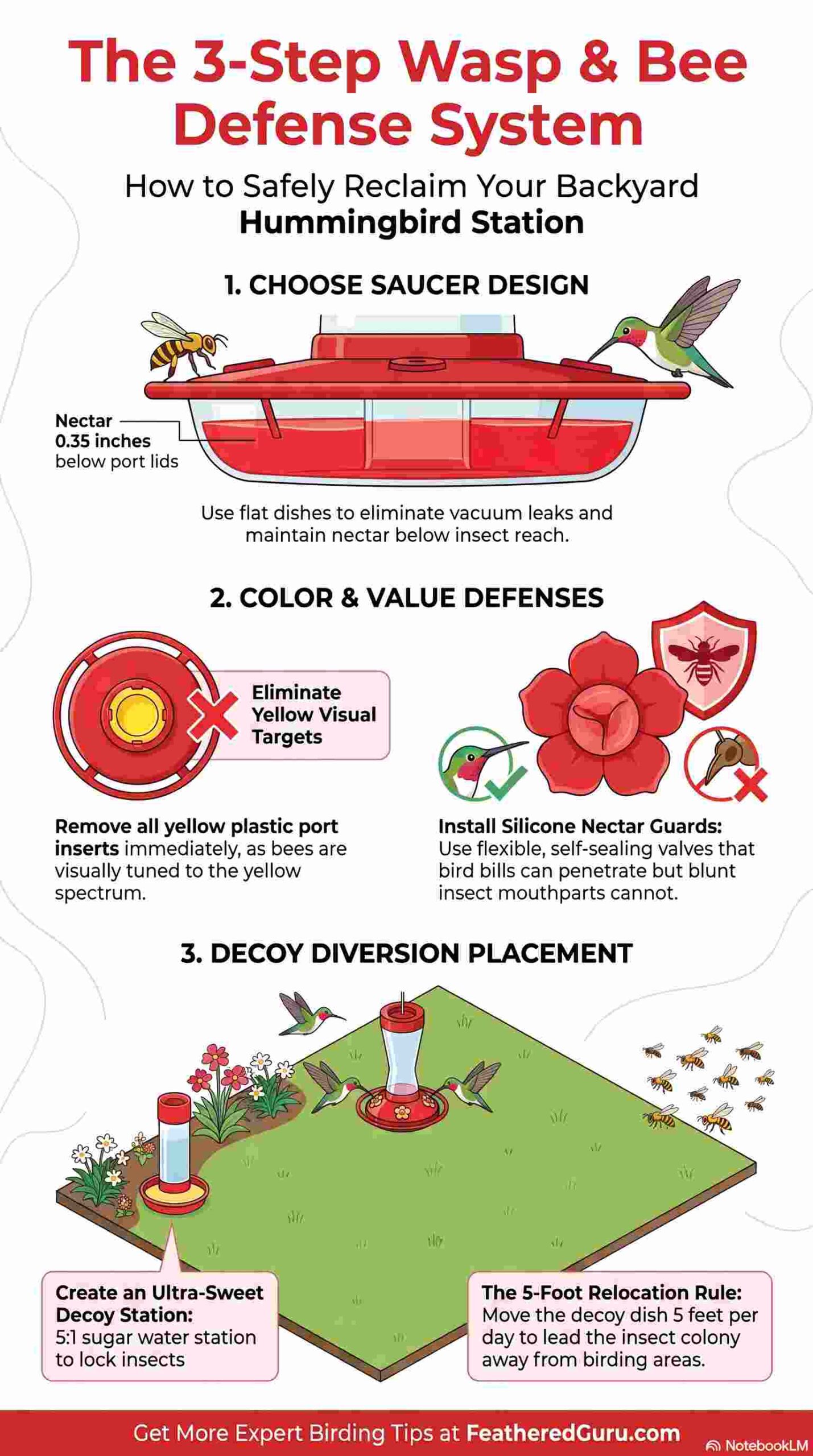
You set up a complete wasp-proof hummingbird station by combining three mechanical boundaries in sequence: a flat saucer-style nectar lift, all-red port shielding with no yellow inserts, and a remote ultra-sweet decoy diversion feeder.
Visualizing how these individual steps work together can help you map out your backyard layout without introducing hazardous sprays into your ecosystem. Review the quick-reference checklist blueprint below to see exactly how to position your hardware and eliminate pest access points across your entire property.
Connecting Your Summer Property Strategies
Maintaining a clean, balanced backyard environment requires managing your other summer wildlife features concurrently.
Maintain Your Summer Bird Baths
Ensure bird baths remain accessible to small songbirds while preventing aggressive pest birds from dominating, as discussed in our guide on managing starling behavior in bird baths.
Frequently Asked Questions on Managing Summer Feeders
Can I use essential oils like peppermint to deter wasps and bees?
No. You must never apply essential oils, concentrated peppermint oils, or chemical scent blockers to the ports. Maintaining a safe backyard station requires keeping all foreign chemical residues entirely away from the birds’ food supply. These potent oils can easily seep into your sugar solution, which can cause chemical burns to a hummingbird’s tongue or destroy their highly sensitive respiratory receptors.
Will moving my hummingbird feeder just a few feet confuse foraging insects?
Yes, moving your feeder by just 3 to 4 feet is a highly effective disruption method. Social insects like honeybees rely on ultra-precise navigational flight grids based on geographic landmarks. Moving your sugar station just a few feet away completely breaks the pest colony’s active memory loop, forcing them to spend hours hunting for the source while your local hummingbirds locate it visually right away.
Do fake wasp nests actually deter yellowjackets from approaching a feeder?
No, fake nests are completely ineffective against late-summer yellowjackets. While early-spring paper wasps are highly territorial and will avoid building an active colony near a rival nest, yellowjackets are cavity-nesters that live underground. Late-season social insects are driven purely by resource scarcity rather than airspace markers, meaning a paper target will never stop them from pursuing a high-value sugar source.
Why do bees prefer yellow feeding ports over all-red designs?
Bees prefer yellow feeding ports because their vision is tuned to a completely different wavelength spectrum than birds. Hymenoptera possess specialized photoreceptors that make them highly sensitive to ultraviolet light and yellow light, which they associate with pollen-bearing blooms. Hummingbirds, conversely, are strongly attracted to deep reds, meaning switching to all-red ports cleanly removes the primary visual signal insects use to locate your yard.