Telling the difference in a Red-bellied vs Red-headed Woodpecker encounter is one of the most persistent hurdles for backyard birders across eastern North America. Novice birders frequently look at a bird with a brilliant scarlet cap, assume it must bear the name of its most obvious feature, and misidentify a common visitor.
This taxonomy confusion creates regular debates in online wildlife communities. Understanding true morphological markers, behavioral quirks, and flight profiles will prevent you from making this classic identification mistake in the field.
Plumage Pitfalls and the Misleading Red Crown Misconception
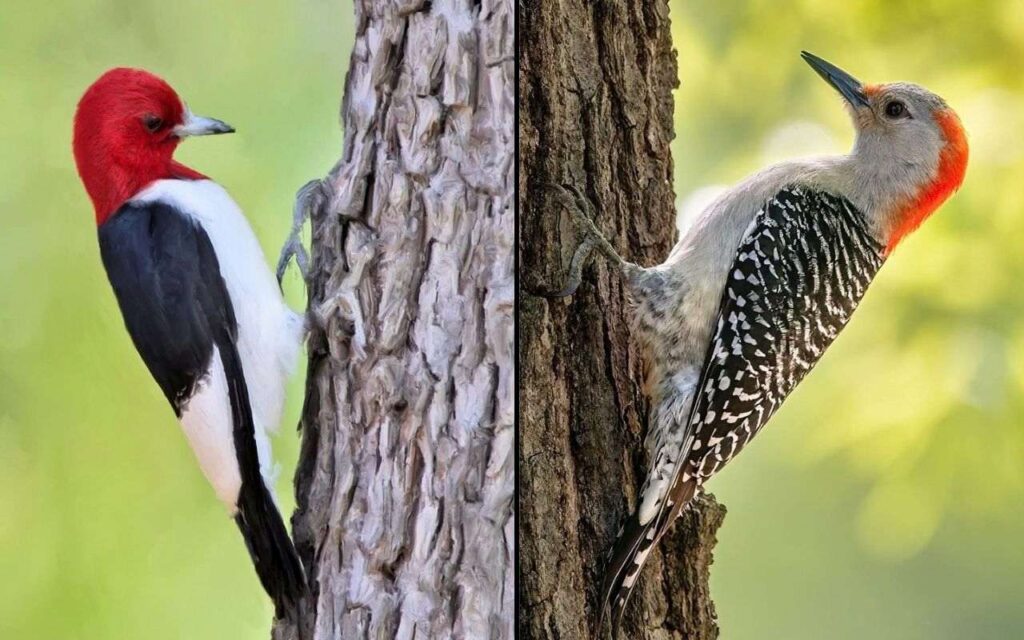
The most common point of failure for backyard observers stems from common bird naming conventions. A Red-bellied Woodpecker (Melanerpes carolinus) features a prominent red stripe extending from the base of the bill, over the crown, and down the nape in males, while females display red restricted solely to the nape and nostrils.
In contrast, an adult Red-headed Woodpecker (Melanerpes erythrocephalus) exhibits an entire hood of crimson plumage covering the chin, throat, crown, and neck down to the upper mantle. On bird identification forums like r/whatsthisbird, users constantly upload photos of Red-bellied Woodpeckers asking why their bird lacks a bright red stomach.
The belly of a Red-bellied Woodpecker is pale grayish white, marked only by a faint, low-contrast blush of pinkish-red low on the lower abdomen between the legs. In natural field conditions, this wash is virtually invisible because birds press their undersides flush against tree bark while hitching vertically.
- Red-bellied adult male: Scarlet streak running seamlessly from the base of the bill over the crown to the nape.
- Red-bellied adult female: Scarlet wash isolated to the nape and nasal tufts, leaving a pale gray crown.
- Red-bellied dorsal pattern: Tight black-and-white horizontal zebra barring running entirely down the back.
- Red-headed adult (both sexes): Completely unbroken crimson hood across the entire head, neck, and throat.
- Red-headed dorsal pattern: Pitch-black back contrasting sharply with a pristine, snow-white breast and belly.
Because these patterns produce distinctly different visual profiles, looking at the throat and back rather than the top of the head instantly resolves the identification.
Juvenile Molts and Confusing Immature Field Marks
Late summer and autumn bring a wave of confusing juvenile sightings that trigger spikes in community troubleshooting threads. Forum contributors on platforms like r/ornithology frequently document brown-headed woodpeckers visiting suet feeders, confusing them for obscure sapsuckers or aberrant species.
These birds are immature Red-headed Woodpeckers, which leave the nest completely devoid of the diagnostic crimson hood. Juvenile Red-headed Woodpeckers retain a mottled, dusty-brown head and neck throughout their first summer and autumn.
Their backs display dusky brown-and-gray barring across the wing coverts, though the bold white secondary wing patch is already present beneath dark smudges. As winter approaches, these young birds undergo a slow preformative molt, showing patchy blotches of red feathers pushing through the brown fleece.
- Immature Red-headed head: Dusty grayish brown without any crimson plumage during early independence.
- Immature Red-headed wings: Large white secondary patches broken up by two dusky black transverse bars.
- Immature Red-bellied head: Pale gray crown that closely mirrors the adult female, with faint nape color emerging early.
- Immature Red-bellied wings: Black-and-white zebra barring that looks nearly identical to full adult plumage immediately after fledging.
Spotting an all-brown head alongside large white rectangular wing blocks is the definitive signature of a first-year Red-headed Woodpecker.
Flight Silhouette Dynamics and Dorsal Wing Block Geometry
When birds flush from utility poles or forest edges, diagnostic facial details vanish instantly against the sky. Observers must instead rely on the stark dorsal geometry that each species presents in flight. A flying Red-headed Woodpecker creates an unmistakable three-color checkerboard pattern, flashing solid black shoulders, brilliant white lower secondaries, and a solid white rump.
The Red-bellied Woodpecker in flight reveals a much more uniform, textured profile. Its zebra-barred wings produce a flickering gray effect across distance, interrupted primarily by a white patch at the base of the primary flight feathers.
A user on a regional birding board noted that a Red-headed Woodpecker in flight looks like a flying oriole or magpie due to its solid color blocks, whereas a Red-bellied appears textured like tree bark.
- Red-headed flight mark: Half-black, half-white wings created by solid white secondaries contrasting with black primaries.
- Red-headed rump: Unbroken snow-white patch visible above the solid black tail feathers.
- Red-bellied flight mark: White crescent-shaped flashes at the base of the dark primaries, known as primary patches.
- Red-bellied rump: White rump patch heavily marked with faint dark flecks and chevrons.
Evaluating whether the wings display bold solid blocks or fine zebra striping ensures accurate flight identification even at extreme distances.
Feeder Territory Battles and Backyard Suet Hardware Setup
Backyard feeding dynamics between these two species reveal distinct preferences in food sources and foraging mechanics. Red-bellied Woodpeckers adapt readily to suburban yards, clinging comfortably to standard cage feeders, vertical bark butter logs, and suet cages with extended tail props.
Red-headed Woodpeckers are far more nomadic, prioritizing oak savannas and dead snags, though they will aggressively dominate winter suet blocks when present. Many feeder enthusiasts report real-world hardware issues when attempting to host both birds simultaneously.
Starling-deterrent cages featuring 1.5-inch square mesh will occasionally exclude larger adult Red-bellied males, while the slightly more compact Red-headed Woodpecker can squeeze inside to access the fat cakes. To support their biomechanics, feeders should incorporate a stiff tail prop extending at least 5 inches below the suet cage to support their rigid rectrices.
- Preferred food Red-bellied: Shelled peanuts, black oil sunflower seeds, suet blends containing rendered beef tallow, and chopped maize.
- Preferred food Red-headed: Whole acorns, cached beechnuts, sunflower hearts, and mealworms scattered on tray feeders.
- Hardware adaptation Red-bellied: Readily uses upright suet logs and hanging hopper perches with no modification.
- Hardware adaptation Red-headed: Prefers open platform trays or dead snag feeding stations positioned near open clearings.
Providing both clinging hardware and wide flat platforms minimizes aggressive feeder collisions and lets you view their physical differences up close.
Acoustic Signatures and Habitat Overlap in Mature Deciduous Woodlands
In dense forest canopies where visual identification is obstructed by foliage, vocalizations offer absolute certainty. The Red-bellied Woodpecker delivers a rolling, descending vocalization transcribed as a rich churr-churr or a sharp cha-cha-cha. This call carries substantial reverberation across mixed hardwood forests, pine flatwoods, and urban parks.
The Red-headed Woodpecker possesses a distinctly raspier, nasal acoustic catalog. Its primary contact note is a harsh, descending screech resembling a queer or krrrk, similar to the call of a Northern Flicker but noticeably higher in pitch. Their drumming patterns also reveal slight physical differences in territory defense across overlapping riverine corridors.
- Red-bellied vocalization: Rolling, liquid churr or rattling trill delivered in brief, two-second intervals.
- Red-bellied drum: Short, rapid bursts consisting of roughly 10 to 12 taps per second with uniform force.
- Red-headed vocalization: Guttural, dry tchur or raspy squeal without liquid reverberation.
- Red-headed drum: Slightly longer, rhythmic bursts that often sound noticeably hollow against dead snags.
Learning these auditory differences allows you to confirm species presence high in the tree canopy long before binoculars can cut through the leaves.