
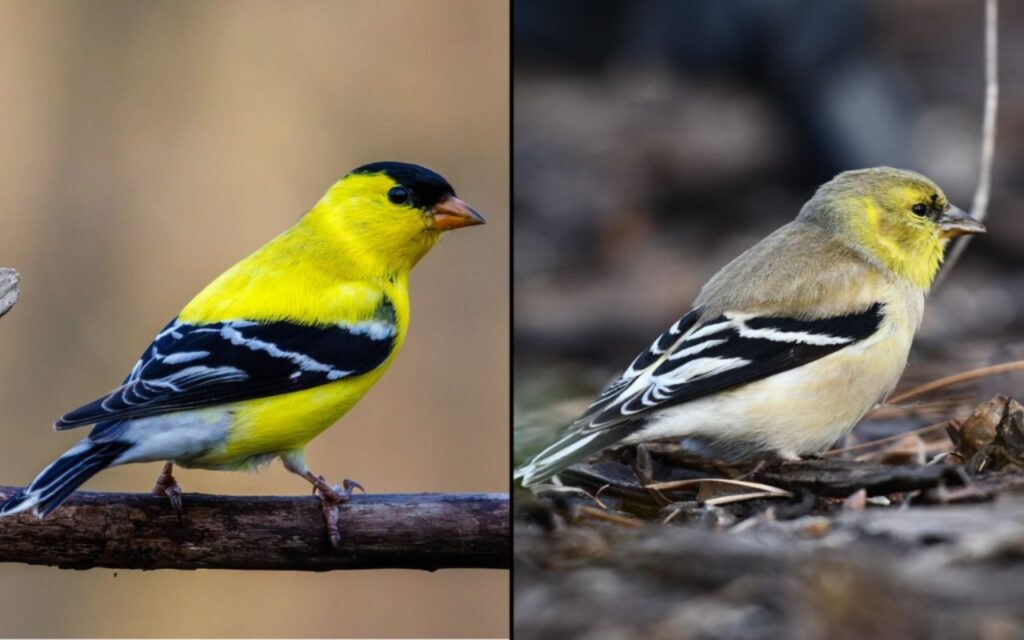
Tracking bird identification by season requires moving past simple backyard color charts and focusing directly on annual feather molts. Millions of homeowners watch their vibrant spring visitors vanish every August, completely unaware that those exact same birds have simply traded their bright plumage for drab winter coats.
Mastering these natural population replacements ensures you can accurately identify every new visitor at your cold-weather feeding stations. By learning to look past temporary camouflage, you can easily track passing migrants without getting tripped up by confusing seasonal disguises.
Quick Answer: How do bird profiles change across different seasons?
You can master bird identification by season by tracking their lifecycle plumages. Look for vibrant breeding feathers in spring, identify drab juvenile gapes in summer, spot muted migratory coats in fall, and note unique winter irruptions using structural shape markings.
Spring: The Breeding Plumage & Courtship Wave (March – May)
Spring marks the most visually spectacular window for backyard bird identification as millions of neotropical migrants return from southern wintering grounds. Driven by intense reproductive hormones, male birds undergo a pre-breeding molt, shedding their dull winter coats to reveal highly vibrant, high-contrast plumages.
Crucially, many species possess feathers that reflect ultraviolet (UV) light; while invisible to human eyes, this vivid coloration is a primary trigger for avian mate selection and territorial dominance.
Dominant Avian Arrivals & Identification Triggers
- The Warbler Rush: Species like Yellow, Chestnut-sided, and Black-throated Blue Warblers arrive alongside canopy insect cycles. Identify them by their hyperactive flitting habits and micro-sized profiles. Yellow Warblers dominate low canopies, while Black-throated Blues stay hidden in dense understory shrubs. Map these specific nesting zones using our guide to bird identification by habitat.
- The Scarlet Tanager Envelope: Arriving in mature hardwood forests, the male displays a breathtaking solid scarlet-red body contrasted sharply against pitch-black wings. To confirm a sighting when lighting is poor, look for the female’s distinctly camouflaged olive-yellow feathers, and listen for the male’s unique vocal signature—a raspy, hurried series of notes that sounds exactly like a robin with a sore throat.
- The Rose-breasted Grosbeak: Easily identified by its heavy, bone-colored, cone-shaped beak engineered for crushing thick seed hulls. The male features a vivid, triangular ruby-red patch painted right across an otherwise pitch-black and white chest, while the female resembles an oversized sparrow with a heavy white eyebrow stripe.
Advanced Field Markings & Vocal Signals
- Pristine Feather Margins: Look closely through binoculars at the wing bars and tail feathers; spring arrivals show zero feather wear or ragged edges because they have just completed a fresh, late-winter molt specifically for migration.
- Decibel-Heavy Territorial Songs: True spring identification relies heavily on audio tracking during the peak 5:00 AM dawn chorus. Listen for sustained musical phrases, or use our field primer to master bird identification by song to separate complex melodies from simple contact calls.
Summer: The Juvenile Swarms & Post-Breeding Molts (June – August)
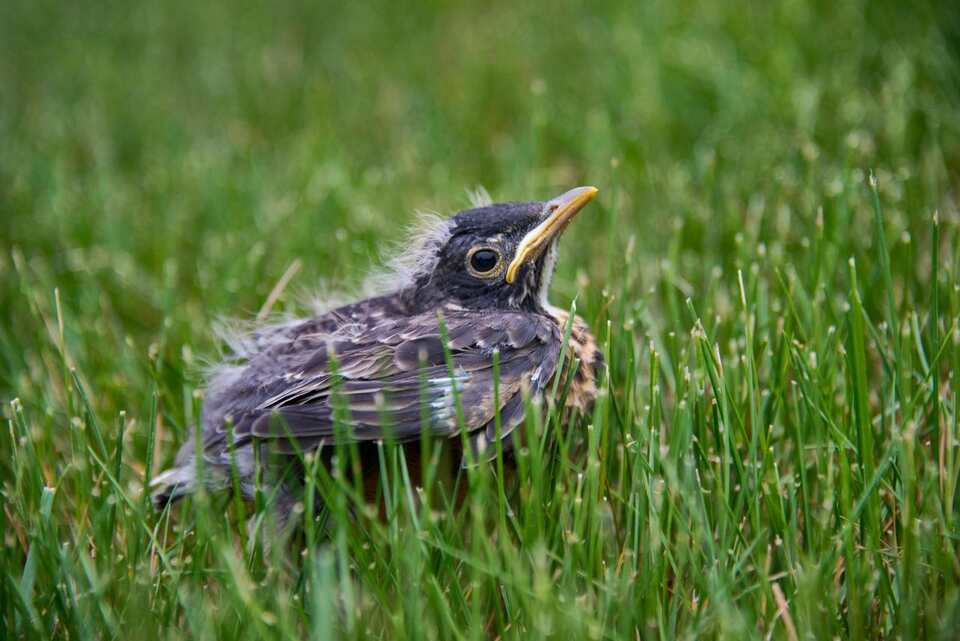
By mid-summer, the frantic pace of spring courtship transitions into a high-volume reproductive boom. Backyard properties quickly fill with awkwardly flying fledglings and worn-out adult parents who rapidly lose their brilliant spring colors. This phase introduces an immense identification challenge as single species split into multiple distinct age and gender profiles simultaneously.
Identifying Confusing Summer Fledglings
- The Speckled Robin Mask: Newly fledged American Robins look completely different than adults, displaying heavily spotted, dark brown speckled chests and pale throat patches that mimic woodland thrushes. To avoid misidentification, ignore the breast entirely and focus on their classic large-bodied stature, bright white eye-ring segments, and the characteristic tail-twitching behavior shared with their parents.
- The Dull Juvenile Cardinal: Young Northern Cardinals closely match the warm, olive-brown camouflage tones of adult females but are instantly identified by their dark, smoky-black beaks. This dark bill indicates a hatch-year bird whose beak will not transition to the classic, calcified bright orange color until late autumn approaches.
- The Fluffy Chipping Sparrow: Fledgling sparrows display heavily streaked, dark underparts and lack the distinct solid rust-red cap worn by their parents during spring nesting weeks. Look closely for a prominent dark eye-line cutting across a pale face, and observe their begging behavior—they will aggressively quiver their wings while making high-pitched, persistent chipping noises to demand food from nearby adults.
Spotting the Late-Summer Eclipse Plumage
- The Complete Post-Breeding Molt: As nesting wraps up, adult birds undergo a highly energy-intensive complete post-breeding molt to replace feathers damaged by territorial battles, nest friction, and migration wear. Look for a distinctly scruffy, asymmetrical head or missing flight feathers on wings, which often makes birds look sickly when they are actually undergoing a completely healthy cellular renewal.
- The High-Camouflage Eclipse Phase: Male ducks and common songbirds enter a temporary “eclipse phase,” looking highly ragged, patchy, and dull as they shed their bright breeding outfits. They deliberately take on the camouflaged appearance of females to stay hidden from predators while their primary flight feathers regrow, making positive identification dependent on bill shape and structural size rather than feather color.
Fall: The Southbound Migrants & Drab Winter Overcoats (September – November)
Fall identification is widely considered the ultimate test of a bird watcher’s skill due to the arrival of “confusing fall warblers.” As millions of birds head south, adults and juveniles alike travel in muted, green-brown winter overcoats that completely strip away their vibrant spring color patches. This massive camouflage shift forces birders to abandon color reliance and look at structural or behavioral markers instead.
The Great Camouflage Shift
- The Drab Goldfinch Morph: The brilliant, electric-yellow male American Goldfinch completely sheds its bright golden jacket by October. It undergoes a basic molt into a quiet, uniform olive-brown coat with dull buff-colored wing bars, which perfectly blends with dying autumn foliage and drying thistle patches.
- The Muted Yellow-rumped Warbler: Known as the “Butter-butt” in spring for its bright yellow crown and throat patches, its fall coat fades into a streaky gray-brown tone. To identify this bird instantly, look exclusively for its one unchanging anchor marker: a small, bright yellow rump patch that flashes clearly every time the bird flies away from you.
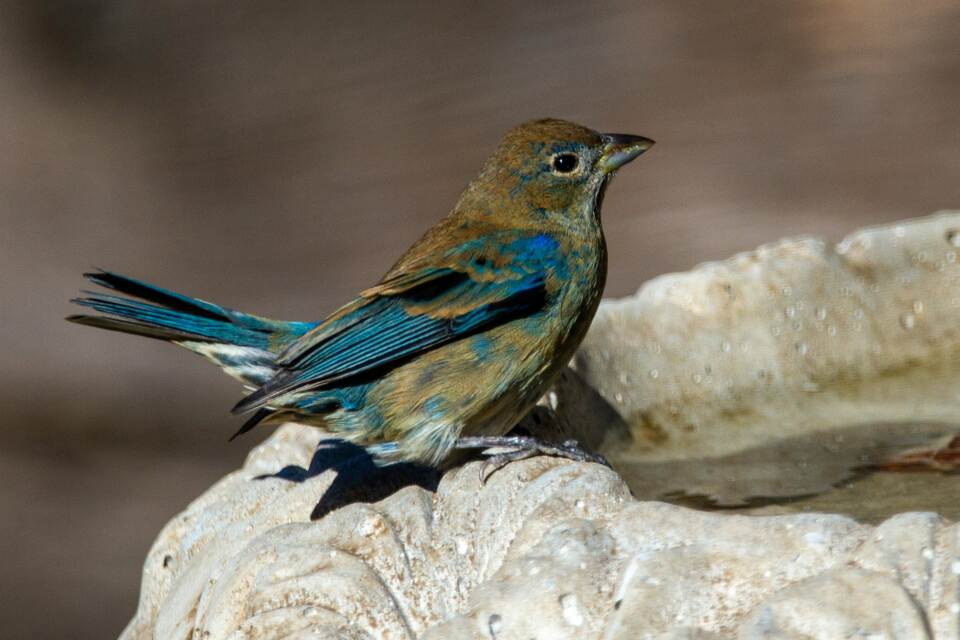
- The Indigo Bunting Transition: The solid, deep-blue male bunting transforms into a patchy, brown mottled coat. During this awkward multi-week transition, look closely for tiny, stray flecks of electric blue along the wing edges and tail feathers to confirm the species before it exits your yard.
Shifting Behavior Patterns
- The Silence of Chip Notes: Birds stop singing their long, complex territorial songs completely to avoid drawing the attention of migrating hawks. Instead, they shift entirely to short, sharp, single-note “chip notes” or flight calls, which they use to keep multi-species foraging flocks connected while traveling under the cover of night.
- Hyper-Active Mixed Foraging Flocks: Local and passing birds bunch into massive, mixed foraging groups to maximize safety from predators. They move rapidly through tree lines in a rolling wave, working together to strip remaining wild berries. Tracking these fast-moving autumn waves requires watching how a bird hops or walks along branches. Pinpoint hidden species by watching how they move with our simple guide to bird identification by behavior.
Winter: The Irruptive Northerners & Feeding Station Crowds (December – February)
Winter narrows your local bird list down to hardy year-round residents and brings down specialized northern visitors fleeing harsh Arctic weather conditions. Because deciduous leaves are completely gone from the trees, you should use our foundational guide to bird identification by shape to easily isolate these visiting profiles by body structure alone.
Identifying Winter Irruptive Species
- The Pine Siskin: Often mistaken for standard winter goldfinches, these erratic northern finches arrive in massive flocks when coniferous seed crops fail up north. Identify them by their heavily streaked brown breast profiles, sharply pointed, needle-like bills, and subtle flash-yellow panels hidden inside their wing bars and tail bases that become visible only during flight.
- The Dark-eyed Junco: Known as the classic “snowbird,” these clean-cut ground foragers arrive right as the first frost hits. They display a solid slate-gray head and back contrasted sharply against a clean white belly, and they flash bright white outer tail feathers like a beacon whenever they are startled off the lawn.
- The Red-breasted Nuthatch: Fleeing northern boreal forests during seed shortages, this tiny bird is instantly identified by its unique habit of walking down tree trunks completely headfirst. Look for its short tail, bold black eye stripe slicing across a white face, and a warm rusty-orange underbelly that brightens during freezing weather stretches.
Visual Anchor Point Techniques
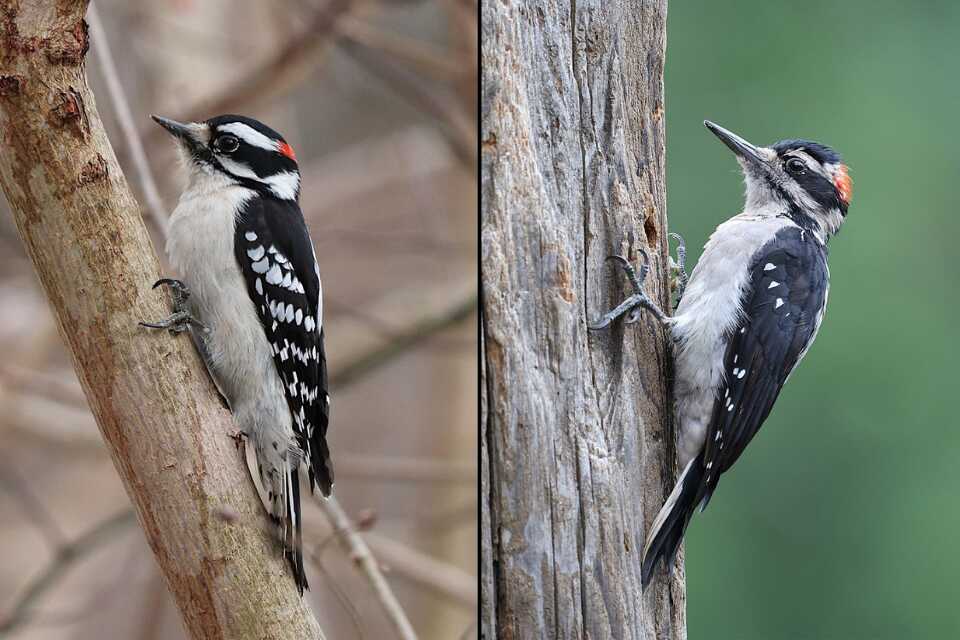
- Beak-to-Head Size Scaling: Identify look-alike winter woodpeckers entirely by comparing bill proportions rather than plumage. The dainty Downy Woodpecker possesses a tiny beak that is strictly shorter than the front-to-back width of its own head, while the larger Hairy Woodpecker sports a heavy, chisel-like beak that is equal to or longer than its entire head length.
- Winter Crown Profiles & Social Cues: Look for distinct head shapes at your suet cages to judge species temperament. Tufted Titmice and Blue Jays raise prominent feathers into pointed head crests to communicate dominance or alarm within crowded winter feeding flocks, allowing you to identify them from across the yard even in heavy snow.
Comprehensive Seasonal Bird Identification Index
Use this quick reference matrix to match changing calendar windows with dominant avian plumages and field behaviors:
| Calendar Window | Dominant Bird Status | Dominant Color Profile | Key Field Marking Anchors | Vocalization Patterns |
|---|---|---|---|---|
| Spring (Mar–May) | Neotropical migrants arriving | High-contrast vibrant breeding plumages | Pristine wing bars, bright crown patches | Sustained, complex territorial songs |
| Summer (Jun–Aug) | Resident families & fledglings | Ragged eclipse molts, spotted juvenile coats | Dark bills on juveniles, patchy adult feathers | Family contact notes, fledgling begging calls |
| Fall (Sep–Nov) | Southbound travelers passing | Uniform olive, gray, and brown overcoats | Rump patches, wing bars, white eye rings | Short, single-note connecting chip notes |
| Winter (Dec–Feb) | Hardy residents & northern guests | Clean slate, gray, and streaky brown wraps | Tail feather flashes, bill-to-head size ratios | Short chatter calls, winter feeding flock notes |
The Science of Seasonal Avian Molting Cycles
Accurate multi-season identification relies on understanding the biological mechanics that dictate how and why birds alter their feathers throughout the year. Rather than arbitrary changes, these seasonal transitions are highly coordinated evolutionary survival strategies.
Hormonal Feather Renewal Profiles
Landmark research published in The Auk expands on this timeline, revealing that birds face a strict biological speed limit when regenerating their wings. Accelerating individual feather tissue growth at the follicular level compromises structural quality, which severely threatens future winter survival.
Because of this physiological bottleneck, birds under tight seasonal constraints cannot simply grow single feathers faster. Instead, they shorten their molting windows by increasing molt intensity, dropping and growing multiple flight feathers simultaneously to maximize efficiency before migration.
Irruptive Migration Climate Triggers
Continental bird tracking details published by the National Audubon Society reveal that the sudden winter appearance of northern finches and owls across southern latitudes is not caused by cold temperatures. Instead, these winter irruptions are entirely driven by widespread seed crop failures across northern forests.
This lack of food forces massive flocks to travel south in search of backyard feeding stations. Because these seasonal tree yields can be mapped in advance, backyard observers can actually predict sudden winter population spikes by tracking annual winter finch forecasts from northern boreal regions.
Frequently Asked Questions About Seasonal Bird Identification
Why Do Male Goldfinches Change Colors So Radically in Fall?
Male goldfinches swap their electric-yellow jackets for olive-brown coats to trigger a total metabolic shutdown of their ornamental pigments. Maintaining bright carotenoid feathers requires an immense amount of cellular energy.
The bird must redirect this energy toward fat storage and baseline winter thermoregulation to survive sub-zero nights. This basic molt replaces high-maintenance breeding colors with dense, insulating down feathers.
How Can I Tell a Juvenile Bird From a Different Species in Summer?
Look closely at the corners of the beak where the mouth meets the bill. Fledglings display a soft, swollen yellow tissue line called a gape.
This fleshy structure acts as a wide visual target for parents dropping food into the nest. The bright gape gradually shrinks and hardens as the young bird transitions to independent foraging.
Do Birds Sing the Same Songs in Winter as They Do in Spring?
No, birds rarely sing full territorial songs in winter. Their reproductive organs actually shrink significantly after the breeding season ends due to dropping hormone levels.
This biological shutdown stops complex vocal production completely. Birds shift to short, single-note contact chirps to locate food sources without alerting winter predators.
Summary Checklist for Year-Round Bird Identification
Spring: Focus entirely on checking for pristine, razor-sharp wing bars using a 10×42 binocular magnification loop.
Summer: Identify confusing fledglings by checking the corners of the beak for a swollen, soft-tissue yellow gape line.
Fall: Track camouflaged warblers exclusively by looking for the bright yellow butter-butt lower back patch as they fly away.
Winter: Isolate look-alike woodpeckers using a strict 1:1 bill-to-head ratio rule to instantly separate Downy and Hairy species.
Wrapping Up Your Year-Round Birding Journey
Mastering seasonal avian shifts transforms your backyard window into an ever-changing theatre of biological survival. By looking past temporary color changes and focusing on underlying molting cycles, you can accurately identify any passing migrant with total confidence.
Now that you know how feathers change with the calendar, you can take your backyard setup to the next level. Check out our comprehensive guide on choosing the right bird feeder styles to ensure your yard attracts the exact species migrating through your region this month.