
You know that frustrating feeling when local songbirds completely ignore your fresh backyard garden pool just to drink from dirty driveway puddles instead? If you are trying to understand why wild flocks choose specific bird baths over others, realizing that birds evaluate an oasis based on strict physical and sensory parameters rather than a high price tag can save you from wasting hundreds of dollars on ineffective hardware.
Creating an irresistible watering station does not require a massive investment; understanding basic avian biology will help you bypass common product design traps, eliminate stubborn water issues, and naturally draw birds straight to your garden.
How Do You Get Birds to Use a New Bird Bath?
Quick Answer: To attract wild birds to backyard bird baths, keep the water depth between 1 and 1.5 inches to accommodate their physical buoyancy limitations. Positioning the basin within 6 to 10 feet of dense foliage provides essential escape cover from predators while maintaining open sightlines.
Before You Buy: The Depth Rule That Determines Success
The single most common mistake made by backyard bird enthusiasts is buying a deep, bowl-shaped pedestal basin under the assumption that more water volume equals a better experience. Ground-feeding and smaller songbirds, like sparrows, robins, and finches, tend to avoid basins that are too deep.
Robins are well known for preferring shallow, ground-level water over tall, deep pedestal designs. Birds have hollow, lightweight bones that make them naturally buoyant, so unlike ducks, they can’t comfortably wade or paddle in deep water. Because of this buoyancy, most small songbirds need a maximum water depth of 1 to 1.5 inches for safe, confident bathing.
Orioles are a notable exception. Their larger body size lets them tolerate water up to 2 to 3 inches deep, so if you’re specifically trying to attract orioles, you can build in a slightly deeper zone at one end of the basin while keeping the rest of the bath within the standard 1 to 1.5 inch range for your smaller visitors.
This is why an inexpensive flat plastic plant saucer often gets more use than an elaborate deep stone pedestal bath. Cost has nothing to do with it. The saucer simply happens to match the shallow depth most birds are looking for, while many premium pedestal designs are built deeper than what most songbirds will use.
This is why an inexpensive flat plastic plant saucer often gets more use than an elaborate deep stone pedestal bath. Cost has nothing to do with it. The saucer simply happens to match the shallow depth most birds are looking for, while many premium pedestal designs are built deeper than what most songbirds will use.
According to extensive user tracking threads on Reddit’s r/birding community, expensive commercial options frequently fail to attract visitors simply because they are manufactured with deep, steep vertical walls meant for larger animals. When a small songbird looks down into a deep, steep drop-off, their natural survival instincts kick in, and they flag the water as a drowning hazard.
If you already own a deep commercial basin sitting unused in your garden, you can fix this without throwing it out. Never try to solve the problem by simply underfilling the bowl, since wet metal or smooth ceramic rims leave birds with no landing traction.
Instead, buy small crushed gravel or smooth river stones and layer them flat across the bottom of the bowl, using enough to build a gradual, sloped sub-base that limits the active water depth to under 1.5 inches. The exact amount will depend on your basin’s size, a small saucer might need a single layer, while a deep pedestal bowl could need several inches of buildup.
For a complete framework on configuring these baseline dimensions to maximize early yard activity, review our step-by-step guide on how to attract birds to bird baths.
Why Bees Might Take Over Your Bird Bath
This exact river stone modification pulls double duty when severe summer heat waves peak. During dry spells, honeybees and wasps will aggressively flock to open water basins to hydrate, creating a swarming threshold that can easily scare your local birds away from the yard entirely.
According to advice shared by Smithsonian entomologist Dr. Allan Cabrero in a House Digest profile on managing bird baths, adding shallow gravel to the bowl provides these vital insect pollinators with a stable, dry landing pad to drink safely without slipping below the surface tension.
Layering stones into your deep pedestal basins gives visiting songbirds crucial physical texture and stable foot traction for their talons while keeping local bug populations from drowning. This quick addition keeps the insects completely safe while ensuring your resident birds feel secure enough to reclaim their favorite watering hole.
The Terracotta Saucer Table Hack: Low-Cost High-Performance Bathing
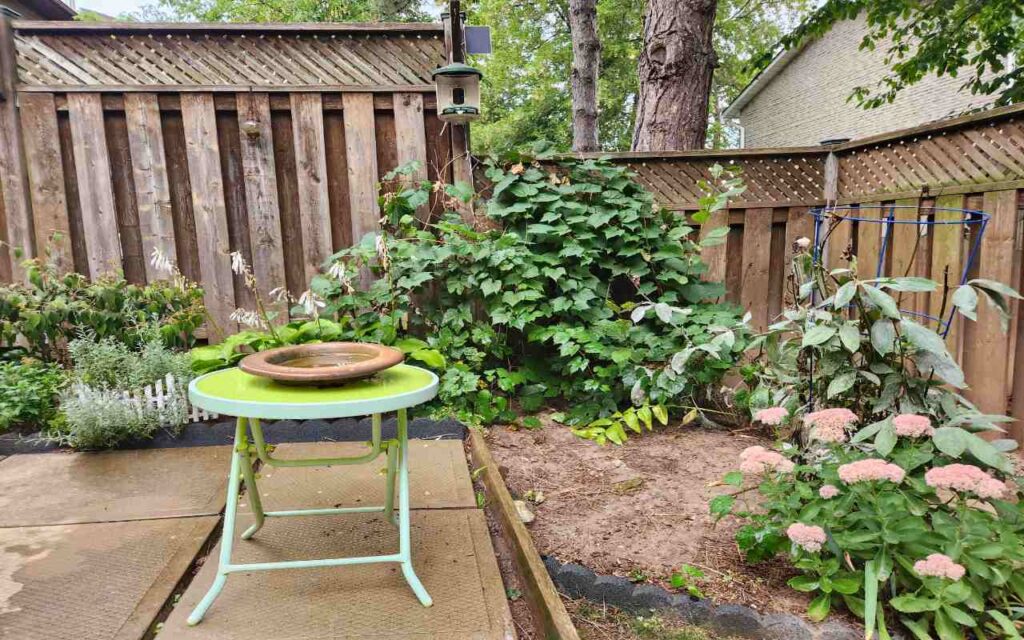
If you want to skip the flaws common in expensive commercial bird baths, you can build a highly effective watering station using a standard, unglazed clay plant saucer placed on top of a raised garden table.
Because a basic gardening saucer has a sloped basin wall that tapers toward the bottom, it naturally creates a gradual, shallow wading area that works well for songbirds of most sizes.
The shallow rim of a classic clay saucer also helps prevent the deep, steep-sided drop-off common in many pedestal-style bird baths, which can discourage smaller birds from wading in.
Unglazed earthenware clay also has a naturally rough surface, giving birds better grip than the smooth glazed ceramic or plastic used in many commercial baths, so they’re less likely to slip.
Placing this setup on an elevated garden stool keeps it out of easy reach for cats while still giving birds a clear, open view of their surroundings as they bathe.
Improving Surface Grip for Smaller Birds
When setting up a smooth resin, glazed ceramic, or plastic basin, you must evaluate how easily a bird can grip the bottom floor. Many modern bird baths feature a slick polished surface coating that completely compromises an avian foot hold.
When a small bird lands on a wet, slippery slope, its toes slide sideways. This sudden loss of traction triggers immediate panic, causing the bird to fly away and abandon the station entirely.
The simplest fix is also the safest: place a layer of flat river stones, pea gravel, or a textured rubber mat across the bottom of the basin. This gives birds an immediate, stable gripping surface without altering the material of the bath itself.
If you want a more permanent texture fix for a glazed ceramic bowl specifically, some birders lightly score the interior floor with coarse sandpaper to rough it up. Use this approach with caution on plastic basins, though.
Scoring plastic creates micro-grooves that can trap algae and organic film, making the bowl harder to keep clean over time, which works against the very problem you’re trying to solve. Stones or a textured mat remain the lower-risk option for most setups.
Whichever texture method you choose, stones, a mat, or a scored surface, that added grip only helps if you keep it clean.
Any rough surface holds onto algae and grime more stubbornly than a smooth one, so pair this fix with our comprehensive guide on how to clean a bird bath without chemicals to keep your new texture from becoming its own maintenance headache.
Why Is My Bird Bath Water Turning Red? (The Hidden Culprit)
Every backyard birder is familiar with the battle against standard green slime. However, water turning a deep, rusty red color within days of a fresh refill is a completely different issue. Most homeowners misdiagnose this staining as iron contamination or copper oxidation runoff, leading them to scrub the bowl with brute physical force with only partial success.
According to the AlgaeBase Taxonomic Database, the true culprit is a single-celled organism called Haematococcus pluvialis (now formally classified as Haematococcus lacustris). AlgaeBase’s own reference photo for this species was documented directly from a birdbath in the UK, confirming this exact scenario is well documented in the wild.
This organism lives a double life. It has a free-floating green form that drifts loosely in the water column, and a dormant, astaxanthin-rich red cyst form that develops once the algae is stressed by intense UV light.
It’s this red cyst stage that anchors deep within the porous interior matrix of concrete, unglazed stone, and terra cotta basins, secreting the carotenoid pigment astaxanthin as a natural sunscreen and staining the water a deep rust-red in the process.
If you use a porous concrete bowl, a basic surface scrub alone is notoriously difficult to fully clear. The cysts burrow into the tiny physical fissures of the stone, surviving casual cleaning and blooming back into a dense red cloud once you refill the basin.
Many birders address this by applying a masonry sealant marketed as safe for wildlife use over the dry interior of the clean basin.
Sealing fills in the tiny pores, creating a smoother barrier that gives the algae less surface to anchor to. One honest caveat: no major wildlife authority, not Cornell Lab, Audubon, or US Fish and Wildlife, has formally tested or endorsed sealant safety for bird baths specifically.
This is a widely practiced, community-tested fix backed by manufacturer non-toxicity claims, not an official wildlife-agency standard, so always let any product cure fully per the label before refilling.
Additionally, shifting your station out of direct sunlight into a partially shaded alcove slows the UV stress that triggers the red cyst stage in the first place, keeping the algae from multiplying as quickly.
The Solar Fountain Angle Fix: Preventing Pump Clogs
Adding a continuous water circulation pump to your backyard basin is one of the most effective ways to drive up your yard’s daily traffic scores. Moving ripples act like a massive visual sign for high-altitude traveling flocks, while the splashing sounds draw in shy species from blocks away.
However, inexpensive solar-powered fountain pumps frequently clog with thick slime within 30 days or suffer from complete battery backup failure. Before you throw your fountain pump away or file a product return, check your physical installation angles.
A bad solar panel angle is almost always the cause of sudden motor failure, not a broken engine. Many floating solar discs lay completely flat on top of the water column, meaning they only receive optimal light during peak noon hours.
To keep the built-in battery backup continuously topped off to run through cloudy stretches, prop the separate solar panel up at an angle roughly matching your local latitude, facing true south.
A yard in Florida (around 25 to 30 degrees latitude) needs a much shallower panel angle than one in Minnesota (around 44 to 48 degrees latitude), so there’s no single universal angle that works everywhere. As a simple starting point, look up your city’s latitude and match your panel’s tilt to that number.
The second hidden failure point is a jammed internal impeller fan. When thick organic matter and dander get sucked into the pump housing, the grime wraps tightly around the plastic fan blades, locking the engine.
To clear it, pop open the plastic outer screen casing, slip a small paperclip into the blade housing, and clear out the caked gunk until the fan spins freely. Furthermore, high-velocity solar pumps often create a forceful spray that pushes water entirely outside the rim, leaving your basin empty within hours.
You can weigh down the pump’s base plate with heavy river stones to anchor the floating disc safely in place, using enough stones that the pump can no longer drift or tip.
The right amount will depend on your pump’s size and your basin’s depth, a stability tactic that pairs perfectly with our guide on using pure elements to keep bird baths clean with copper pennies all summer.
Disruption Methods: Preventing Mosquito Colonization Without Chemicals
When you introduce stagnant water pools to your garden landscape, you must actively address the threat of insect breeding cycles. Standing backyard water columns serve as primary breeding habitats for mosquito lineages, creating an annoying nuisance for homeowners and a potential health risk for local birds.
Here’s a counterintuitive finding worth knowing: a 2012 Urban Ecosystems study on West Nile virus found that residential yards actually carried a higher risk of infected mosquitoes than the wetlands right next to them.
Researchers call this a “dilution effect.” Wetlands host a much wider diversity of bird species, and many of those species are poor viral hosts, which spreads mosquito bites thin across many different, less-competent carriers.
Residential yards, by contrast, tend to have a narrower mix of highly competent host birds, concentrating the virus instead of diluting it. In other words, your tidy backyard water feature can be part of a bigger ecological picture than you’d expect, which is exactly why responsible water management at home matters for both human and bird health.
While traditional lawn guides recommend dropping chemical larvicides or synthetic oil films into the basin, these chemical options can dissolve into feather structures and destroy a songbird’s natural waterproof preening defenses.
Standard mosquito control guidance indicates that homeowners can easily break up basic backyard breeding cycles simply by emptying and rinsing the saucers of flowerpots or garden basins at least once every 48 hours to prevent standing pools from stagnating.
If you want to keep your water features constantly filled, you must focus entirely on surface tension disruption. Mosquitoes require completely still, stagnant surface film to successfully glue their egg rafts down and allow their larvae to breathe through surface tubes.
Installing a battery-operated or solar-powered water agitator, commonly sold as a water wiggler, creates continuous, gentle surface ripples across the entire bowl. This constant movement makes it physically impossible for flying pests to land or breed.
Researchers have also tested ultrasonic acoustic devices, like the Larvasonic system studied in a 2020 Applied Sciences trial, and found that targeted ultrasonic frequencies could rupture the internal structures of Aedes aegypti mosquito larvae in laboratory testing, without harming non-target aquatic species.
This technology is still primarily used in research and municipal mosquito control settings rather than sold as an off-the-shelf backyard product, so for most home setups, a simple water wiggler remains the more practical option available today.
For standard home setups, combining a continuous mechanical surface agitator with a strict habit of flushing the basin every few days completely shatters the insect’s reproductive cycle without requiring a single drop of toxic additives.
Shielding Backyard Flocks From Overhead Predators
The final hazard to eliminate is the extreme vulnerability that wide water features present to high-altitude apex predators. When wild birds are completely drenched and preening, their flight muscles are weighed down by moisture, making them incredibly slow to launch and highly vulnerable to fast-moving garden raptors like Cooper’s Hawks or Sharp-shinned Hawks.
To secure your watering station from aerial ambushes without creating dangerous visual strike hazards, you must follow strict environmental spacing rules. Never place mirror tiles or highly reflective metallic items around your basin, as shiny surfaces create severe visual collision traps that cause songbirds to fly straight into structures and sustain fatal injuries.
Instead, position your watering table roughly 6 to 10 feet away from dense native evergreens, cedar hedges, or brush piles. This distance balances the layout well.
It is close enough to allow a waterlogged songbird to make a split-second dash into dense, protective foliage if a predator attacks, but far enough out in the open to deny a ground-stalking cat a close, hidden launching pad.
If your yard lacks natural plant cover, simply positioning a solid canvas patio umbrella directly over the basin frame acts as a physical ceiling shield, blinding top-down sightlines from high roof lines and allowing local flocks to bathe in complete privacy.
Masking these visual tracking signatures is an exceptionally reliable way to preserve territory safety, a layout change that pairs naturally with the seasonal preparation tips outlined in our manual on how to keep bird baths from freezing in winter to maintain year-round flock protection.
Rebalancing Your Summer Yard Resources
While providing water sources and strategic canopy cover is a spectacular way to protect territory balance, severe summer weather introduces unique environmental and behavioral challenges that backyard enthusiasts must continuously monitor.
The Scorching Bird Bath Trap
Exposed plastic or concrete basins present a severe hidden danger during regional heatwaves. Standard garden bird baths sitting in direct sunlight can quickly reach scorching temperatures well over 100°F, turning your refreshing backyard oasis into a dangerous scalding trap.
It stands to reason that birds will avoid uncomfortably hot water just as readily as they’d avoid a dangerously cold one, and warm standing water is well documented to accelerate bacterial growth.
To fix this issue without moving heavy hardware, place your basins under deep canopy shade and drop a few large ice cubes into the water tray every afternoon to maintain a refreshing, safe temperature.
This creates a territorial crowding problem that you can permanently solve using the tactical structural depth limits highlighted across our specialized manual on how to keep starlings away from bird baths.
Why Your Local Birds Might Skip the Water Entirely
If you notice your water basin is completely empty on a hot afternoon, your local visitors might not be avoiding your setup due to water temperature. Over 200 bird species, including robins and jays, occasionally skip water entirely to take an “Ant Bath” instead.
This fascinating grooming behavior is called anting. Birds will sit directly on active anthills or rub live ants through their feathers to release formic acid, which acts as a natural pest defense to clear out hidden feather mites and parasites.
The Bottom Line for Backyard Birders
So, if your carefully configured bird bath sits quiet on a July afternoon, don’t panic. Your local flocks haven’t permanently abandoned your yard—they might just be down in the dirt taking a quick chemical treatment.
By maintaining a shallow 1 to 1.5-inch water depth, keeping the basin in the shade, and ensuring stable talon traction, your backyard oasis will remain the top-rated watering hole in the neighborhood the moment they are done.